In this paper, we discuss the progress of quantum cascade lasers (QCLs) grown by gas-source molecular beam epitaxy. Room temperature QCL operation has been reported for lasers emitting between 5– 11 μm , with 9– 11 μm lasers operating up to 425 K . Laser technology for the 3– 5 μm range takes advantage of a strain-balanced active layer design. We also demonstrate record room temperature peak output powers at 9 and 11 μm (2.5 and 1 W , respectively) as well as record low 80 K threshold current densities (250 A / cm 2 ) for some laser designs. Preliminary distributed feedback (DFB) results are also presented and exhibit single mode operation for 9 μm lasers at room temperature.
We report record-low threshold current density and high output power for lambda similar to 11 mum Al0.48In0.52As/Ga0.47In0.53As quantum cascade lasers operating up to 425 K. The threshold current density is 1.1, 3.83, and 7.08 kA/cm(2) at 80, 300, and 425 K, respectively, for 5 mus pulses at a 200 Hz repetition rate. The cavity length is 3 mm with a stripe width of 20 mum. The maximum peak output power per facet is 1 W at 80 K, 0.5 W at 300 K, and more than 75 mW at 425 K. The characteristic temperature of these lasers is 174 K between 80 and 300 K and 218 K in the range of 300-425 K. (C) 2001 American Institute of Physics.
We report record-low threshold current density and high output power for λ∼11 μm Al0.48In0.52As/Ga0.47In0.53As quantum cascade lasers operating up to 425 K. The threshold current density is 1.1, 3.83, and 7.08 kA/cm2 at 80, 300, and 425 K, respectively, for 5 μs pulses at a 200 Hz repetition rate. The cavity length is 3 mm with a stripe width of 20 μm. The maximum peak output power per facet is 1 W at 80 K, 0.5 W at 300 K, and more than 75 mW at 425 K. The characteristic temperature of these lasers is 174 K between 80 and 300 K and 218 K in the range of 300–425 K.
Recent improvements in quantum cascade laser technology have led to a number of very impressive results. This paper is a brief summary of the technological development and state-of- the-art performance of quantum cascade lasers produced at the Center for Quantum Devices. Laser design will be discussed, as well as experimental details of device fabrication. Room temperature QCL operation has been reported for lasers emitting between 5 - 11 micrometers , with 9 - 11 micrometers lasers operating up to 425 K. We also demonstrate record room temperature peak output powers at 9 and 11 micrometers (2.5 W and 1 W respectively) as well as record low 80 K threshold current densities (250 A/cm2) for some laser designs. Finally, some of the current limitations to laser efficiency are mentioned, as well as a means to combat them.
Diode lasers with reliable operation in the mid and long wavelength infrared (MWIR & 1 WIR) wavelength range, 4 - 12μm are needed for many portable applications such as biological/chemical spectroscopy systems, directed infrared countermeasure systems, and free space optical communication in the atmospheric "window" of low absorption. The quantum cascade laser (QCI) has emerged as a viable highly durable, and repeatable source for MWIR and 1 WIR radiation.
We have studied the dependence of the well doping density in n-type GaInAs/InP quantum well infrared photodetectors (QWIPs) grown by low-pressure metalorganic chemical vapor deposition (LP-MOCVD). Three identical GaInAs/InP QWIP structures were grown with well sheet carrier densities of 1 x 10(11) cm(-2), 3 x 10(11) cm(-2), and 10 x 10(11) cm(-2); all three samples had very sharp spectral responses at lambda = 9.0 mu m. We find that there is a large sensitivity of responsivity, dark current, noise current and detectivity with the well doping density. Measurements revealed that the lowest-doped sample had an extremely low responsivity relative to the doping concentration while the highest-doped sample had an excessively high dark current relative to doping. The middle-doped sample yielded the optimal results. This QWIP had a responsivity of 33.2 A/W and operated with a detectivity of 3.5 x 10(10) cmHz(1/2)W(-1) at a bias of 0.75 V and temperature of 80 K. This responsivity is the highest value reported for any QWIP in the lambda = 8-9 mu m range. Analysis is also presented explaining the dependence of the measured QWIP parameters to well doping density.
We report a low threshold current density and high power for λ∼9 μmAlInAs/GaInAs quantum cascade lasers operating at room temperature. The threshold current density is 1.95 kA/cm2 at 300 K and 0.61 kA/cm2 at 80 K for 5 μs pulses at 200 Hz repetition rate. The peak output power is 700 mW at room temperature and 1.3 W at 80 K per two facets for cavity length is 3 mm with a stripe width of 20 μm. The characteristic temperature T0 is 185 °C. The slope efficiency is 450 and 800 mW/A at 300 and 80 K, respectively. In continuous wave operation, the output power is more than 150 mW at 80 K and 25 mW at 140 K. This high performance was achieved by improving the material growth and processing technology.
Multi-quantum well structures of GaxIn1-xAsyP1-y were grown by metalorganic chemical vapor deposition for the fabrication of quantum well IR photodetectors. The thickness and composition of the wells was determined by high-resolution x-ray diffraction and photoluminescence experiments. The intersubband absorption spectrum of the Ga0.47In0.53As/InP, Ga0.38In0.62As0.80P0.20 (1.55 micrometers )/InP, and Ga0.27In0.73As0.57P0.43 (1.3 micrometers )/InP quantum wells are found to have cutoff wavelengths of 9.3 micrometers , 10.7 micrometers , and 14.2 micrometers respectively. These wavelengths are consistent with a conduction band offset to bandgap ratio of approximately 0.32. Facet coupled illumination responsivity and detectivity are reported for each composition.
We report low-threshold 7.3 μm superlattice-based quantum cascade lasers. The threshold current density is 3.4 kA/cm2 at 300 K and 1.25 kA/cm2 at 79 K in pulsed mode for narrow (∼20 μm), 2-mm-long laser diodes. The characteristic temperature (T0) is 210 K. The slope efficiencies are 153 and 650 mW/A at 300 and 100 K, respectively. Power output is in excess of 100 mW at 300 K. Laser far-field intensity measurements give divergence angles of 64° and 29° in the growth direction and in the plane of the quantum wells, respectively. Far-field simulations show excellent agreement with the measured results.
We report single-mode continuous-wave operation of a lambda similar to 8 mu m quantum cascade laser at 140 K. The threshold current density is 4.2 kA/cm(2) at 300 K in pulsed mode and 2.5 kA/cm(2) at 140 K in continuous wave for 2 mm long index-guided laser cavities of 20 mu m width. Wide stripe (W similar to 100 mu m), index-guided lasers from the same wafer in pulsed operation demonstrate an average T-0 of 210 K with other wafers demonstrating a T-0 as high as 290 K for temperatures from 80 to 300 K. This improvement in high-temperature performance is a direct result of three factors: excellent material quality, a low-loss waveguide design, and a low-leakage index-guided laser geometry. (C) 1999 American Institute of Physics. [S0003-6951(99)05402-9].
We report single-mode continuous-wave operation of a λ∼8 μm quantum cascade laser at 140 K. The threshold current density is 4.2 kA/cm2 at 300 K in pulsed mode and 2.5 kA/cm2 at 140 K in continuous wave for 2 mm long index-guided laser cavities of 20 μm width. Wide stripe (W∼100 μm), index-guided lasers from the same wafer in pulsed operation demonstrate an average T0 of 210 K with other wafers demonstrating a T0 as high as 290 K for temperatures from 80 to 300 K. This improvement in high-temperature performance is a direct result of three factors: excellent material quality, a low-loss waveguide design, and a low-leakage index-guided laser geometry.
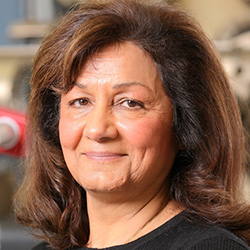 Manijeh Razeghi合作论文数Center for Quantum Devices, Department of Electrical and Computer Engineering, McCormick School of Engineering, Northwestern University18
 Steven Slivken合作论文数Department of Electrical Engineering and Computer Science, Northwestern University Center for Quantum Devices16
 Abbes Tahraoui合作论文数12adam rybaltowski合作论文数10C. Jelen合作论文数9K. J. Luo合作论文数4Jaqueline E Diaz合作论文数4jaqueline e diaz合作论文数2zixin wu合作论文数2j c diaz合作论文数2
 Gail J Brown合作论文数Air Force Research Laboratory2M. Erdtmann合作论文数2V. A. Kaygorodov合作论文数1D.J. Pinner合作论文数1euisong kim合作论文数1chih chang合作论文数1daniel s hinkel合作论文数1R. W. van Es合作论文数1jan blochwitz合作论文数1To Klaassen合作论文数1byounghee lee合作论文数1Av Nurmikko合作论文数1thomas fritz合作论文数1zhimou wu合作论文数1Thierry Aellen合作论文数1Masafumi Mizuguchi合作论文数1s horst合作论文数1hiroshi ishikawa合作论文数1Wenfang Sun (孙文芳)合作论文数1gillian hill合作论文数1Chan, K.合作论文数1
 S. V. Sorokin合作论文数1
 T. V. Shubina合作论文数AF Ioffe Phys Tech Inst, St Petersburg 194021, Russia1A. A. Toropov合作论文数1
 Stefan W. Hell合作论文数Max Planck Institute for Medical Research;Max Planck Institute for Multidisciplinary Sciences1
 Ahmed, M.M.合作论文数1
 Keiichi Nashimoto合作论文数EpiPhotonics Corp1Naone, R.L.合作论文数1Simoyama, T.合作论文数1
 Dmitry Donetsky合作论文数Dept ECE, SUNY Stony Brook1Turk, H.合作论文数1Hopkinson, M.合作论文数1
 Hiroshi Kawazoe合作论文数1
 Tsutomu Takeuchi (竹内勤)合作论文数Research Center for Advanced Science and Technology, The University of Tokyo;Keio University;Saitama Medical University1
 Greg Sun合作论文数Department of Engineering, University of Massachusetts Boston1
 Nir Tessler合作论文数Department of Electrical Engineering, Technion-Israel Institute of Technology1
 Richard A. Soref合作论文数University of Massachusetts at Boston1




