Detection of radioactive material at distances greater than the radiated particle range is an important goal with applications in areas such as national defense and disaster response. Here, we demonstrate avalanche-breakdown-based remote detection of a 3.6 mCi alpha-particle source at a standoff distance of 10 m, using 70 ps, long-wave infrared (lambda = 9.2 mu m) CO2 laser pulses. This is similar to 10 times longer than our previous results using a mid-IR laser. The primary detection method is direct backscatter from microplasmas generated in the laser focal volume. The backscatter signal is amplified as it propagates back through the CO2 laser chain, enhancing sensitivity by >100 times. We also characterize breakdown plasmas with fluorescence imaging, and present a simple model to estimate backscattered signals as a function of the seed density profile in the laser focal volume. All of this is achieved with a relatively long-drive laser focal geometry (f/200) that is readily scalable to >100 m.
We demonstrate high-efficiency diffraction of intense λ=3.9 um laser pulses from plasma gratings generated by avalanche ionization of atomic clusters driven by a pair of intersecting 1.064 nm pulses.
The effect of realistic atmospheric conditions on mid-IR (λ = 3.9 µm) and long-wave-IR (λ = 10 µm) laser-induced avalanche breakdown for the remote detection of radioactive material is examined experimentally and with propagation simulations. Our short-range in-lab mid-IR laser experiments show a correlation between increasing turbulence level and a reduced number of breakdown sites associated with a reduction in the portion of the focal volume above the breakdown threshold. Simulations of propagation through turbulence are in excellent agreement with these measurements and provide code validation. We then simulate propagation through realistic atmospheric turbulence over a long range (0.1-1 km) in the long-wave-IR regime (λ = 10 µm). The avalanche threshold focal volume is found to be robust even in the presence of strong turbulence, only dropping by ∼50% over a propagation length of ∼0.6 km. We also experimentally assess the impact of aerosols on avalanche-based detection, finding that, while background counts increase, a useful signal is extractable even at aerosol concentrations 105 times greater than what is typically observed in atmospheric conditions. Our results show promise for the long-range detection of radioactive sources under realistic atmospheric conditions.
A. Zingale , N. Czapla, D. M. Nasir, S. K. Barber, J. H. Bin, A. J. Gonsalves, F. Isono, J. van Tilborg, S. Steinke, K. Nakamura , G. E. Cochran, J. Purcell , W. P. Leemans,2∥ C. G. R. Geddes, C. B. Schroeder, E. Esarey, and D.W. Schumacher The Ohio State University, Columbus, Ohio 43210, USA Lawrence Berkeley National Laboratory, Berkeley, California 94720, USA Lawrence Livermore National Laboratory, 7000 East Ave, Livermore, California 94550, USA
High-resolution (sub-%), single-shot energy distribution, and emittance measurements of GeV-class electron beams generated by laser plasma accelerators (LPAs) have been enabled through the use of an active plasma lens combined with relatively short dipole magnets. This setup, with only 60 cm between the LPA source and the final diagnostic screen, was facilitated through the use of a replenishable ∼20–40 nm thick liquid crystal plasma mirror to separate remnant laser radiation from the electron beam without emittance degradation. As LPAs capable of generating GeV-class electron beams at cm-scale distances become increasingly ubiquitous, there is a need to supplement these compact accelerators with equally compact diagnostics.
We present an experimental demonstration of the efficient acceleration of electrons beyond 60 MeV using micro-channel plasma targets. We employed a high-contrast, 2.5 J, 32 fs short pulse laser interacting with a 5 \mu m inner diameter, 300 \mu m long micro-channel plasma target. The micro-channel was aligned to be collinear with the incident laser pulse, confining the majority of the laser energy within the channel. The measured electron spectrum showed a large increase of the cut-off energy and slope temperature when compared to that from a 2 \mu m flat Copper target, with the cutoff energy enhanced by over 2.6 times and the total energy in electrons >5 MeV enhanced by over 10 times. Three-dimensional particle-in-cell simulations confirm efficient direct laser acceleration enabled by the novel structure as the dominant acceleration mechanism for the high energy electrons. The simulations further reveal the guiding effect of the channel that successfully explains preferential acceleration on the laser/channel axis observed in experiments. Finally, systematic simulations provide scalings for the energy and charge of the electron pulses. Our results show that the micro-channel plasma target is a promising electron source for applications such as ion acceleration, Bremsstrahlung X-ray radiation, and THZ generation.
 S. Waczynski合作论文数2F. Isono合作论文数2A. J. Gonsalves合作论文数2
 Jianhui Bin (宾建辉)合作论文数Shanghai Institute of Optics and Fine Mechanics, Chinese Academy of Sciences;University of Chinese Academy of Sciences2
 Samuel Barber合作论文数Lawrence Berkeley Natl Lab2Ginevra Cochran合作论文数Lawrence Livermore Natl Lab, NIF & Photon Sci2Steinke S合作论文数Lawrence Berkeley Natl Lab2
 Kei Nakamura合作论文数2
 Wim Leemans合作论文数2
 Jeroen Van Tilborg合作论文数Berkeley Lab Laser Accelerator Center, Lawrence Berkeley National Laboratory2
 C. B. Schroeder合作论文数Lawrence Berkeley National Laboratory2
 Cameron Geddes合作论文数Accelerator Technology and Applied Physics Division, Lawrence Berkeley National Laboratory;BELLA Center, Lawrence Berkeley National Laboratory2
 Eric Esarey合作论文数Berkeley Lab Laser Accelerator Center2
 Douglass Schumacher合作论文数The Ohio State University2Abraham Handler合作论文数1Derek Nasir合作论文数1
 Kevin George合作论文数Natl Acad Sci Engn & Med1
 Joseph Snyder合作论文数Dept Math & Phys Sci, Miami Univ1
 Baifei Shen (沈百飞)合作论文数Shanghai Institute of Optics and Fine Mechanics, Chinese Academy of Sciences1
 Matthew R. Edwards合作论文数Princeton University, Department of Mechanical and Aerospace Engineering, Princeton, New Jersey, 08544, USA1
 Pierre Michel合作论文数Lawrence Livermore Natl Lab1
 Patrick Poole合作论文数Lawrence Livermore National Laboratory1
 Rebecca Lynn Daskalova合作论文数1
 Liangliang Ji (吉亮亮)合作论文数Shanghai Institute of Optics and Fine Mechanics, Chinese Academy of Sciences1D. Schumacher合作论文数1
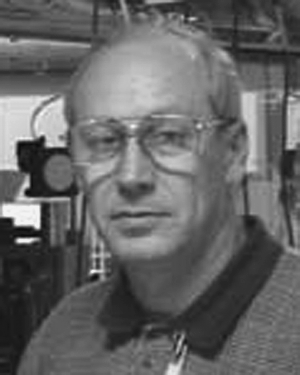 Igor V. Pogorelsky合作论文数Accelerator Test Facil, Brookhaven Natl Lab1
 Howard Milchberg合作论文数Department of Electrical and Computer Engineering, A. James Clark;School of Engineering, University of Maryland;Laboratory for Intense Laser-Matter Interactions, Institute for Research in Electronics and Applied Physics, University of Maryland1
 Enam Ahmed Chowdhury合作论文数Ohio State University1
 Mikhail Polyanskiy合作论文数Accelerator Test Facility, Brookhaven National Laboratory1




