The electronic effects of the chromium tricarbonyl fragment on the structure of the benzene ring of (eta(6)-C(6)H(6))Cr(CO)(3) is investigated theoretically using ab initio molecular orbital calculations with electron correlation included by using both Moller-Plesset second-order calculations and density functional theory. The results of the calculations showed that the solid-state structure of alternating long and short carbon-carbon distances in the benzene ring is a result of the orientation of the Cr(CO)(3) fragment with respect to the benzene ring in which the carbonyl groups lie over the midpoint of alternate carbon-carbon bonds of the benzene ring, called the staggered conformation. A different distortion of the benzene ring is observed even in the eclipsed conformation in which the carbonyls Lie over alternate carbon atoms of the benzene ring. The results of these calculations indicate that the distortion of the benzene ring in (eta(6)-C(6)H(6))Cr(CO)(3) is a result of the electronic influence of the Cr(CO)(3) fragment on the benzene ring. (C) 2000 John Wiley & Sons, Inc.
Ab initio calculations on (eta5-C5H5)2CO2(mu-NO)2 show that the singlet ground state possesses a bent, ''butterfly'' core (Co2N2) in contrast to the published X-ray structure but in agreement with both the solution and solid-state IR measurements. This bent, singlet ground state lies nearly 100 kJ mol-1 below the planar singlet or triplet states, which are nearly degenerate. Our results resolve the discrepancy between other recent theoretical results which predict a low-lying triplet state for the planar structure and the magnetic susceptibility measurements which prove that the molecule is diamagnetic with no low-lying paramagnetic states. Further evidence that our predicted structure is correct comes from parallel calculations, reported here, that correctly predict the structure of the related (eta5-C5H5)2Fe2(mu-NO)2, (eta5-C5H5)2Co2(mu-CO)2, and (eta5-C5H5)2Ni2(mu-CO)2 molecules. Detailed topological analysis of the electron density of (eta5-C5H5)2CO2(mu-NO)2 shows that at certain geometries and levels of electron correlation there exists a Co-Co bond but at other geometries and levels of electron correlation the Co-Co bond critical point vanishes, to be replaced by a Co2N2 ring critical point. Thus, we must conclude that, like Co2(CO)8, the Co-Co interaction is near the region of change from having to not having a bond. Orbital and deformation density analyses of the bent dimer support the traditional view of a Co-Co single bond, albeit a weak one. A redetermination of the structure of (eta5-C5H5)2Co2(mu-NO)2 might result in a different Co-Co bond length, which would help resolve the nature of the Co-Co interaction and finally resolve the longstanding dilemma of the lack of variation in Co-Co bond distances with bond order as the bridging ligands are changed from nitrosyl to carbonyl.
AbstractChemInform is a weekly Abstracting Service, delivering concise information at a glance that was extracted from about 100 leading journals. To access a ChemInform Abstract of an article which was published elsewhere, please select a “Full Text” option. The original article is trackable via the “References” option.
Self-consistent field calculations on Co2(CO)8 were used to examine its electronic structure through an analysis of the electron density. In the standard deformation density map, an accumulation zone extends from the cobalt nucleus toward the region of the Co-Co bent bond. This accumulation in the Co-Co bent-bond region is rather weak and could be due to coincidental accumulations in the vacant coordination site of each cobalt. However, through the use of various promolecules to produce different fragment deformation density maps, it can be concluded that the accumulation of density in the bent-bond region must be due at least in part to constructive interference between the two cobalt atoms. An analysis of the topology of the charge density of Co2(CO)8 shows interaction lines between the Co atoms and the C atoms with (3,-1) critical points, which are indicative of a bond. There is no interaction line connecting the Co atoms. Instead, there is a (3,+1) ring critical point close to the Co-Co midpoint. Therefore, although some constructive interference occurs between the two cobalt atoms, it is not sufficient to produce a Co-Co bond in the topology of the charge density.
ADVERTISEMENT RETURN TO ISSUEPREVArticleNEXTSeparation of hybridization, delocalization, and constructive interference in the electron deformation densities of the first-row hydridesArthur A. Low and Michael B. HallCite this: J. Phys. Chem. 1990, 94, 2, 628–637Publication Date (Print):January 1, 1990Publication History Published online1 May 2002Published inissue 1 January 1990https://pubs.acs.org/doi/10.1021/j100365a025https://doi.org/10.1021/j100365a025research-articleACS PublicationsRequest reuse permissionsArticle Views54Altmetric-Citations5LEARN ABOUT THESE METRICSArticle Views are the COUNTER-compliant sum of full text article downloads since November 2008 (both PDF and HTML) across all institutions and individuals. These metrics are regularly updated to reflect usage leading up to the last few days.Citations are the number of other articles citing this article, calculated by Crossref and updated daily. Find more information about Crossref citation counts.The Altmetric Attention Score is a quantitative measure of the attention that a research article has received online. Clicking on the donut icon will load a page at altmetric.com with additional details about the score and the social media presence for the given article. Find more information on the Altmetric Attention Score and how the score is calculated. Share Add toView InAdd Full Text with ReferenceAdd Description ExportRISCitationCitation and abstractCitation and referencesMore Options Share onFacebookTwitterWechatLinked InRedditEmail Other access options Get e-Alerts
ADVERTISEMENT RETURN TO ISSUEPREVArticleNEXTOrigin of inequivalent chromium-carbonyl bond lengths in chlorotetracarbonylethylidynechromiumArthur A. Low and Michael B. HallCite this: Organometallics 1990, 9, 3, 701–708Publication Date (Print):March 1, 1990Publication History Published online1 May 2002Published inissue 1 March 1990https://pubs.acs.org/doi/10.1021/om00117a028https://doi.org/10.1021/om00117a028research-articleACS PublicationsRequest reuse permissionsArticle Views52Altmetric-Citations9LEARN ABOUT THESE METRICSArticle Views are the COUNTER-compliant sum of full text article downloads since November 2008 (both PDF and HTML) across all institutions and individuals. These metrics are regularly updated to reflect usage leading up to the last few days.Citations are the number of other articles citing this article, calculated by Crossref and updated daily. Find more information about Crossref citation counts.The Altmetric Attention Score is a quantitative measure of the attention that a research article has received online. Clicking on the donut icon will load a page at altmetric.com with additional details about the score and the social media presence for the given article. Find more information on the Altmetric Attention Score and how the score is calculated. Share Add toView InAdd Full Text with ReferenceAdd Description ExportRISCitationCitation and abstractCitation and referencesMore Options Share onFacebookTwitterWechatLinked InRedditEmail Other access optionsGet e-Alertsclose Get e-Alerts
The compound Fe4(CO)10(μ-CO)(μ4-S)2 (1) was synthesized in 38% yield by the UV induced decarbonylation of Fe(CO)5 in the presence of Fe3(CO)9(μ3-S)2. Compound 1 was characterized by a single-crystal X-ray diffraction analysis. Space group: Pccn, a = 6.603(1), b = 15.429(3), c = 17.292(4) Å, Z = 4. The structure was solved by direct methods and was refined (807 reflections) to the final values of the residuals R = 0.043 and Rw = 0.054. The molecule consists of a planar array of four iron atoms with a quadruply bridging sulphido ligand on each side of the plane. The shortest metal-metal bond, 2.489(3) Å, contains a bridging carbonyl ligand. Semi-bridging carbonyl ligands bridge the two adjacent metal-metal bonds, 2.532(2) Å. The longest metal-metal bond, 2.605(2) Å, has no carbonyl bridge. Compound 1 is unsaturated (by EAN rule) by the amount of two electrons. The two semi-bridged carbonyl-metal bonds in 1 are significantly shorter than those in the saturated cluster Fe2CO2(CO)11(μ4-S)2. A molecular orbital description which explains the differences in bonding between the two compounds is proposed.
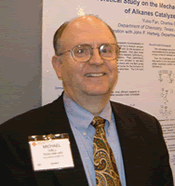 Michael B. Hall合作论文数Department of Chemistry, Texas A&M University15
 r l williamson合作论文数2Jin Guu Wang合作论文数1Mf Guest合作论文数1Kl Kunze合作论文数1Je Babin合作论文数1
 Richard D. Adams合作论文数Department of Chemistry and Biochemistry, College of Arts and Sciences, University of South Carolina1
 Zhenyang Lin (林振陽)合作论文数Department of Chemistry, The Hong Kong University of Science and Technology1Jun Song合作论文数1Andrew L. Sargent合作论文数Department of Chemistry, Texas A&M University1Javier Estrada合作论文数1
 Preston MacDougall合作论文数Department of Chemistry, Middle Tennessee State University1




