We introduce The FACTS Leaderboard, an online leaderboard suite and associated set of benchmarks that comprehensively evaluates the ability of language models to generate factually accurate text across diverse scenarios. The suite provides a holistic measure of factuality by aggregating the performance of models on four distinct sub-leaderboards: (1) FACTS Multimodal, which measures the factuality of responses to image-based questions; (2) FACTS Parametric, which assesses models' world knowledge by answering closed-book factoid questions from internal parameters; (3) FACTS Search, which evaluates factuality in information-seeking scenarios, where the model must use a search API; and (4) FACTS Grounding (v2), which evaluates whether long-form responses are grounded in provided documents, featuring significantly improved judge models. Each sub-leaderboard employs automated judge models to score model responses, and the final suite score is an average of the four components, designed to provide a robust and balanced assessment of a model's overall factuality. The FACTS Leaderboard Suite will be actively maintained, containing both public and private splits to allow for external participation while guarding its integrity. It can be found at https://www.kaggle.com/benchmarks/google/facts .
The scaling of inference computation has unlocked the potential of long-context large language models (LLMs) across diverse settings. For knowledge-intensive tasks, the increased compute is often allocated to incorporate more external knowledge. However, without effectively utilizing such knowledge, solely expanding context does not always enhance performance. In this work, we investigate inference scaling for retrieval augmented generation (RAG), exploring the combination of multiple strategies beyond simply increasing the quantity of knowledge, including in-context learning and iterative prompting. These strategies provide additional flexibility to scale test-time computation (e.g., by increasing retrieved documents or generation steps), thereby enhancing LLMs’ ability to effectively acquire and utilize contextual information. We address two key questions: (1) How does RAG performance benefit from the scaling of inference computation when optimally configured? (2) Can we predict the optimal test-time compute allocation for a given budget by modeling the relationship between RAG performance and inference parameters? Our observations reveal that increasing inference computation leads to nearly linear gains in RAG performance when optimally allocated, a relationship we describe as the inference scaling laws for RAG. Building on this, we further develop the computation allocation model to estimate RAG performance across different inference configurations. The model predicts optimal inference parameters under various computation constraints, which align closely with the experimental results. By applying these optimal configurations, we demonstrate that scaling inference compute on long-context LLMs achieves up to 58.9% gains on benchmark datasets compared to standard RAG.
The distillation of ranking models has become an important topic in both academia and industry. In recent years, several advanced methods have been proposed to tackle this problem, often leveraging ranking information from teacher rankers that is absent in traditional classification settings. To date, there is no well-established consensus on how to evaluate this class of models. Moreover, inconsistent benchmarking on a wide range of tasks and datasets make it difficult to assess or invigorate advances in this field. This paper first examines representative prior arts on ranking distillation, and raises three questions to be answered around methodology and reproducibility. To that end, we propose a systematic and unified benchmark, Ranking Distillation Suite (RD-Suite), which is a suite of tasks with 4 large real-world datasets, encompassing two major modalities (textual and numeric) and two applications (standard distillation and distillation transfer). RD-Suite consists of benchmark results that challenge some of the common wisdom in the field, and the release of datasets with teacher scores and evaluation scripts for future research. RD-Suite paves the way towards better understanding of ranking distillation, facilities more research in this direction, and presents new challenges.
As Learning-to-Rank (LTR) approaches primarily seek to improve ranking quality, their output scores are not scale-calibrated by design. This fundamentally limits LTR usage in score-sensitive applications. Though a simple multi-objective approach that combines a regression and a ranking objective can effectively learn scale-calibrated scores, we argue that the two objectives are not necessarily compatible, which makes the trade-off less ideal for either of them. In this paper, we propose a practical regression compatible ranking (RCR) approach that achieves a better trade-off, where the two ranking and regression components are proved to be mutually aligned. Although the same idea applies to ranking with both binary and graded relevance, we mainly focus on binary labels in this paper. We evaluate the proposed approach on several public LTR benchmarks and show that it consistently achieves either best or competitive result in terms of both regression and ranking metrics, and significantly improves the Pareto frontiers in the context of multi-objective optimization. Furthermore, we evaluated the proposed approach on YouTube Search and found that it not only improved the ranking quality of the production pCTR model, but also brought gains to the click prediction accuracy. The proposed approach has been successfully deployed in the YouTube production system.
Many machine learning systems are implemented as pipelines. A pipeline is essentially a chain/network of information processing units. As information flows in and out and gradients vice versa, ideally, a pipeline can be trained end-to-end via backpropagation provided with the right supervision and loss function. However, this is usually impossible in practice, because either the loss function itself may be non-differentiable, or there may exist some non-differentiable units. One popular way to superficially resolve this issue is to separate a pipeline into a set of differentiable sub-pipelines and train them with isolated loss functions. Yet, from a decision-theoretical point of view, this is equivalent to making myopic decisions using ad hoc heuristics along the pipeline while ignoring the real utility, which prevents the pipeline from behaving optimally. In this paper, we show that by converting a pipeline into a stochastic counterpart, it can then be trained end-to-end in the presence of non-differentiable parts. Thus, the resulting pipeline is optimal under certain conditions with respect to any criterion attached to it. In experiments, we apply the proposed approach - reinforced pipeline optimization - to Faster R-CNN, a state-of-the-art object detection pipeline, and obtain empirically near-optimal object detectors consistent with its base design in terms of mean average precision.
Monte Carlo tree search (MCTS) has recently been drawing great interest in the domain of planning and learning under uncertainty. One of the fundamental challenges is the trade-off between exploration and exploitation. To address this problem, we propose to balance between exploration and exploitation via posterior sampling in the contexts of Markov decision process (MDP) and partially observable Markov decision process (POMDP). Specifically, we treat the cumulative reward returned by taking an action from a search node in the MCTS search tree as a random variable following an unknown distribution. We parametrize this distribution by introducing necessary hidden parameters, and infer the posterior distribution of the hidden parameters in a Bayesian way. We further expand a node in the search tree by using Thompson sampling to select an action based on its posterior probability of being optimal. Following this idea, we develop Dirichlet-NormalGamma based Monte Carlo tree search (DNG-MCTS) and Dirichlet-Dirichlet-NormalGamma based partially observable Monte Carlo planning (D(2)NG-POMCP) algorithms respectively for Monte Carlo planning in MDPs and POMDPs. Experimental results show that the proposed algorithms outperform the state-of-the-art with better values on several benchmark problems.
RoboCup Keepaway, originated from the RoboCup soccer simulation 2D challenge, has been widely used as a machine learning benchmark. In this paper, we present a concurrent hierarchical reinforcement learning approach to RoboCup Keepaway. Following the idea of hierarchies of abstract machines (HAMs), we write a partial policy as a HAM from the perspective of a single keeper, run multiple instances of the HAM, and use reinforcement learning to learn the optimal completion of the resulting joint HAM. Furthermore, we apply the idea of exploiting the intrinsic internal transitions within the HAM structure for more efficient learning. Experimental results confirm that the concurrent HAM approaches outperform the state of the art significantly on the very complex RoboCup Keepaway domain.
We summarise the results of RoboCup 2D Soccer Simulation League in 2016 (Leipzig), including the main competition and the evaluation round. The evaluation round held in Leipzig confirmed the strength of RoboCup-2015 champion (WrightEagle, i.e. WE2015) in the League, with only eventual finalists of 2016 competition capable of defeating WE2015. An extended, post-Leipzig, round-robin tournament which included the top 8 teams of 2016, as well as WE2015, with over 1000 games played for each pair, placed WE2015 third behind the champion team (Gliders2016) and the runner-up (HELIOS2016). This establishes WE2015 as a stable benchmark for the 2D Simulation League. We then contrast two ranking methods and suggest two options for future evaluation challenges. The first one, "The Champions Simulation League", is proposed to include 6 previous champions, directly competing against each other in a round-robin tournament, with the view to systematically trace the advancements in the League. The second proposal, "The Global Challenge", is aimed to increase the realism of the environmental conditions during the simulated games, by simulating specific features of different participating countries.
In the context of hierarchical reinforcement learning, the idea of hierarchies of abstract machines (HAMs) is to write a partial policy as a set of hierarchical finite state machines with unspecified choice states, and use reinforcement learning to learn an optimal completion of this partial policy. Given a HAM with potentially deep hierarchical structure, there often exist many internal transitions where a machine calls another machine with the environment state unchanged. In this paper, we propose a new hierarchical reinforcement learning algorithm that automatically discovers such internal transitions, and shortcircuits them recursively in the computation of Q values. We empirically confirm that the resulting HAMQINT algorithm outperforms the state of the art significantly on the benchmark Taxi domain and a much more complex RoboCup Keepaway domain.
In the context of hierarchical reinforcement learning, the idea of hierarchies of abstract machines (HAMs) is to write a partial policy as a set of hierarchical finite state machines with unspecified choice states, and use reinforcement learning to learn an optimal completion of this partial policy. Given a HAM with potentially deep hierarchical structure, there often exist many internal transitions where a machine calls another machine with the environment state unchanged. In this paper, we propose a new hierarchical reinforcement learning algorithm that discovers such internal transitions automatically, and shortcircuits them recursively in computation of Q values. The resulting HAMQ-INT algorithm outperforms the state of the art significantly on the benchmark Taxi domain and a much more complex RoboCup Keepaway domain.
Markov decision processes (MDPs) provide a rich framework for planning and learning under uncertainty. In the context of hierarchical planning and learning for MDPs, state abstraction is an important technique for scaling MDP algorithms by treating a group of states as a unit. As is well known, however, it introduces difficulties due to the non-Markovian nature of state-abstracted models. Whereas prior approaches rely upon ad hoc fixes for this issue, we propose instead to view the state-abstracted model as a partially observable MDP (POMDP) and show that we can thereby take advantage of state abstraction without sacrificing the Markov property. We bound the performance loss induced by the abstraction, and exploit the hierarchical structure introduced by state abstraction by extending the theory of options to a POMDP setting. In this context, we propose a hierarchical Monte Carlo tree search algorithm for approximately solving the abstracted POMDP and show that it converges to a recursively optimal hierarchical policy. Both theoretical and empirical results suggest that abstracting an MDP into a POMDP yields a scalable solution approach.
State abstraction is an important technique for scaling MDP algorithms. As is well known, however, it introduces difficulties due to the non-Markovian nature of state-abstracted models. Whereas prior approaches rely upon ad hoc fixes for this issue, we propose instead to view the state-abstracted model as a POMDP and show that we can thereby take advantage of state abstraction without sacrificing the Markov property. We further exploit the hierarchical structure introduced by state abstraction by extending the theory of options to a POMDP setting. In this context we propose a hierarchical Monte Carlo tree search algorithm and show that it converges to a recursively optimal hierarchical policy. Both theoretical and empirical results suggest that abstracting an MDP into a POMDP yields a scalable solution approach.
The ability for an autonomous agent or robot to track and identify potentially multiple objects in a dynamic environment is essential for many applications, such as automated surveillance, traffic monitoring, human-robot interaction, etc. The main challenge is due to the noisy and incomplete perception including inevitable false negative and false positive errors from a low-level detector. In this paper, we propose a novel multi-object tracking and identification over sets approach to address this challenge. We define joint states and observations both as finite sets, and develop motion and observation functions accordingly. The object identification problem is then formulated and solved by using expectation-maximization methods. The set formulation enables us to avoid directly performing observation-to-object association. We empirically confirm that the overall algorithm outperforms the state-of-the-art in a popular PETS dataset.
This summary reports main efforts and results in the RoboCup Federation project “the Research Challenge”. The original motivation of the project was to establish an abstract and simplified 2D competition as a research challenge of the 2D league. We have tried to fulfill the goal through a middleware that implements a set of high-level actions, instead of the soccer server primitive actions, for the agents. This allows one to concentrate on “high-level” research issues such as decision-making in a multi-agent setting as well as agent cooperation. It provides a new bridge for linking RoboCup competitions with the related basic research in AI and Robotics, such as planning and machine learning.
Markov decision processes (MDPs) provide a rich framework for planning under uncertainty. However, exactly solving a large MDP is usually intractable due to the “curse of dimensionality”— the state space grows exponentially with the number of state variables. Online algorithms tackle this problem by avoiding computing a policy for the entire state space. On the other hand, since online algorithm has to find a near-optimal action online in almost real time, the computation time is often very limited. In the context of reinforcement learning, MAXQ is a value function decomposition method that exploits the underlying structure of the original MDP and decomposes it into a combination of smaller subproblems arranged over a task hierarchy. In this article, we present MAXQ-OP—a novel online planning algorithm for large MDPs that utilizes MAXQ hierarchical decomposition in online settings. Compared to traditional online planning algorithms, MAXQ-OP is able to reach much more deeper states in the search tree with relatively less computation time by exploiting MAXQ hierarchical decomposition online. We empirically evaluate our algorithm in the standard Taxi domain—a common benchmark for MDPs—to show the effectiveness of our approach. We have also conducted a long-term case study in a highly complex simulated soccer domain and developed a team named WrightEagle that has won five world champions and five runners-up in the recent 10 years of RoboCup Soccer Simulation 2D annual competitions. The results in the RoboCup domain confirm the scalability of MAXQ-OP to very large domains.
Trial-based asynchronous value iteration algorithms for large Partially Observable Markov Decision Processes (POMDPs), such as HSVI2, FSVI and SARSOP, have made impressive progress in the past decade. In the forward exploration phase of these algorithms, only the outcome that has the highest potential impact is searched. This paper provides a novel approach, called Palm LEAf SEarch (PLEASE), which allows the selection of more than one outcome when their potential impacts are close to the highest one. Compared with existing trial-based algorithms, PLEASE can save considerable time to propagate the bound improvements of beliefs in deep levels of the search tree to the root belief because of fewer point-based value backups. Experiments show that PLEASE scales up SARSOP, one of the fastest algorithms, by orders of magnitude on some POMDP tasks with large observation spaces.
Monte-Carlo tree search (MCTS) has been drawing great interest in recent years for planning under uncertainty. One of the key challenges is the tradeoff between exploration and exploitation. To address this, we introduce a novel online planning algorithm for large POMDPs using Thompson sampling based MCTS that balances between cumulative and simple regrets. The proposed algorithm - Dirichlet-Dirichlet-NormalGamma based Partially Observable Monte-Carlo Planning (D2NG-POMCP) - treats the accumulated reward of performing an action from a belief state in the MCTS search tree as a random variable following an unknown distribution with hidden parameters. Bayesian method is used to model and infer the posterior distribution of these parameters by choosing the conjugate prior in the form of a combination of two Dirichlet and one NormalGamma distributions. Thompson sampling is exploited to guide the action selection in the search tree. Experimental results confirmed that our algorithm outperforms the state-of-the-art approaches on several common benchmark problems.
The ability for an autonomous robot to track and identify multiple humans and understand their intentions is crucial for socialized human-robot interactions in dynamic environments (Michalowski and Simmons 2006). Take CoBot (Rosenthal, Biswas, and Veloso 2010) trying to enter an elevator as an example. When the elevator door opens, suppose there are multiple humans occupied, CoBot needs to track each human’s state and intention in terms of whether he/she is going to exit the elevator or not. For the purposes of safely and friendly interacting with humans, CoBot can only make the decision to enter the elevator when any human who intends to exit is believed to have exited. Most multi-object tracking (MOT) methods follow a tracking-by-detection paradigm (Yilmaz, Javed, and Shah 2006; Andriluka, Roth, and Schiele 2008). In this setting, an object detector runs on each frame to obtain a set of detections as inputs for a tracker. Tracking-by-detection algorithms can be roughly classified into two groups: online and offline. Online tracking intends to recursively estimate the current situation given past observations in a Bayesian way; offline tracking is typically formulated as a global optimization problem to find optimal paths given the whole sequence of observations. In this paper, we focus on online tracking which is more suitable for applications on robots. Provided with an inevitable imperfect human detector (with false and missing detections occasionally), we model the intention-aware online multi-human tracking problem as a hidden Markov model (HMM). Formally, a joint state S is defined as a set of all humans, S = {hi}i=1:|S|, where a human is represented as a high-dimensional vector h = (s, i). Here s = (x, y, ẋ, ẏ) is the physical state, and i ∈ I is an intention. In our experiments, we introduce a moving intention to move to a potential goal, and a staying intention to stay almost in the same area. In MOT domain, most existing approaches assume one
The RoboCup soccer simulation 2D domain is a very large testbed for the research of planning and machine learning. It has competed in the annual world championship tournaments in the past 15 years. However it is still unclear that whether more principled techniques such as decision-theoretic planning take an important role in the success for a RoboCup 2D team. In this paper, we present a novel approach based on MAXQ-OP to automated planning in the RoboCup 2D domain. It combines the benefits of a general hierarchical structure based on MAXQ value function decomposition with the power of heuristic and approximate techniques. The proposed framework provides a principled solution to programming autonomous agents in large stochastic domains. The MAXQ-OP framework has been implemented in our RoboCup 2D team, WrightEagle. The empirical results indicated that the agents developed with this framework and related techniques reached outstanding performances, showing its potential of scalability to very large domains.
 Xiaoping Chen (陈小平)合作论文数Robotics Lab, School of Computer Science and Technology, University of Science and Technology of China15
 Feng Wu (吴锋)合作论文数Multi-Agent Systems Laboratory, School of Computer Science and Technology, University of Science and Technology of China8
 Ke Shi合作论文数4
 Xuanhui Wang合作论文数Google DeepMind4
 Zhen Qin (秦臻)合作论文数Google DeepMind GenAI Unit3
 Stuart Russell (斯图尔特·罗素)合作论文数Computer Science Division, Department of Electrical Engineering and Computer Sciences, University of California, Berkeley3
 Honglei Zhuang合作论文数3
 Rolf Jagerman合作论文数Google Research3Changjie Fan合作论文数2Tengfei Liu合作论文数2Wenkui Wang合作论文数2
 Zongzhang Zhang (章宗长)合作论文数School of Artificial Intelligence, Nanjing University;State Key Laboratory for Novel Software Technology, Nanjing University2
 Kai Hui合作论文数Google DeepMind2
 Le Yan合作论文数Google DeepMind;Google Research2Patrick Macalpine合作论文数University of Texas at Austin2
 Samuel Barrett合作论文数The University of Texas at Austin2
 Siddharth Srivastava合作论文数School of Computing and Augmented Intelligence, Arizona State University2
 Peter Stone合作论文数Department of Computer Science, College of Natural Sciences, The University of Texas at Austin;Sony AI;Sony Research2Daniel Urieli合作论文数The University of Texas at Austin2
 Michael Bendersky合作论文数Databricks2He Zhang合作论文数1
 Gaurav Singh Tomar合作论文数Google DeepMind1
 Adam Bloniarz合作论文数Google Labs1
 Priyanka Agrawal合作论文数Google DeepMind1
 Ori Ram合作论文数AI21 Labs;School of Computer Science, Tel Aviv University1
 Alon Jacovi合作论文数Google Research1
 Zhenrui Yue (岳真锐)合作论文数Meta1Sushant Prakash合作论文数1Itay Laish合作论文数Google Research, Google LLC, Mountain View, USA1
 Zhan Wei Lim合作论文数Natl Univ Singapore, Sch Comp, Singapore, Singapore1Dong Wang合作论文数1
 Ben-David Eyal合作论文数The Institute of Life Sciences, The Hebrew University of Jerusalem1
 Hansi Zeng (曾翰偲)合作论文数University of Massachusetts Amherst1
 Yonatan Bitton合作论文数Google Research1
 Rama Kumar Pasumarthi合作论文数Google1Xin Jiang合作论文数1
 Yossi Matias合作论文数Google Research;Tel Aviv University;Verily Life Sciences;SandboxAQ;Israeli Advanced Technology Industries1
 Dongdong Chen合作论文数Microsoft GenAI1
 David Hsu合作论文数Department of Computer Science, National University of Singapore;Smart Systems Institute, National University of Singapore1
 Slav Petrov合作论文数Google DeepMind1Peter Wang合作论文数CSIRO Information and Communication Technology Centre1
 Lu Yuan合作论文数Meta1
 Gang Hua (华刚)合作论文数Amazon1Sofia Erell合作论文数Google Research1
 Manuela Maria Veloso合作论文数Department of Computer Science, School of Computer Science, Carnegie Mellon University1
 Thibault Sellam合作论文数Google DeepMind1
 Dipanjan Das合作论文数Google Deepmind1
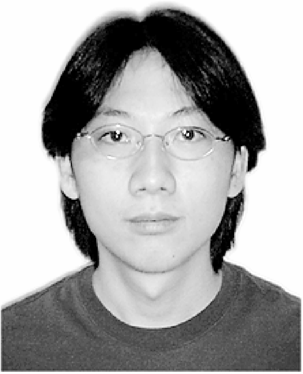 Bing-Rong Lin合作论文数Penn State University1
 Reid Simmons合作论文数Robotics Institute, School of Computer Science, Carnegie Mellon University1




