Adversarial attacks are designed to perturb input samples to induce incorrect predictions from a model, which are key tools for assessing model robustness. Although extensive research has focused on designing adversarial attacks for classification tasks, robustness analysis for segmentation tasks remains relatively underexplored. Given that segmentation enables fine-grained, pixel-wise semantic analysis, we argue that adversarial attacks aiming at pixel-level robustness assessment are particularly valuable. A fundamental prerequisite for generating adversarial examples is the availability of a well-trained victim model (VM), which is the model being attacked. However, relying on task-specific architectures limits the generality and flexibility of attack strategies. To address this issue, we design an effective adversarial attack without relying on victim models. In particular, we propose a novel adversarial sample generation model, termed the Data Distribution Estimation (DDE) model, for segmentation tasks. Built upon DDE, our model operates without relying on any segmentation-specific model architecture. This adversarial sample generation model operates directly on the data distribution by estimating its gradient and perturbing samples at the pixel level toward lower-density regions, effectively guiding the samples away from the natural image manifold. Extensive experiments show that our method can generate effective and transferable adversarial examples for segmentation tasks. These results validate the feasibility and potential of generating adversarial samples solely based on data distributions, providing a new perspective for studying robustness in dense prediction tasks.
Transformer, which originates from machine translation, is particularly powerful at modeling long-range dependencies. Currently, the transformer is making revolutionary progress in various vision tasks, leading to significant performance improvements compared with the convolutional neural network (CNN) based frameworks. In this paper, we conduct extensive research on exploiting the contributions of transformers for accurate and reliable salient object detection. For the former, we apply transformer to a deterministic model, and explain that the effective structure modeling and global context modeling abilities lead to its superior performance compared with the CNN based frameworks. For the latter, we observe that both CNN and transformer based frameworks suffer greatly from the over-confidence issue, where the models tend to generate wrong predictions with high confidence. To estimate the reliability degree of both CNN- and transformer-based frameworks, we further present a latent variable model, namely inferential generative adversarial network (iGAN), based on the generative adversarial network (GAN). The stochastic attribute of the latent variable makes it convenient to estimate the predictive uncertainty, serving as an auxiliary output to evaluate the reliability of model prediction. Different from the conventional GAN, which defines the distribution of the latent variable as fixed standard normal distribution $\mathcal{N}(0,\mathbf{I})$, the proposed iGAN infers the latent variable by gradient-based Markov Chain Monte Carlo (MCMC), namely Langevin dynamics, leading to an input-dependent latent variable model. We apply our proposed iGAN to both fully and weakly supervised salient object detection, and explain that iGAN within the transformer framework leads to both accurate and reliable salient object detection.
In this paper, we present a weakly-supervised RGB-D salient object detection model via scribble supervision. Specifically, as a multimodal learning task, we focus on effective multimodal representation learning via inter-modal mutual information regularization. In particular, following the principle of disentangled representation learning, we introduce a mutual information upper bound with a mutual information minimization regularizer to encourage the disentangled representation of each modality for salient object detection. Based on our multimodal representation learning framework, we introduce an asymmetric feature extractor for our multimodal data, which is proven more effective than the conventional symmetric backbone setting. We also introduce multimodal variational auto-encoder as stochastic prediction refinement techniques, which takes pseudo labels from the first training stage as supervision and generates refined prediction. Experimental results on benchmark RGB-D salient object detection datasets verify both effectiveness of our explicit multimodal disentangled representation learning method and the stochastic prediction refinement strategy, achieving comparable performance with the state-of-the-art fully supervised models. Our code and data are available at: https://npucvr.github.io/MIRV/ .
Preys in the wild evolve to be camouflaged to avoid being recognized by predators. In this way, camouflage acts as a key defence mechanism across species that is critical to survival. To detect and segment the whole scope of a camouflaged object, camouflaged object detection (COD) is introduced as a binary segmentation task, with the binary ground truth camouflage map indicating the exact regions of the camouflaged objects. In this paper, we revisit this task and argue that the binary segmentation setting fails to fully understand the concept of camouflage. We find that explicitly modeling the conspicuousness of camouflaged objects against their particular backgrounds can not only lead to a better understanding about camouflage, but also provide guidance to designing more sophisticated camouflage techniques. Furthermore, we observe that it is some specific parts of camouflaged objects that make them detectable by predators. With the above understanding about camouflaged objects, we present the first triple-task learning framework to simultaneously localize, segment, and rank camouflaged objects, indicating the conspicuousness level of camouflage. As no corresponding datasets exist for either the localization model or the ranking model, we generate localization maps with an eye tracker, which are then processed according to the instance level labels to generate our ranking-based training and testing dataset. We also contribute the largest COD testing set to comprehensively analyse performance of the COD models. Experimental results show that our triple-task learning framework achieves new state-of-the-art, leading to a more explainable COD network. Our code, data, and results are available at: https://github.com/JingZhang617/COD-Rank-Localize-and-Segment .
We explore a new task for audio-visual-language modeling called fine-grained audible video description (FAVD). It aims to provide detailed textual descriptions for the given audible videos, including the appearance and spatial locations of each object, the actions of moving objects, and the sounds in videos. Existing visual-language modeling tasks often concentrate on visual cues in videos while undervaluing the language and audio modalities. On the other hand, FAVD requires not only audio-visual-language modeling skills but also paragraph-level language generation abilities. We construct the first fine-grained audible video description benchmark (FAVDBench) to facilitate this research. For each video clip, we first provide a one-sentence summary of the video, ie, the caption, followed by 4-6 sentences describing the visual details and 1-2 audio-related descriptions at the end. The descriptions are provided in both English and Chinese. We create two new metrics for this task: an EntityScore to gauge the completeness of entities in the visual descriptions, and an AudioScore to assess the audio descriptions. As a preliminary approach to this task, we propose an audio-visual-language transformer that extends existing video captioning model with an additional audio branch. We combine the masked language modeling and auto-regressive language modeling losses to optimize our model so that it can produce paragraph-level descriptions. We illustrate the efficiency of our model in audio-visual-language modeling by evaluating it against the proposed benchmark using both conventional captioning metrics and our proposed metrics. We further put our benchmark to the test in video generation models, demonstrating that employing fine-grained video descriptions can create more intricate videos than using captions.
•We design a saliency encoder-decoder with adversarial discriminator to generate a confidence map, representing the network uncertainty on the current prediction. We then select the least confident (discriminative) samples from the unlabeled pool to form the “candidate labeled pool”.•We train a Variational Auto-Encoder (VAE) to select and add the most representative data from the “candidate labeled pool” into the labeled pool by comparing their corresponding features in the latent space. Within our frame-work, these two networks are optimized conditioned on the states of each other progressively.
Camouflaged object detection (COD) aims to segment camouflaged objects hiding in the environment, which is challenging due to the similar appearance of camouflaged objects and their surroundings. Research in biology suggests depth can provide useful object localization cues for camouflaged object discovery. In this paper, we study the depth contribution for camouflaged object detection, where the depth maps are generated with existing monocular depth estimation (MDE) methods. Due to the domain gap between the MDE dataset and our COD dataset, the generated depth maps are not accurate enough to be directly used. We then introduce two solutions to avoid the noisy depth maps from dominating the training process. Firstly, we present an auxiliary depth estimation branch ("ADE"), aiming to regress the depth maps. We find that "ADE" is especially necessary for our "generated depth" scenario. Secondly, we introduce a multi-modal confidence-aware loss function via a generative adversarial network to weigh the contribution of depth for camouflaged object detection. Our extensive experiments on various camouflaged object detection datasets explain that the existing "sensor depth" based RGB-D segmentation techniques work poorly with "generated depth", and our proposed two solutions work cooperatively, achieving effective depth contribution exploration for camouflaged object detection.
The transformer networks are particularly good at modeling long-range dependencies within a long sequence. In this paper, we conduct research on applying the transformer networks for salient object detection (SOD). We adopt the dense transformer backbone for fully supervised RGB image based SOD, RGB-D image pair based SOD, and weakly supervised SOD within a unified framework based on the observation that the transformer backbone can provide accurate structure modeling, which makes it powerful in learning from weak labels with less structure information. Further, we find that the vision transformer architectures do not offer direct spatial supervision, instead encoding position as a feature. Therefore, we investigate the contributions of two strategies to provide stronger spatial supervision through the transformer layers within our unified framework, namely deep supervision and difficulty-aware learning. We find that deep supervision can get gradients back into the higher level features, thus leads to uniform activation within the same semantic object. Difficulty-aware learning on the other hand is capable of identifying the hard pixels for effective hard negative mining. We also visualize features of conventional backbone and transformer backbone before and after fine-tuning them for SOD, and find that transformer backbone encodes more accurate object structure information and more distinct semantic information within the lower and higher level features respectively. We also apply our model to camouflaged object detection (COD) and achieve similar observations as the above three SOD tasks. Extensive experimental results on various SOD and COD tasks illustrate that transformer networks can transform SOD and COD, leading to new benchmarks for each related task. The source code and experimental results are available via our project page: this https URL.
Visual salient object detection (SOD) aims at finding the salient object(s) that attract human attention, while camouflaged object detection (COD) on the contrary intends to discover the camouflaged object(s) that hidden in the surrounding. In this paper, we propose a paradigm of lever-aging the contradictory information to enhance the detection ability of both salient object detection and camouflaged object detection. We start by exploiting the easy positive samples in the COD dataset to serve as hard positive samples in the SOD task to improve the robustness of the SOD model. Then, we introduce a "similarity measure" module to explicitly model the contradicting attributes of these two tasks. Furthermore, considering the uncertainty of labeling in both tasks’ datasets, we propose an adversarial learning network to achieve both higher order similarity measure and network confidence estimation. Experimental results on benchmark datasets demonstrate that our solution leads to state-of-the-art (SOTA) performance for both tasks 1 .
The transformer networks, which originate from machine translation, are particularly good at modeling long-range dependencies within a long sequence. Currently, the transformer networks are making revolutionary progress in various vision tasks ranging from high-level classification tasks to low-level dense prediction tasks. In this paper, we conduct research on applying the transformer networks for salient object detection (SOD). Specifically, we adopt the dense transformer backbone for fully supervised RGB image based SOD, RGB-D image pair based SOD, and weakly supervised SOD within a unified framework based on the observation that the transformer backbone can provide accurate structure modeling, which makes it powerful in learning from weak labels with less structure information. Further, we find that the vision transformer architectures do not offer direct spatial supervision, instead encoding position as a feature. Therefore, we investigate the contributions of two strategies to provide stronger spatial supervision through the transformer layers within our unified framework, namely deep supervision and difficulty-aware learning. We find that deep supervision can get gradients back into the higher level features, thus leads to uniform activation within the same semantic object. Difficulty-aware learning on the other hand is capable of identifying the hard pixels for effective hard negative mining. We also visualize features of conventional backbone and transformer backbone before and after fine-tuning them for SOD, and find that transformer backbone encodes more accurate object structure information and more distinct semantic information within the lower and higher level features respectively. As an extension, we also apply our model to camouflaged object detection (COD) and achieve similar observations as the above three SOD related tasks. Extensive experimental results on various SOD and COD tasks illustrate that transformer networks can transform salient object detection and camouflaged object detection, leading to new benchmarks for each related task. The source code and experimental results are publicly available via our project page: https://github.com/fupiao1998/TrasformerSOD.
Camouflaged object detection (COD) aims to segment camouflaged objects hiding in the environment, which is challenging due to the similar appearance of camouflaged objects and their surroundings. Research in biology suggests that depth can provide useful object localization cues for camouflaged object discovery, as all the animals have 3D perception ability. However, the depth information has not been exploited for camouflaged object detection. To explore the contribution of depth for camouflage detection, we present a depth-guided camouflaged object detection network with pre-computed depth maps from existing monocular depth estimation methods. Due to the domain gap between the depth estimation dataset and our camouflaged object detection dataset, the generated depth may not be accurate enough to be directly used in our framework. We then introduce a depth quality assessment module to evaluate the quality of depth based on the model prediction from both RGB COD branch and RGB-D COD branch. During training, only high-quality depth is used to update the modal interaction module for multi-modal learning. During testing, our depth quality assessment module can effectively determine the contribution of depth and select the RGB branch or RGB-D branch for camouflage prediction. Extensive experiments on various camouflaged object detection datasets prove the effectiveness of our solution in exploring the depth information for camouflaged object detection. Our code and data is publicly available at: https: //github.com/JingZhang617/RGBD-COD.
Camouflage is a key defence mechanism across species that is critical to survival. Common strategies for camouflage include background matching, imitating the color and pattern of the environment, and disruptive coloration, disguising body outlines [37]. Camouflaged object detection (COD) aims to segment camouflaged objects hiding in their surroundings. Existing COD models are built upon binary ground truth to segment the camouflaged objects without illustrating the level of camouflage. In this paper, we revisit this task and argue that explicitly modeling the conspicuousness of camouflaged objects against their particular backgrounds can not only lead to a better understanding about camouflage and evolution of animals, but also provide guidance to design more sophisticated camouflage techniques. Furthermore, we observe that it is some specific parts of the camouflaged objects that make them detectable by predators. With the above understanding about camouflaged objects, we present the first ranking based COD network (Rank-Net) to simultaneously localize, segment and rank camouflaged objects. The localization model is proposed to find the discriminative regions that make the camouflaged object obvious. The segmentation model segments the full scope of the camouflaged objects. Further, the ranking model infers the detectability of different camouflaged objects. Moreover, we contribute a large COD testing set to evaluate the generalization ability of COD models. Experimental results show that our model achieves new state-of-the-art, leading to a more interpretable COD network1.
Compared with laborious pixel-wise dense labeling, it is much easier to label data by scribbles, which only costs 1~2 seconds to label one image. However, using scribble labels to learn salient object detection has not been explored. In this paper, we propose a weakly-supervised salient object detection model to learn saliency from such annotations. In doing so, we first relabel an existing large-scale salient object detection dataset with scribbles, namely S-DUTS dataset. Since object structure and detail information is not identified by scribbles, directly training with scribble labels will lead to saliency maps of poor boundary localization. To mitigate this problem, we propose an auxiliary edge detection task to localize object edges explicitly, and a gated structure-aware loss to place constraints on the scope of structure to be recovered. Moreover, we design a scribble boosting scheme to iteratively consolidate our scribble annotations, which are then employed as supervision to learn high-quality saliency maps. As existing saliency evaluation metrics neglect to measure structure alignment of the predictions, the saliency map ranking may not comply with human perception. We present a new metric, termed saliency structure measure, as a complementary metric to evaluate sharpness of the prediction. Extensive experiments on six benchmark datasets demonstrate that our method not only outperforms existing weakly-supervised/unsupervised methods, but also is on par with several fully-supervised state-of-the-art models (Our code and data is publicly available at: https://github.com/JingZhang617/Scribble_Saliency).
 Yuchao Dai (戴玉超)合作论文数School of Electronics and Information, Northwestern Polytechnical University15
 Jing Zhang (张静)合作论文数Division of Biomedical Science and Biochemistry, Research School of Biology, College of Science, Australian National University;College of Engineering and Computer Science, Australian National University;Research School of Engineering, Australian National University14
 Yunqiu Lv合作论文数9
 Zhexiong Wan (万哲雄)合作论文数Huawei5
 Yiran Zhong合作论文数Shanghai AI Laboratory5
 Yuxin Mao合作论文数Northwestern Polytechnical University4
 Bowen Liu合作论文数School of Electronics and Information, Northwestern Polytechnical University, Xi'an, China4
 Nick Barnes合作论文数School of Computing, College of Engineering, Computing and Cybernetics, The Australian National University;Research School of Engineering, The Australian National University4
 Deng-Ping Fan (范登平)合作论文数College of Computer Science, Nankai University4Xinyu Tian合作论文数3Mochu Xiang合作论文数2
 Tong Zhang合作论文数Image and Visual Representation Laboratory, Ecole Polytechnique Federale de Lausanne2
 Xuyang Shen合作论文数SenseTime1Bowen He合作论文数1
 Xiaodong Han合作论文数1
 Jinxing Zhou合作论文数Mohamed Bin Zayed University of Artificial Intelligence1
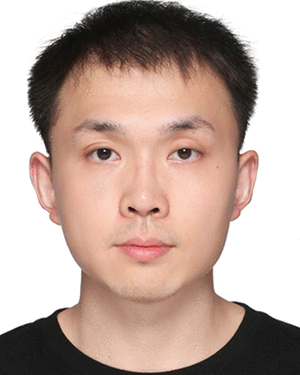 Zhen Qin合作论文数Sch Mech Engn, Shandong Univ Technol1
 Meng Wang (汪萌)合作论文数School of Computer Science and Information Engineering, Hefei University of Technology1Peipei Song合作论文数School of Computing, Australian National University1
 Yu Qiao (乔宇)合作论文数Multimedia Laboratory, Shenzhen Institutes of Advanced Technology, Chinese Academy of Sciences;Shanghai AI Laboratory;Shenzhen University of Advanced Technology1
 Xin Yu合作论文数1
 Li Dong (董力)合作论文数Microsoft Research Asia1
 Lingpeng Kong合作论文数Natural Language Processing Group, Department of Computer Science, Faculty of Engineering, The University of Hong Kong1




