ABSTRACT Although plumage displays often reliably signal individual condition and age, how these sexually selected traits vary with geographic region is not well understood. Golden-winged Warbler (Vermivora chrysoptera) populations are fragmented and declining precipitously in the Appalachian Mountains. Limited research suggests that Golden-winged Warbler facial plumage ornaments may be under sexual selection; black throat (melanin-based) coloration is associated with mate acquisition while yellow crown (carotenoid-based) coloration is associated with aggression and habitat quality. We tested whether multiple plumage traits (crown, throat, and tail coloration) (1) varied across the Appalachian breeding range, (2) varied with age class or body condition, and (3) covaried with each other and whether the covariance differed with geographic region. We found that crown and throat coloration followed a latitudinal gradient, with the more southern birds showing lower ornamentation. Moreover, after-second-year birds had tails with a greater extent of white than second-year, suggesting tail color may reliably signal age that conspecifics could assess. Males with more-ornamented crown color had more-ornamented throat coloration, suggesting that this species demonstrates some potential for both redundant (facial coloration) and independent (tail white) signaling. We found no evidence, however, that covariation between traits differed across the breeding range or that the plumage traits varied with body condition. Additional research investigating the signaling function of multiple plumage ornaments in Golden-winged Warblers across their breeding range could shed light on habitat preferences and communication. Received 28 October 2016. Accepted 4 January 2018.
For at-risk wildlife species, it is important to consider conservation within the process of adaptive management. Golden-winged Warblers (Vermivora chrysoptera) are Neotropical migratory songbirds that are experiencing long-term population declines due in part to the loss of early-successional nesting habitat. Recently-developed Golden-winged Warbler habitat management guidelines are being implemented by USDA: Natural Resource Conservation Service (2014) and its partners through the Working Lands For Wildlife (WLFW) program. During 2012–2014, we studied the nesting ecology of Golden-winged Warblers in managed habitats of the eastern US that conformed to WLFW conservation practices. We evaluated five NRCS “management scenarios” with respect to nesting success and attainment of recommended nest site vegetation conditions outlined in the Golden-winged Warbler breeding habitat guidelines. Using estimates of territory density, pairing rate, nest survival, and clutch size, we also estimated fledgling productivity (number of fledglings/ha) for each management scenario. In general, Golden-winged Warbler nest survival declined as each breeding season advanced, but nest survival was similar across management scenarios. Within each management scenario, vegetation variables had little influence on nest survival. Still, percent Rubus cover and density of >2 m tall shrubs were relevant in some management scenarios. All five management scenarios rarely attained recommended levels of nest site vegetation conditions for Golden-winged, yet nest survival was high. Fledgling productivity estimates for each management scenario ranged from 2.1 to 8.6 fledglings/10 hectares. Our results indicate that targeted habitat management for Golden-winged Warblers using a variety of management techniques on private lands has the capability to yield high nest survival and fledgling productivity, and thus have the potential to contribute to the species recovery.
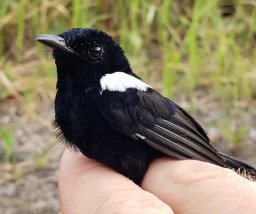
Avian plumage represents some of the greatest diversity in integument coloration of all animals. Plumage signals are diverse in function, including those that allow for assessing potential mates or the mitigation of agonistic interactions between rivals. Many bird species possess multiple ornamental traits that have the potential to serve as multiple or redundant signals. For example, male golden-winged warblers (Vermivora chrysoptera) have brilliant carotenoid-based yellow crowns, melanin-based black throats, and structurally based white patches on their outer tail feathers. Using a correlative approach, we investigated whether plumage ornaments have the potential to reliably signal ability to acquire higher quality territory, aggressive response to simulated territorial intrusions, and reproductive success. We found that both crown chroma and tail brightness were significantly related to habitat quality and aggression; more ornamented birds held territories with higher quality habitat and were less aggressive toward simulated conspecific stimuli. Older birds sang less threatening songs than younger birds and were more likely to sing their mate attraction song type (type 1) rather than songs typically reserved for agonistic interactions (type 2). Finally, despite our previous research demonstrating that habitat strongly predicts reproductive success in this warbler population, we found no evidence of a direct link between ornamentation and reproductive success. Overall, these data suggest that younger males, and those with lower quality ornaments, compensate with more aggressive behaviors. Additional research is needed to investigate the dynamics between behavioral traits and ornaments to better understand complex signaling and how golden wing signals function in conspecific interactions (male–male interactions and mate-choice).
When multiple species occur sympatrically, divergence in morphological and behavioural traits associated with species recognition and resource use are expected. Individuals that engage in interspecific aggression often suffer fitness consequences if the benefits of securing resources do not outweigh the risks associated with agonism. In the southern Appalachians, interspecific aggression frequently occurs between chestnut-sided warblers, Setophaga pensylvanica, and golden-winged warblers, Vermivora chrysoptera, a species that is experiencing sharp declines in population numbers. Using a combination of correlative and experimental approaches, we explored two potential explanations for interspecific aggression: interspecific competition and mistaken identity. It is commonly inferred that aggressive interactions are the product of competition due to an ecological niche overlap. However, because these warblers have similar crown coloration and aggressive interactions appear stochastic, aggression may be a result of mistaken identity. First, in 2014, we documented spatial overlap of the two species and measured reproductive success and habitat preference (using remote sensing) of golden-winged warblers. We found that golden-winged warblers that settled among high densities of chestnut-sided warblers were more aggressive, but chestnut-sided warbler density did not negatively influence their reproductive success; rather, habitat structure best predicted reproductive success. Next, in 2015, we tested for misidentification using models of conspecifics and heterospecifics in simulated territorial intrusions. We found that both warbler species were equally likely to both types of models, and that the most aggressive individuals were more likely to attack models. Our results suggest that, from the golden-winged warbler's perspective, sympatry is not detrimental and aggression is probably a function of mistaken identity. Yet, these behavioural interactions should be maladaptive, which may lead to the segregation of habitat types or divergence in crown morphology between species. (C) 2016 The Association for the Study of Animal Behaviour. Published by Elsevier Ltd. All rights reserved.
Substantial evidence has now demonstrated that fertilization competition selects for the most effective status-signaling and female-stimulating ornaments and that females measurably benefit from choosing males with the most elaborate ornaments. Studying sexually selected traits begins with characterizing ornaments and identifying signaling functions. In this study, I characterized ornamentation of the carotenoid-based crown plumage, melanin-based throat plumage, and structurally derived tail white plumage of breeding male Golden-winged Warblers in the Appalachian Mountains. I tested for geographic and age-based variation of plumage traits and investigated their quality indicating and behavioral signaling functions. I found a latitudinal gradient of variation in crown and throat coloration and regional differences in body condition, with the southern birds showing less ornamentation and lower body condition. Plumage traits were not indicative of body condition but older birds displayed more white on their tails and co-variation of crown and throat coloration. Males with less-ornamented crowns were more aggressive to simulated territorial intrusions while males with greater tail white ornamentation provisioned nestlings more often. My study has demonstrated that there is measurable variation and signaling potential in male Golden-winged Warbler plumage traits, thus suggesting these ornaments are sexually selected traits.
 John Anthony Jones合作论文数Department of Ecology and Evolutionary Biology, Tulane University4
 Lynn Siefferman合作论文数Department of Biological Sciences;Auburn University;Department of Biological Sciences, Auburn University4
 Jeffery L Larkin合作论文数University of Kentucky;Department of Forestry4
 Marja H. Bakermans合作论文数School of Natural Resources, The Ohio State University4
 Kyle R. Aldinger合作论文数West Virginia Cooperat Fish & Wildlife Res Unit, West Virginia Univ2
 Darin J. McNeil合作论文数2Lehman Justin A合作论文数1Petra Bohall Wood合作论文数1
 David A. Buehler合作论文数Department of Forestry;University of Tennessee;Department of Forestry, University of Tennessee1




