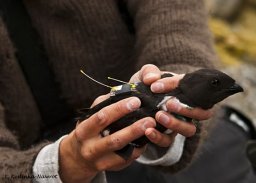
—Examining body mass and physiological parameters in breeding adults may provide valuable insight into parental efforts provided by males and females at a given stage of breeding. Here, we examined body mass and physiological variables (hemoglobin and cholesterol concentrations, leukocyte profile) in males and females in a small pelagic seabird, the European Storm Petrel (Hydrobates p. pelagicus) during the incubation period. We expected females to be in poorer physiological condition compared to males because of their assumed higher investment (production of costly egg, with all other parental activities performed being similar). Contrary to our expectation, we did not find sex differences in the hematological values, indicating similar non-resource–based costs of reproduction. Also, we found females in good nutritional state, being heavier and having higher cholesterol concentration than males. Although we are not able to explicitly identify mechanisms responsible for the pattern observed, we suggest that common assumptions about female-biased efforts during the pre-laying and/or equal male and female parental efforts during incubation periods in the European Storm Petrel require verification. Received 25 June 2015. Accepted 6 January 2016.
Examining body mass and physiological parameters in breeding adults may provide valuable insight into parental efforts provided by males and females at a given stage of breeding. Here, we examined body mass and physiological variables (hemoglobin and cholesterol concentrations, leukocyte profile) in males and females in a small pelagic seabird, the European Storm Petrel (Hydrobates p. pelagicus) during the incubation period. We expected females to be in poorer physiological condition compared to males because of their assumed higher investment (production of costly egg, with all other parental activities performed being similar). Contrary to our expectation, we did not find sex differences in the hematological values, indicating similar non-resource-based costs of reproduction. Also, we found females in good nutritional state, being heavier and having higher cholesterol concentration than males. Although we are not able to explicitly identify mechanisms responsible for the pattern observed, we suggest that common assumptions about female-biased efforts during the pre-laying and/or equal male and female parental efforts during incubation periods in the European Storm Petrel require verification.
Leucocyte profiles, especially the heterophil/lymphocyte ratio (H/L), are widely used to assess immune function and stress in birds. In this study, we investigated whether leucocyte profiles in a small colonial seabird, the little auk ( Alle alle ), are related to age (chicks, adults), sex or biometric traits, including body mass. We blood-sampled chicks at 4–8 and 14–18 days of life and chick-feeding adults with 14–20- and 24–30-day-old chicks. Relative numbers of heterophils and H/L generally differed among chicks and adults, with the highest values in adults with 14–20-day-old chicks and the lowest ones in 4–8-day-old chicks. Females had a higher proportion of lymphocytes than males. The relative numbers of eosinophils were similar in all the groups. The percentage of monocytes tended to differ among the age categories. Analyses of chicks revealed that the percentage of heterophils and the H/L ratios were significantly higher in older than in younger chicks. The opposite pattern was recorded for lymphocytes. In 14–18-day-old chicks, H/L (stress level) was negatively related to body mass, head-bill length and bill width. This time period is energetically stressful as nestlings start to exercise their wings outside the nest chamber. This suggests that the origin of stress in nestlings was mainly nutritional. We found a significant positive correlation between body mass at fledging and the relative number of eosinophils at 14–18 days of life, indicating a higher level of stress in lighter nestlings. The significant relationship between fledging age and the percentage of monocytes at 14–18 days of life suggested a poorer state of health in chicks that fledged at an older age.
Although abnormal or injured legs are not uncommon in Hydrobatidae, they are rarely investigated. We aimed in this study to estimate the frequency of leg abnormalities and determine health status (expressed by leucocyte profile) in molecularly sexed European Storm-Petrels (Hydrobates p. pelagicus) captured on the Faroe Islands. We found that 2.4% of individuals captured during the breding season had some leg abnormalities. Half of the birds with abnormalities had puffinosis-like changes, while the rest were missing some part of the leg. Both types of abnormalities were recorded in the two sexes with similar frequency. The proportion of the birds with leg abnormalities seems to be relatively low compared to other Procellariiformes, and stable over time. Despite the apparent disability of the birds with leg abnormalities, we found no significant effect of abnormality status on the leucocyte profile.
In a number of species with biparental care, the parents of one sex desert the mate and brood before the chick is independent. The reasons for this desertion are poorly understood. In the study reported here we investigated whether sex-specific changes in body mass corrected for size (in short body mass) and the stress-related heterophil to lymphocyte ratio (H:L) during the late incubation and chick-rearing period are related to female brood desertion in a small Arctic seabird, the Little Auk (Alle alle). The body mass of both sexes did not change during the study periods, although females were significantly lighter than males. No sex differences were found in the pattern of changes in the H:L ratio. In both sexes, the H:L ratio, and thus the stress level, increased significantly just after hatching and remained high until the last week of chick rearing when it fell back to the level recorded during incubation. These results support behavioural reports of an equal male and female contribution to parental care. The similar body condition of males and females undermines the hypothesis on the depletion of female body reserves as the main trigger of their earlier brood desertion. It is possible that a sex-specific role in parental care during and after fledging and/or an ancestral pattern of parental care are responsible for the transition to paternal care in Little Auks.
 Dariusz Jakubas合作论文数Department of Vertebrate Ecology and Zoology;University of Gdansk;Department of Vertebrate Ecology and Zoology, University of Gdansk5
 Katarzyna Wojczulanis-Jakubas合作论文数Department of Vertebrate Ecology and Zoology;University of Gdansk;Department of Vertebrate Ecology and Zoology, University of Gdansk4
 Jens-Kjeld Jensen合作论文数Í Geilini 37 FO-270 Nólsoy Faroe Islands1
 Dorota Kidawa合作论文数Department of Vertebrate Ecology and Zoology, University of Gdańsk1




