Triangle counting and sampling are two fundamental problems for streaming algorithms. It may be noted that triangle counting has received far greater attention in the literature than the sampling variant. In this work, we consider the problem of approximately sampling triangles in different models of streaming, with the focus being on the adjacency list model. In this problem, the edges of a graph G will arrive over a data stream. The goal is to design efficient streaming algorithms that can sample and output a triangle from a distribution, over the triangles in G, that is close to the uniform distribution over the triangles in G. The distance between distributions is measured in terms of l1-distance. The main technical contribution of this paper is to design algorithms for this triangle sampling problem in the adjacency list model with the space complexities matching their counting variants. For the sake of completeness, we also show results on the vertex and edge arrival models.
The degree distribution of a graph G=(V,E), |V|=n, |E|=m is one of the most fundamental objects of study in the analysis of graphs as it embodies relationship among entities. In particular, an important derived distribution from degree distribution is the complementary cumulative degree histogram (ccdh). The ccdh is a fundamental summary of graph structure, capturing, for each threshold d, the number of vertices with degree at least d. For approximating ccdh, we consider the (ε_D,ε_R)-BiCriteria Multiplicative Approximation, which allows for controlled multiplicative slack in both the domain and the range. The exact complexity of the problem was not known and had been posed as an open problem in WOLA 2019 [Sublinear.info, Problem 98]. In this work, we first design an algorithm that can approximate ccdh if a suitable vertex sample and an edge sample can be obtained and thus, the algorithm is independent of any sublinear model. Next, we show that in the streaming and query models, these samples can be obtained efficiently. On the other end, we establish the first lower bounds for this problem in both query and streaming models, and (almost) settle the complexity of the problem across both the sublinear models.
We present a simple nonadaptive randomized algorithm that estimates the number of edges in a simple, unweighted, undirected graph, possibly containing isolated vertices, using only degree and random edge queries. For an n-vertex graph, our method requires only O(√(n)) queries, achieving sublinear query complexity. The algorithm independently samples a set of vertices and queries their degrees, and also independently samples a set of edges, using the answers to these queries to estimate the total number of edges in the graph. We further prove a matching lower bound, establishing the optimality of our algorithm and resolving the non-adaptive query complexity of this problem with respect to degree and random-edge queries.
Given a point set, mostly a grid in our case, we seek upper and lower bounds on the number of curves that are needed to cover the point set. We say a curve covers a point if the curve passes through the point. We consider such coverings by monotonic curves, lines, orthoconvex curves, circles, etc. We also study a problem that is converse of the covering problem – if a set of n^2 points in the plane is covered by n lines then can we say something about the configuration of the points?
Given a simple, unweighted, undirected graph G=(V,E) with |V|=n and |E|=m, and parameters 0 < ε, δ <1, along with , , and query access to G, we provide a query based randomized algorithm to generate an estimate T of the number of triangles T in G, such that T∈ [(1-ε)T , (1+ε)T] with probability at least 1-δ. The query complexity of our algorithm is O(m αlog(1/δ)/ε^3 T), where α is the arboricity of G. Our work can be seen as a continuation in the line of recent works [Eden et al., SIAM J Comp., 2017; Assadi et al., ITCS 2019; Eden et al. SODA 2020] that considered subgraph or triangle counting with or without the use of query. Of these works, Eden et al. [SODA 2020] considers the role of arboricity. Our work considers how query can leverage the notion of arboricity. Furthermore, continuing in the line of work of Assadi et al. [APPROX/RANDOM 2022], we also provide a lower bound of Ω(m αlog(1/δ)/ε^2 T) that matches the upper bound exactly on arboricity and the parameter δ and almost on ε.
In this work, we consider d - Hyperedge Estimation and d - Hyperedge Sample problems that deal with estimation and uniform sampling of hyperedges in a hypergraph ℋ( U (ℋ), ℱ(ℋ) in the query complexity framework, where U (ℋ) denotes the set of vertices and ℱ(ℋ) denotes the set of hyperedges. The oracle access to the hypergraph is called Colorful Independence Oracle ( CID ), which takes d (non-empty) pairwise disjoint subsets of vertices A 1 ,..., A d ⊆ U (ℋ) as input and answers whether there exists a hyperedge in ℋ having exactly one vertex in each A i for all i ∈ {1, 2, ..., d }. Apart from the fact that d - Hyperedge Estimation and d - Hyperedge Sample problems with CID oracle access seem to be nice combinatorial problems, Dell et al. [SODA’20 & SICOMP’22] established that decision vs. counting complexities of a number of combinatorial optimization problems can be abstracted out as d - Hyperedge Estimation problem with a CID oracle access. The main technical contribution of this article is an algorithm that estimates m = |ℱ(ℋ)| with \(\widehat{m}\) such that \(\begin{equation*} \frac{1}{C_{d}\log ^{d-1} n} \;\le \; \frac{\widehat{m}}{m} \;\le \; C_{d} \log ^{d-1} n \end{equation*}\) by using at most C d log d +2 n CID queries, where n denotes the number of vertices in the hypergraph ℋ and C d is a constant that depends only on d . Our result, when coupled with the framework proposed by Dell et al. (SODA’20 & SICOMP’22), leads to implies improved bounds for (1 ± ε)-approximation (where ε ∈ (0,1)) for the following fundamental problems: Edge Estimation using the Bipartite Independent Set ( BIS ) query. We improve the bound obtained by Beame et al. (ITCS’18 & TALG’20). Triangle Estimation using the Tripartite Independent Set ( TIS ) query. Currently, Dell et al.’s result gives the best bound for the case of triangle estimation in general graphs (SODA’20 & SICOMP’22). The previous best bound for the case of graphs with low co-degree (co-degree of a graph is the maximum number of triangles incident over any edge of the graph) was due to Bhattacharya et al. (ISAAC’19 & TOCS’21). We improve both of these bounds. Hyperedge Estimation & Sampling using Colorful Independence Oracle ( CID ). We give an improvement over the bounds obtained by Dell et al. (SODA’20 & SICOMP’22).
Given a point set, mostly a grid in our case, we seek upper and lower bounds on the number of curves that are needed to cover the point set. We say a curve covers a point if the curve passes through the point. We consider such coverings by monotonic curves, lines, orthoconvex curves, circles, etc. We also study a problem that is converse of the covering problem – if a set of $$n^2$$ points in the plane is covered by n lines then can we say something about the configuration of the points?
In this paper, we focus on Hitting-Set , a fundamental problem in combinatorial optimization, through the lens of sublinear time algorithms. Given access to the hypergraph through a subset query oracle in the query model, we give sublinear time algorithms for Hitting-Set with almost tight parameterized query complexity. In parameterized query complexity , we estimate the number of queries to the oracle based on the parameter k , the size of the Hitting-Set . The subset query oracle we use in this paper is called Generalized d -partite Independent Set query oracle (GPIS) and it was introduced by Bishnu et al. (ISAAC'18). GPIS is a generalization to hypergraphs of the Bipartite Independent Set query oracle (BIS) introduced by Beame et al. (ITCS'18 and TALG'20) for estimating the number of edges in graphs. Since its introduction GPIS query oracle has been used for estimating the number of hyperedges independently by Dell et al. (SODA'20 and SICOMP'22) and Bhattacharya et al. (STACS'22), and for estimating the number of triangles in a graph by Bhattacharya et al. (ISAAC'19 and TOCS'21). Formally, GPIS is defined as follows: GPIS oracle for a d-uniform hypergraph H takes as input d pairwise disjoint non-empty subsets A 1 , … , A d of vertices in H and answers whether there is a hyperedge in H that intersects each set A i , where i ∈ { 1 , 2 , … , d } . For d = 2, the GPIS oracle is nothing but BIS oracle. We show that d - Hitting-Set , the hitting set problem for d -uniform hypergraphs, can be solved using O ˜ d ( k d log n ) GPIS queries. Additionally, we also showed that d - Decision-Hitting-Set , the decision version of d - Hitting-Set can be solved with O ˜ d ( min { k d log n, k 2 d 2 } ) GPIS queries. We complement these parameterized upper bounds with an almost matching parameterized lower bound that states that any algorithm that solves d - Decision-Hitting-Set requires Ω ( ( k + d d ) ) GPIS queries.
For an unknown n × n matrix A having non-negative entries, the inner product ( IP ) oracle takes as inputs a specified row (or a column) of A and a vector v ∈ R n with non-negative entries, and returns their inner product. Given two input vectors x and y in R n with non-negative entries, and an unknown matrix A with non-negative entries with IP oracle access, we design almost optimal sublinear time algorithms for the following two fundamental matrix problems: Find an estimate X for the bilinear form x T A y such that X ≈ x T A y . Designing a sampler Z for the entries of the matrix A such that P ( Z = ( i, j )) ≈ x i A ij y j / (cid:0) x T A y (cid:1) , where x i and y j are i -th and j -th coordinate of x and y respectively. As special cases of the above results, for any submatrix of an unknown matrix with non-negative entries and IP oracle access, we can efficiently estimate the sum of the entries of any submatrix, and also sample a random entry from the submatrix with probability proportional to its weight. We will show that the above results imply that if we are given IP oracle access to the adjacency matrix of a graph, with non-negative weights on the edges, then we can design sublinear time algorithms for the following two fundamental graph problems:
We study a graph coloring problem that is otherwise easy in the RAM model but becomes quite non-trivial in the one-pass streaming model. In contrast to previous graph coloring problems in streaming that try to find an assignment of colors to vertices, our main work is on estimating the number of conflicting or monochromatic edges given a coloring function that is streaming along with the graph; we call the problem Conflict-Est. The coloring function on a vertex can be read or accessed only when the vertex is revealed in the stream. If we need the color on a vertex that has streamed past, then that color, along with its vertex, has to be stored explicitly. We provide algorithms for a graph that is streaming in different variants of the vertex arrival in one-pass streaming model, viz. the Vertex Arrival (VA), Vertex Arrival With Degree Oracle (VAdeg), Vertex Arrival in Random Order (VArand) models, with special focus on the random order model. We also provide matching lower bounds for most of the cases. The mainstay of our work is in showing that the properties of a random order stream can be exploited to design efficient streaming algorithms for estimating the number of monochromatic edges. We have also obtained a lower bound, though not matching the upper bound, for the random order model. Among all the three models vis-a-vis this problem, we can show a clear separation of power in favor of the VArand model.
The database skyline query (or non-domination query) has a spatial form: Given a set P with n point sites, and a point set S of m locations of interest, a site p∈P is a skyline point if and only if for each q∈P∖{p}, there exists at least one location s∈S that is closer to p than to q. We reduce the problem of determining skyline points to the problem of finding sites that have non-empty cells in an additively weighted Voronoi diagram under a convex distance function. The weights of said Voronoi diagram are derived from the coordinates of the sites of P, while the convex distance function is derived from the set of locations S. In the two-dimensional plane, this reduction gives an O((n+m)log(n+m))-time algorithm to find the skyline points.
Estimating the number of triangles in a graph is one of the most fundamental problems in sublinear algorithms. In this work, we provide an algorithm that approximately counts the number of triangles in a graph using only polylogarithmic queries when the number of triangles on any edge in the graph is polylogarithmically bounded. Our query oracle Tripartite Independent Set (TIS) takes three disjoint sets of vertices A, B and C as inputs, and answers whether there exists a triangle having one endpoint in each of these three sets. Our query model generally belongs to the class of group queries (Ron and Tsur ACM Trans. Comput. Theory 8(4), 15, 2016; Dell and Lapinskas 2018) and in particular is inspired by the Bipartite Independent Set (BIS) query oracle of Beame et al. (2018). We extend the algorithmic framework of Beame et al., with TIS replacing BIS, for approximately counting triangles in graphs.
Beame et al. [ITCS 2018&TALG 2021] introduced and used the Bipartite Independent Set (BIS) and Independent Set (IS) oracle access to an unknown, simple, unweighted and undirected graph and solved the edge estimation problem. The introduction of this oracle set forth a series of works in a short span of time that either solved open questions mentioned by Beame et al. or were generalizations of their work as in Dell and Lapinskas [STOC 2018], Dell, Lapinskas and Meeks [SODA 2020], Bhattacharya et al. [ISAAC 2019&Theory Comput. Syst. 2021], and Chen et al. [SODA 2020]. Edge estimation using BIS can be done using polylogarithmic queries, while IS queries need sub-linear but more than polylogarithmic queries. Chen et al. improved Beame et al.'s upper bound result for edge estimation using IS and also showed an almost matching lower bound. Beame et al. in their introductory work asked a few open questions out of which one was on estimating structures of higher order than edges, like triangles and cliques, using BIS queries. In this work, we completely resolve the query complexity of estimating triangles using BIS oracle. While doing so, we prove a lower bound for an even stronger query oracle called Edge Emptiness (EE) oracle, recently introduced by Assadi, Chakrabarty and Khanna [ESA 2021] to test graph connectivity.
The grid obstacle representation, or alternately, ℓ1-obstacle representation of a graph G=(V,E) is an injective function f:V→Z2 and a set of point obstacles O on the grid points of Z2 (where no vertex of V has been mapped) such that uv is an edge in G if and only if there exists a Manhattan path between f(u) and f(v) in Z2 avoiding the obstacles of O and points in f(V). This work shows that planar graphs admit such a representation while there exist some non-planar graphs that do not admit such a representation. Moreover, we show that every graph admits a grid obstacle representation in Z3. We also show NP-hardness result for the point set embeddability of an ℓ1-obstacle representation.
Using geometric techniques like projection and dimensionality reduction, we show that there exists a randomized sub-linear time algorithm that can estimate the Hamming distance between two matrices. Consider two matrices ${\bf A}$ and ${\bf B}$ of size $n \times n$ whose dimensions are known to the algorithm but the entries are not. The entries of the matrix are real numbers. The access to any matrix is through an oracle that computes the projection of a row (or a column) of the matrix on a vector in $\{0,1\}^n$. We call this query oracle to be an {\sc Inner Product} oracle (shortened as {\sc IP}). We show that our algorithm returns a $(1\pm \epsilon)$ approximation to ${\bf D}_{\bf M} ({\bf A},{\bf B})$ with high probability by making ${\cal O}\left(\frac{n}{\sqrt{{\bf D}_{\bf M} ({\bf A},{\bf B})}}\mbox{poly}\left(\log n, \frac{1}{\epsilon}\right)\right)$ oracle queries, where ${\bf D}_{\bf M} ({\bf A},{\bf B})$ denotes the Hamming distance (the number of corresponding entries in which ${\bf A}$ and ${\bf B}$ differ) between two matrices ${\bf A}$ and ${\bf B}$ of size $n \times n$. We also show a matching lower bound on the number of such {\sc IP} queries needed. Though our main result is on estimating ${\bf D}_{\bf M} ({\bf A},{\bf B})$ using {\sc IP}, we also compare our results with other query models.
A $k$-linear coloring of a graph $G$ is an edge coloring of $G$ with $k$ colors so that each color class forms a linear forest -- a forest whose each connected component is a path. The linear arboricity $\chi_l'(G)$ of $G$ is the minimum integer $k$ such that there exists a $k$-linear coloring of $G$. Akiyama, Exoo and Harary conjectured in 1980 that for every graph $G$, $\chi_l'(G)\leq \left \lceil \frac{\Delta(G)+1}{2}\right\rceil$ where $\Delta(G)$ is the maximum degree of $G$. First, we prove the conjecture for 3-degenerate graphs. This establishes the conjecture for graphs of treewidth at most 3 and provides an alternative proof for the conjecture in some classes of graphs like cubic graphs and triangle-free planar graphs for which the conjecture was already known to be true. Next, for every 2-degenerate graph $G$, we show that $\chi'_l(G)=\left\lceil\frac{\Delta(G)}{2}\right\rceil$ if $\Delta(G)\geq 5$. We conjecture that this equality holds also when $\Delta(G)\in\{3,4\}$ and show that this is the case for some well-known subclasses of 2-degenerate graphs. All our proofs can be converted into linear time algorithms.
We study a graph coloring problem that is otherwise easy but becomes quite non-trivial in the one-pass streaming model. In contrast to previous graph coloring problems in streaming that try to find an assignment of colors to vertices, our main work is on estimating the number of conflicting or monochromatic edges given a coloring function that is streaming along with the graph; we call the problem {\sc Conflict-Est}. The coloring function on a vertex can be read or accessed only when the vertex is revealed in the stream. If we need the color on a vertex that has streamed past, then that color, along with its vertex, has to be stored explicitly. We provide algorithms for a graph that is streaming in different variants of the one-pass vertex arrival streaming model, viz. the {\sc Vertex Arrival} ({\sc VA}), {Vertex Arrival With Degree Oracle} ({\sc VAdeg}), {\sc Vertex Arrival in Random Order} ({\sc VArand}) models, with special focus on the random order model. We also provide matching lower bounds for most of the cases. The mainstay of our work is in showing that the properties of a random order stream can be exploited to design streaming algorithms for estimating the number of conflicting edges. We have also obtained a lower bound, though not matching the upper bound, for the random order model. Among all the three models vis-a-vis this problem, we can show a clear separation of power in favor of the {\sc VArand} model.
A planar support for a hypergraph is a planar graph that captures the structural properties of the hypergraph. In this paper, we show, using elementary techniques, that a wide class of geometric hypergraphs of planar non-piercing regions admit a planar support. We also discuss some direct consequences of our results.
 Gopinath Mishra合作论文数Indian Statistical Institute27
 Arijit Ghosh合作论文数University of California25
 S. C. Nandy合作论文数Indian Statistical Institute(ISI);Advanced Computing and Microelectronic Unit13
 Tinku Acharya合作论文数Videonetics Technology Private Limited13
 Malay Kumar Kundu合作论文数Machine Intelligence Unit, Indian Statistical Institute13
 Bhargab B. Bhattacharya合作论文数Indian Statistical Institute;Advanced Computing & Microelectronics Unit 12
 Chivukula A. Murthy合作论文数Indian Statistical Institute;Machine Intelligence Unit12
 Anup Bhattacharya合作论文数10
 Sandip Das合作论文数Advanced Computing and Microelectronics Unit, Computer and Communication Sciences Division, Indian Statistical Institute8B. B. Bhattacharya合作论文数Advanced Computing & Microelectronics Unit
Indian Statistical Institute8
Sandip Das合作论文数Advanced Computing and Microelectronics Unit, Computer and Communication Sciences Division, Indian Statistical Institute8B. B. Bhattacharya合作论文数Advanced Computing & Microelectronics Unit
Indian Statistical Institute8 Tetsuo Asano (浅野哲夫)合作论文数Japan Advanced Institute of Science and Technology;Kanazawa University7
 Subhabrata Paul合作论文数7Anannya Upasana合作论文数6
 Dinesh Dash合作论文数Department of Computer Science and Engineering, National Institute of Technology Patna, Patna, India6
 Partha Bhowmick合作论文数6
 Arobinda Gupta合作论文数Dept Comp Sci & Engn, Indian Inst Technol6
 Xuefeng Liang (梁雪峰)合作论文数School of Artifical Intelligent, Xidian University;Graduate School of Informatics, Kyoto University6Manaswi Paraashar合作论文数Indian Statistical Institute4Mathew C Francis合作论文数Department of Computer Science and Automation, Indian Institute of Science4Drimit Pattanayak合作论文数3
 Pritha Banerjee合作论文数Dept Phys, Jadavpur Univ3Sudeshna Kolay合作论文数The Institute of Mathematical Sciences3
 I. Sengupta合作论文数Department of Computer Science and Engineering, Indian Institute of Technology3Anirvan Duttagupta合作论文数3
 Basavaraju Manu合作论文数3Arindam Karmakar合作论文数ACM Unit, Indian Statistical Institute3Jayanta K. Dey合作论文数3
 Mridul Aanjaneya合作论文数Laboratory for Interactive Virtual Environments, Department of Computer Science, Rutgers University3Sandip Banerjee合作论文数2
 Arnab Sinha合作论文数Amazon2
 Sameer Desai合作论文数2
 Chivukula Anjaneya Murthy合作论文数Indian Statistical Institute2
 Saket Saurabh合作论文数The Institute of Mathematical Sciences2Sabyasachi Dey合作论文数Bhargab B. Bhattacharya Indian Statistical Institute, Calcutta - 700 108, India
Malay K. Kundu Indian Statistical Institute, Calcutta - 700 108, India2Soumyottam Chatterjee合作论文数2
Saket Saurabh合作论文数The Institute of Mathematical Sciences2Sabyasachi Dey合作论文数Bhargab B. Bhattacharya Indian Statistical Institute, Calcutta - 700 108, India
Malay K. Kundu Indian Statistical Institute, Calcutta - 700 108, India2Soumyottam Chatterjee合作论文数2 Aritra Banik合作论文数School of Computer Sciences, National Institute of Science Education and Research2
 Piyush Bhunre合作论文数National University of Singapore2
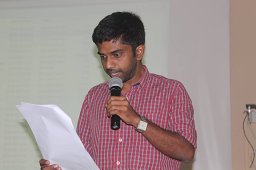 Rogers Mathew合作论文数Department of Computer Science and Automation, Indian Institute of Science2Anvesh Komuravelli合作论文数Computer Science Department, Carnegie Mellon University2
 Otfried Cheong合作论文数Discrete and Computational Geometry Lab, School of Computing, Korea Advanced Institute of Science and Technology2
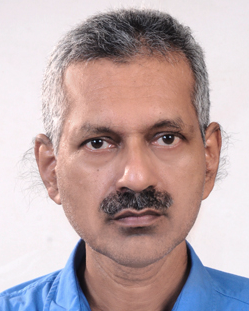 Sudebkumar Prasant Pal合作论文数Department of Computer Science and Engineering, Indian Institute of Technology Kharagpur2
 Binay Bhattacharyya合作论文数Laboratory of Algorithms and Complexity, School of Computing Science, Simon Fraser University2
 Sandeep Sen合作论文数1Sayantan Sen合作论文数1
 Abhay Kumar合作论文数1
 Arindam Khan合作论文数Department of Computer Science and Automation, Indian Institute of Science1
 Mayank Goswami合作论文数Graduate Center, City University of New York;Department of Computer Science, Queens College, City University of New York1
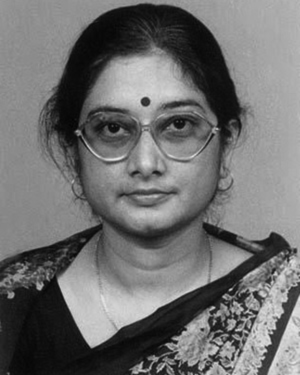 Susmita Sur-Kolay合作论文数Advanced Computing and Microelectronics Unit, Indian Statistical Institute1




