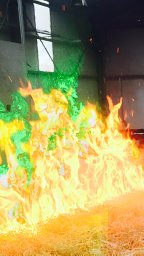
Real scale experimentations have been conducted in order to investigate interactions that may occur in a compartment where sprinklers and Smoke and Heat Exhaust Vent Systems coexist. Fuel oil spray was used as fire source with steady heat release rate of 400 and 800 kW. Both sprinkler system and natural Smoke and Heat Exhaust Vent Systems were designed according to the French standards. Effect of vent on sprinkler activation time was studied. An analysis of the temperature field inside the compartment was conducted while vent was opened prior or after sprinkler activation. Simulations of the experiments were also carried out with Fire Dynamics Simulator v.6 for validation purpose and also to provide supplementary data regarding soot flow rate and energy extracted at the vent.
Experiments in a real-scale room were done on water mist application to a pool fire. A fire produced with fuel oil in a 35cm cylindrical pool was used, with a heat release rate reaching 75kW in stationary conditions. Water application was studied with a nominal flow rate equal to 25l/min provided by a set of four nozzles, injecting droplets with mean Sauter diameter equal to 112μm. Observations of fire suppression in these conditions showed two behaviors, which were analyzed and detailed with the help of numerical simulations conducted with FDS.v5. On one hand, a fast suppression (about 10s required) was observed when water mist was applied to a developed fire. In this case, droplets were injected into a hot environment and thus evaporated strongly, generating a significant vapor concentration and resulting in a fast gas cooling and in an inerting effect. On the other hand, when the mist was applied early, fire growth was controlled, but its suppression required a longer application (about 1min) and only occurred after a significant cooling of the flame and the liquid pool. These two mechanisms were detailed numerically through mass and energy balances for both the gas and the liquid phases and could help to derive suppression model improvements.
Among the primary phenomena observed when studying fire suppression are fuel surface cooling, fire plume cooling and inerting effects. The last two result from water evaporation generating a significant vapor concentration, thus leading to an important heat sink as well as displacement and dilution of both oxygen and fuel vapor. Fire Dynamics Simulator (FDS. v6) is expected to be able to reproduce these effects. Extinguishment criterion focusing on plume cooling and inerting effects is based on a dedicated heat balance, whereas suppression model related to fuel surface cooling evaluates the burning rate decrease according to an exponential law taking into account local water mass reaching the fuel surface per unit area and an empirical constant which penalizes the prediction ability. Therefore, a new model derived from an Arrhenius equation has been implemented, which links the burning rate to the fuel surface temperature. Numerical simulations are conducted and compared with experimental data for all extinguishing mechanisms.