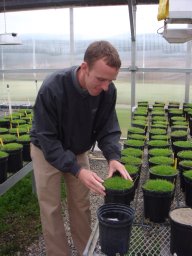
hours per day to compensate for reduced natural lighting during winter months. Sod was collected from a TifEagle bermudagrass green established in July 2002 at the Turf Service Center in Clemson. Soil was washed and plugs placed in polyvinyl chloride containers with 40-centimeter depths and 324-square-centimeter surface areas built to United States Golf Association specification (USGA Green Section Staff, 1993) with an 85:15 (by volume) of sand and peat moss rootzone mix. Starting fertilizer (918-17) at 48 kilograms of nitrogen per hectare was mixed into the soil, and bermudagrass was established four and six weeks in Studies 1 and 2, respectively, before treatments. Urea-based nitrogen fertilizer (16-4-8) with complete micronutrients was applied to all containers at 24 kilograms of nitrogen per hectare two weeks before initial treatments and at 12 kilograms of nitrogen per hectare eight weeks after experiment initiation. Continued on page 74 Q U I C K T IP
Bermudagrass (Cynodon spp. L. C. Rich) is the most widely used turfgrass in the southem United States(Emmons, 2000). Native to eastern Africa, bermudagrass has aggressive stolons and rhizomes that form vigorous turf with high shoot densities and rapid growth capabilities (Beard, 1973). Bermudagrass has excellent wear, drought and salt tolerances, but needs high nitrogen fertility, full sunlight and routine cultivation (McCarty and Miller, 2002). In all, it is a good choice for golf courses.
Pressure to consistently produce ideal putting-green quality has superintendents including regular plant growth regulator (PGR) applications in their management programs. PGRs are compounds that reduce growth by modifying turfgrass hormone synthesis. For fairways, tees and roughs, PGR applications reduce mowing requirements, which minimize labor and equipment operation (Watcshke et al., 1992). PGRs are also used to promote smooth and uniform putting surfaces by reducing diurnal shoot growth fluctuations (McCarty, 2001). Challenges superintendents face with ultradwarf bermudagrass varieties include maintaining appropriate fertility, managing thatch/mat development and promoting root growth. Dwarf bermudagrass varieties show some sensitivity to herbicide and PGR practices previously acceptable for traditional bermudagrass cultivars. Hybrid bermudagrass (Cynodon dactylon (L.) Pers. x C. transvaalensis Burtt-Davey) is the warm-season turfgrass used most commonly on putting greens in the warm, humid climatic regions (Beard, 2002). Bermudagrass putting-green quality has long been considered inferior to fine-textured creeping bentgrass (Agrostis palustris Huds.) because of the inabilities of cultivars such asTifgreen andTifdwarf to withstand routine mowing heights lower than three-sixteenths to one-quarter inch (Beard, 1973). Problems also exist from genetic instabilities of these cultivars leading to off-type patches of different color and texture, causing greens to become mosaic and difficult to play (McCarty and Miller, 2002; Beard, 2002). Dwarf bermudagrass varieties have recently been introduced that tolerate mowing heights of one-eighth inch or closer on a consistent basis (McCarty and Miller, 2002). Dwarf bermudagrass is characterized by fine leaf textures, high shoot densities and low growth habits suitable for close mowing and producing ball roll distances once exclusive to creeping bentgrass greens (McCarty and Miller, 2002; Beard, 2002). However, management programs designed for Tifdwarf andTifgreen bermudagrass putting greens appear questionable for successful long-term ultradwarf bermudagrass culture. Continued on page 70 Root growth inhibition from PGRs appears to be excessive on dwarf bermudagrass regardless of turf quality and clipping yield reductions. T l I D C / Z D I U K n j K
Successful course management is based on turfgrass quality and not total yield. Turf managers fertilize putting greens to promote color and plant health. However, luxuriant growth often disrupts surface uniformity and decreases green speeds. Inhibiting undesirable shoot growth with plant growth regulators (PGRs) provides more consistent putting surfaces and may further enhance turfgrass color and quality. Currently, trinexapac-ethyl (TE) is the most popular PGR in the turfgrass industry. TE (Primo Maxx) represents a newer generation of gibberellic acid (GA) inhibitors that interferes with the 3b-hydroxylase conversion of GA20 to GA1, inhibiting cellular elongation in turfgrass leaves (Rademacher, 2000). Sequential applications of TE on Tifway bermudagrass provide consistent growth suppression, avoidance of post inhibition growth enhancement and improvements in turf quality (Fagerness and Yelverton 2000). Multiple applications of TE to bermudagrass may also delay fall dormancy and promote spring greenup (Fagerness and Yelverton, 2000; Richardson, 2002). Research demonstrates TE improves turf grown under stressful conditions that would otherwise
 Haibo Liu合作论文数Dept Hort, Clemson Univ12Patrick E. Mccullough合作论文数7Alan G. Estes合作论文数3michael toubakaris合作论文数3B. Todd Bunnell合作论文数3Ian R. Rodriguez合作论文数3greg willis合作论文数2
 Christian M. Baldwin合作论文数2roy b dodd合作论文数1
 jeffrey l atkinson合作论文数Dept Agr & Environm Sci, Clemson, SC USA1robert b cross合作论文数1Grady L. Miller合作论文数Turfgrass Science1F. Wesley Totten合作论文数1Ted Whitwell合作论文数Agronomy and Soils Department;Clemson University;Agronomy and Soils Department, Clemson University1




