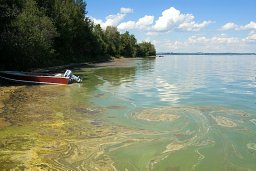
Cyanobacterial toxins are a serious water quality concern in productive water bodies worldwide. Microcystins (MCs), which are hepatotoxins, are prevalent in Canadian freshwaters while the occurrence of neurotoxins anatoxin-a, anatoxin-a(s) and saxitoxin appears to be much less common. Concentrations of microcystin-LR (MCLR), presumed to be the most common of the more than 70 MC analogues, are highly variable in phytoplankton assemblages of lakes and greatly influenced by phytoplankton species composition. The frequency of occurrence and concentrations of MC in lakes in western Canada tend to increase with lake trophic status as well as decreasing N:P ratio. Microcystins accumulate in the aquatic food web through feeding activities of invertebrates (i.e., filter-feeding by clams and grazing by zooplankton and gastropods). Eventual trophic transfer of MC to fish, and resulting mortalities have been documented. Human health may also be at risk. Conventional water treatment may adequately remove low MC concentrations from source water, but can fail to completely remove MCs when initial concentrations are high. To address human health concerns, Health Canada established a drinking water guideline of 1.5 mu g/L of MCLR. More recently, it has been suggested that beta-N-methylamino-L-alanine (BMAA), a non-protein amino acid produced by many species of cyanobacteria, may cause neuro-degenerative disease, thus representing a significant emerging health issue.
1. Stable carbon and nitrogen isotope and fish stomach content analyses were used to investigate food webs in five relatively undisturbed lakes on the Boreal Plain of Canada. Stable isotope analysis was also used to determine the importance of external and internal carbon sources.2. Overlap in the carbon and nitrogen signatures of primary producers made it difficult to determine unambiguously the feeding habits of many invertebrates. However, isotope analysis suggested that external carbon inputs were detectable in the aquatic food chains of the one lake with a short water residence time («1 year). In the other four lakes, with water residence times ≥1 year, autochthonous carbon was the only detectable carbon source in the food webs.3. Food webs in these lakes spanned a range of four to five trophic levels. Both invertebrates and fish appeared to eat a variety of food, often feeding at more than one trophic level.4. With the exception of one lake (SPH20), top predators in these lakes, northern pike (Esox lucius) and fathead minnows (Pimephales promelas), occupied similar trophic positions despite large differences in body size and trophic morphology. In SPH20, where there were two additional fish species, pike occupied a higher trophic position. However, all the top predators in each lake appeared to be omnivores and generalists.5. The prevalence of omnivory and the apparent generalist feeding habits of fish in these lakes suggest that organisms are flexible in their feeding habits and that these food webs will be resilient to disturbance.
A survey of eutrophic to hypereutrophic hardwater lakes in central Alberta was conducted to test the hypotheses that the concentration of the cyanobacterial toxin microcystin-LR (MC-LR) in phytoplankton is regulated by environmental factors that affect both the biomass of the main producer of the toxin, Microcystis aeruginosa, and the concentration of the toxin in the cells. Of all environmental factors examined, total phosphorus was the strongest correlate of both M. aeruginosa biomass and cellular MC-LR (expressed as micrograms per gram of M. aeruginosa). Microcystis aeruginosa biomass was also strongly negatively related to the total nitrogen to total phosphorus ratio (TN:TP) and inorganic nitrogen (NO2- + NO3-, NH4+). A univariate regression model of TN:TP explained the most variation in MC-LR concentration (expressed as nanograms of cellular toxin per litre) in mixed phytoplankton communities. This study indicated that MC-LR dynamics in phytoplankton of lakes was related to changes in the concentration and ratio of phosphorus and nitrogen.
Phosphorus dynamics in shallow subsurface waters (<2.5 m depth) were studied in harvested and unharvested subcatchments of a Boreal Plain lake. The organic soil layer was underlain by discontinuous layers of sand and clay glacial till. Total dissolved P (TDP) concentrations (6-798 µg·L-1) of discrete water samples from mineral layers (0.9-2.5 m deep) generally decreased with depth, were negatively related to Ca (rs < -0.7), and were lower in clay. When the groundwater table rose and saturated the organic layer, TDP concentrations increased in the composite (organic mineral layer) but not in the discrete (mineral layer) water samples, indicating that elevated TDP concentrations originate from the near-surface organic layer. TDP concentrations in composite samples were negatively correlated with water table depth (rs = -0.6) and were positively correlated with transmissivity (rs = 0.7) and dissolved organic C concentration (rs > 0.6). In the riparian buffer zone of the harvested subcatchment, TDP concentrations of composite samples decreased during high runoff, but these values remained higher than concentrations in the unharvested subcatchment. However, surface topography and variable depth to confining clay layers resulted in higher groundwater tables in the harvested subcatchment, especially in the cut area. Mean daily TDP export coefficients were similar between the unharvested (14 µg·m-2) and harvested (12 µg·m-2) subcatchments.
1. To assess the influence of lake trophic status on the occurrence of microcystin‐LR (MCLR) in the tissue of resident pulmonate snails, we sampled seven lakes of varying primary productivity in Alberta, Canada. Parameters associated with productivity were measured every 2 weeks from mid‐May through mid‐September 1995. Phytoplankton and resident pulmonate snails were collected and analysed for MCLR concentration via high‐performance liquid chromatography.2. For all species of gastropod (i.e. Lymnaea stagnalis, Helisoma trivolvis and Physa gyrina), the concentration of MCLR in the tissue was correlated (P ≤ 0.03) with toxin in the phytoplankton, but not with extracellular aqueous microcystin (P > 0.28). The concentrations of toxin in the tissues of L. stagnalis and P. gyrina were also correlated with the relative abundance of Microcystis spp. (P < 0.01).3. Given that Microcystis spp. abundance and MCLR concentration within phytoplankton are correlated with indicators of productivity, we conclude that trophic status is important in influencing the occurrence and concentration of MCLR in pulmonate snails.
Freshwater clams (Anodonta grandis simpsoniana) exposed to 51-55 µg · L -1 of dissolved microcystin-LR (MC-LR) in the laboratory for 3 days did not accumulate MC-LR equivalents (MC-LReq). However, clams placed in three eutrophic lakes with phytoplankton containing MC-LR (concentrations from below detection to 8.3 µg · L -1 cellular toxin) for 12-28 days accumulated the toxin (24 ± 7 to 527 ± 330 ng · g -1 MC-LReq; mean ± SE). The relative MC-LReq concentrations in clams reflected MC-LR concentrations in lake phytoplankton, but individual variation was high. In individual clams exposed for 24 days, the average MC-LReq concentration was usually greater in the visceral mass than in gills and muscle, but average toxin concentrations in the three tissues were similar (587, 310, and 364 ng · g dry weight -1 ). In clams removed from the lake and placed in toxin-free water, MC-LReq concentrations in tissues declined rapidly for 6 days (by 69-88%) but remained relatively stable for the remaining 15 days. Analysis of clam tissues appears to be a more sensitive MC-LR indicator than analysis of phytoplankton. Accumulation of potent cyanobacterial toxins by this clam warrants further study as many are consumed by muskrats (Ondatra zibethicus), which in turn are consumed by terrestrial predators.
Pendant une periode atteignant une duree de 3 ans, on a mesure les concentrations de microcystine-LR (MC-LR) dans l'eau et le phytoplancton ainsi que chez les invertebres et chez deux especes de poissons de 4 lacs du centre de l'Alberta ou le gradient trophique de phosphore total epilimnetique allait de 15 a plus de 500 μg.L -1 . La HPLC du phytoplancton du lac oligomesotrophe n'a pas mis en evidence de MC-LR; la concentration de la toxine cellulaire etait inferieure a 150 ng.L -1 d'eau dans le lac eutrophe-hypereutrophe et elle atteignait 6000 et 11 000 ng.L -1 dans les deux hypereutrophes. Par ailleurs, on a note une forte correlation entre la concentration de MC-LR phytoplanctonique et l'abondance de la cyanobacterie Microcystis aeruginosa et la concentration de microcystine aqueuse, dosee avec une proteine-phosphatase (r = 0,83). On a aussi detecte de la MC-LR chez le zooplancton jusqu'a 67 μg.g -1 de biomasse) et observe une correlation entre les concentrations de MC-LR zooplanctonique et phytoplanctonique (r = 0,69). On a analyse neuf groupes de macroinvertebres, mais la MC-LR n'a ete detecte que chez les gasteropodes jusqu'a 120 μg.g -1 ). La MC-LR semble passer aux invertebres par le broutage. On n'en a pas detecte dans le foie du broche (Esox lucius) et du meunier noir (Catostomus commersoni) preleves dans l'un des lacs ou le phytoplancton est producteur de toxine. La bioconcentation de MC-LR dans les reseaux trophiques aquatiques semble survenir au niveau des consommateurs primaires et il y a probablement transfert de la toxine aux niveaux trophiques plus eleves.
The occurrence of neuro- and hepatotoxins produced by cyanobacteria (blue-green algae) was assessed in eight lakes and six farm dugouts, located in Alberta. Anatoxin-a, an alkaloid neurotoxin produced by Anabaena flos-aquae, was not detected in the lake blooms with gas chromatography-mass spectrometry (GC-MS). Algal blooms which contained Microcystis aeruginosa almost always had detectable concentrations of microcystin-LR, a peptide hepatotoxin, based on high performance liquid chromatography (HPLC) analyses. Bloom samples from the six farm dugouts contained no detectable quantity of either anatoxin-a or microcystin-LR. However, anatoxin-a and microcystin-LR were detected in algae isolated and subsequently cultured from two separate dugouts. Microcystin-RR was not detected in any bloom sample collected.Among three lakes studied in greater detail, the concentration of microcystin-LR present in the blooms was highly variable between lakes and temporally within each lake over the limited sampling period. Fast atom bombardment-mass spectrometry (FAB-MS) performed on a composite of several bloom samples from one lake confirmed the identity of microcystin-LR. Bioassays were performed with a subset of the bloom samples to determine acute toxicity to mice. Intraperitoneal injection of bloom extracts containing microcystin-LR resulted in a massive dose-dependent pooling of blood in the liver, shock and very rapid (as quickly as 50 min post-injection) death of injected mice.
 Ellie Prepas合作论文数Department of Natural Resources Management, Lakehead University9
 Steve Hrudey合作论文数Department of Laboratory Medicine & Pathology, Faculty of Medicine & Dentistry, University of Alberta5
 R. W. Zurawell合作论文数3
 Sandra L Kenefick合作论文数2Hg Peterson合作论文数1li wassenaar合作论文数1
 William Tonn合作论文数Department of Biological Sciences, Faculty of Science, University of Alberta1
 James E Evans合作论文数Lincoln Laboratory, Massachusetts Institute of Technology1Norine Best合作论文数1Catherine P. Beaudoin合作论文数1J. Catherine Evans合作论文数1
 Linda M Campbell合作论文数Environment Canada, CCIW1
 Kevin Devito合作论文数Faculty of Science, University of Alberta1
 Colin G Rousseaux合作论文数1David L. Fritz合作论文数1




