Accidental risk can occur anywhere in daily life, with typical examples including pedestrian accidents and concerns about child safety on school campuses. In response to these risks, the field of dangerous behavior detection technology has gained considerable attention. Such technology aims to minimize response times and mitigate the occurrence of harm through early detection of potentially dangerous behavior. However, when it comes to generating label data for these models, the diversity of human behavior and the subjective nature of defining dangerous behaviors make the labeling process challenging, often leading to ambiguous situations. To overcome this challenge, we introduce a labeling generation framework based on pair comparison called Strategic Pair Selection (SPS). SPS employs a comparative approach to assist annotators in determining ambiguous cases, thus enhancing the accuracy of the detection of dangerous behavior. Additionally, SPS combines video-based action analysis to learn distinctive features of dangerous behaviors, optimizing the selection of pairs for comparison. The experimental results on real data demonstrate that SPS outperforms other pairwise sampling baseline models, showing its attractive practicability.
Recently, the demand of IC Packages has grown rapidly in automotive applications. Advanced Driver Assistance Systems (ADAS) require more powerful and more chips to enable Level 2 and higher systems. However, automotive package operates in severer environment than consumer package, so it requires higher reliability whether in package-level or board-level reliability tests. To ensure packages reliability, a more comprehensive approach needs to be implemented. In this study, our aim is to predict high-performance flip-chip BGA (HFCBGA) substrate copper trace fatigue life in temperature cyclic test (TCT). HFCBGA is the composite package of FCBGA with heat spreader that is used to extend the heat conduction area and enhance package warpage control because of its high power and high speed demand. We used advanced Metrology Analyzer (aMA) to measure package warpage especially from TCT - condition 55 degrees C to 125 degrees C and then used finite element method (FEM) to establish 3-D numerical model for validation. Afterwards, we built up a detailed sub-model to simulate substrate copper trace plastic work density (PWD) considering Anand's model under thermal cycling, and brought the PWD increment into Collin-Manson Model to predict substrate copper trace fatigue life. From the simulation results, we can get the key factors affecting substrate copper trace fatigue life. Through different structure designs and BOM selection such as heat spreader designs, adhesive types, soldermask types, trace layout, etc., substrate copper trace broken risk can be lowest to meet automotive specification of AEC - Q100.
According to market investigation and requirement in the future. Panel level package is promising, and focus on development in global assembly company. In this study, we can predict, estimate and be known for warpage behavior before processing. To evaluate what material, design. structure. thickness is available for large panel fan-out package. The factors of material are coefficient of thermal expansion (CTE), modulus, and design can study on fan-out ratio, structure, thickness, The simulation is demonstrated same trend with realistic result after sample build on 600X600mm large panel for warpage collection.
As IC components become denser and smaller in a package, more problems emerge. In the mold filling process, because epoxy molding compound (EMC) contains approximately 80 wt.% silica fillers, the fillers may clog at the gate of gap if the gap height between the component and the substrate is too small. This clogging will cause a popcorn effect due to the high resin content in the gap. In order to determine the EMC filling process in the mold cavity and the relation between the gap height and the filler size, we simulate the EMC filling process and the EMC filler concentration distribution in the mold cavity using mold flow analysis software and then use computational fluid dynamics-discrete element method (CFD-DEM) coupling method to simulate the EMC filler motion to determine the relationship between gap height and filler size and the factors that affect filler clogging. Based on the mold flow analysis results, the filler concentration was higher at the gate of gap than in other regions, and the filler concentration at the gate of gap for the 30- $\mu \text{m}$ gap-height model was higher than that for the 50- $\mu \text{m}$ gap-height model. Based on the DEM-CFD coupling results, particles with a single diameter larger than one-half of the gap height caused particle clogging the gate of gap, and particles with a mean particle size larger than one-third of the gap height caused particle clogging the gate of gap.
Blur artifacts can seriously degrade the visual quality of images, and numerous deblurring methods have been proposed for specific scenarios. However, in most real-world images, blur is caused by different factors, e.g., motion and defocus. In this paper, we address how different deblurring methods perform on general types of blur. For in-depth performance evaluation, we construct a new large-scale multi-cause image deblurring dataset called (MC-Blur) including real-world and synthesized blurry images with mixed factors of blurs. The images in the proposed MC-Blur dataset are collected using different techniques: convolving Ultra-High-Definition (UHD) sharp images with large kernels, averaging sharp images captured by a 1000 fps high-speed camera, adding defocus to images, and real-world blurred images captured by various camera models. These results provide a comprehensive overview of the advantages and limitations of current deblurring methods. Further, we propose a new baseline model, level-attention deblurring network, to adapt to multiple causes of blurs. By including different weights of attention to the different levels of features, the proposed network derives more powerful features with larger weights assigned to more important levels, thereby enhancing the feature representation. Extensive experimental results on the new dataset demonstrate the effectiveness of the proposed model for the multi-cause blur scenarios.
Healthcare workers (HCWs) are recommended to measure their body temperature every 8 hours to reduce the risk of cross infections during the COVID-19 pandemic in Taiwan. However, temperature reporting accuracy among HCWs is difficult to attain due to busy working schedules and high chances of human errors. This study describes the application of a continuous temperature monitoring system (HEARThermo Care AI.) based on the Internet of Things (IoT) among HCWs in hospitals during the COVID-19 outbreak. A prospective cohort study was conducted among HCWs in a major tertiary hospital in southern Taiwan. HCWs participated in this study wore HEARThermo, an innovative wearable device used to measure body surface temperature and heart rate every 10s, to continue monitoring their body surface temperature and heart rate during working hours. The HEARThermo Care AI. system combined with the routine body temperature measurement flow were used to automatedly notify the manager about the HCWs with fever risks. The completion rate of body temperature measurements was calculated as the number of HCWs using the continuous temperature monitoring system divided by the number of HCWs on duty. A total of 52 HCWs (medical doctors, nurses, and interns) working in the medical ward between April 22 and June 30, 2020, voluntarily participated. The completion rate of body temperature measurements increased from 77.7% to 85% among HCWs in hospitals using HEARThermo Care AI. system. All the HCWs who received warning messages were reconfirmed by their managers and found they had discomforts at that time. The application of the continuous temperature monitoring system serves as a solution to early identify HCWs suspected of having discomforts during the COVID-19 pandemic.
当前,随着信息化技术和人工智能技术的进一步发展和应用,人工智能的电力营业厅也不断的兴起,在该类电力营业厅的服务过程中,要通过人工智能技术针对服务模式进行不断的创新,进一步提升服务质量和服务效率,为客户提供更为优质的便捷的服务,以此使客户的满意度显著改善,进一步提高舆情风险防范能力.
With the popularity of mobile devices and various sensors, the local geographical activities of human beings can be easily accessed than ever. Yet due to the privacy concern, it is difficult to acquire the social connections among people possessed by services providers, which can benefit applications such as identifying terrorists and recommender systems. In this paper, we propose the location-aware acquaintance inference (LAI) problem, which aims at finding the acquaintances for any given query individual based on solely people’s local geographical activities, such as geo-tagged posts in Instagram and meeting events in Meetup, within a targeted geo-spatial area. We propose to leverage the concept of active learning to tackle the LAI problem. We develop a novel semi-supervised model, active learning-enhanced random walk (ARW), which imposes the idea of active learning into the technique of random walk with restart (RWR) in an activity graph . Specifically, we devise a series of candidate selection strategies to select unlabeled individuals for labeling and perform the different graph refinement mechanisms that reflect the labeling feedback to guide the RWR random surfer. Experiments conducted on Instagram and Meetup datasets exhibit the promising performance, compared with a set of state-of-the-art methods. With a series of empirical settings, ARW is demonstrated to derive satisfying results of acquaintance inference in different real scenarios.
Spatial pyramid matching using sparse coding (ScSPM) has become an efficient method and a benchmark in image classification. However, since it is unsupervised, the trained dictionary may be suboptimal. To further improve classification accuracy, in this paper we propose a sparse coding network with spatial pyramid pooling based on the end-to-end deep learning approach. In our new system, the minimization problem in sparse coding can be modeled as a feed-forward neural network and image features can be extracted by the deep convolutional network. By minimizing the final classifier loss using the end-to-end deep learning method, the sparse coding network can be trained in a supervised way. Our proposed model is tested on three image databases and in terms of classification accuracy, it significantly outperforms ScSPM. Compared with other image classification approaches based on deep learning, it can also achieve a noticeable improvement.
Location-based social services such as Foursquare and Facebook Place allow users to perform check-ins at places and interact with each other in geography (e.g. check-in together). While existing studies have exhibited that the adversary can accurately infer social ties based on check-in data, the traditional check-in mechanism cannot protect the acquaintance privacy of users. In this work, therefore, we propose a novel shielding check-in system, whose goal is to guide users to check-in at secure places. We accordingly propose a novel research problem, Check-in Shielding against Acquaintance Inference (CSAI), which aims at recommending a list of secure places when users intend to check-ins so that the potential that the adversary correctly identifies the friends of users can be significantly reduced. We develop the Check-in Shielding Scheme (CSS) framework to solve the CSAI problem. CSS consists of two steps, namely estimating the social strength between users and generating a list of secure places. Experiments conducted on Foursquare and Gowalla check-in datasets show that CSS is able to not only outperform several competing methods under various scenario settings, but also lead to the check-in distance preserving and ensure the usability of the new check-in data in Point-of-Interest (POI) recommendation.
•We propose an end-to-end model called localized and second-order VLAD Network (LSO-VLADNet) for image recognition.•The proposed network uses an end-to-end dimension reduction layer to ensure the learned feature has low dimension.•The back-propagation models of all the layers are obtained, and the entire network is trained by the end-to-end manner.•Experiments on four image databases demonstrate that the proposed network is very competitive.
Vector of locally aggregated descriptor (VLAD) coding has become an efficient feature coding model for retrieval and classification. In some recent works, the VLAD coding method is extended to a deep feature coding model which is called NetVLAD. NetVLAD improves significantly over the original VLAD method. Although the NetVLAD model has shown its potential for retrieval and classification, the discriminative ability is not fully researched. In this paper, we propose a new end-to-end feature coding network which is more discriminative than the NetVLAD model. First, we propose a sparsely-adaptive and covariance VLAD model. Next, we derive the back propagation models of all the proposed layers and extend the proposed feature coding model to an end-to-end neural network. Finally, we construct a multi-path feature coding network which aggregates multiple newly-designed feature coding networks for visual classification. Some experimental results show that our feature coding network is very effective for visual classification.
Sparse representation and discriminative dictionary learning (DDL) algorithm has become a widely-used model in visual recognition systems, and various discrimination terms are introduced into the DDL models to enhance the discriminative ability and the recognition rate. Recently, an algorithm named dictionary pair learning (DPL) was proposed which jointly learned a synthesis dictionary and an analysis dictionary to promote the recognition performance. In this paper, a novel dictionary learning model is proposed which introduces a differentiable support vector discriminative term into the original DPL model. In the dictionary learning stage, the proposed model can jointly train a synthesis dictionary, an analysis dictionary and a support vector discriminative term. In the classification stage, the class label is decided by the joint effect of the reconstruction residual, the projective discrimination term and the support vector function. Experimental results on various image recognition benchmarks such as face recognition, scene categorization and object classification are presented to demonstrate the effectiveness of the proposed method.
Spatio-temporal pattern mining attempts to discover unknown, potentially interesting and useful event sequences in which events occur within a specific time interval and spatial region. In the literature, mining of spatio-temporal sequential patterns generally relies on the existence of identity in formation for the accumulation of pattern appearances. For the recent trend of open data, which are mostly released without the specific identity information due to privacy concern, previous work will encounter the challenging difficulty to properly transform such non-identity data into the mining process. In this paper, we propose a practical approach, called Top K Spatio-Temporal Chaining Patterns Discovery (abbreviated as TKSTP), to discover frequent spatio-temporal chaining patterns. The TKSTP framework is applied on two real criminal datasets which are released without the identity information. As shown in our experimental studies, the proposed framework effectively discovers high-quality spatio-temporal patterns. In addition, case studies of crime pattern analysis also demonstrate their applicability and reveal several interestingly hidden phenomenons.
In this paper, we present a novel classification model which combines the convolutional sparse coding framework with the classification strategy. In the training phase, the proposed model trained a convolutional filter bank by all images of each class. In the test phase, the label of test image is determined by all convolutional filter banks. Compared with canonical sparse representation and dictionary learning classification algorithm, more representative information of the corresponding images could be captured by the trained filters, thus better classification performance can be obtained. Experimental results on some image benchmark databases demonstrated the effectiveness of the proposed method.
Creating a composed image from a set of aerial images is a fundamental step in orthomosaic generation. One of the processes involved in this technique is determining an optimal seamline in an overlapping region to stitch image patches seamlessly. Most previous studies have solved this optimization problem by searching for a one-pixel-wide seamline with an objective function. This strategy significantly reduced pixel mismatches on the seamline caused by geometric distortions of images but did not fully consider color discontinuity and mismatch problems that occur around the seamline, which sometimes cause mosaicking artifacts. This study proposes a blending zone determination scheme with a novel path finding algorithm to reduce the occurrence of unwanted artifacts. Instead of searching for a one-pixel-wide seamline, a blending zone, which is a k-pixel-wide seamline that passes through high-similarity pixels in the overlapping region, is determined using a hierarchical structure. This strategy allows for not only seamless stitching but also smooth color blending of neighboring image patches. Moreover, the proposed method searches for a blending zone without the pre-process of highly mismatched pixel removal and additional geographic data of road vectors and digital surface/elevation models, which increases the usability of the approach. Qualitative and quantitative analyses of aerial images demonstrate the superiority of the proposed method to related methods in terms of avoidance of passing highly mismatched pixels.
针对铁路长大及特长隧道应急通信中有线应急电话的解决方案,从系统结构、设备组成、系统功能的需求进行详细论述.
Spatiotemporal pattern mining attempts to discover unknown, potentially interesting and useful event sequences where events occur within a specific time interval and region. Previous works use partition-based or ill-defined representation of spatial objects which will miss some spatial properties in original spatiotemporal data. Moreover, the problem of non-transactional spatiotemporal database can not be resolved by traditional sequential pattern mining. In this paper, we propose an practical approach to retain the disappearance of spatial correlation which is caused by improper data representation, called Spatiotemporal Frequent Pattern Mining (abbreviated as STFPM), to discover frequent sequential spatiotemporal pattern. Finally, with a case study of crime pattern analysis, our experimental studies show that the proposed (STFPM) framework effectively discovers high-quality spatiotemporal patterns.
 Kun-Ta Chuang (莊坤達)合作论文数Department of Computer Science and Information Engineering, College of Electrical Engineering and Computer Science, National Cheng Kung University;Institute of Medical Informatics, College of Electrical Engineering and Computer Science, National Cheng Kung University8
 Biyun Ma合作论文数7
 Gang Wei (韦岗)合作论文数School of Electronic and Information Engineering, South China University of Technology6
 Jie Li合作论文数5
 CP Hung合作论文数2
 Bo-Yi Lin合作论文数2
 Cheng-Te Li (李政德)合作论文数Department of Computer Science and Information Engineering, National Cheng Kung University;Department of Statistics, National Cheng Kung University2Chao-Hung Lin合作论文数School of Accounting and Business Information Systems2Jeffrey Yang合作论文数1Yu-Jen Lin合作论文数1
 Yu-Shuo Yang合作论文数1Lok-Him Leung合作论文数1
 Yu-Yang Chang合作论文数1
 Bing-Yuan Huang合作论文数1Yi-Ting Chung合作论文数1
 Ian Hu合作论文数1jenkuang fang合作论文数1Wei-Hong Lai合作论文数1
 Yige Wang (王一歌)合作论文数1Chang-Chun Chen合作论文数1
 David Tarng合作论文数1
 Chun-Yin Yeh合作论文数1
 Jun Pang合作论文数Department of Computer Science, Faculty of Science, Technology and Medicine, University of Luxembourg1
 Yang Zhang (张阳)合作论文数CISPA Helmholtz Center for Information Security1Shan-Yun Teng合作论文数1
 Yen-Chin Chen合作论文数1
 Wenqi Ren (任文琦)合作论文数School of Cyber Science and Technology, Sun Yat-sen University1
 Kaihao Zhang (张凯皓)合作论文数School of Computer Science and Technology, Harbin Institute of Technology (Shenzhen)1
 Wei Liu (刘威)合作论文数Video Rebirth1
 Hung-Yu Kao (高宏宇)合作论文数National Cheng Kung University1
 Wenhan Luo (罗文寒)合作论文数Hong Kong University of Science and Technology1Po-Lin Chen合作论文数College of Medicine and Hospital, National Cheng Kung University1
 Nai-Ying Ko (柯乃熒)合作论文数Department of Nursing, College of Medicine, National Cheng-Kung University1
 Huei-Huang Lee合作论文数1
 Dao-Long Chen合作论文数1
 Wen-Chien Ko (柯文谦)合作论文数Department of Medcine, National Cheng Kung University1
 Yu-Chen Shu合作论文数Institute of Applied Mechanics, National Taiwan University1
 Ming-Hsuan Yang合作论文数Vision and Learning Lab, University of California, Merced;Google DeepMind1
 Hongdong Li (李宏东)合作论文数School of Computing, College of Systems & Society, Australian National University1
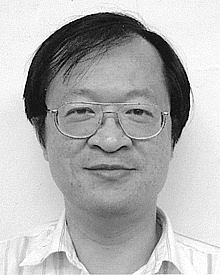 Sheng-Jye Hwang合作论文数Dept Mech Engn, Natl Cheng Kung Univ1
 Björn Stenger合作论文数Rakuten Institute of Technology;Rakuten Group, Inc.1
 Jiun-Ling Wang合作论文数E-Da Hospital, I-Shou University1
 Chao-Chun Chen (陳朝鈞)合作论文数Computational Intelligence and loT Lab, Institute of Manufacturing Information and Systems, College of Electrical Engineering and Computer Science, National Cheng-Kung University1
 C. Robert Kao合作论文数Department of Materials Science and Engineering, National Taiwan University1




