Learning from nature for tissue and organ repair remains an enduring theme in the life sciences. In particular, engineering artificial bone that mimics the natural bone tissue for the treatment of bone defects remains a significant challenge. Inspired by the hierarchical architecture and multifunctionality of natural bone, we constructed a ZrO2-GelMA-MgO@ZIF-8 (ZrO2-G-M@Z) biomimetic scaffold. The design, preparation, and both in vitro and in vivo experimental results of this study indicated that the porous ZrO2 serves as a biomimetic rigid skeleton, providing space-maintaining structural stability; GelMA hydrogel networks, simulating flexible collagen fibers, provide desirable cell affinity; and MgO@ZIF-8 core-shell nanoparticles enable the programmable release of Mg2+ and Zn2+ ions to promote osteoinduction, vascularization and sequential immunomodulation. This study further showed that the synergistic dual release of Zn2+ and Mg2+ promotes macrophage polarization from the M0 to M1-like phenotype and subsequently to M2-like phenotype, thereby providing a stage-adaptive immune niche for bone repair. This study offers a promising material design strategy for bone regeneration by coupling structural maintenance with sequential immune-osteogenic regulation.
Abstract The Bacterial_Exotoxin_B family constitutes translocating pore-forming proteins that function as the binding (B) component in the binary AB Toxin mechanism. While the two-component system of the family is consistent among well-characterised members, the single-component Vpb4 subclass from entomopathogenic Bacillus thuringiensis challenges this dogma. Here, through single-particle cryo-electron microscopy, we elucidate the inserted pore structure of a Vpb4 member, Vpb4Aa2, at 2.2 Å resolution. The structure reveals distinguishing features from other family members: missing molecular bottleneck and neutrally charged β-barrel. Accordingly, preliminary electrophysiology studies show greater ion flux by Vpb4Aa2 compared to archetypal family member, PA. Through our findings, structure-guided database search allows identification of putative Vpb4-like proteins, which suggest a broader class of single-component proteins within the larger family. This provides mechanistic understanding of the differences between independent pores and translocating pores, with implications in the agricultural industry for screening and identification of future pest control candidates.
We combined in silicomodelling with fully genetically encoded strain promoted azide-alkyne cycloaddition, to construct bespoke protein dimers. Using fluorescent proteins GFP and Venus as models, homo and heterodimers were constructed that switched ON once assembled and displayed enhanced spectral properties. The determined molecular structure reveals long range polar bond networks involving amino acids and structured water molecules play a key role in activation and functional enhancement by directly linking the two functional centres. Single molecule analysis revealed the dimer is more resistant to photobleaching spending longer times in the ON state with only one CRO likely to be active at any one time. Thus, genetically encoded bioorthogonal chemistry can be used beyond simple passive linkage approaches to generate new and truly integrated protein complexes that form long range bonds networks, which have a profound effect on function and our understanding of fluorescent protein function.
Functional integration of proteins with carbon-based nanomaterials such as nanotubes holds great promise in emerging electronic and optoelectronic applications. Control over protein attachment poses a major challenge for consistent and useful device fabrication, especially when utilizing single/few molecule properties. Here, we exploit genetically encoded phenyl azide photochemistry to define the direct covalent attachment of three different proteins, including the fluorescent protein GFP, to carbon nanotube side walls. Single molecule fluorescence revealed that on attachment to SWCNTs GFP’s fluorescence changed in terms of intensity and improved resistance to photobleaching; essentially GFP is fluorescent for much longer on attachment. The site of attachment proved important in terms of electronic impact on GFP function, with the attachment site furthest from the functional center having the larger effect on fluorescence. Our approach provides a versatile and general method for generating intimate protein-CNT hybrid bioconjugates. It can be potentially applied easily to any protein of choice; attachment position and thus interface characteristics with the CNT can easily be changed by simply placing the phenyl azide chemistry at different residues by gene mutagenesis. Thus, our approach will allow consistent construction and modulate functional coupling through changing the protein attachment position.
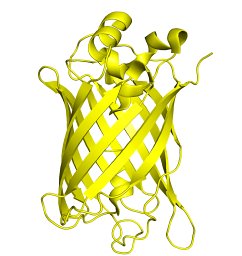
Fluorescent proteins (FPs) are a crucial tool for cell imaging, but with developments in fluorescence microscopy and researcher requirements there is still a need to develop brighter versions that remain fluorescent for longer. Using short time-scale molecular dynamics-based modelling to predict changes in local chromophore interaction networks and solvation, we constructed an Aequorea victoria GFP (avGFP) variant called YuzuFP that is 1.5 times brighter than the starting superfolding variant (sfGFP) with a near 3-fold increased resistance to photobleaching in situ. YuzuFP contained a single mutation that replaces the chromophore interacting residue H148 with a serine. Longer time scale molecular dynamics revealed the likely mechanism of action is S148 makes more persistent polar interactions with the chromophore phenol group and increases the residency time of an important water molecule. As demonstrated by live cell imaging, YuzuFP not only offers a timely upgrade as a useful green-yellow avGFP for cell imaging applications over longer timescales, but it also provides a basic scaffold for future avGFP engineering efforts. ### Competing Interest Statement The authors have declared no competing interest.
Fluorescent proteins (FPs) are a crucial tool for cell imaging, but with developments in fluorescence microscopy and researcher requirements there is still a need to develop brighter versions that remain fluorescent for longer. Using short time-scale molecular dynamics-based modelling to predict changes in local chromophore interaction networks and solvation, we constructed an Aequorea victoria GFP (avGFP) variant called YuzuFP that is 1.5 times brighter than the starting superfolding variant (sfGFP) with a near 3-fold increased resistance to photobleaching in situ. YuzuFP contained a single mutation that replaces the chromophore interacting residue H148 with a serine. Longer time scale molecular dynamics revealed the likely mechanism of action: S148 forms more persistent H-bond with the chromophore phenolate group and increases the residency time of an important water molecule. As demonstrated by live cell imaging, YuzuFP not only offers a timely upgrade as a useful green-yellow avGFP for cell imaging applications over longer time scales, but it also provides a basic scaffold for future avGFP engineering efforts.
We perform computer simulations of an agglomeration process for monodisperse and polydisperse systems of spherical particles in a cylindrical container, using a simplified stochastic-hydrodynamic model. We consider a ternary system with three particle types A, B, and C, in which only connections of the type A - B can be forged, while any other connections with particles of the same type or with C-particles are forbidden, and for comparison a binary system with two particle types A and C, in which only connections of the type A - A can be formed. We study the breakdown of the percolation in the agglomeration at the bottom of the cylinder with an increasing fraction of C-particles.
Droplet Interface Bilayers (DIBs) constitute a commonly used model of artificial membranes for synthetic biology research applications. However, their practical use is often limited by their requirement to be surrounded by oil. Here we demonstrate in-situ bilayer manipulation of submillimeter, hydrogel-encapsulated droplet interface bilayers (eDIBs). Monolithic, Cyclic Olefin Copolymer/Nylon 3D-printed microfluidic devices facilitated the eDIB formation through high-order emulsification. By exposing the eDIB capsules to varying lysophosphatidylcholine (LPC) concentrations, we investigated the interaction of lysolipids with three-dimensional DIB networks. Micellar LPC concentrations triggered the bursting of encapsulated droplet networks, while at lower concentrations the droplet network endured structural changes, precisely affecting the membrane dimensions. This chemically-mediated manipulation of enclosed, 3D-orchestrated membrane mimics, facilitates the exploration of readily accessible compartmentalized artificial cellular machinery. Collectively, the droplet-based construct can pose as a chemically responsive soft material for studying membrane mechanics, and drug delivery, by controlling the cargo release from artificial cell chassis. Droplet interface bilayers can be used as a model of artificial membranes for synthetic biology and drug delivery applications, however, their accessibility using non-invasive techniques remains challenging. Here, the authors develop an in-situ bilayer manipulation of encapsulated droplet interface bilayers in hydrogel capsules, generated by high-order emulsification in monolithic 3D-printed microfluidic devices.
One of the open questions regarding the origin of life is the problem how macromolecules could be created. One possible answer is the existence of autocatalytic sets in which some macromolecules mutually catalyze each other’s formation. This mechanism is theoretically described in the Kauffman model. We introduce and simulate an extension of the Kauffman model, in which ligation and cleavage reactions are spatially separated in different containers connected by diffusion, and provide computational results for instances with and without autocatalytic sets, focusing on the time evolution of the densities of the various molecules. Furthermore, we study the rich behavior of a randomly generated instance containing an autocatalytic metabolism, in which molecules are created by ligation processes and destroyed by cleavage processes and vice versa or generated and destroyed both by ligation processes.
Living systems do not operate in solitude, rather, intimate intercellular communication regulates and coordinates their behavior. Yet, studying cell-cell interactions is challenging due to the demands of recreating the biological membrane complexity and interfacing with biophysical measurement tools. The study of current models is usually unable to capture the dynamic intermembrane communication encountered in living cells.We present the development of an artificial double membrane system, a synapse-like architecture, comprised of an encapsulated giant unilamellar vesicle (GUV) and a droplet interface bilayer (DIB), interlinked by cholesterol-tethered DNA interactions.
Microfluidic-microwave devices (MMDs) have emerged as precision tools for the rapid, accurate, sensitive, and non-invasive characterisation of liquids in low-volumes. However, the fabrication of MMDs remains a significant challenge. This is due to the complexities associated with integrating fluidic ducts and electronic components. Herein, we present a versatile and economical 3D-printing approach using ducts filled with liquid metal as an electrical conductor. Cyclic olefin copolymer, polylactic acid, and polypropylene were identified as printable dielectric materials for MMD fabrication. Substrates of 3D-printed cyclic olefin copolymer exhibited the lowest loss tangent (0.002 at 2.7 GHz), making them suitable materials for high-frequency microwave devices. Liquid metal, specifically gallium-indium eutectic, was injected into the printed ducts to form electrically conductive microwave structures. Exemplary MMDs operating at 2 GHz integrated split-ring microwave resonators that serve as sensitive detection geometries able to measure changes in dielectric properties, with droplet-forming fluidic junctions and flow channels. The performance of 3D-printed MMDs for microwave droplet sensing was comprehensively evaluated. These devices were used in the formation and characterisation of water-in-oil emulsions, constructing definable lipid-segregated droplet interface bilayer (DIB) networks. This work indicates the feasibility of using 3D-printed manifolds for the rapid prototyping of customised MMDs, and also demonstrates the potential of MMDs as new analytical research tools in droplet-based materials and biochemistry studies. A 3D-printed microwave-microfluidic device using a liquid metal resonator for droplet network formation and characterisation.
The development of low-cost accessible technologies for rapid prototyping of mechanical components has democratised engineering tools for hobbyists and researchers alike. The development of analogous approaches to fabrication of soft-matter, and biologically compatible materials containing living cells, is anticipated to be similarly enabling across multiple fields of biological research. LEGO toy construction bricks represent low-cost, precision engineered, and versatile construction materials for rapid prototyping. This study demonstrates construction of a benchtop LEGO 3D bioprinter for additive layer manufacture of a 3D structure containing viable human skin cells within a hydrogel scaffold. 3D bioprinted structures are formed from the deposition of microfluidically generated bio-ink droplets containing live keratinocyte skin cells, representing components toward an artificial skin model. Fluid flow rates and printer speed, together with bio-ink gelation rate, determine droplet packing arrangement in the bioprinted structures. The printing of 3D structures containing multiple bio-inks is demonstrated and live cells are imaged in the resulting bioprints. Fluid delivery can be achieved using LEGO pumps and readily available, or home-3D-printed, microfluidic components, therefore avoiding the need for any specialist microfluidic hardware. Build instructions are described to enable easy uptake, modification and improvement by other laboratories, as well provide an accessible platform for learning and education. Affordable, accessible, and easy to use tools for 3D bioprinting are anticipated to open opportunities for a greater number of research labs to work with 3D cell culture and bio-printed materials, with bioprinting expected to assist in better understanding of disease, contribute to tissue engineering and repair, and enable personalised medicine through the printing of cultured patient cells. The presented approach is not only an easily accessible laboratory tool for bioprinting, but also provides a learning system for mechanical construction, robotics, coding, microfluidics and cell biology, making it a versatile platform for research, education, and science engagement.
We simulate the movement and agglomeration of oil droplets in water under constraints, using a simplified stochastic-hydrodynamic model. We analyze both local and global properties of the networks formed by the agglomerations of droplets for various system sizes. We focus on the differences of these properties for monodisperse and polydisperse systems of droplets. For the mean degree, we obtain different values for critical exponents.
Experimentally, periodically released droplets in systems of widening pipes show clustering. This is surprising, as purely hydrodynamic interactions are repulsive so that agglomeration should be prevented. In the main part of this paper, we investigate the clustering of droplets under the influence of phenomenological hydrostatic forces and some hypothetical attraction. In two appendices, we explain why a direct numerical simulation for this system is rather more difficult (and probably not possible with current methods) than the “simple” geometry would suggest.
The COVID-19 pandemic demonstrated the need for rapid molecular diagnostics. Vaccination programs can provide protection and facilitate the opening of society, but newly emergent and existing viral variants capable of evading the immune system endanger their efficacy. Effective surveillance for Variants of Concern (VOC) is therefore important. Rapid and specific molecular diagnostics can provide speed and coverage advantages compared to genomic sequencing alone, benefitting the public health response and facilitating VOC containment. Here we expand the recently developed SARS-CoV-2 CRISPR-Cas detection technology (SHERLOCK) to provide rapid and sensitive discrimination of SARS-CoV-2 VOCs that can be used at point of care, implemented in the pipelines of small or large testing facilities, and even determine the proportion of VOCs in pooled population-level wastewater samples. This technology complements sequencing efforts to allow facile and rapid identification of individuals infected with VOCs to help break infection chains. We show the optimisation of our VarLOCK assays (Variant-specific SHERLOCK) for multiple specific mutations in the S gene of SARS-CoV-2 and validation with samples from the Cardiff University Testing Service. We also show the applicability of VarLOCK to national wastewater surveillance of SARS-CoV-2 variants and the rapid adaptability of the technique for new and emerging VOCs.
Whilst it is highly desirable to produce artificial lipid bilayer arrays allowing for systematic high-content screening of membrane conditions, it remains a challenge due to the combined requirements of scaled membrane production, simple measurement access, and independent control over individual bilayer experimental conditions. Here, droplet bilayers encapsulated within a hydrogel shell are output individually into multi-well plates for simple, arrayed quantitative measurements. The afforded experimental throughput is used to conduct a 2D concentration screen characterising the synergistic pore-forming peptides Magainin2 and PGLa. Maximal enhanced activity is revealed at equimolar peptide concentrations via a membrane dye leakage assay, a finding consistent with models proposed from NMR data. The versatility of the platform is demonstrated by performing in situ electrophysiology, revealing low conductance pore activity (∼15 to 20 pA with 4.5 pA sub-states). In conclusion, this array platform addresses the aforementioned challenges and provides new and flexible opportunities for high-throughput membrane studies. Furthermore, the ability to engineer droplet networks within each construct paves the way for “lab-in-a-capsule” approaches accommodating multiple assays per construct and allowing for communicative reaction pathways.
Within the scope of the European Horizon 2020 project ACDC – Artificial Cells with Distributed Cores to Decipher Protein Function , we aim at the development of a chemical compiler governing the three-dimensional arrangement of droplets, which are filled with various chemicals. Neighboring droplets form bilayers with pores which allow chemicals to move from one droplet to its neighbors. With an appropriate three-dimensional configuration of droplets, we can thus enable gradual biochemical reaction schemes for various purposes, e.g., for the production of macromolecules for pharmaceutical purposes. In this paper, we demonstrate with artificial chemistry simulations that the ACDC technology is excellently suitable to maximize the yield of desired reaction products or to minimize the relative output of unwanted side products.
Intracellular compartments are functional units that support the metabolism within living cells, through spatiotemporal regulation of chemical reactions and biological processes. Consequently, as a step forward in the bottom-up creation of artificial cells, building analogous intracellular architectures is essential for the expansion of cell-mimicking functionality. Herein, we report the development of a droplet laboratory platform to engineer complex emulsion-based, multicompartment artificial cells, using microfluidics and acoustic levitation. Such levitated models provide free-standing, dynamic, definable droplet networks for the compartmentalisation of chemical species. Equally, they can be remotely operated with pneumatic, heating, and magnetic elements for post-processing, including the incorporation of membrane proteins; alpha-hemolysin; and mechanosensitive channel of large-conductance. The assembly of droplet networks is three-dimensionally patterned with fluidic input configurations determining droplet contents and connectivity, whilst acoustic manipulation can be harnessed to reconfigure the droplet network in situ. The mechanosensitive channel can be repeatedly activated and deactivated in the levitated artificial cell by the application of acoustic and magnetic fields to modulate membrane tension on demand. This offers possibilities beyond one-time chemically mediated activation to provide repeated, non-contact, control of membrane protein function. Collectively, this expands our growing capability to program and operate increasingly sophisticated artificial cells as life-like materials.
Microfluidic droplet generation affords precise, low volume, high throughput opportunities for molecular diagnostics. Isothermal DNA amplification with bioluminescent detection is a fast, low-cost, highly specific molecular diagnostic technique that is triggerable by temperature. Combining loop-mediated isothermal nucleic acid amplification (LAMP) and bioluminescent assay in real time (BART), with droplet microfluidics, should enable high-throughput, low copy, sequence-specific DNA detection by simple light emission. Stable, uniform LAMP-BART droplets are generated with low cost equipment. The composition and scale of these droplets are controllable and the bioluminescent output during DNA amplification can be imaged and quantified. Furthermore these droplets are readily incorporated into encapsulated droplet interface bilayers (eDIBs), or artificial cells, and the bioluminescence tracked in real time for accurate quantification off chip. Microfluidic LAMP-BART droplets with high stability and uniformity of scale coupled with high throughput and low cost generation are suited to digital DNA quantification at low template concentrations and volumes, where multiple measurement partitions are required. The triggerable reaction in the core of eDIBs can be used to study the interrelationship of the droplets with the environment and also used for more complex chemical processing via a self-contained network of droplets, paving the way for smart soft-matter diagnostics.
 William David Jamieson合作论文数Department of Biology and Biochemistry, University of Bath24
 David a Barrow合作论文数18
 Jin Li合作论文数11
 Christopher J. Allender合作论文数11
 Mark Ian Wallace合作论文数Department of Primary Care Health Sciences, University of Oxford10
 David Anthony Barrow合作论文数8
 Divesh K. Baxani合作论文数7
 Pantelitsa Dimitriou合作论文数Sch Engn, Cardiff Univ7
 D. Dafydd Jones合作论文数Sch Biosci, Cardiff Univ6
 Johannes J. Schneider合作论文数Institute of Physics;Johannes Gutenberg;University of Mainz;Institute of Physics|Johannes Gutenberg, University of Mainz6Lorena Cebolla Sanahuja合作论文数5Federica Casiraghi合作论文数5Aitor Patiño Diaz合作论文数5Mathias S. Weyland合作论文数5
 Silvia Holler合作论文数University of Trento5Dandolo Flumini合作论文数5
 Alessia Faggian合作论文数Regional Center for Biomarkers, Department of Clinical Pathology and Transfusion Medicine, Azienda ULSS 3 Serenissima, SS Giovanni e Paolo Regional Hospital, Campo SS Giovanni e Paolo 6777, 30122 Venice (VE),Italy5Hans-Georg Matuttis合作论文数5
 Martin M. Hanczyc合作论文数Lab Artificial Biol, Univ Trento5
 Rudolf M. Füchslin合作论文数Zurich University of Applied Sciences5Peter Eggenberger Hotz合作论文数5
 Husam Sabah Auhim合作论文数College of Science, University of Baghdad4Wen Xu合作论文数4Harley Luke Worthy合作论文数4
 Patricia M Dijkman合作论文数Department of Biochemistry, University of Oxford4
 Pierre Rizkallah合作论文数Department of Infection, Immunity and Biochemistry, Cardiff University4Alan Goddard合作论文数4Daniel W. Watkins合作论文数3
 Rachel L Johnson合作论文数3
 Jacob Pope合作论文数3
 Adnan Masood合作论文数3Gross Linda C M合作论文数3
 Adrian Porch合作论文数School of Electronic and Electrical Engineering, University of Birmingham3Bríd Cronin合作论文数3
 Rochelle Ahmed合作论文数2
 Anthony Watts合作论文数Biochem Dept, Univ Oxford2
 Benjamin Bowen合作论文数2
 alex j l morgan合作论文数Cardiff Sch Engn, Cardiff Univ2Aaron Wall合作论文数2
 Suzanne K Thomas合作论文数Swansea University, Swansea, United Kingdom2
 Martin - Elliott合作论文数Sch Social Sci, Cardiff Univ2Berridge James合作论文数2
 Jim Murray合作论文数School of Biosciences, Cardiff University2
 Kailasam Senthilkumar合作论文数2
 Patrick Hardinge合作论文数2
 J. Emyr Macdonald合作论文数Sch Phys & Astron, Cardiff Univ2
 Victoria Garcia Rocha合作论文数Department of Chemistry of Materials, Instituto Nacional del Carbón2
 Chris De Graaf合作论文数Department of Pharmacochemistry, Vrije Universiteit2Richard Stanton合作论文数1




