Improving the efficacy of lower extremity rehabilitation/training strategies holds significant importance in expediting patient recovery. Our system integrates diverse methodologies, including synthesizing walking motions, analyzing joint kine-matics, reconstructing musculoskeletal models, and conducting dynamic assessments, to design user-centric gait patterns tai-lored to individual rehabilitation needs. This integration leads to natural gait patterns that are finely tuned to enhance the patient's rehabilitation progress. Furthermore, our platform offers a customized rehabilitation approach, empowering medical professionals to design and adapt personalized rehabilitation plans according to each patient's unique requirements.
Since the emergence of ChatGPT, research on large language models (LLMs) has actively progressed across various fields. LLMs, pre-trained on vast text datasets, have exhibited exceptional abilities in understanding natural language and planning tasks. These abilities of LLMs are promising in robotics. In general, traditional supervised learning-based robot intelligence systems have a significant lack of adaptability to dynamically changing environments. However, LLMs help a robot intelligence system to improve its generalization ability in dynamic and complex real-world environments. Indeed, findings from ongoing robotics studies indicate that LLMs can significantly improve robots’ behavior planning and execution capabilities. Additionally, vision-language models (VLMs), trained on extensive visual and linguistic data for the vision question answering (VQA) problem, excel at integrating computer vision with natural language processing. VLMs can comprehend visual contexts and execute actions through natural language. They also provide descriptions of scenes in natural language. Several studies have explored the enhancement of robot intelligence using multimodal data, including object recognition and description by VLMs, along with the execution of language-driven commands integrated with visual information. This review paper thoroughly investigates how foundation models such as LLMs and VLMs have been employed to boost robot intelligence. For clarity, the research areas are categorized into five topics: reward design in reinforcement learning, low-level control, high-level planning, manipulation, and scene understanding. This review also summarizes studies that show how foundation models, such as the Eureka model for automating reward function design in reinforcement learning, RT-2 for integrating visual data, language, and robot actions in vision-language-action models, and AutoRT for generating feasible tasks and executing robot behavior policies via LLMs, have improved robot intelligence.
This paper aims to enhance the Analytic Hierarchy Process (AHP)-based path planning algorithm by addressing some of its shortcomings. Existing algorithms both struggle to identify optimal paths and lack a systematic approach for constructing relative importance matrices (RMs). To remedy this, the proposed AAHP method integrates the A* algorithm to enhance path efficiency and incorporates robot sensor detection to systematically determine the optimal RM, unlike the existing AHP method. The performance of the proposed algorithm was evaluated by comparing the navigation performance of the existing AHP method, AAHP without A*, and AAHP in various scenarios. Simulation results demonstrate the AAHP's superiority over existing methods in terms of distance and rotation, ultimately highlighting its efficiency in path planning.
This study proposes a sensor data process and motion control method for a mobile platform essential for transporting finished products or subsidiary materials in a smart factory. We developed a system that recognizes a fiducial marker printed on the work clothes worn by a worker, estimates the worker’s location, and follows the worker using the estimated location. To overcome the limitations of simulation-based research, gait data on a two-dimensional plane were derived through a human gait model and an error model according to the distance between the image sensor and the reference marker. The derived gait data were defined as the localization result for the worker, and a Kalman filter was used to robustly address the uncertainty of the localization result. A virtual spring-damper system was applied to follow the Mecanum wheel-based mobile platform workers. The performance of the proposed algorithm was demonstrated through comparative simulations with existing methods.
The rise of smart factories and warehouses has ushered in an era of intelligent manufacturing, with autonomous robots playing a pivotal role. This study focuses on improving the navigation and control of autonomous forklifts in warehouse environments. It introduces an innovative approach that combines a modified Linear Segment with Parabolic Blends (LSPB) trajectory planning with Model Predictive Control (MPC) to ensure efficient and secure robot movement. To validate the performance of our proposed path-planning method, MATLAB-based simulations were conducted in various scenarios, including rectangular and warehouse-like environments, to demonstrate the feasibility and effectiveness of the proposed method. The results demonstrated the feasibility of employing Mecanum wheel-based robots in automated warehouses. Also, to show the superiority of the proposed control algorithm performance, the navigation results were compared with the performance of a system using the PID control as a lower-level controller. By offering an optimized path-planning approach, our study enhances the operational efficiency and effectiveness of Mecanum wheel robots in real-world applications such as automated warehousing systems.
In this study, a method of deriving the optimal control parameters in the design of an anti-sway controller for a patient transfer robot is proposed. Patient transfer robots are used in medical facilities to move patients who cannot move on their own. However, the sway that occurs in the process of moving a patient on a patient transfer robot not only threatens the patient’s safety, but also creates anxiety. To control such sways, this study proposes the analytic hierarchy process as a method for designing a controller that satisfies a given control specification and at the same time designing an optimal controller for various control gains. Simulation results demonstrate a control performance that satisfies the control specifications.
This study proposes a user's intuitive intention-based control system for mobile robot platforms. As an application of the control scheme, we focused on a robot that transports patients in medical facilities. However, since most of the people who operate the patient transfer robot (PTR) are not robotics experts, an intuitive control method is needed to enable easy operation of the robot system. Also minimizing the discomfort experienced by the patient in the process of transferring the patient through the patient transfer robot is another important issue to consider. Therefore, the main contributions of this are developing an intuitive user interface and proposing a sway reduction control scheme. To accomplish the first issue, the intuitive control is implemented by proposing a robot control interface, where four force-sensing resistor (FSR) sensors are installed on a robot's handle (where a user holds a robot). Through this, the robot can be easily moved with only a simple and intuitive operation of the user. Therefore forward, backward, left movement, right movement, left turn, and right turn operation can be controlled through the intuitive movement of the user input through the developed user interface. Additionally, in order to satisfy the second requirement, the patient's sway reduction strategy is suggested by applying fuzzy logic-based control command generation method to the user intention. Through this method, the sway that occurs during the movement of the robot is reduced. In this study, the mecanum wheel was applied to the driving platform of the patient transfer robot to enable omnidirectional movement. The performance of the proposed control method is verified through simulations and experiments. Simulation and experimental results confirm that the proposed method reduced the acceleration and jerk root mean square values of the robot compared to a comparison method.
We developed a sensitive and reliable thermal micro-flow sensor (T mu FS) to measure extremely low flow rates for a drug infusion system. The T mu FS exploits a calorimetric principle. Various temperature differences upstream and downstream of a heated area were monitored by three temperature sensors to enable measurement of both cooling and heating effects at the multiple temperature-sensing areas. The flow rate was measured by subtraction or summation of the temperature differences between selected locations upstream and downstream. The temperature differences between heat loss and diffusion increased sensitivity of flow rate detection in range of 0-100 mL/h. The T mu FS takes non-invasive and non-intrusive measurements by monitoring thermal variations on the outer surface of a silicone IV tube. The T mu FS could detect flow rates as low as similar to 0.1 mL/h, with uncertainty <5%. The micro-flow sensor was accurate at a range of flow rates, initial liquid temperature, and tube inner diameters. In addition, temperatures variations in the T mu FS for flow rates agreed with numerical simulation. (C) 2020 Elsevier B.V. All rights reserved.
In this paper, for the purpose of increasing the wafer yield by controlling the non-uniformity of the material removal rate during the chemical mechanical polishing process, the influence of the cross-sectional shape of the metal-inserted retainer ring and the pressure distribution on the wafer and the retainer ring generated from the multi-zone carrier head are investigated. First, in order to verify the finite element analysis model, it is correlated using the test data. By using a validated finite element model, simulation studies involving several parameters are performed to reduce the irregularity in the wafer: (1) tapered bottom of the retainer ring, (2) machining round corners at the bottom of the retainer ring, (3) the changes in pressure applied to the wafer, (4) the changes in pressure applied to the retainer ring.
This research presents a control structure for an omni-wheel mobile robot (OWMR). The control structure includes the path planning module and the motion control module. In order to secure the robustness and fast control performance required in the operating environment of OWMR, a bio-inspired control method, brain limbic system (BLS)-based control, was applied. Based on the derived OWMR kinematic model, a motion controller was designed. Additionally, an optimal path planning module is suggested by combining the advantages of A* algorithm and the fuzzy analytic hierarchy process (FAHP). In order to verify the performance of the proposed motion control strategy and path planning algorithm, numerical simulations were conducted. Through a point-to-point movement task, circular path tracking task, and randomly moving target tracking task, it was confirmed that the suggesting motion controller is superior to the existing controllers, such as PID. In addition, A*–FAHP was applied to the OWMR to verify the performance of the proposed path planning algorithm, and it was simulated based on the static warehouse environment, dynamic warehouse environment, and autonomous ballet parking scenarios. The simulation results demonstrated that the proposed algorithm generates the optimal path in a short time without collision with stop and moving obstacles.
This research presents the effect of the thermal boundary condition on the tilting pad journal bearing characteristics. The thermal boundary condition includes the temperature around the bearing pad, spinning journal, and lubricant supply temperature. Change in bearing performance according to the temperature around each element constituting the bearing was analyzed without paying attention to how the actual thermal boundary conditions around the bearing are configured. High fidelity numerical model of tilting pad journal bearing is presented for (1) the analysis of heat generation in the thin film, (2) heat transfer in the lubricant, (3) heat flux flowing into the journal and pad, (4) temperature change in the journal and bearing, (5) the resultant thermal deformation, (6) change in the lubricant film thickness arising from the thermal deformation of journal and bearing pads, and (7) the resulting change in the heat generation in the thin film. To reach the steady state of the bearing–journal system, the Runge–Kutta scheme with adaptive time step is adopted where the dynamic and thermal system are solved simultaneously in multi-physics model. Performance change of the bearing according to three changes: (a) boundary temperature around shaft, (b) boundary temperature around bearing pads, and (c) lubricant supply temperature were investigated.
Robotic prosthetic hands are a device that helps to improve the quality of life for patients without hands. Recently, robotic prosthetic hands can perform various grasping patterns because of improvement of bioengineering and robotics. The research that automatically selects the appropriate operation according to the situation is important. Many previous studies have used EMG signals. However, EMG signals are difficult to generalize because EMG signals vary depending on the position of the muscle. In this study, we developed a system for controlling robotic prosthetic hands using images and deep learning to facilitate generalization. We also proposed a method for selecting a grasping target to be held in the image. These results will help to improve the quality of life of the robotic prosthetic hand user.
This study presents a multi-robot navigation strategy based on a multi-objective decision-making algorithm, the Fuzzy Analytic Hierarchy Process (FAHP). FAHP analytically selects an optimal position as a sub-goal among points on the sensing boundary of a mobile robot considering the following three objectives: the travel distance to the target, collision safety with obstacles, and the rotation of the robot to face the target. Alternative solutions are evaluated by quantifying the relative importance of the objectives. As the FAHP algorithm is insufficient for multi-robot navigation, cooperative game theory is added to improve it. The performance of the proposed multi-robot navigation algorithm is tested with up to 12 mobile robots in several simulation conditions, altering factors such as the number of operating robots and the warehouse layout.
This study presents a new path planning method based on Fuzzy Analytic Hierarchy Process (FAHP) for a mobile robot to be effectively operated through a multi-objective decision making problem. Unlike typical AHP, the proposed FAHP has a difference in using triangulation fuzzy number based extent analysis to derive weight vectors among the considerations. FAHP framework for finding the optimal position in this study is defined with the highest level (goal), middle level (objectives), and the lowest level (alternatives). It analytically selects an optimal position as a sub-goal among points on the sensing boundary of the mobile robot considering the three objectives: the travel distance to the target, robot’s rotation, and safety against collision between obstacles. Alternative solutions are evaluated by quantifying the relative importance for the objectives. Comparative results obtained from the artificial potential field, AHP, and FAHP simulations show that FAHP is much preferable for mobile robot’s path planning than typical AHP.
Fully automated system for sample preparation in molecular diagnostics was developed. The small cartridge with multiple chambers and a rotating valve was designed for automated processes such as extraction, separation and purifications during the DNA sample preparation. The automated processes such as injection, mixing, capturing and valve on/off motions were controlled by an affordable, motorized control system. We demonstrated the automated DNA extraction of pathogenic bacteria using this system. The deviations in the purity and real-time polymerase chain reaction (PCR) detection of the automated DNA extraction samples were clearly decreased. The device provided rapid, reliable, and reproducible sample preparation in comparison with manual DNA extraction. This automated platform can be utilized in emergent point-of-care testing of infectious disease and foodborne bacteria.
The autonomous emergency braking system is one of advanced driving assist systems. It is an advanced safety function designed to prevent collision with a forward vehicle or a pedestrian in the event of driver’s carelessness or a sudden accident ahead. Because the AEB stops the vehicle with a maximum deceleration command at the last possible time to brake so that collision avoidance is possible, it can prevent a collision with a preceding vehicle. However, there are risks of a secondary collision with a trailing vehicle and injury to a passenger due to sharp deceleration. In addition, sudden braking control can present a driving feeling gap to the driver. These problems must be solved because they can amplify a user"s rejection of automatic emergency braking (AEB) and negatively affect the acceptability of this technology. In this study, the driver"s braking propensity is derived by means of deep learning and it is applied to a customized AEB system to prevent secondary accidents caused by sudden braking and to improve user acceptance. In order to derive a driver"s braking behavior, normal driving data and stationary target based braking test data are collected. Utilizing a deep neural network, the driver’s braking profile during ordinary driving and a sudden stop are extracted. The correlation between the two extracted driver’s braking behaviors is analyzed. This provides the means to derive sudden braking behavior as a function of driving speed, leading to customized AEB parameters.
Optimal design of transmission gears is important to ensure product durability and reliability. This study measured a multi-purpose cultivator during a rotary ditching operation and analyzed the strength of the power take off (PTO) gear-train for the cultivator using analysis software (KISSsoft, KISSsoft AG—A Gleason Company, Bubikon, Switzerland) based on ISO 6336 standards and a modified Miner’s rule. A load measurement system was installed on the cultivator to measure the load on the PTO shaft. To measure the load on the PTO shaft, the load measuring system consisting of a data acquisition board (NI USB-6212, National Instruments, Austin, TX, USA) and a torque sensor was installed on the cultivator. Rotary ditching operations were conducted at two ground speeds and two PTO rotational speeds on a field with the same soil conditions. The measured load data were constructed using the rainflow-counting algorithm and the Smith-Watson-Topper equation. When the ground speed or PTO rotational speed increased, the average and maximum PTO torque increased significantly. The average measured torque ratio to rated torque of the PTO input shaft (19.6 Nm) was in the range of 50.1–105.9%. The simulation results using the actual measurement load indicated that the strength of the PTO gear-train tended to decrease with higher transmission gear stage and lower PTO gear stage except for the G2 and G3 gears. The simulation results of the safety factor for contact stress were lower than the minimum safety factor of ‘1.0’ at the T2P1 gear stage (G4 and G2). The simulation results of the fatigue life analysis showed fatigue life of less than service life (1000 h) at T2P2 (G2) and T2P1 (G2, G3, and G4). The simulation results indicate that there is a possibility of gear failure before service life at the T2P1 (G2, G3, and G4) and T2P2 (G2). It is known that the weak parts (G2, G3, and G4) should be the focus of design optimization through gear strength simulation to meet upward of a 1.0 safety factor and service life.
 Oh-Won Kwon合作论文数12
 Reza Langari合作论文数J. Mike Walker '66 Department ofMechanical Engineering, College of Engineering, Texas A&M University11
 Joonho Seo合作论文数Department of Civil and Environmental Engineering, Korea Advanced Institute of Science and Technology8
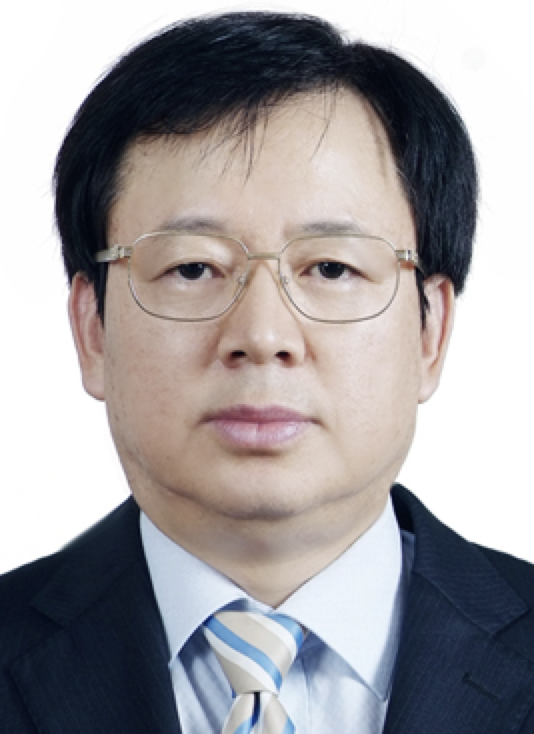 Keum-Shik Hong (洪金植)合作论文数Department of Cogno-Mechatronics Engineering, School of Mechanical Engineering, Pusan National University;Integrated Dynamics and Control Engineering Laboratory, Pusan National University;Cogno-Mechatronics Laboratory, Pusan National University8
 Dong-kyu Lee合作论文数7
 Yeesock Kim合作论文数Zachry Department of Civil Engineering, Texas A&M University6Hahn Park合作论文数5Hak Yi合作论文数4
 Je-Heon Han合作论文数Department of Mechanical Engineering, Tech University of Korea3
 Gabriel Lodewijks合作论文数School of Engineering, University of New South Wales3
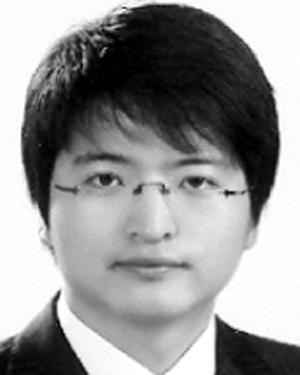 Kangho Lee合作论文数3Jang Ho Cho合作论文数2Haejune Park合作论文数2
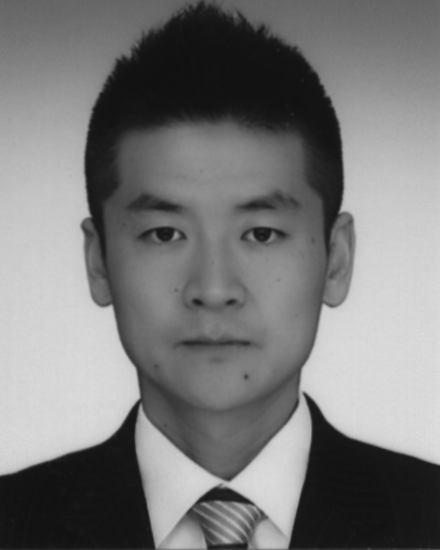 Suwoong Lee合作论文数Korea Inst Ind Technol, Mechatron Technol Convergence Grp, Daegu, South Korea2
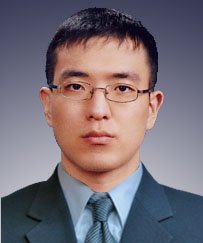 Junho Suh合作论文数Sch Mech Engn, Pusan Natl Univ2
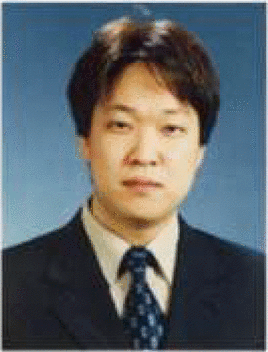 Yong-Joo Kim合作论文数2
 Seonghwan Kim合作论文数Dept Mech & Mfg Engn, Univ Calgary2
 Rolf Isermann合作论文数Institute of Automatic Control and Mechatronics, Technical University of Darmstadt;Control and Cyber-Physical Systems Laboratory, Technical University of Darmstadt2Carlo Ackermann合作论文数2
 Kyung-Chang Lee合作论文数1Shamanth Shanmuga Prasad合作论文数1Young-Jun Park合作论文数1Jake Edmond Hughes合作论文数1soonjung hong合作论文数1Hee Kyung An合作论文数1Jongsu Yun合作论文数1Youngwoo Kim合作论文数1Jeong-Hoon Jang合作论文数1Jong-il Lee合作论文数1Hyeongrok Yoo合作论文数1wonki chun合作论文数1Junmin Baek合作论文数1Kang-Hyun Ye合作论文数1Bohyeon An合作论文数1Soo Yeon Kim合作论文数1Pa-Ul Lee合作论文数1
 Jaewoo Park合作论文数Yonsei University, Yonsei University1
 Sungtae Shin合作论文数Department of Mechanical Engineering, Dong-A University1
 Wan-Soo Kim合作论文数Dept Biosyst Machinery Engn, Chungnam Natl Univ1
 Inseok Chae合作论文数Biological Systems and Engineering, Lawrence Berkeley National Laboratory1Bo Ram Cho合作论文数Korea Inst Ind Technol, Mechatron Technol Convergence Grp, Daegu, South Korea1
 Kim Sungmin合作论文数1
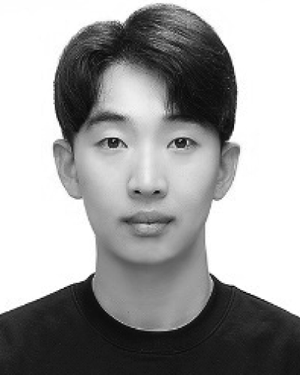 Yangkyu Park合作论文数1
 Lee Kyeong-Hwan合作论文数Agricultural Robotics and Automation Research Center, Chonnam National University1
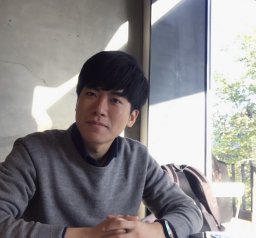 Joo Su-Bin合作论文数1
 Umberto Berardi合作论文数Politecnico di Bari;Berardi Consulting1
 Min Woo Lee合作论文数Department of Radiology and Center for Imaging Science, Samsung Medical Center1Taeho Kim合作论文数1
 Thomas Thundat合作论文数Department of Chemical and Biological Engineering, School of Engineering and Applied Sciences, University at Buffalo, The State University of New York;Department of Chemical and Biological Engineering, University of Alberta;Shanghai Jiao Tong University1




