Large-scale text-to-image generative models have demonstrated remarkable success in generating diverse and high-quality faces. However, current methods for face editing often unintentionally modify facial features that are intended to be preserved. Multi-step denoising methods necessitate storing multi-step gradients, leading to considerable time and memory consumption. In this study, we propose FASTER(Face Attribute Sliders wiTh sEmantic Rewards), an effective method that employs stable diffusion models for face attribute editing. The key idea is to identify a low-rank attribute editing direction by leveraging attribute reward and S-CLIP reward between the original face and the edited face. This process helps to establish the desired face attribute slider. To acquire the edited face, we introduce an efficient one-step reward technique by utilizing denoised results at random timesteps for learning. This technique reduces training time by 6x. FASTER achieves 98.67% editing accuracy while simultaneously improving attribute preservation by nearly 10% compared to other methods on the CelebA-HQ dataset, all without compromising identity information.
Multi-view classification (MVC) faces inherent challenges due to domain gaps and inconsistencies across different views, often resulting in uncertainties during the fusion process. While Evidential Deep Learning (EDL) has been effective in addressing view uncertainty, existing methods predominantly rely on the Dempster-Shafer combination rule, which is sensitive to conflicting evidence and often neglects the critical role of neighborhood structures within multi-view data. To address these limitations, we propose a Trusted Unified Feature-NEighborhood Dynamics (TUNED) model for robust MVC. This method effectively integrates local and global feature-neighborhood (F-N) structures for robust decision-making. Specifically, we begin by extracting local F-N structures within each view. To further mitigate potential uncertainties and conflicts in multi-view fusion, we employ a selective Markov random field that adaptively manages cross-view neighborhood dependencies. Additionally, we employ a shared parameterized evidence extractor that learns global consensus conditioned on local F-N structures, thereby enhancing the global integration of multi-view features. Experiments on benchmark datasets show that our method improves accuracy and robustness over existing approaches, particularly in scenarios with high uncertainty and conflicting views.
Text-video retrieval aims to find the most relevant cross-modal samples for a given query. Recent methods focus on modeling the whole spatial-temporal relations. However, since video clips contain more diverse content than captions, the model aligning these asymmetric video-text pairs has a high risk of retrieving many false positive results. In this paper, we propose Probabilistic Token Aggregation (ProTA) to handle cross-modal interaction with content asymmetry. Specifically, we propose dual partial-related aggregation to disentangle and re-aggregate token representations in both low-dimension and high-dimension spaces. We propose token-based probabilistic alignment to generate token-level probabilistic representation and maintain the feature representation diversity. In addition, an adaptive contrastive loss is proposed to learn compact cross-modal distribution space. Based on extensive experiments, ProTA achieves significant improvements on MSR-VTT (50.9%), LSMDC (25.8%), and DiDeMo (47.2%).
Recent text-to-image (T2I) synthesis models have demonstrated intriguing abilities to produce high-quality images based on text prompts. However, current models still face Text-Image Misalignment problem (e.g., attribute errors and relation mistakes) for compositional generation. Existing models attempted to condition T2I models on grounding inputs to improve controllability while ignoring the explicit supervision from the layout conditions. To tackle this issue, we propose Grounded jOint lAyout aLignment (GOAL), an effective framework for T2I synthesis. Two novel modules, discriminative semantic alignment (DSAlign) and masked attention alignment (MAAlign), are proposed and incorporated in this framework to improve the text-image alignment. DSAlign leverages discriminative tasks at the region-wise level to ensure low-level semantic alignment. MAAlign provides high-level attention alignment by guiding the model to focus on the target object. We also build a dataset GOAL2K for model fine-tuning, which composes 2000 semantically accurate image-text pairs and their layout annotations. Comprehensive evaluations on T2I-Compbench, NSR-1K, and Drawbench demonstrate the superior generation performance of our method. Especially, there are improvements of 19%, 13%, and 12% in color, shape, and texture metrics for T2I-Compbench. Additionally, Q-Align metrics demonstrate that our method can generate images of higher quality.
Video Moment Retrieval, which aims to locate in-context video moments according to a natural language query, is an essential task for cross-modal grounding. Existing methods focus on enhancing the cross-modal interactions between all moments and the textual description for video understanding. However, constantly interacting with all locations is unreasonable because of uneven semantic distribution across the timeline and noisy visual backgrounds. This paper proposes a cross-modal Context Denoising Network (CDNet) for accurate moment retrieval by disentangling complex correlations and denoising irrelevant dynamics.Specifically, we propose a query-guided semantic disentanglement (QSD) to decouple video moments by estimating alignment levels according to the global and fine-grained correlation. A Context-aware Dynamic Denoisement (CDD) is proposed to enhance understanding of aligned spatial-temporal details by learning a group of query-relevant offsets. Extensive experiments on public benchmarks demonstrate that the proposed CDNet achieves state-of-the-art performances.
Existing Video Temporal Grounding (VTG) models excel in accuracy but often overlook open-world challenges posed by open-vocabulary queries and untrimmed videos. This leads to unreliable predictions for noisy, corrupted, and out-of-distribution data. Adapting VTG models to dynamically estimate uncertainties based on user input can address this issue. To this end, we introduce SRAM, a robust network module that benefits from a two-stage cross-modal alignment task. More importantly, it integrates Deep Evidential Regression (DER) to explicitly and thoroughly quantify uncertainty during training, thus allowing the model to say "I do not know" in scenarios beyond its handling capacity. However, the direct application of traditional DER theory and its regularizer reveals structural flaws, leading to unintended constraints in VTG tasks. In response, we develop a simple yet effective Geom-regularizer that enhances the uncertainty learning framework from the ground up. To the best of our knowledge, this marks the first successful attempt of DER in VTG. Our extensive quantitative and qualitative results affirm the effectiveness, robustness, and interpretability of our modules and the uncertainty learning paradigm in VTG tasks. The code will be made available.
Pre-trained models have demonstrated considerable performance, especially in enhancing cross-modal understanding between videos and text. However, fine-tuning them at scale becomes costly and poses challenges for adapting to various downstream tasks. To tackle these challenges, we propose the Alignment-generation Adapter (AGAdapter), establishing semantic coherence between alignment and generation models for efficient video-text adaptation across multiple tasks simultaneously. We propose an alignment adapter with knowledge-sharing to adapt the frozen CLIP model for fine-grained video-language interaction. Additionally, we introduce the generation adapter with prompt tuning to leverage the large language model for captioning. Furthermore, we introduce instruction joint tuning, combining textual and cross-modal instructions, to capture detailed descriptions. Our AGAdapter achieves state-of-the-art performance on video-text retrieval and video captioning tasks, including two benchmarks, MSR-VTT and ActivityNet.
This paper investigates a baseline approach for text-based person search by using a transformer-based framework. Existing methods usually treat the visual and textual features as independent entities for speeding up the model inference process. However, the attention to the same images should be changed according to different texts. In this paper, we use a commonly employed framework with a fused feature as the baseline, which overcomes the misalignment problem introduced by fixed features. A thorough investigation is conducted in this paper. Moreover, we propose Cross-View Matching (CVM) to provide challenging, positive text-image pairs that enable the model to learn cross-view meta-information. Furthermore, we suggest a novel evaluation process to reduce the inference time and GPU memory demand. The experiments are conducted on CUHK-PEDES, ICFG-PEDES, and RSTPReid benchmarks. Through extensive parameter analysis, the potentials of a transformer-based framework are fully explored. Although the proposed scheme is a simple framework, it achieves significant performance improvements compared with other state-of-the-art methods.
Recent studies have explored the potential of large language models (LLMs) for understanding the semantic information in images. However, the use of LLMs to understand videos, which contain continuous contextual information, remains limited. In this paper, we propose LLaV-iLo (LLaMa-Video-Localizer), a video moment retrieval pipeline powered by a large language model. LLaViLo has two key features: 1) In contrast to fine-tuning the entire LLM, we introduce and optimize only 1.7% of additional parameters in adapter modules, freezing the pre-trained LLM to enable efficient alignment of video and text. 2) A multi-objective optimization framework concurrently op-timizes two objectives: a set prediction objective and a captioning objective. The joint training of these two objectives allows the proposed framework to produce high-quality time coordinates. Compared with other state-of-the-art methods, the proposed LLaViLo achieves significant performance improvement on QVHighlights and Charades-STA datasets.
Recently, masked video modeling has been widely explored and improved the model's understanding ability of visual regions at a local level. However, existing methods usually adopt random masking and follow the same reconstruction paradigm to complete the masked regions, which do not leverage the correlations between cross-modal content. In this paper, we present MAsk for Semantics COmpleTion (MASCOT) based on semantic-based masked modeling. Specifically, after applying attention-based video masking to generate high-informed and low-informed masks, we propose Informed Semantics Completion to recover masked semantics information. The recovery mechanism is achieved by aligning the masked content with the unmasked visual regions and corresponding textual context, which makes the model capture more text-related details at a patch level. Additionally, we shift the emphasis of reconstruction from irrelevant backgrounds to discriminative parts to ignore regions with low-informed masks. Furthermore, we design co-learning to incorporate video cues under different masks and learn more aligned representation. Our MASCOT performs state-of-the-art performance on four text-video retrieval benchmarks, including MSR-VTT, LSMDC, ActivityNet, and DiDeMo.
 Fang Han (韩芳)合作论文数10
 Xianghao Zang合作论文数Sch Elect & Comp Engn, Peking Univ8Zhongjiang He合作论文数7
 Zerun Feng合作论文数Beijing University of Posts and Telecommunications6Yongxiang Li合作论文数4Lanxiang Zhou合作论文数4Kaijing Ma合作论文数4Jingyan Chen合作论文数2Yaqi Li合作论文数2Zhifei Yang合作论文数2Yuhan Wei合作论文数2
 Jiani Hu (胡佳妮)合作论文数School of Artificial Intelligence, Beijing University of Posts and Telecommunications2Chuanyu Qin合作论文数1Huayu Zhang合作论文数1
 Haojian Huang (黃浩健)合作论文数The Hong Kong University of Science and Technology (Guangzhou)1
 Wei Gao (高伟)合作论文数School of Electronic and Computer Engineering, Peking University;National Engineering Laboratory for Video Technology - Shenzhen Division, Shenzhen Graduate School, Peking University1
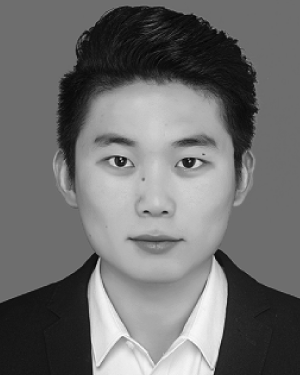 Zhe Liu合作论文数College of Mathematics and Computer, Xinyu University;School of Computer Sciences, Universiti Sains Malaysia1
 Ge Li (李戈)合作论文数School of Computer Science, Peking University1
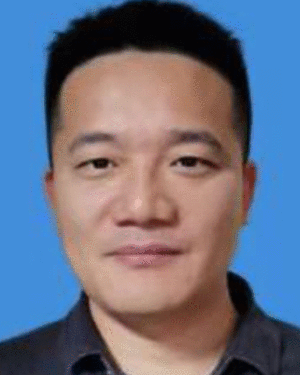 Jin Chen合作论文数1
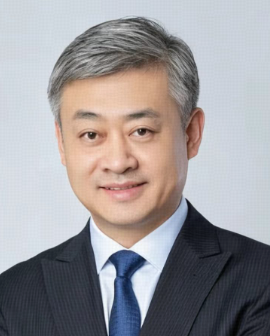 Xuelong Li (李学龙)合作论文数Institute of Artificial Intelligence, China Telecom1
 Hao Sun合作论文数1




