We provide a taxonomy of a dozen enabling network architectures, protocols, and technologies that will define the evolution from 5G to 6G. These technologies span the network protocol stack, different target deployment environments, and various perceived levels of technical maturity. We outline four areas of societal focus that will be impacted by these technologies, and overview several research directions that hold the potential to address the problems in these important focus areas.
For the development of new 5G systems to operate in bands up to 100 GHz, there is a need for accurate radio propagation models at these bands that currently are not add ressed by existing channel models developed for bands below 6 GHz. T his document presents a preliminary overview of 5G channel mode ls for bands up to 100 GHz. These have been derived based on extensive measurement and ray tracing results across a mult itude of frequencies from 6 GHz to 100 GHz, and this document describe s an initial 3D channel model which includes: 1) typical deployment scenarios for urban microcells (UMi) and urban macrocells ( UMa), and 2) a baseline model for incorporating path loss, shadow f ading, line of sight probability, penetration and blockage models for the typical scenarios. Various processing methodologies s uch as clustering and antenna decoupling algorithms are also pres ented.
Future mobile communications systems are likely to be very different to those of today with new service innovations driven by increasing data traffic demand, increasing processing power of smart devices and new innovative applications. To meet these service demands the telecommunications industry is converging on a common set of 5G requirements which includes network speeds as high as 10 Gbps, cell edge rate greater than 100 Mbps, and latency of less than 1 msec. To reach these 5G requirements the industry is looking at new spectrum bands in the range up to 100 GHz where there is spectrum availability for wide bandwidth channels. For the development of new 5G systems to operate in bands up to 100 GHz there is a need for accurate radio propagation models which are not addressed by existing channel models developed for bands below 6 GHz. This paper presents a preliminary overview of the 5G channel models for bands up to 100 GHz in indoor offices and shopping malls, derived from extensive measurements across a multitude of bands. These studies have found some extensibility of the existing 3GPP models (e.g. 3GPP TR36.873) to the higher frequency bands up to 100 GHz. The measurements indicate that the smaller wavelengths introduce an increased sensitivity of the propagation models to the scale of the environment and show some frequency dependence of the path loss as well as increased occurrence of blockage. Further, the penetration loss is highly dependent on the material and tends to increase with frequency. The small-scale characteristics of the channel such as delay spread and angular spread and the multipath richness is somewhat similar over the frequency range, which is encouraging for extending the existing 3GPP models to the wider frequency range. Further work will be carried out to complete these models, but this paper presents the first steps for an initial basis for the model development.
For the development of new 5G systems to operate in bands up to 100 GHz, there is a need for accurate radio propagation models at these bands that currently are not addressed by existing channel models developed for bands below 6 GHz. This document presents a preliminary overview of 5G channel models for bands up to 100 GHz. These have been derived based on extensive measurement and ray tracing results across a multitude of frequencies from 6 GHz to 100 GHz, and this document describes an initial 3D channel model which includes: 1) typical deployment scenarios for urban microcells (UMi) and urban macrocells (UMa), and 2) a baseline model for incorporating path loss, shadow fading, line of sight probability, penetration and blockage models for the typical scenarios. Various processing methodologies such as clustering and antenna decoupling algorithms are also presented.
 Amitabha Ghosh合作论文数Nokia Bell Labs5
 Jian Li合作论文数4
 Shu Sun (孙舒)合作论文数Department of Electronic Engineering, Shanghai Jiao Tong University4Arun Ghosh合作论文数4David Steer合作论文数4Sunguk Lee合作论文数4Thomas, T.A.合作论文数4
 Mathew K. Samimi合作论文数OneCart Easy E-Commerce4
 Katsuyuki Haneda合作论文数Department of Electronics and Nanoengineering, School of Electrical Engineering, Aalto University;Helsinki University of Technology4
 Andreas F. Molisch合作论文数Department of Electrical Engineering, Viterbi School of Engineering, University of Southern California4
 Evangelos Mellios合作论文数Commun Syst & Networks Grp, Univ Bristol4
 Sooyoung Hur合作论文数College of Medicine, The Catholic University of Korea4Haralabos Papadopoulos合作论文数4
 Ozge H. Koymen合作论文数4
 Yuichi Kakishima合作论文数4
 George R. Maccartney合作论文数New York University4
 Henrik Asplund合作论文数4Charlie Zhang合作论文数3takehiro nakamura合作论文数3Ted Rappaport合作论文数Courant Institute of Mathematical Sciences, New York University3
 Lei Tian (田磊)合作论文数School of Information and Communication Engineering, Beijing University of Posts and Telecommunications3
 Jeongho Park合作论文数3
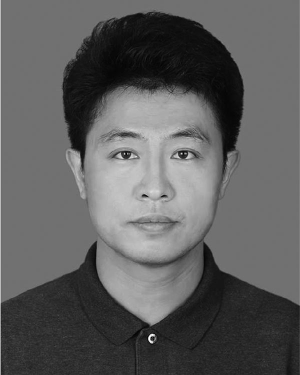 Yi Zheng合作论文数3
 Tetsuro Imai合作论文数3
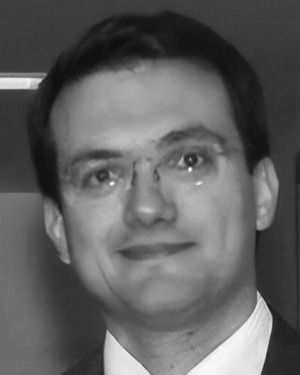 Tommaso Balercia合作论文数3Saeed S. Ghassamzadah合作论文数2YoungSuk Kim合作论文数2
 Saeed S. Ghassemzadeh合作论文数AT&T Labs. Research2john e smee合作论文数1kwang taik kim合作论文数1
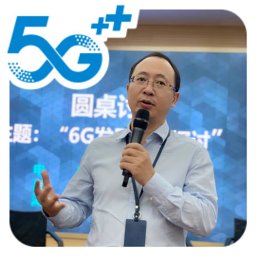 Guangyi Liu合作论文数China Mobile Res Inst1Young-Suk Kim合作论文数1
 Volker Ziegler合作论文数1
 Christopher G. Brinton合作论文数Zoomi Inc1
 Mung Chiang合作论文数Elmore Family School of Electrical and Computer Engineering, College of Engineering, Purdue University1
 Yi Wang (王义)合作论文数School of Computer Science and Engineering, Northeastern University;Department of Information Technology, Uppsala University1
 Geng Wu合作论文数Intel Corporation1
 Jianhua Zhang (张建华)合作论文数Key Laboratory of Universal Wireless Communications, Ministry of Education, Beijing University of Posts and Telecommunications;School of Science, Beijing University of Posts and Telecommunications1
 Theodore (Ted) S. Rappaport合作论文数Electrical and Computer Engineering Department, Tandon School of Engineering, New York University;Polytechnic Institute, Tandon School of Engineering, New York University;School of Medicine, New York University1
 Lei Tan合作论文数College of Life Sciences, Hunan Normal University1
 Takehiro Nakamura (中村丈洋)合作论文数Department of Physiology 2, Kawasaki Medical School1
 David J. Love合作论文数Purdue NextG Center for Communications and Sensing, School of Electrical and Computer Engineering, Purdue University1
 Tingfang Ji合作论文数1




