Despite rapid mobile and Internet penetration in India, e-commerce adoption remains slow among emergent users. In this paper, we conduct a mixed-method study involving a two-phase user study and an analysis of app reviews posted on app stores. The findings reveal that emergent users often replicate offline shopping behaviours in digital contexts, struggle with product search and filtering, and prefer cash-on-delivery due to distrust in online payments. Many users misinterpret rating systems and lack confidence in post-purchase processes, further deterring adoption. Our research underscores the need for intuitive design, clearer communication of platform features, and trust-building mechanisms to enhance user engagement with e-commerce. We propose design recommendations to make e-commerce platforms more accessible, addressing the specific needs of this user group.
The poor miss out when teaching goes online, leaving millions without proper education. Millions of children in India may never return to school following the severe disruptions of rolling COVID-19 lockdowns in 2020 and 2021. Online teaching — meant to replace in-classroom instruction — mostly failed for a variety of reasons. Poor internet coverage and […]
Policymakers often make decisions based on GDP, unemployment rate, industrial output, etc. The primary methods to obtain or estimate such information are resource-intensive. In order to make timely and well-informed decisions, it is imperative to come up with proxies for these parameters, which can be sampled quickly and efficiently, especially during disruptive events like the COVID-19 pandemic. We explore the use of remotely sensed data for this task. The data has become cheaper to collect than surveys and can be available in real-time. In this work, we present Regional GDP-NightLight (ReGNL), a neural network trained to predict GDP given the nightlights data and geographical coordinates. Taking the case of 50 US states, we find that ReGNL is disruption-agnostic and can predict the GDP for both normal years (2019) and years with a disruptive event (2020). ReGNL outperforms time-series ARIMA methods for prediction, even during the pandemic.
Video conferencing platforms have been appropriated during the COVID-19 pandemic for different purposes, including classroom teaching. However, the platforms are not designed for many of these objectives. When users, like educationists, select a platform, it is unclear which platform will perform better given the same network and hardware resources to meet the required Quality of Experience (QoE). Similarly, when developers design a new video conferencing platform, they do not have clear guidelines for making design choices given the QoE requirements. In this paper, we provide a set of networks and systems measurements, and quantitative user studies to measure the performance of video conferencing apps in terms of both, Quality of Service (QoS) and QoE. Using those metrics, we measure the performance of Google Meet, Microsoft Teams, and Zoom, which are three popular platforms in education and business. We find a substantial difference in how the three apps treat video and audio streams. Our quantitative user studies confirm the findings of our quantitative measurements. While each platform has its benefits, we find that no app is ideal. A user can choose a suitable platform depending on which of the following, audio, video, or network bandwidth, matters more.
“Fake News” and Misinformation can have far-reaching negative social impacts. Scalable fake news classification techniques for resource-poor languages such as Hindi are in their infancy due to the lack of data sets and lack of robust NLP libraries in these languages. We present Aletheia, a Fake News classification system for Hindi. We curate a dataset of approximately 13,000 news articles by media organizations that flag authentic and fake news. We present preliminary results using several Machine Learning models on this dataset. We also developed a system accessible over the web (http://responsible-tech.bits-hyderabad.ac.in/aletheia/demo/) using which users can test if a given piece of news is fake or authentic. We also use the website to collect crowd-sourced labelled news data and present additional information on the dataset and the models to the users.
Most online information sources are text-based and in Western Languages like English. However, many new and first time users of the Internet are in contexts with low English proficiency and are unable to access vital information online. Several researchers have focused on building conversational information systems over voice for this demographic, and also highlighted the importance of building trust towards the information source. In this work we develop four versions of a voice based chat-bot on the Google Assistant platform in which we vary the gender, friendliness and personalisation of the bot. We find that the users rank the female version of the bot with more personalisations over the others; however when rating the bots individually, the ratings depend on the ability of the bot to understand the users' spoken query and respond accurately.
The COVID-19 induced lockdowns forced people to shift several activities, including education, online. However, in the context of online schooling, the Digital Divides have magnified and perpetuated existing inequities in the education system and in society. Through a qualitative study with 48 participants across four stakeholder groups we find that students in under-funded government schools in India largely have not been able to access online classes because of a lack of devices, poor quality of Internet access, unreliable data networks and expensive data plans. We also document attempts by teachers and non-profit workers to use mass media broadcast technologies to work around the issue of digital access, highlighting the importance of a human infrastructure to build resilience during a disruptive event. Socioeconomic factors have also forced several students to drop out of schools and into taking up jobs to support their families. We document the importance of enabling environments and economic safety nets at home for online education to succeed. We present some focus points for researchers and policy makers working in the space of digital divide and education to build more resilient systems through Digital Welfarism.
Campylobacter is one of the major foodborne pathogens of concern in its growing trend of antimicrobial resistance. C. jejuni and C. coli are the major causative agents, with C. jejuni contributing to most of the cases in approximately 90% in the world. Infection is transmitted to humans due to consumption of contaminated food and water. Campylobacteriosis caused by C. jejuni is commonly presented with severe diarrhoea, abdominal pain, fever, headache, nausea, and vomiting with some extreme cases resulting in Guillain–Barré syndrome (GBS) and acute flaccid paralysis. Symptoms are severe in cases of children below 5 years, elderly and individuals who are immunocompromised. The infection is usually sporadic, and self-limiting and thus does not require antibiotics for treatment. Still, the antimicrobial resistance in Campylobacter is a major concern because of the transmission of resistance from animal sources to humans. This review highlights the recent epidemiology, geographical impact, resistance mechanisms, spread of Campylobacter spp. and the strategies to control the transmission of Campylobacter from veterinary sources and its antimicrobial resistance.
Proliferation of “Fake News” and misinformation is resulting in widespread negative social fallout. Scalable Fake News classification techniques for resource poor languages like Hindi are in early stages because of a lack of datasets and lack of robust NLP libraries for these languages. In this exploratory study we curate a dataset of around 13,000 data points of true news articles, and, articles on fake news authored by media organisations which flag fake news. We then use seven ML classification models on this dataset and present the preliminary results. Our results show that concerted efforts need to be made by the research community towards dataset curation and improving the NLP models for resource poor languages in order to make scalable classification systems.
The design of participatory media platforms can have many variations in terms of whether or not anonymous communication is allowed, what moderation policies are in use, the conversation model that is supported, etc. We use six case-studies of voice-based ICT4D participatory media platforms running in India to outline a typology of design axes that can be used to characterize these platforms. Such typologies can be useful for ICT4D practitioners to conceptualize suitable designs for their platforms in different contexts, and to reconfigure the platforms in case design changes are required. We also use this typology to discuss the design constraints and flexibilities allowed by Internet based social media platforms.
With increasing penetration of low cost smartphones and affordable data plans in developing countries like India, there is a definite potential that the benefits of access to information can reach a wider audience. However, researchers have also been cognizant that many from this segment are first time users of digital technology and are limited by low text-literacy and low capability to handle and use digital platforms. The established norms of application building for a more tech-savvy and text-literate audience might need to be revisited. We conduct detailed interviews in an ecologically valid setting with 20 farmers from rural Maharashtra and Chhattisgarh to understand the information seeking behaviour and culture of digital platform usage among these populations. Through these interviews we are able to distill some very salient characteristics of the new Internet users and draw a broad set of guidelines for designing information systems for these users. We find the constructs of trust, external invisibility, peers and family play a very important role in the uptake of digital platforms in addition to the accessibility features of text-free design.
Social welfare schemes and public infrastructure services often face implementation and last mile delivery challenges. Governments in India have set up phone helplines for beneficiaries to report irregularities but we find that it remains challenging for beneficiaries to realise positive outcomes through these helplines; without a personal follow-up with the concerned local government officials by experienced members from the civil society, the redressals done are often inadequate. To combine the scalability of centralised helplines with the effectiveness of decentralised mediation by civil society groups, we set up an IVR (Interactive Voice Response) system where beneficiaries can record their grievances, which are then delegated to a network of civil society volunteers who do the required local follow-ups for resolution of these grievances. Through this pilot, we analysed over 200 cases of redressal and document how volunteer networks operate and can plug accountability gaps in government services. We advocate for formalisation of this civil-society mediated and technology assisted model into the design of public welfare schemes to enable citizens to engage with government departments in productive ways.
This paper proposes a new method for recognizing both activities and gestures by using acceleration data collected on a smartwatch. While both activity recognition techniques and gesture recognition techniques employ acceleration data, these techniques are studied independently due to the large difference between the characteristics of activity sensor data and gesture sensor data. In this study, we combine their recognition using a tree structured classifier that combines features that are widely used to recognize activities with dynamic time warping-based k-nearest neighbor classifiers. Our method can recognize both activities and gestures with low computational cost by executing only the minimal set of feature extraction and classification processes that are required to recognize an input sensor-data segment. An experiment on 30 sessions of sensor data shows that our method can recognize both activities and gestures simultaneously with 95.8% accuracy while reducing computation costs by 97.3% when compared with a baseline method.
Finding a parking spot in a busy indoor parking lot is a daunting task. Retracing a parked vehicle can be equally frustrating. We present BluePark, a collaborative sensing mechanism using smartphone sensors to solve these problems in real-time, without any input from user. We propose a novel technique of combining accelerometer and WiFi data to detect and localize parking and un-parking events in indoor parking lot. We validate our approach at the basement parking of a popular shopping mall. The proposed method outperforms Google Activity Recognition API by 20% in detecting drive state in indoor parking lot. Our experiments show 100% precision and recall for parking and un-parking detection events at low accelerometer sampling rate of 15Hz, irrespective of phone?s position. It has a low detection latency of 20s with probability of 0.9 and good location accuracy of 10m.
Citizen feedback on the implementation of social welfare schemes can help fine tune their design, understand problems, and assess the benefits and impact from these schemes. Such feedback loops however are singularly missing in most schemes in India, and are conveyed only indirectly via civil society and social audit organisations that try to serve as a bridge between citizens and the government. We leverage the deep penetration of mobile phones in India to design a suite of IVR (Interactive Voice Response) tools that can help capture community perceptions, improve awareness of the people, and verify official records directly by the beneficiaries themselves. In the context of a rural employment guarantee scheme, we evaluate these tools in a few villages in the state of Haryana and demonstrate that there is good scope for using IVR tools to serve as a citizen engagement channel for welfare schemes. Our contribution lies in outlining several use-cases for technology interventions, and uncovering nuances that should be addressed if such systems are integrated into the implementation of social welfare schemes.
This paper considers bi-objective knapsack problem with fuzzy weights, says bi-objective fuzzy knapsack problem (BOFKP). Here we introduce an index which gives the possibility of choosing the item (weights and knapsack availability are fuzzy in nature) for knapsack with crisp capacity such that both the objective value are optimized. A methodology using dynamic programming technique has been introduced in this paper with an algorithm which gives the optimal solution for single objective fuzzy knapsack problem (FKP) with some possibility. Using this methodology an algorithm is given to find the Pareto frontier in case of bi-objective fuzzy knapsack problem. Compromise ratio method for decision-making under fuzzy environment has been used to find the compromise solution. The possibility index gives an idea to choose the solution according to decision-maker's choice. An illustrative example is given to demonstrate the methodology.
 Anupam Joshi合作论文数Department of Computer Science and Electrical Engineering, University of Maryland, Baltimore County;Center for Cybersecurity, College of Engineering and Information Technology, University of Maryland, Baltimore County43
 Sumit Mittal合作论文数Tata Consultancy Services26
 Nilanjan Banerjee合作论文数University of Maryland Baltimore County24
 Karl Aberer合作论文数Distributed Information Systems Laboratory, Ecole Polytechnique Federale de Lausanne;LinkAlong24
 Koustav Dasgupta合作论文数IBM India Research Laboratory23
 Archan Misra合作论文数A*STAR-SMU Joint Lab in Social and Human-Centered Computing, School of Computing and Information Systems, Singapore Management University20
 Amit A. Nanavati合作论文数School of Engineering and Applied Science, Ahmedabad University17
 Zhixian Yan合作论文数Google16
 Sougata Mukherjea合作论文数Georgia Institute of Technology15
 Perich, F.合作论文数12
 Tim Finin合作论文数Department of Computer Science and Electrical Engineering, College of Engineering and Information Technology, University of Maryland, Baltimore County;Center for Artificial Intelligence, University of Maryland, Baltimore County;Human Language Technology Center of Excellence, Johns Hopkins University12
 Sheetal Agarwal合作论文数IBM India Research Lab, New Delhi, India11Sasikanth Avancha合作论文数Department of Computer Science and Electrical Engineering, University of Maryland11
 Arun Kumar合作论文数10
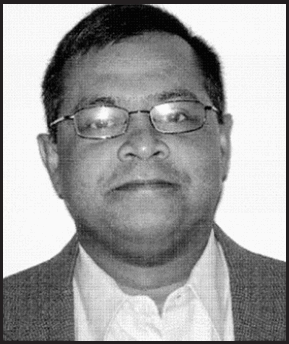 Arup Acharya合作论文数IBM T. J. Watson Research Center9
 Arkady Zaslavsky合作论文数Caulfield School of IT8
 Dipyaman Banerjee合作论文数Airtel Digital8Y Yesha合作论文数7Xiping Wang合作论文数7
 Seema Nagar合作论文数Indian Institue of Technology7
 Shachi Sharma合作论文数India Research Lab, IBM Research7
 Saket Sathe合作论文数Amazon Web Services6
 Nitendra Rajput合作论文数AI Garage Center, Mastercard6Angshu Rai合作论文数6
 Yelena Yesha合作论文数Department of Computer Science and Electrical Engineering, College of Engineering and Information Technology, University of Maryland, Baltimore County;Center for Accelerated Real Time Analytics, University of Maryland, Baltimore County5
 Tapan Kamdar合作论文数Department of Computer Science and Electrical Engineering;University of Maryland5
 Deva P. Seetharam合作论文数Kailash Consulting5
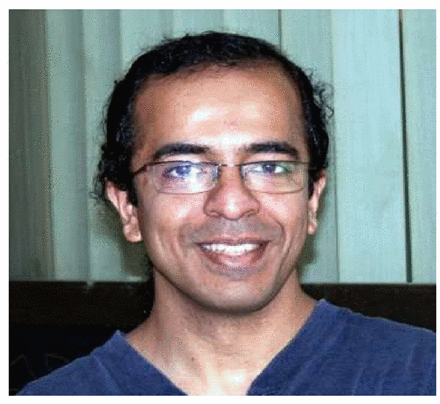 Aaditeshwar Seth合作论文数IIT Delhi5
 Saguna Saguna合作论文数CaSIT, Monash University5Parikshit Sharma合作论文数4Suraj Jaiswal合作论文数Indian Institute of Technology4
 Vigneshwaran Subbaraju合作论文数Agency for Science, Technology and Research4Dhiral Gada合作论文数4
 Stefano Spaccapietra合作论文数École Polytechnique Fédérale de Lausanne4
 Amit Anil Nanavati合作论文数Analytics & Mobile-Enabled Solutions Research India Research Laboratory4
 Sunil Goyal合作论文数Mechanical Metallurgy Division, Indira Gandhi Centre for Atomic Research4Rajendran Narayanan合作论文数4
 Tanuja Ganu合作论文数Center for Societal impact through Cloud and Artificial Intelligence, Microsoft Research Lab – India, Microsoft4Charles P. Wright合作论文数IBM T. J. Watson Research Center4Ken A. Johns合作论文数3Vl Malyshev合作论文数3
 James T Linnemann合作论文数Department of Physics and Astronomy, College of Natural Science, Michigan State University3ratan borman合作论文数3Thomas Nunnemann合作论文数Faculty of Physics, Ludwig-Maximilians-Universität München3
 Alexander Kupčo合作论文数Institute of Physics, Czech Academy of Sciences3
 Daniel Wicke合作论文数Ritzenhoefer & Company3D. Zieminska合作论文数3
 Alexander Khanov合作论文数Department of Physics, The College of Arts and Sciences, Oklahoma State University3F. Rizatdinova合作论文数3