The precise mechanisms related to the accretion of protoplanetesimals from dust in protoplanetary disks (PPDs) are poorly understood. In order to better understand the early stages of planet formation and the growth of millimeter–centimeter agglomerates, we conducted a series of aggregation experiments in reduced gravity. Our objectives are to determine the effects of particle size, bulk density, and composition on the aggregation potential of dust-scale grains. This work builds upon previous microgravity experiments initially performed by astronaut Don Pettit on board the International Space Station, where free-floated bags of finely grained materials showed the aggregation of the cohesive materials. We expand upon these experiments using material more analogous to the PPD such as olivine, enstatite, ordinary chondrite, carbonaceous chondrite, and a carbonaceous chondrite simulant. We find that particle size is the most important driver of aggregate growth, with bulk density showing little dependence. The largest aggregate size ratios were formed from the finest particle size distributions, while aggregate sizes approach the mean grain size for particles greater than 1 mm. We measured aggregate sizes spanning roughly 2 orders of magnitude (∼0.2–20.0 mm), but the results show 5 orders of magnitude variations in aggregate size ratios (∼1–1 × 10 ^5 ). This could suggest that protoplanetesimals have an increased likelihood of accreting from micron-sized grains in particle size distributions with initially steeper slopes. Our results further the body of work that points to grain size and grain properties constraining the growth potential of protoplanetesimals, with implications for the timescale and initial conditions of accretion in the disk.
Geologists have long conducted laboratory experiments to offer a controlled environment for understanding processes that occur in nature and linking those processes with natural geologic landforms. And, for over 70 yr, pilots and researchers have accessed reduced-gravity and microgravity conditions by flying aircraft in parabolic arc-shaped trajectories. However, only recently (technically since the 1980s but practically since the 2010s) has experimental geology begun to find a home in reduced-gravity flight with application to the solid-bodied worlds of the solar system. The methodology of our recent experimental campaign investigating impact crater ejecta emplacement serves as a case study in reduced-gravity experimental geology. We hope this case study will inspire future utilization of reduced-gravity flight as a laboratory method for better understanding geological processes on worlds throughout the solar system.
We studied impact processes by means of smoothed-particle hydrodynamics (SPH) simulations. The method was applied to modelling formation of main-belt families during the cometary bombardment (either early or late, ~ 3.85 Gy ago). If asteroids were bombarded by comets, as predicted by the Nice model, hundreds of asteroid families (catastrophic disruptions of diameter D >= 100 km bodies) should have been created, but the observed number is only 20. Therefore we computed a standard set of 125 simulations of collisions between representative D = 100 km asteroids and high-speed icy projectiles (comets), in the range 8 to 15 km/s. According to our results, the largest remnant mass M-lr is similar as in low-speed collisions, due to appropriate scaling with the effective strength Q(eff), but the largest fragment mass M-lf exhibits systematic differences - it is typically smaller for craterings and bigger for super-catastrophic events. This trend does not, however, explain the non-existence of old families. The respective parametric relations can be used in other statistical (Monte-Carlo) models to better understand collisions between asteroidal and cometary populations.
Successful deflection of a hazardous asteroid by kinetic impact requires cratering without disruption in order to avoid possibly leaving a large fragment of the asteroid on a collision course with Earth. A critical issue is the determination of the maximum change in velocity, and thus the orbital change, that can be imparted to asteroid material by a single hypervelocity kinetic impact while producing only cratering rather than fragmentation. Porosity, strength, mineralogy, and hydration influence the response of a target to hypervelocity impact. To investigate the maximum velocity that can be transferred by a single kinetic impact we performed a series of laboratory-scale hypervelocity impact cratering and disruption measurements on two types of anhydrous asteroid samples, the Northwest Africa (NWA) 869 ordinary chondrite meteorite and the NWA 4502 carbonaceous chondrite meteorite, using the NASA Ames Vertical Gun Range. Our results demonstrate that if disruption is to be avoided there is a factor of seven difference in the maximum velocity that can be imparted by a single kinetic impact between these two types of asteroid material. To investigate the effect of hydration on the maximum velocity transfer we impacted laboratory-prepared simulant of a hydrous carbonaceous meteorite target and determined that its behavior was similar to that of the NWA 4502 targets. Our results indicate that the maximum velocity change that can be imparted by a single kinetic impactor to this carbonaceous meteorite target is only ~0.27 m/s. This suggests that multiple kinetic impacts may be required for non-disruptive deflection of many Potentially Hazardous Asteroids, particularly the weaker carbonaceous asteroids.
A definitive orbit is derived for asteroid (317) Roxane's satellite Olympias [S/2009 (317)1] by combining the 2009 discovery images from Gemini North (Merline et al.2009) with images from Keck and the VLT obtained in 2012, as well as images from its 2016-2017 apparition from the Starfire Optical Range. The orbit is retrograde with respect to the ecliptic but in the same sense as Roxane's spin. Olympias has a period of P=11.9440+0.0005 days, a semi-major axis of alpha=245 +/- 3 km, and an orbital pole at RA=97 degrees, Dec=-71 degrees, or ecliptic coordinates lambda=245 degrees, beta=-85 degrees, close to the south ecliptic pole. This satellite orbital pole is only 3 degrees from Roxane's orbital pole (but in a retrograde sense) and restricts all observations of Olympias from Earth to within 4 degrees of the satellite's orbital plane. By fitting the brightness ratios between Roxane (rotational period of 8.16961 +/- 0.00005 h) and Olympias as a Fourier series, we find a rotational period for Olympias of 8.2587 +/- 0.0001 h, making this an asynchronous wide binary. From the brightness ratios, and with the average infrared modeling diameter found in the literature of 19.16 +/- 0.39 km (error of the mean), we estimate triaxial ellipsoid radii of 14.5 x 8.5 x 7.2 km for Roxane and 3.6 x 2.5 x 2.0 km for Olympias. We can then apportion the mass between the two objects and find a density for both (assumed to be the same) of 2.16 +/- 0.18 g/cm(3). There are only a few E-type binaries known and this is the first direct determination of E-type density from a binary. We suggest that the system was formed by the Escaping Ejecta Binary (EEB) mechanism of Durda et al. (2004a), probably forming closer together, and then undergoing the complex evolution steps described by Jacobson et al. (2014) involving synchronization, BYORP orbit expansion, loss of tidal lock, and then YORP spinup. Roxane and Olympias may be the only known EEB system to date. From the same 2016-2017 apparition the orbit of Linus around asteroid (22) Kalliope is derived from the SOR. This well-observed bright satellite is found to have a circular orbit with a period of P=3.5956 +/- 0.0004 days, in good agreement with the latest elements of Vachier et al. (2012) of P=3.5957 +/- 0.0001 days, and a semi-major axis of a=1099 +/- 6 km, somewhat greater than their a=1082 +/- 11 km for a slightly eccentric orbit (e=0.007 +/- 0.010). With a diameter for Kalliope of 161 +/- 6 km (Hannus et al. 2017), we derive a density for Kalliope of 3.72 +/- 0.25 g/cm(3) from our one apparition study, the same as Hanus et al. (2017) but greater than the 3.24 +/- 0.16 of Vachier et al. (2012).
Introduction: Asteroid impact studies allow us to gain a greater understanding of our solar system and the interactions within it. There is currently not a lot of data on the physical properties of meteorites and this data is essential to understanding our solar system, including impacts within it. An understanding of the physical properties of various types of meteorites, like wet carbonaceous chondrites, can be applied to larger scale solar system processes. Compression strength is a common method used to test the physical properties of rock or rock-like materials. Wet carbonaceous chondrites do not often fall to Earth which makes them rare and hard to obtain for our studies. Using a carbonaceous chondrite meteorite simulant created in our lab (Hydrated Northwest Africa 4502 and Hydrated Northwest Africa 869) as well as commercially produced materials (Exolith CC) allows us to make first order approximations of the compression strength of these materials [1,3]. Data from previous studies done in this lab allow us to expand the knowledge about compression strength that we have for different types of meteorites and terrestrial samples [1,2,4]. Experimental: A series of experiments were performed to test the compression strength of Exolith CC, Hydrated Northwest Africa 4502, and Hydrated Northwest Africa 869 samples. Each sample was created in our lab using previously established hydration methods [2]. After the hydration process is compete the sample is placed into a 2 cm cube mold and put on a hot plate overnight. The sample comes out of the mold as a firm cube and the dimensions and mass of the sample are measured. It is then placed in a plastic dish to catch the debris created when it fails during testing. Testing is performed using a bottle that is secured on top of the sample and incrementally filled with water until it fails (Figure 1). The amount of water and the bottle is then weighed in order to find the weight needed to crush the sample [2].
Many advancements in planetary science are achieved by seizing upon the opportunity created by rare natural events (e.g. comet Shoemaker-Levy 9 Jupiter impact; 1994) and by planned physical interactions (e.g. Deep Impact into comet Tempel 1; 2005). A forthcoming opportunity to seize upon a natural physical “experiment” occurs on April 13, 2029 with the unprecedentedly close Earth encounter by the large 340m asteroid (99942) Apophis. On that date, nature is performing the “experiment” of subjecting the physical body of Apophis to Earth’s tidal torques as it approaches to within 31,000 km of Earth’s surface, a distance that is closer than orbiting geosynchronous satellites. A potentially hazardous asteroid (PHA) as large as Apophis encountering Earth this closely (within 0.1 lunar distances) is, on average, a once-per-thousand year event. (In context, Apophis is 7 times larger and 350 times more massive than the Tunguska 1908 impactor; 5000 times more massive than Chelyabinsk 2013.) Because of this event’s incredible rarity, knowledge gained through measurements and outcomes of the Apophis 2029 “natural experiment” are clearly a decadal, if not millennial, opportunity for planetary science. Most specifically, this knowledge opportunity is for the science supporting planetary defense. Further, on April 13, 2029 all of Earth will be watching: Apophis will be visible to the naked eye speeding across the evening sky for an estimated 2 billion people spanning western Europe and northern Africa. In this White Paper we outline our current best understanding, and uncertainties, for scientific advances in the physical study of potentially hazardous asteroids that may be achievable by measuring physical changes of Apophis’ spin, surface structure, and/or shape configuration in response to Earth’s tidal torques. If tidal torques themselves, or surface configuration changes induce any measurable seismic vibration signal inside Apophis, a new field of asteroid seismology has the potential to be born. Over six decades of planetary science, seismology has been achieved beyond Earth for only two planetary worlds: Moon and Mars. With this White Paper, we take no position on how to implement specific investigations capable of achieving the science advances offered by the Apophis 2029 opportunity. Instead we advocate that competitive selection of investigations, be they theoretical or observational (ground-based, space-based, or in situ), be executed under the direction of NASA’s Planetary Defense Coordination Office, with a projected and perhaps necessarily augmented budget capable of supporting them. International collaboration is strongly encouraged. Thus, summarizing in four specific points, we urge the framers of the Decadal Survey to: • Recognize the decadal, if not millennial, opportunity for the science of planetary defense presented by the Apophis 2029 once-per-thousand-year “natural experiment.” • Prioritize as a top-level planetary defense science goal modeling and measuring the physical outcome on Apophis exerted by Earth’s tidal torques so as to achieve the greatest possible new insights into the physical nature, including the internal structure, of PHAs. • Recognize that time is of the essence for defining and implementing investigations of physical effects on Apophis, particularly if in situ measurements are to be considered. An Apophis 2029 Science Definition Team may be prescribed. • Recognize that the achievable knowledge of PHAs presented by the Apophis 2029 opportunity could have immeasurable benefits to the future of humanity, in the highly unlikely, but not impossible necessity to mitigate a future impact threat
A series of experiments have been conducted to study the failure behavior of columns and piles comprised of cohesive fine powders in 1 g as a proxy for those which might occur in the agglomerated asteroid structure composed of cm-m size pebbles and boulders in a microgravity environment. Initially symmetrical piles of fine powders, under gravitation or centrifugal stress, develop features similar to those observed on asteroids, such as slide planes and finer cohesive structures. Failure of cohesive columns of fine powders occurs by the nucleation and propagation of fracture planes. In some cases, forming steep cliffs, also reminiscent of features observed on asteroids. Correlation between observed column failure and numerical simulations has been demonstrated based on preliminary results. Microstructure and particle size distribution are shown to substantially determine the extent of cohesiveness. Enhanced cohesion was observed for specific ratios of larger particle intermixed with fine powders. We propose that the wide range of qualitative features and behaviors may reasonably represent those observed on asteroid features as the surface ages. This work has important implications for our understanding and preparation for future missions to NEOs.
Two NASA missions that will be launched in 2022 have spun renewed interest in hypervelocity impact of rocks and metals. This work focuses on the prediction of the momentum enhancement effect, i.e. the extra momentum acquired by the target due to the ejecta flying off the target in the direction of the impactor. Predicting the momentum enhancement with simulations has been elusive, probably because the target material is rarely well characterized. This presentation shows that, given a good knowledge of the properties of the target material and, by adding two essential pieces of the physics (strength of failed material and bulking after failure), the computer simulations can provide good predictions of the momentum enhancement for hypervelocity impact tests performed at Southwest Research Institute.
We used existing data from the New Horizons Long-range Reconnaissance Imager (LORRI) to measure the optical-band (0.4 less than or similar to lambda less than or similar to 0.9 mu m) sky brightness within seven high-Galactic latitude fields. The average raw level measured while New Horizons was 42-45 au from the Sun is 33.2 +/- 0.5 nW m(-2) sr(-1). This is similar to 10x as dark as the darkest sky accessible to the Hubble Space Telescope, highlighting the utility of New Horizons for detecting the cosmic optical background (COB). Isolating the COB contribution to the raw total required subtracting scattered light from bright stars and galaxies, faint stars below the photometric detection limit within the fields, and diffuse Milky Way light scattered by infrared cirrus. We removed newly identified residual zodiacal light from the IRIS 100 mu m all-sky maps to generate two different estimates for the diffuse Galactic light. Using these yielded a highly significant detection of the COB in the range 15.9 +/- 4.2 (1.8 stat., 3.7 sys.) nW m(-2) sr(-1) to 18.7 +/- 3.8 (1.8 stat., 3.3 sys.) nW m(-2) sr(-1) at the LORRI pivot wavelength of 0.608 mu m. Subtraction of the integrated light of galaxies fainter than the photometric detection limit from the total COB level left a diffuse flux component of unknown origin in the range 8.8 +/- 4.9 (1.8 stat., 4.5 sys.) nW m(-2) sr(-1) to 11.9 +/- 4.6 (1.8 +/- stat., 4.2 sys.) nW m(-2) sr(-1). Explaining it with undetected galaxies requires the assumption that the galaxy count faint-end slope steepens markedly at V > 24 or that existing surveys are missing half the galaxies with V < 30.
Introduction: Over the lifetime of the surface of a small body, meteoroid and micrometeoroid impacts rework the surface [1]. Each impact generates impact ejecta with a range of sizes and energies that are diagnostic of the impact process and the surface conditions [2,3]. Simultaneous, in situ measurements by a future spacecraft could use the size and energy characteristics of ejecta to discern surface properties. However, previous laboratory studies and spaceflight instruments have generally measured only one aspect of the ejecta’s characteristics, either size [2] or velocity [4]. Therefore, we are developing the Grain Velocimetry and Tomography Analysis System (GraVeTAS), an instrument intended to measure the shape, and 3D velocity of ejecta simultaneously, both under laboratory conditions and eventually in situ on small bodies. GraVeTAS design. GraVeTAS employs techniques developed for velocimetry and nephelometry [5,6,7]. In a typical impact experiment in a chamber (see Figure 1), GraVeTAS is set up to characterize ejecta that pass through one or multiple, specific volumes of space. Laser beams encoded with a fringe pattern are projected through the sampling volume. Associated with each beam is an array of photodiodes that are color-filtered to collect scattered light from only one laser wavelength. As a particle passes through the beam, the forward-scattered light is collected at multiple angles by the photodiodes. This forward scattered light maintains the fringe pattern of the original laser beam. A time-series of the scattered light signals is collected by the photodiodes from which the velocity, size, and shape of the particle is determined. The spacing of the peaks of the scattered fringe pattern directly measures the particle velocity. Using the optical fringe spacing, Lf, which is set by the optics, and the measured time between scattered fringe peaks, t, the particle velocity is calculated by v=Lf/t (see reference [5] for more details). By using asymmetric fringes, we determine the direction of the particle movement. We use computational tomography and Fourieranalysis techniques to derive the size and shape of the measured particle [Kak and Slaney, 2001; Goodman, 2005]. The photodetectors sample separate Fourier components of the scattered light, which encode spatial information about the scattering particle. Thus, by sampling the Fourier components we acquire sufficient information to derive the particle's dimensions. Ongoing work. We are currently incorporating the GraVeTAS instrumentation into small chambers in which we will conduct impact experiments, under vacuum, at 1 g and at lower gravity levels. The 1 g experiments will be conducted in our laboratory in Boulder, CO. The lower-gravity experiments will be conducted on reduced gravity flights provide by Canada’s National Research Council Falcon 20 research aircraft. We will present the current status of this project and outline the near-term laboratory and flight experiments that will be conducted with the GraVeTAS instrumentation.
The meteorites provide samples of their asteroidal parent bodies, allowing laboratory measurements of the response of asteroidal material to hypervelocity impacts. The meteorites span a wide range of physical properties, with porosities ranging from near zero to more than 40%, comparable to the range determined for stony asteroids. To investigate the effects of target properties on cratering, impact disruption, momentum transfer and dust production we have begun a series of hypervelocity impact experiments on various types of meteorite targets. In this work whole stones or fragments of the Northwest Africa 4502 (NWA 4502) CV3 carbonaceous chondrite were impacted by 1/16" or 1/8" Al-spheres at speeds ranging from 4.11 to 5.89 km/s at the NASA Ames Vertical Gun Range. These samples had a mean porosity of similar to 2.1% and a mean unconfined compressive strength of similar to 32.9 MPa. Eight hypervelocity disruptions demonstrated that these NWA 4502 targets are less resistant to disruption, i.e., they require less impactor kinetic energy per unit target mass to produce an equivalent disruption, than nonporous terrestrial basalt targets or ordinary chondrite meteorite targets. The threshold collisional specific energy, Q*(D), for these NWA 4502 targets is similar to 224 J/kg, which is significantly lower than the similar to 1795 J/kg value we measured previously for the moderately porous (similar to 6.4%) ordinary chondrite meteorite Northwest Africa 869. This likely results from the numerous cracks crosscutting the NWA 4502 samples. We measured the post-impact momentum of seven NWA 4502 cratering events and found a mean momentum transfer of 3.55 times the momentum of the projectile, showing that the recoil from the crater ejecta significantly exceeded the direct momentum transferred by absorption of the projectile. In two cases we found much higher momentum transfer values (11.72 and 8.95), suggesting these two impactors struck a different material, likely hydrous weathering veins, which fill the cracks, than the other five NWA 4502 cratering impacts. This suggests that hydrous asteroids and comets would experience significantly more recoil from hypervelocity impact than anhydrous targets having similar strength and porosity.
 Melissa M. Strait合作论文数52G.J. Flynn合作论文数38
 Erik Asphaug合作论文数Dept. of Planetary Sciences, The University of Arizona31
 William F. Bottke合作论文数Solar System Science and Exploration Division, Southwest Research Institute;Center for Lunar Origin and Evolution, NASA's Solar System Exploration Research Virtual Institute30
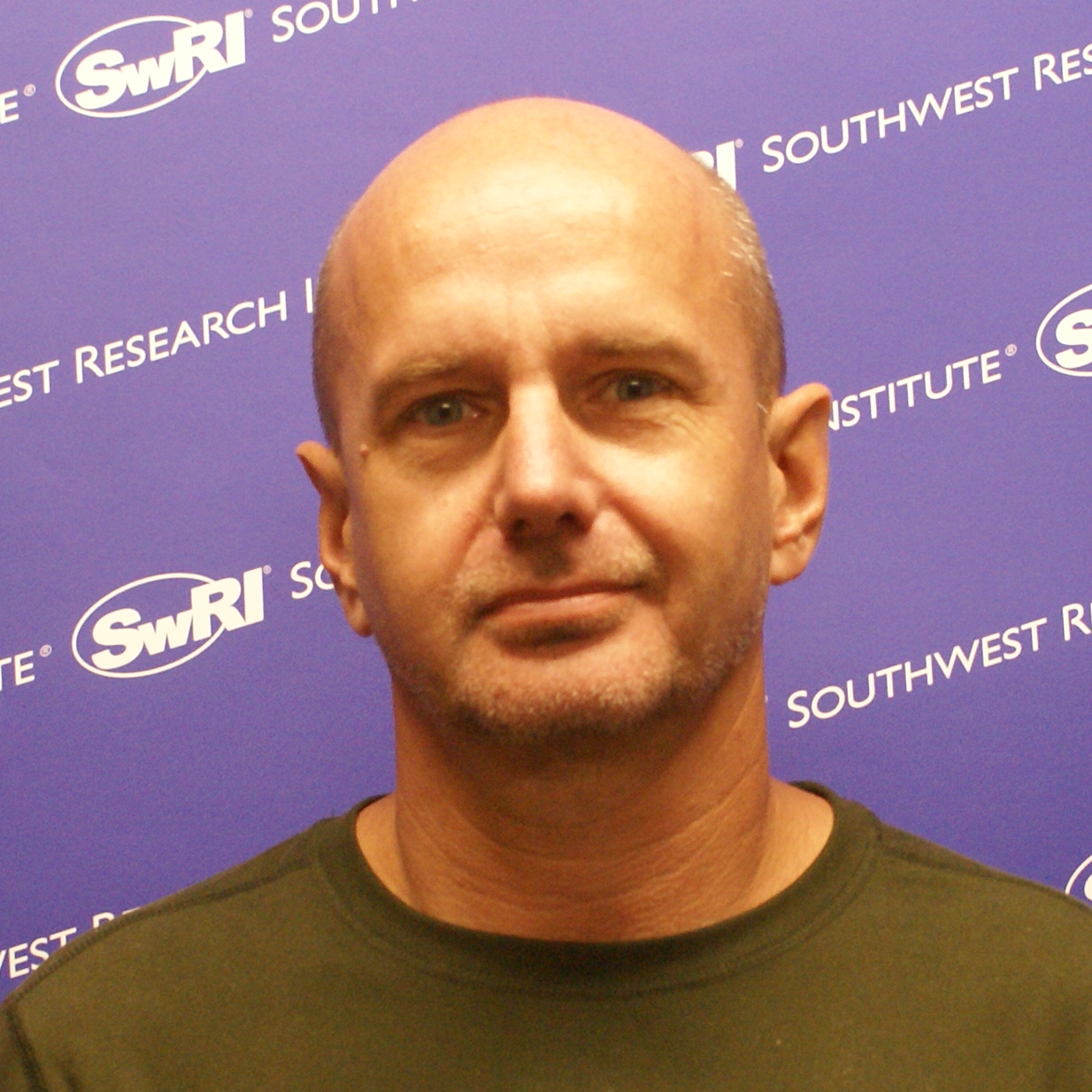 David Nesvorny合作论文数Department of Space Studies, Southwest Research Institute26
 Derek Charles Richardson合作论文数Department of Astronomy, University of Maryland24
 Stanley F. Dermott合作论文数Department of Astronomy, University of Florida23
 Richard Greenberg合作论文数Lunar & Planetary Laboratory, College of Science, University of Arizona18
 Clark R. Chapman合作论文数Department of Space Studies, Southwest Research Institute16
 Paul E. Geissler合作论文数Astrogeology Science Center, US Geological Survey16George J. Flynn合作论文数15Sumita Jayaraman合作论文数15
 Alan Stern合作论文数Space Sector, Southwest Research Institute;World View Enterprises15
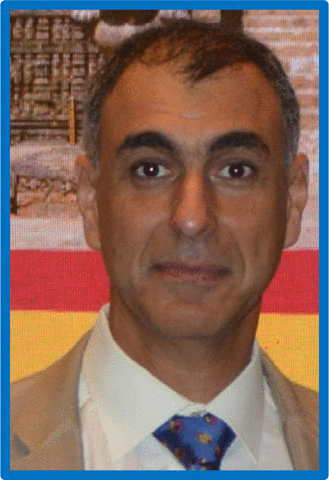 Sidney Chocron合作论文数Southwest Research Institute14
 James Walker合作论文数13S. J. Jack合作论文数12Mason J. Molesky合作论文数12Donald J. Grosch合作论文数12
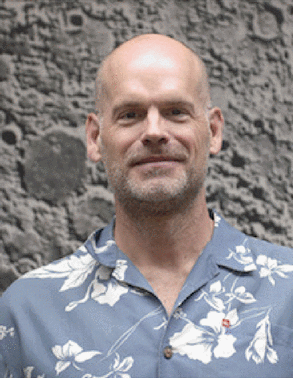 Robert Jedicke合作论文数11Peter M Tamblyn合作论文数11
 Christophe Dumas合作论文数11
 David A. Kring合作论文数Lunar and Planetary Institute10William Jon Merline合作论文数10William J. Merline合作论文数9Harold F. Levison合作论文数Department of Space Studies, Southwest Research Institute8Alex D. Storrs合作论文数8
 Robert J. Macke合作论文数8
 Laird M Close合作论文数Steward Observatory, University of Arizona;Department of Astronomy, University of Arizona8
 Naor Movshovitz合作论文数Dept . of Geophysics & Planetary Science;Tel Aviv University;Dept . of Geophysics & Planetary Science, Tel Aviv University7B. R. Tufts合作论文数7
 Joel Wm. Parker合作论文数Solar System Science and Exploration Division, Southwest Research Institute;University of Colorado7Kevin R. Housen合作论文数7E. B. Patmore合作论文数6A. N. Clayton合作论文数6j w kreft合作论文数6B. A. May合作论文数6
 Alessandro Morbidelli合作论文数Collège de France;Observatoire de la Côre d'Azur6
 David Vokrouhlicky合作论文数Astronomical Institute, Charles University6Brian L. Enke合作论文数6
 Dirk Terrell合作论文数Department of Space Studies;Southwest Research Institute;Department of Space Studies, Southwest Research Institute6Bo Ake Sture Gustafson合作论文数6David C. Slater合作论文数6K. R. Housen合作论文数5m d lipman合作论文数5B. L. Enke合作论文数5W. B. Colwell合作论文数5
 Daniel Scheeres合作论文数Celestial and Spaceflight Mechanics Laboratory, University of Colorado Boulder;Department of Aerospace Engineering Sciences, University of Colorado Boulder;Colorado Center for Astrodynamics Research, University of Colorado Boulder5
 Francois Menard合作论文数Institut de Planétologie et d’Astrophysique de Grenoble, Centre National de la Recherche Scientifique5




