This report presents the results of a U.S. review of the 1996 Detailed Design Report (DDR) of the International Thermonuclear Experimental Reactor (ITER) project. It was prepared by a panel established by the U.S. Department of Energy (USDOE) Fusion Energy Sciences Advisory Committee (FESAC) and was subsequently endorsed by FESAC and provided to the USDOE. Copies of the charge and transmittal letters are incorporated at the end of this paper. Also incorporated in this paper are the reports of several subpanels established to provide detailed review and recommendations on specific topics. The authors of those subpanel reports are acknowledged in the text. The ITER was subsequently reduced in size and scope; this review refers to the full-size ITER design as it was completed in 1996.
Results from the Tandem Mirror Experiment-Upgrade (TMX-U) demonstrate that radial transport in the plasma volume can be affected by the boundary conditions at the end wall. Measurements in which end-wall plates, mapping to the plasma core, are switched from floating to grounded during plugging operation demonstrate that this floating increases the build-up rate of the central cell plasma (by increasing the radial confinement time), steepens the core density profile, and affects the plasma throughout the entire cross section.
For pt.I see ibid., vol.19, p.237 (1977). It is shown that the kinetic equation for a plasma situated in a magnetic field, of a strength such that the ion Larmor radius is larger than the electron Debye length, has the form of a Fokker Planck equation in which the diffusion and friction coefficients can be derived from 'Rosenbluth potentials' in the usual manner. These 'magnetic Rosenbluth potentials' are however anisotropic, even if the plasma distribution functions is isotropic, because the magnetic field alters the dynamics of ion-electron collisions, and significantly enhances the duration of interaction of ions and electrons with no relative motion parallel to the magnetic field. The potentials are evaluated explicitly in the case of Maxwellian electrons.
Equations are derived which may be used to describe the propagation of electromagnetic waves in non-uniform magnetized plasma when the wave frequency is near the second electron cyclotron harmonic. The method used is to expand the linearized Vlasov equation in powers of the electron Larmor radius divided by a typical scale length. The general equations are then specialized to the problem of the coupling of transverse waves to the longitudinal modes (Bernstein modes) which exist when all quantities vary only in a plane perpendicular to a straight magnetic field. The form of these equations for two simple models of the equilibrium plasma is given. Comments are made about the equations for the higher harmonics, and the question of boundary conditions is discussed. Finally, the general equations are examined in the limit Ω→0 in order to provide equations suitable for the description of high frequency waves in non-magnetized plasmas.
ADVERTISEMENT RETURN TO ISSUEPREVArticleNEXTHeat Transfer in Beds of Oriented SpheresD. E. Baldwin Jr., R. B. Beckman, R. R. Rothfus, and R. I. KermodeCite this: Ind. Eng. Chem. Process Des. Dev. 1966, 5, 3, 281–284Publication Date (Print):July 1, 1966Publication History Published online1 May 2002Published inissue 1 July 1966https://doi.org/10.1021/i260019a016RIGHTS & PERMISSIONSArticle Views102Altmetric-Citations7LEARN ABOUT THESE METRICSArticle Views are the COUNTER-compliant sum of full text article downloads since November 2008 (both PDF and HTML) across all institutions and individuals. These metrics are regularly updated to reflect usage leading up to the last few days.Citations are the number of other articles citing this article, calculated by Crossref and updated daily. Find more information about Crossref citation counts.The Altmetric Attention Score is a quantitative measure of the attention that a research article has received online. Clicking on the donut icon will load a page at altmetric.com with additional details about the score and the social media presence for the given article. Find more information on the Altmetric Attention Score and how the score is calculated. Share Add toView InAdd Full Text with ReferenceAdd Description ExportRISCitationCitation and abstractCitation and referencesMore Options Share onFacebookTwitterWechatLinked InReddit PDF (404 KB) Get e-Alerts
AIChE JournalVolume 7, Issue 2 p. 352-352 Article Effect of entrance shape on flow between parallel plates R. R. Rothfus, R. R. Rothfus Carnegie Institute of Technology, Pittsburgh, PennsylvaniaSearch for more papers by this authorD. E. Baldwin Jr., D. E. Baldwin Jr. Carnegie Institute of Technology, Pittsburgh, PennsylvaniaSearch for more papers by this author R. R. Rothfus, R. R. Rothfus Carnegie Institute of Technology, Pittsburgh, PennsylvaniaSearch for more papers by this authorD. E. Baldwin Jr., D. E. Baldwin Jr. Carnegie Institute of Technology, Pittsburgh, PennsylvaniaSearch for more papers by this author First published: June 1961 https://doi.org/10.1002/aic.690070240Citations: 1AboutPDF ToolsRequest permissionExport citationAdd to favoritesTrack citation ShareShare Give accessShare full text accessShare full-text accessPlease review our Terms and Conditions of Use and check box below to share full-text version of article.I have read and accept the Wiley Online Library Terms and Conditions of UseShareable LinkUse the link below to share a full-text version of this article with your friends and colleagues. Learn more.Copy URL Share a linkShare onFacebookTwitterLinked InRedditWechat No abstract is available for this article.Citing Literature Volume7, Issue2June 1961Pages 352-352 RelatedInformation
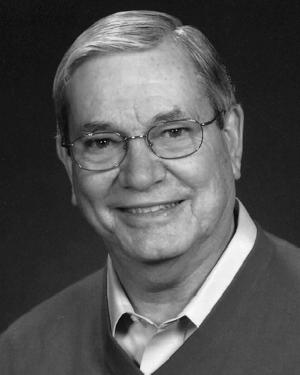 Richard E. Siemon合作论文数University of Nevada Physics Department3
 N. F. Ness合作论文数2So Dean合作论文数2
 John P. Holdren合作论文数Harvard Kennedy School, Harvard University;Department of Earth and Planetary Sciences, Harvard University;School of Engineering and Applied Sciences, Harvard University2
 Ronald R. Parker合作论文数Massachusetts Institute of Technology2
 Robert W. Conn合作论文数Kavli Foundation2David O. Overskei合作论文数2
 Floyd L. Culler合作论文数Electric Power Research Institute2K. H. Berkner合作论文数2H WEITZNER合作论文数2Robert R Rothfus合作论文数2RI KERMODE合作论文数1R. J. Briggs合作论文数1Ts Taylor合作论文数1
 Robert J. Goldston合作论文数Princeton University1
 Richard Hazeltine合作论文数Department of Physics, College of Natural Sciences, The University of Texas at Austin1R. Linford合作论文数1P. Rutherford合作论文数1
 Ronald C. Davidson合作论文数Plasma Physics Laboratory, Princeton University1E Bickford Hooper合作论文数1T. Kenneth Fowler合作论文数University of California,Berkeley1Richard P. Hora合作论文数1
 Robert L. McCrory合作论文数Department of Physics and Astronomy, School of Arts & Sciences, University of Rochester;Department of Mechanical Engineering, Hajim School of Engineering & Applied Sciences, University of Rochester1
 Don Steiner合作论文数Rensselaer Polytechnic Institute1Daniel A. Dreyfus合作论文数1John Sheffield合作论文数1
 Mohamed Abdou合作论文数Samueli School of Engineering, University of California, Los Angeles;Fusion Science and Technology Center, University of California, Los Angeles;Center for Energy Science and Advanced Technology Research1B. H. Ripkin合作论文数1C J H Watson合作论文数1
 James Callen合作论文数Department of Engineering Physics, College of Engineering, University of Wisconsin-Madison1WB GAUSTER合作论文数1d a defreece合作论文数1Peter Staudhammer合作论文数1
 W. C. Turner合作论文数1




