Received 11 November 2022DOI:https://doi.org/10.1103/PhysRevC.106.069901©2022 American Physical SocietyPhysics Subject Headings (PhySH)Research AreasElectromagnetic transitionsEnergy levels & level densitiesNuclear structure & decaysProperties90 ≤ A ≤ 149Nuclear Physics
Received 3 October 2022DOI:https://doi.org/10.1103/PhysRevC.106.049902©2022 American Physical SocietyPhysics Subject Headings (PhySH)Research AreasCollective levelsElectromagnetic transitionsEnergy levels & level densitiesNuclear structure & decaysProperties90 ≤ A ≤ 149Nuclear Physics
The beta decay of the most neutron-rich iron isotopes was investigated, leading to the first determination of the Fe-72 half-life and new measurements of the half-lives of Fe69-71. The experimental results are compared with theoretical predictions and presented in the context of the weak astrophysical rapid neutron capture process.
Additional information is reported on single-neutron states above the doubly closed-shell nucleus Sn-132. A radioactive ion beam of Te-134(N = 82) at 565 MeV and a stable ion beam of Xe-136(N = 82) at 560 MeV were used to study single-neutron states in the N = 83 nuclei Te-135 and Xe-137, respectively, by (C-13, C-12 gamma) and (Be-9, Be-8 gamma) direct reactions in inverse kinematics. Particle-gamma and particle-gamma-gamma coincidence measurements using CsI and HPGe arrays allowed determination of decay paths, high-precision level energies, multipolarities of transitions, and relative cross sections. One-neutron transfer with heavy ions is employed to gain selectivity to both low- and high-spin single-neutron states above the N = 82 shell closure. Results are presented for the 13/2(1)(+) states in the N = 83 nuclei Te-135 and Xe-137 at 2108.8(9) keV and 1752.6(3) keV, respectively, and for the 3(1)(-) collective octupole state observed at 3749(5) keV in Te-134(N = 82) inelastic scattering, all previously unknown. While the 13/2(1)(+) state (or nu 1i(13/2) centroid) in Sn-133(Z = 50, N = 83) remains unknown, the present results provide the best empirical prediction of its energy available to date.
By means of γ-γ-γ and γ-γ(θ) measurements of prompt fission γrays from 252Cf using Gammasphere, new insights have been gained into the A~100 (Z~40, N>56) neutron-rich region, which has long been of interest for shape transitions, shape coexistence and onset of deformations. The systematic investigations of odd-Z isotopes have revealed a shape transition from axially symmetric shapes with very large quadrupole deformations in Z=39 (Y) to near maximum triaxial shapes with moderate quadrupole deformations in Z=43(Tc), 44 (Ru),45(Rh)isotopes. The Nb(Z=41)isotopes are found to be transitional with regard to this shape transition. The band-crossings observed in the even-N Tc and Rh isotopes are attributed to alignment of a pair of h11/2 neutrons. The long-expected sudden shape transition in Nb isotopic chain is now observed. The long-sought high-spin level scheme and deformed states in 100Nb (N=59) were identified. The ground state of 100Nb was found to be strongly deformed, in disagreement with existing theory. The'shape coexistence was confirmed in the nucleus, and the sudden shape transiti0n in the Nb isotopic chain was seen to occur between N=58 (spherical) to N=59 (strongly deformed), in contrast to the sudden shape transition from N=59 (spherical) to N=60 (strongly deformed) in Sr (Z=38), Y (Z=39) and Zr (Z=40) isotopic chains. The observation of strongly deformed ground state in 100Nb and its very large and irregular moments of inertia make 100Nb an especially interesting case for further theoretical studies. Recent detailed studies of octupole excitations in odd-Z Cs (Z=55) and La (Z=57) isotopes have discovered a sharp drop in electric dipole moments Do in the Cs isotopic chain 141,143. 144Cs,and, most likely, the previously reported moderate drop in Do in 145, 147La is extended sharply down in 148La. The sharp drops of Do in Cs and La are most likely analogous to those reported in 146Ba and 224Ra, which were accounted for by the reflection-asymmetric mean field shell correction theory. The very large Do in both 141Cs and 142Xe and the simplex-dependent Do deduced in 141Cs but not in 143Cs need further theoretical studies. Based on rotational frequency ratios,ω- (I)/ω+(I), octupole vibrations are proposed in Cs isotopes, like the cases in Xe isotopes, while octupole deformations are suggested in La isotopes.
(Section 1 and Section 2): New insights have been gained into the frontiers of nuclear structure of neutron-rich nuclei by means of γ-γ-γ and γ-γ(θ) coincidences of prompt γ rays emit-ted in the spontaneous fission of 252Cf at Gammasphere. Over 5.7×10¹¹ triple-and higher-fold co-incidence events and the less-compressed cube data provide excellent conditions for searches and studies over a wide unknown range with more neutron excess. High-spin yrast and near yrast level schemes of neutron-rich nuclei in regions of physics interest have been identified for the first time,or extensively extended and expanded compared to previous preliminary measurements.Chiral symmetry breaking was recently identified in even-even neutron-rich 110,112 Ru and 108 Mo isotopes. The former have the largest lowering of ground state energy when axial symmetry is bro-ken, and near maximum triaxiality was deduced in the isotopes. By exhibiting all the fingerprints for chiral doubling, especially the best energy degeneracy, the doublet bands observed in these Ru and Mo isotopes are the best examples of chiral properties reported in this region. The evolution of chirality from γ-soft 108 Ru to triaxial110, 212 Ru is proposed. Tilted axis cranking (TAC) calculations extended by random phase approximation (RPA) calculations can explain the features of the dou-blet bands in terms of a soft chiral vibration for these even-even nuclei. The chirality in these even-even nuclei cannot be reduced to the simple geometrical picture as in odd-odd nuclei. Instead, in these even-even nuclei the tendency to chirality comes about from the interplay of all the neutrons in the open shell.Systematic studies of the N=83 isotonic chain in the vicinity of the doubly-magic 132Sn have yielded a wealth of spectroscopic information in this attractive region. The new data of N=83 iso-tones135Te (Z=52), 136>I (Z=53), 137Xe (Z=54), 138Cs (Z=55) and 139Ba (Z=56), especially the observation of the long-sought level scheme of 138Cs, and shell model calculations, indicate the key role played by the coupling of the excitations of the few g7/2 valence protons outside the Z= 50 major shell closure and the f7/2 valence neutrons outside the N=82 major shell closure. Resem-blance of spectroscopy and counterparts were observed between the 132 Sn region and 208Pb region.Tilted rotation(magnetic rotation) was observed in 135 Te, which is the first observation of magne-tic rotation in the vicinity of 132Sn.
In an experiment carried out at the 4 pi Ge detector facility Gammasphere the yields of ternary fission events of Cf-252 accompanied by the emission of He, Be and C LCPs were measured. For the first time independent yields were measured for 59 pairs of secondary fragments of the He ternary fission and for many fission fragments detected together with the He, Be and C LCPs. With a reasonable assumption that the detected LCPs predominantly are He-4, Be-10 and C-14 their yields and the charge distributions of fission fragments were conjointly analyzed in terms of the "energy cost" concept first suggested by Halpern.
We have reinvestigated the beta decay of the three isomers of Ag-116 at the Holifield Radioactive Ion Beam Facility (HRIBF). Through the use of half-life information, we have been able to construct individual decay schemes for each isomer and correct what was a puzzling inconsistency with the published data, namely the beta feeding of 2(+) states by a 5(+) isomer. Our results indicate that the feeding of these levels arises from a 3(+) isomer in Ag-116. A total of 271 gamma-ray transitions (159 new) were assigned to 148 levels (94 new) from the beta decay of Ag-116(m1,m2,gs). Significant deviations are observed from IBM-2 calculations for the decay of the 0(+) and 2(+) members of the previously assigned three-phonon quintuplet. Candidate states for the quadrupole-octupole quintuplet states and pi g(9/2)-pi p(1/2), pi g(9/2)-pi p(3/2), nu h(11/2)-nu s(1/2), nu h(11/2)-nu d(3/2), and nu h(11/2)-nu d(5/2) broken-pair states are assigned.
We have re-investigated the beta decay of the three isomers of $$^{116}$$Ag at the Holifield Radioactive Ion Beam Facility (HRIBF). Through the use of half-life information, we have been able to construct individual decay schemes for each isomer, and correct what was a puzzling inconsistency with the published data, namely the beta feeding of 2$^+$ states by a 5$^+$ isomer. Our results indicate that the feeding of these levels arises from a 3$^+$ isomer in $$^{116}$$Ag. A total of 271 gamma-ray transitions (159 new) were assigned to 148 levels (94 new) from the beta-decay of $$^{116m1,m2,gs}$$Ag. Significant deviations are observed from expected U(5) symmetry in the 0$^+$ and 2$^+$ members of the previously assigned three-phonon quintuplet. Candidate states for the quadrupole-octupole quintuplet states and $$\pi$$g$$_{9/2}-\pi$$p$$_{1/2}$$, $$\pi$$g$$_{9/2}-\pi$$p$$_{3/2}$$, $$\nu$$h$$_{11/2}-\nu$$s$$_{1/2}$$, $$\nu$$h$$_{11/2}-\nu$$d$$_{3/2}$$, and $$\nu$$h$$_{11/2}-\nu$$d$$_{5/2}$$ broken pair states are assigned.
The high-spin level schemes of odd–odd 100Nb (Z=41, N=59) and 148La (Z=57, N=91) were identified from γ–γ–γ coincidence studies of prompt γ rays in the spontaneous fission of 252Cf with Gammasphere. Spin/parity assignments for the levels in these two nuclei were made based on the low-lying levels assigned in decay work, on the internal conversion coefficient (ICC) measurements and the level systematics of the neighboring isotopes. A Kπ=1+ deformed ground-state band was identified in 100Nb. The onset of ground-state deformation in Nb isotopes is found to take place at N=59, in contrast to N=60 for Sr (Z=38), Y (Z=39) and Zr (Z=40) isotopes. Unlike the observation in 99Nb, the N=56 subshell closure seems to be no longer dominant in 100Nb. The bands observed in 148La are interpreted as aligned coupling of [πh11/2υh9/2]lowJ to the deformed core rotor.
The yrast and near-yrast level scheme of light neutron-rich 143La (Z=57, N=86) is reinvestigated and expanded and that of 144La (N=87) is proposed for the first time by measuring prompt γ rays from the spontaneous fission of 252Cf at Gammasphere. Spins/parities are assigned to the lowest-lying levels of 143,144La based on the early studies of β− decay, and the assignments for high-spin levels of 143,144La are made by measuring internal conversion coefficients and following the level systematics of the neighboring heavier La isotopes and even–even Ba and Ce nuclei. The B(E1)/B(E2) ratios, energy displacements δE(I) and rotational frequency ratios ω−(I)/ω+(I) of the new parity-doublets of 143,144La indicate that octupole deformations/correlations also develop in these nuclei. The band-crossings observed in a rotational frequency range of 0.31 to 0.34 MeV for the two even-parity bands in 143La but being absent in 144La are interpreted as due to alignment of a pair of i13/2 neutrons in 143La.
Recent experiments designed for the multi-parameter analysis of Cf-252 spontaneous fission are described. The technique of multiple gamma-ray spectroscopy was supplemented with the measurements of kinematical characteristics of fission fragments and light charged particles emitted in ternary fission.
Triple coincidence data from the fission of Cf-252 were used to deduce the intensity of the proposed "hot" mode in barium channels. gamma-gamma-gamma and alpha-gamma-gamma fission data were analyzed to find the neutron multiplicity distribution for several binary and ternary charge splits. The binary channels Xe-Ru and Ba-Mo were analyzed, as well as the Ba-alpha-Zr, Mo-alpha-Xe, and Te-alpha-Ru ternary channels. An improved method of analysis was used in order to avoid many of the complexities associated with fission spectra. With this method, we were able to place an upper limit of 1.25% for the relative intensity of the second mode in the Ba-Mo case. For the Ba-alpha-Zr case, we found a relative intensity of 17% for the second mode.
The systematics of the pi h(11/2)circle times nu h(11/2) and pi h(11/2)circle times nu s(1/2) isomeric configurations were studied for the odd-Z N=77 isotones near the proton dripline. The spin and parity of I-pi = 8(+) and 5(-) were deduced for the isomers in (140)'Eu and Tb-142. No evidence for the expected 1(+) ground-state was found in the Ho-144 decay data. The proton emission from Tm-146 was restudied and the spin and parity values of I-pi = 10(+) and 5(-) were established for Tm-146 and Tm-146gs, respectively. The interpretation of the observed decay properties and structure of the proton-emitting states was made by accounting for deformation and proton and neutron coupling to the core excitations.
 J. K. Hwang合作论文数Department of Physics, Vanderbilt University88Jh Hamilton合作论文数83
 Akunuri V. Ramayya合作论文数Physics and Astronomy81
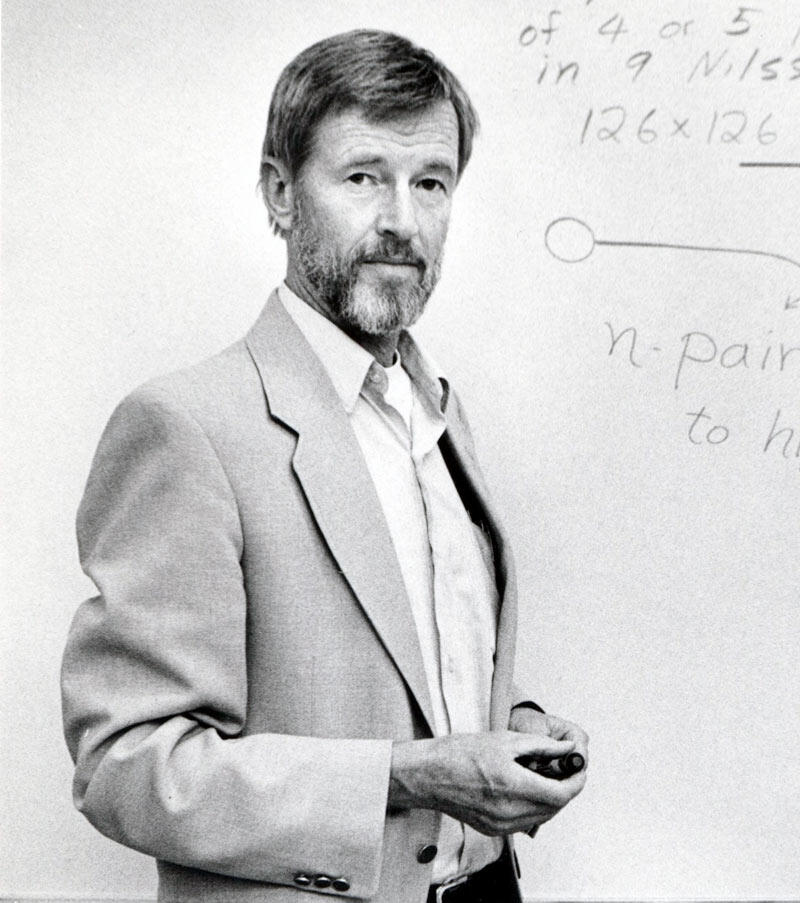 John O. Rasmussen合作论文数College of Chemistry, University of California63
 Raul Jose Donangelo合作论文数Instituto de Física, Universidade Federal do Rio de Janeiro53Av Daniel合作论文数48J. D. Cole合作论文数48
 Mark Alan Stoyer合作论文数46Y. X. Luo合作论文数43
 Shengjiang Zhu (朱胜江)合作论文数Department of Physics, Tsinghua University38
 Carrol R Bingham合作论文数Department of Physics & Astronomy, University of Tennessee36Iy Lee合作论文数35W. Królas合作论文数35
 J. C. Batchelder合作论文数Lousiana State University35
 Robert Grzywacz合作论文数Department of Physics & Astronomy, College of Arts and Sciences, University of Tennessee34
 Konrad Rykaczewski合作论文数School for Engineering of Matter, Transport and Energy, Arizona State University33Gm Ter Akopian合作论文数31
 Yuri Tsolakovich Oganessian合作论文数Flerov Laboratory of Nuclear Reactions, Joint Institute for Nuclear Research31
 Jeff Allen Winger合作论文数UNIRIB, Oak Ridge Associated Universities31A. Piechaczek合作论文数29Pm Gore合作论文数29
 A. S. Fomichev合作论文数29Gs Popeko合作论文数28Am Rodin合作论文数28
 Edward F Zganjar合作论文数28J. Kormicki合作论文数28L. Krupa合作论文数26J. Kliman合作论文数Joint Institute for Nuclear Research Flerov Laboratory of Nuclear Reactions Dubna, Moscow oblast 141980 Russia Dubna, Moscow oblast 141980 Russia26s c wu合作论文数25Mohammed Noor Tantawy合作论文数25Thomas Nelson Ginter合作论文数25
 G. M. Ter-Akopian合作论文数22Marian Jandel合作论文数Los Alamos National Laboratory22Evan F. Jones合作论文数21
 Augusto O. Macchiavelli合作论文数Lawrence Berkeley National Laboratory20CJ Gross合作论文数19Y. Larochelle合作论文数Oak Ridge National Laboratory19David J Hartley合作论文数Department of Physics and Astronomy, University of Tennessee19P Gore合作论文数17Dan Shapira合作论文数17Wc Ma合作论文数16Ke Li合作论文数15C.-H. Yu合作论文数14
 Paul Fallon合作论文数Department of Low Energy Nuclear Science, Nuclear Science Division, Lawrence Berkeley National Laboratory14Christopher T. Goodin合作论文数14CJ Beyer合作论文数13M. Karny合作论文数12E. H. Spejewski合作论文数11
 Jeanchristophe Bilheux合作论文数Oak Ridge National Laboratory;University of Versailles;Oak Ridge National Laboratory, University of Versailles11




