We investigate in the Matrix theory framework, the subgroup of dualities of the DLCQ of M-theory compactified on three-tori, which corresponds to T-duality in the auxiliary Type II string theory. We show how these dualities are realized in the supersymmetric YangMills gauge theories on dual noncommutative three-tori. PACS 11.15.-q, 11.25.-w. *This work was supported in part by the Director, Office of Energy Research, Office of High Energy and Nuclear Physics, Division of High Energy Physics of the U.S. Department of Energy under Contract DE-AC03-76SF00098 and in part by the National Science Foundation under grant PHY-95-14797 t email address: brace@thwk2.lbl.gov temail address: morariu@thsrv.lbl.gciv §email address: zumino@thsrv.lbl.gov
We present an Sp(2n,R) duality invariant Born-Infeld U(1)2n gauge theory with scalar fields. To implement this duality we had to introduce complex gauge fields and as a result the rank of the duality group is only half as large as that of the corresponding Maxwell gauge theory with the same number of gauge fields. The latter is self-dual under Sp(4n,R), the largest allowed duality group. A special case appears for n = 1 when one can also write an SL(2,R) duality invariant Born-Infeld theory with a real gauge field. We also describe the supersymmetric version of the above construction.
We consider Neveu-Schwarz pp-waves with spacetime supersymmetry. Upon compactification of a spacelike direction, these backgrounds develop Closed Null Curves (CNCs) and Closed Timelike Curves (CTCs), and are U-dual to supersymmetric Godel type universes. We study classical and quantum strings in this background, with emphasis on the strings winding around the compact direction. We consider two types of strings: long strings stabilized by NS flux and rotating strings which are stabilized against collapse by angular momentum. Some of the latter strings wrap around CNCs and CTCs, and are thus a potential source of pathology. We analyze the partition function, and in particular discuss the effects of these string states. Although our results are not conclusive, the partition function seems to be dramatically altered due to the presence of CNCs and CTCs. We discuss some interpretations of our results, including a possible sign of unitary violation.
We consider radial oscillations of supertube probes in the Gödel-type background, which is U-dual to the compactified pp-wave obtained from the Penrose limit of the NS five-brane near horizon geometry. The supertube probe computation can be carried over directly to a string probe calculation on the U-dual background. The classical equations of motion are solved exactly. In general, the probe is not restricted to travel unidirectionally through any global time coordinate. In particular, we find geodesics that close in spacetime. Ignoring gravitational backreaction, a supertube traveling along such a geodesic will contribute divergently to the energy momentum tensor, indicating that, in fact, backreation cannot be ignored and that the classical background in the presence of stringy matter is not stable.
We study classical supertube probes on supergravity backgrounds which are sourced by over-rotating supertubes, and which therefore contain closed timelike curves. We show that the BPS probes are stable despite the appearance of negative kinetic terms in the probe action. By studying the radial oscillations of these probes, we show that closed geodesics exist on these backgrounds.
We study classical supertube probes on supergravity backgrounds which are sourced by over-rotating supertubes, and which therefore contain closed timelike curves. We show that the BPS probes are stable despite the appearance of negative kinetic terms in the probe action. By studying the radial oscillations of these probes, we show that closed geodesics exist on these backgrounds.
We consider radial oscillations of supertube probes in the Godel-type background which is U-dual to the compactified pp-wave obtained from the Penrose limit of the NS five-brane near horizon geometry. The supertube probe computation can be carried over directly to a string probe calculation on the U-dual background. The classical equations of motion are solved explicitly. In general, the probe is not restricted to travel unidirectionally through any global time coordinate. In particular, we find geodesics that close.
In this paper, we describe a method for obtaining the nonabelian Seiberg-Witten map for any gauge group and to any order in θ. The equations defining the Seiberg-Witten map are expressed using a coboundary operator, so that they can be solved by constructing a corresponding homotopy operator. The ambiguities, of both the gauge and covariant type, which arise in this map are manifest in our formalism.
We discuss two examples of duality. The first arises in the context of toroidal compactification of the discrete light cone quantization of M-theory. In the presence of nontrivial moduli coming from the M-theory three form, it has been conjectured that the system is described by supersymmetric Yang-Mills gauge theory on a noncommutative torus. We are able to provide evidence for this conjecture, by showing that the dualities of this M-theory compactification, which correspond to T-duality in Type IIA string theory, are also dualities of the noncommutative supersymmetric Yang-Mills description. One can also consider this as evidence for the accuracy of the Matrix Theory description of M-theory in this background. The second type of duality is the self-duality of theories with U(1) gauge fields. After discussing the general theory of duality invariance for theories with complex gauge fields, we are able to find a generalization of the well known U(1) Born-Infeld theory that contains any number of gauge fields and which is invariant under the maximal duality group. We then find a supersymmetric extension of our results, and also show that our results can be extended to find Born-Infeld type actions in any even dimensional spacetime.
We present a cohomological method for obtaining the non-abelian Seiberg-Witten map for any gauge group and to any order in theta. By introducing a ghost field, we are able to express the equations defining the Seiberg-Witten map through a coboundary operator, so that they can be solved by constructing a corresponding homotopy operator.
We show that the Born–Infeld theory with n complex abelian gauge fields written in an auxiliary field formulation has a U(n,n) duality group. We conjecture the form of the Lagrangian obtained by eliminating the auxiliary fields and then introduce a new reality structure leading to a Born–Infeld theory with n real gauge fields and an Sp(2n,R) duality symmetry. The real and complex constructions are extended to arbitrary even dimensions. The maximal noncompact duality group is U(n,n) for complex fields. For real fields the duality group is Sp(2n,R) if half of the dimension of space-time is even and O(n,n) if it is odd. We also discuss duality under the maximal compact subgroup, which is the self-duality group of the theory obtained by fixing the expectation value of a scalar field. Supersymmetric versions of self-dual theories in four dimensions are also discussed.
We present an Sp(2n,R) duality invariant Born-Infeld U(1)^2n gauge theory with scalar fields. To implement this duality we had to introduce complex gauge fields and as a result the rank of the duality group is only half as large as that of the corresponding Maxwell gauge theory with the same number of gauge fields. The latter is self-dual under Sp(4n,R), the largest allowed duality group. A special case appears for n=1 when one can also write an SL(2,R) duality invariant Born-Infeld theory with a real gauge field. We also describe the supersymmetric version of the above construction.
In this paper we prove a conjecture regarding the form of the Born–Infeld Lagrangian with a U(1)2n gauge group after the elimination of the auxiliary fields. We show that the Lagrangian can be written as a symmetrized trace of Lorentz invariant bilinears in the field strength. More generally, we prove a theorem regarding certain solutions of unilateral matrix equations of arbitrary order. For solutions which have perturbative expansions in the matrix coefficients, the solution and all its positive powers are sums of terms which are symmetrized in all the matrix coefficients and of terms which are commutators.
We present an Sp(2n,R) duality invariant Born-Infeld U(1)2n gauge theory with scalar fields. To implement this duality we had to introduce complex gauge fields and as a result the rank of the duality group is only half as large as that of the corresponding Maxwell gauge theory with the same number of gauge fields. The latter is self-dual under Sp(4n,R), the largest allowed duality group. A special case appears for n = 1 when one can also write an SL(2,R) duality invariant Born-Infeld theory with a real gauge field. We also describe the supersymmetric version of the above construction.
We investigate in the Matrix theory framework, the subgroup of dualities of the DLCQ of M-theory compactified on three-tori, which corresponds to T-duality in the auxiliary Type II string theory. We show how these dualities are realized in the supersymmetric Yang-Mills gauge theories on dual non-commutative three-tori.
We investigate T-duality of toroidally compactified Matrix model with arbitrary Ramond-Ramond backgrounds in the framework of non-commutative super Yang-Mills gauge theory.
We calculate, using noncommutative supersymmetric Yang-Mills gauge theory, the part of the spectrum of the toroidally compactified Matrix theory which corresponds to quantized electric fluxes.
 Bogdan Morariu合作论文数10
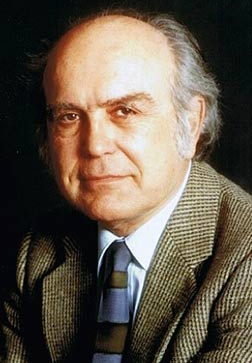 Bruno Zumino合作论文数Department of Physics, University of California, Berkeley9Paolo Aschieri合作论文数Dipartimento di Scienze e Tecnologie Avanzate, Universita del Piemonte3B. Zumino合作论文数2B. L. Cerchiai合作论文数Arnold Regge Ctr2A. F. Pasqua合作论文数1
 Uday Varadarajan合作论文数Theory Group;Physics Department;University of Texas at Austin;Theory Group, University of Texas at Austin1
 Carlos Herdeiro合作论文数Mathematics Department, Aveiro University1
 Shinji Hirano合作论文数Department of Physics;Israel Institute of Technology;Department of Physics, Israel Institute of Technology1




