The importance of DC microgrids is growing in the realm of the today's electrical energy distribution networks. When it comes to the configuration of DC microgrids, several options exist. Yet, two structures have emerged as the most widely adopted: unipolar and bipolar DC microgrids. Consequently, their interconnection could be crucial for various applications. Given that these microgrids can operate at significantly different voltage levels, interconnection must account for this variation. Accordingly, this paper introduces a novel bidirectional DC‑DC converter with a high voltage step-up/down ratio for interconnecting these two DC microgrids. The converter boasts a non-isolated configuration, enabling the transfer of energy between DC microgrids while simultaneously supporting the balance of the bipolar infrastructure. Results from the experimental tests obtained from a laboratory prototype showing the capability to transfer energy in both directions are presented. The findings indicate that the proposed solution aligns with the anticipated outcomes.
This paper presents the design, modeling, and control of a single-stage three-phase buck-boost rectifier designed for high power factor operation in bipolar DC grid applications. The proposed topology supports bidirectional voltage step-up and step-down, allowing efficient interfacing between $A C$ sources and bipolar $D C$ systems. A vectorial slidingmode current control strategy is adopted to achieve near-unity power factor and quasi-sinusoidal input currents. Simulation studies demonstrate the effectiveness of the proposed converter, achieving low total harmonic distortion (THD), fast transient dynamics, and robust voltage regulation under variable load conditions.
DC microgrids have begun to play a significant role within the broader landscape of the electric distribution systems. There are different structures for these microgrids in which their inherent structural characteristics require the development of novel topologies. Within this context, novel non-isolated DC-DC Boost and Buck-Boost converters are introduced in this article. Its key characteristics include a simplified topological structure, reduced voltage stress on the switch, and continuous input current. These are all enabled by the use of a single switch. The topologies are developed for unipolar or bipolar DC microgrids. In the case of the topology that is specially adapted for the bipolar DC microgrid, although the converter uses only one switch, its output currents depend on the voltage level of the bipolar DC microgrid. Thus, if the microgrid experiences any imbalance, the converter will support the pole with the lower voltage level to help maintain the microgrid’s balance. The topologies are also characterized by a wider voltage range and reduced switch voltage stress when compared with conventional topologies. Verification of these converter’s analysis and operation will be conducted via simulation and experimental tests. These different types of tests will yield results that confirm the theoretical analysis and assumptions.
DC-DC power converters are essential to provide the integration of Renewable Energy Sources in DC Microgrids applications, contributing to global decarbonization. Most applications require DC-DC converters with high-voltage conversion ratios to harness as much energy as possible. DC-DC power converters with differential connections are a possible solution to extend the voltage gains when other topologies are unable to achieve it. This paper presents a new symmetric interleaved DC-DC quadratic converter with differential connections with wide static voltage gain. Operating in interleaved mode, this topology leverages the differential concept to reduce inductor size and achieve continuous input current. The proposed topology also benefits from Partial Power Processing to handle only the mismatch power between source and load instead of the full load power. This article describes the proposed converter, along with its main equations and waveforms in continuous conduction mode with interleaved phase-shift PWM. The main waveforms of the proposed converter are demonstrated using computer simulations. Additionally, a laboratory prototype was developed to obtain preliminary confirmation of the results.
Driven by the growing trend toward highefficiency, high-gain converters with reduced component count, many new step-up topologies have emerged. In this context, a new single-switch, non-isolated DC-DC step-up converter topology has been introduced, tailored explicitly for renewable energy applications. The proposed topology exhibits several key advantages, namely a high boost factor, continuous input current, reduced voltage stress on all power semiconductors, and a favorable component count relative to the achieved boost factor. These features satisfy numerous critical design objectives, namely for photovoltaic applications. The steadystate analysis of the proposed converter is then presented and discussed. To validate the theory and performance of the converter, simulation results are presented.
Induction machines play a crucial role in industrial applications, making preventive maintenance combined with fault diagnosis techniques essential for ensuring reliable operation. One of the most widely used diagnostic methods for induction machines is Motor Current Signature Analysis (MCSA). However, this technique has certain limitations, particularly in the detection of incipient or small faults. Another well-established technique is Motor Square Current Signature Analysis (MSCSA), which overcomes some of the limitations of MCSA by extracting additional fault-related information from the motor current signals. This paper proposes a new diagnostic technique, designated MSCSA-APT (Motor Square Current Signature Analysis–Alternative Park Transform), based on the spectral analysis of motor currents. Compared with the conventional MSCSA method, the proposed approach provides additional information from the frequency-domain analysis, thereby improving fault detection capability. The method is based on the square of the motor square current signal and employs an Alternative Park Transform (APT) to enhance the extraction of fault signatures. Simulation and experimental results are presented to validate the proposed approach. Although the method has been evaluated for the identification of different types of faults, it is particularly effective in detecting stator short-circuit faults.
The bipolar DC microgrid is an increasingly attractive alternative for DC power distribution. While offering several benefits compared to conventional DC network topologies, a significant drawback is the potential for voltage unbalance. Such unbalance manifests as disparities between the positive and negative pole voltages, typically stemming from asymmetrical power sourcing or loading conditions. Thus, a new Switched Reluctance Machine (SRM) drive, optimized for bipolar DC microgrid applications, is presented in this paper. To aid in rebalancing the microgrid voltage during unbalanced conditions, the presented converter will exclusively use the pole with the higher absolute voltage to feed the unipolar load. The proposed converter’s analysis is presented and discussed. Besides that, simulation studies and laboratory prototype validation for the new SRM drive are presented and discussed.
This paper introduces a novel modular voltage source inverter, emphasizing high-voltage gain, reduced harmonic distortion and reduced blocking voltage over all power semiconductors. The proposed solution features a three-phase transformerless, nine-level voltage source inverter designed to minimize the number of passive components while achieving a high-voltage gain of up to four times the input DC voltage. The solution results in a substantial reduction in the total voltage blocking requirement, facilitates the standardization of power semiconductors, and enhances the modularity of the converter structure. Additionally, the proposed solution exhibits inherent voltage self-balancing capability, effectively addressing potential balancing challenges associated with the two floating capacitors in each voltage source inverter. The theoretical framework will be validated through several simulation results.
Bipolar DC microgrids have started to play an important role in the context of DC microgrids. However, due to their structural particularities, the development of new topologies is necessary. In this context, this paper presents a new non-isolated DC-DC Buck-Boost converter. This converter is characterized by a simplified topological structure, as it requires only a single switch. Additionally, it is characterized by continuous input current. Although it uses only one switch, the converter's output currents will depend on the voltage level of the bipolar DC microgrid. Thus, if the microgrid experiences any imbalance, the converter will support the pole with the lower voltage level to help maintain the balance of the microgrid. The analysis and operation of this converter will be verified through simulation and experimental tests.
Applications like distributed generation systems often necessitate high voltage gain DC-DC converters. To achieve high voltage gain, converters with differential connections have been proposed. A new DC-DC converter utilizing differential connections is presented in this paper. Two DC-DC converters with high step-up static voltage gain and minimal switch count are used with a differential connection to obtain a wider static voltage gain. Operating in interleaved mode, this topology leverages the differential concept to achieve a reduction in inductor size. Additionally, the converter operates with continuous input current and allows for significant reduction in the voltage stress of the switches and capacitors. The article describes the proposed converter, along with its main equations and waveforms in continuous conduction mode with interleaved modulation. The key waveforms of the proposed converter are demonstrated using computer simulations. Additionally, a laboratory prototype was developed to obtain experimental confirmation of the results.
The paradigm of electricity production is currently changing with the production being now based on renewable energies, as for example, the photovoltaic (PV) generation, with easily installations on roofs of the residential consumers. This decentralized generation or microgeneration typically injects a part of the energy produced into the grid. However, since the classical power distribution network was designed for a unidirectional power flow, there are currently some problems associated with the bidirectional power flow due to the high number of photovoltaics generations. In fact, this lead to overvoltage's and high losses in the grids. One way to improve the integration of small-scale renewable energy sources into low-oltage networks and enhance the quality of energy in the distribution network is to design hybrid networks composed of DC grids, in addition to the existing AC grids This paper presents a study on the impact of photovoltaic generation integration on low voltage AC grids and explores different scenarios using a hybrid grid topology (AC and DC) as a way to mitigate these effects
Despite their inherent robustness, Switched Reluctance Motors (SRMs) are not immune to faults. A fault within any part of the motor drive can have severe system-level implications, potentially causing unexpected shutdowns if not quickly addressed. Among drive components, the power converter exhibits the highest vulnerability to failure. Consequently, extensive research has been conducted on hardware structure reconfiguration for drive fault handling in safety-critical applications. These techniques include adding redundant switches, modifying the power converter topology, and employing multilevel converters with inherent fault-tolerance capabilities. However, ensuring full fault tolerance in multilevel converters typically requires a high number of switches. Thus, in order to minimize the increase in component count, a new fault-tolerant power converter topology for 8/6 SRM drives is proposed. The operation of the drive will be analyzed under normal and fault-tolerant conditions. The validity of the claimed system characteristics will be substantiated through a series of simulation studies.
Several applications require bidirectional power converters with high-voltage gain. While several topologies have been proposed, none of them exhibit Buck-Boost characteristics in both forward and reverse power transfer. Most proposals behave as a Boost converter in forward direction and as a Buck converter in the reverse direction. Therefore, this paper proposes a novel DC-DC bidirectional power converter that exhibits Buck-Boost characteristics in both power flow directions while providing very high wide voltage gain range. The proposed converter has, in addition, the ability to maintain continuous currents in the input and output. The theoretical analysis of the converter under bidirectional power flow conditions will be presented and examined, along with the design of its components. The validation of the characteristics and behavior of the proposed bidirectional power converter were tested in several laboratory experiments. The experimental results obtained from both power flow directions show agreement with the theoretical considerations.
This paper introduces a novel DC-DC converter based on the differential concept. This topology can operate in interleaved mode, which, together with the differential concept, allows for a reduction in the size of the inductors. This converter is also characterized by their continuous input current. Moreover, it is also characterized by an extended voltage range when compared with the classical Buck-Boost converter. Another aspect, is that the voltage stress across the switches is reduced when compared with the output voltage. The same regarding the voltage stress across the capacitors. The proposed converter will be tested through the one of the most used simulation tools, as well as, by a laboratory prototype.
This paper presents a novel approach to enhancing modular voltage source inverters, focusing on achieving high-voltage gain and minimizing harmonic distortion. The suggested solution includes a transformerless, single-phase, nine-level voltage source inverter that cuts down on the number of passive parts that are needed while still achieving a high-voltage gain of up to four times the input DC voltage sources. An essential feature of this topology is that all the switches are subjected to a maximum blocking voltage four times lower than the maximum AC voltage that can be applied to the load. Consequently, this leads to a significant reduction in the Total Voltage Blocking, standardization of the power semiconductors, and converter modularity structure. Furthermore, the proposed inverter topology presents voltage self-balancing capability, eliminating any balancing issues for the two floating capacitors of each voltage source inverter. The theoretical assumptions put forward in this study will be tested through experimental results obtained from a laboratory prototype.
This paper presents a buck-boost DC-DC converter design featuring a wider voltage gain capability. The proposed topology offers advantages such as continuous input current and a common ground connection shared by the input and output ports. The proposed converter's low input current ripple makes it particularly suitable for renewable energy applications, such as photovoltaic (PV) systems. In contrast to conventional buck-boost converters, which typically invert the output voltage polarity, this design delivers a positive output voltage. Additionally, the converter employs only a single main switch, which also benefits from reduced voltage stress, enhancing both reliability and operational efficiency. The converter's operation is grounded in detailed mathematical modeling, with simulation and experimental validation confirming consistency between theoretical predictions and practical performance.
This paper presents a new high-voltage gain single-phase seven -level Boost inverter topology with reduced harmonic distortion. The proposed solution introduces a transformerless multilevel voltage source inverter with reduced number of passive and active power components using only a single input DC power source. The maximum voltage gain is three times higher than the input power source. The circuit is composed by a double boost controlled cell using a single power device where both inductors suppress the capacitors current charge spikes. The proposed topology is verified under different conditions, and the some simulation and experimental results arc presented, considering a 300 W laboratory prototype model.
The Quasi-Impedance-Source Inverter (Quasi-Z inverter) is an interesting DC-AC converter topology that can be used in applications such as fuel cells and photovoltaic generators. This topology allows for both boost capability and DC-side continuous input current. Another very interesting feature is its reliability, as it limits the current when two switches on one leg are conducting simultaneously. This is due to an extra conduction state, specifically the shoot-through state. However, the shoot-through state also causes a loss of performance, increasing electromagnetic interference and harmonic distortion. To address these issues, this work proposes a modified carrier-based control method for the T-Type single-phase quasi-Z inverter. The modified carrier-based method introduces the use of two additional states to replace the standard shoot-through state. The additional states are called the upper shoot-through and the lower shoot-through. An approach to minimize the number of switches that change state during transitions will also be considered to reduce switching losses, improving the converter efficiency. The proposed modified carrier-based control strategy will be tested using computer simulations and laboratory experiments. From the obtained results, the theoretical considerations are confirmed. In fact, through the presented results, it is possible to understand important improvements that can be obtained in the THD of the output voltage and load current. In addition, it is also possible to verify that the modified carrier method also reduces the input current ripple.
Neutral Point Clamped Asymmetric-Half-Bridge (NPC-AHB) has been proposed as one of the power converter topologies for the Switched Reluctance Machine (SRM) drive. This topology is characterized by multilevel operation and the capability to operate in fault tolerant mode, which is most indicated for use in applications that require high reliability. However, one fundamental aspect associated with fault tolerance operation is the necessity to diagnose and identify a fault in the power semiconductors of the converter. Thus, this paper proposes a new approach for the detection and diagnosis of multiple faults in the power semiconductors of this converter. The proposed approach is based on an image analysis, namely through the discrimination of the different eccentricities that will appear. This identification is done through the use of proposed normalized indexes that are developed from the entropy analysis. The proposed approach will allow discriminating multiple power semiconductors in fault, as well as between open and short circuit conditions. The performance and capability of the proposed approach will be tested using a laboratory system.
This paper introduces a new DC-DC power converter topology capable of both step-up and step-down voltage conversion, with an exceptionally high voltage gain ratio. Besides the high extension of the voltage gain range, the converter is also characterized by the use of a single switch. Moreover, the stress imposed on the switch's voltage is minimized, enabling the utilization of low-voltage, low RDS-ON MOSFETs. Consequently, this modification leads to reduced costs and losses associated with switch conduction and turn ON. Another aspect concerning the proposed converter is that the input current exhibits a continuous behavior, which can be significant for various applications. The paper provides insights into the operational performance, steady-state behavior, and mathematical underpinnings of the proposed dc-dc converter. Comparative evaluation of the static voltage gain of the proposed converter and other topologies with comparable characteristics will also be shown. Verification of the presented converter's key features are conducted through both simulation and experimental assessments using a 440-W laboratory prototype. Through these analyses, the efficacy and viability of the modified coupled-inductor SEPIC converter with enhanced voltage gain capability are confirmed.
 Vitor Fernão Pires合作论文数114
 Armando Cordeiro合作论文数Escola Superior de;Tecnologia de Setúbal;Instituto Politécnico de Setúbal Estefanilha;Escola Superior de|Tecnologia de Setúbal, Instituto Politécnico de Setúbal Estefanilha105
 José Fernando Alves da Silva合作论文数Department of Electrical and Computer Engineering, Instituto Superior Técnico, University of Lisbon37
 Armando J. Pires合作论文数Escola Superior de Tecnologia de Setúbal;Instituto Politécnico de Setúbal;Escola Superior de Tecnologia de Setúbal, Instituto Politécnico de Setúbal32
 J. F. Martins合作论文数26
 Tito G. B. Amaral合作论文数18Joao F. Martins合作论文数16
 Monteiro, J.合作论文数11
 Miguel Chaves合作论文数9
 Hao Chen (陈昊)合作论文数School of Electrical Engineering, China University of Mining and Technology8
 Carlos Roncero-Clemente合作论文数8Jose Maia合作论文数7Paulo Gamboa合作论文数Inst. Superior de Engenharia de Lisboa;c6
 Enrique Romero-Cadaval合作论文数School of Industrial Engineering, University of Extremadura6Guerreiro, M.合作论文数5
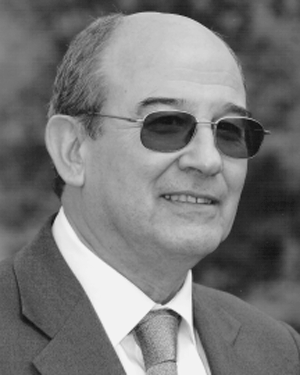 Manuel Guerreiro合作论文数5
 Sonia F Pinto合作论文数4
 Joao Carlos Diniz Martins合作论文数3
 Pedro Fonte合作论文数3
 Oleksandr Bondarenko合作论文数Department of Electronic Devices and Systems, Faculty of Electronics, National Technical University of Ukraine "Igor Sikorsky Kyiv Polytechnic Institute"3José-Inácio Rocha合作论文数3Rui M. Castro合作论文数2Hélio Lopes合作论文数2manuel gaspar合作论文数2
 Jorge Esteves合作论文数2
 Ricardo Luís合作论文数2
 Filipe Barata合作论文数Departamento de Engenharia Electrotécnica e Automação;Instituto Superior de Engenharia de Lisboa;Departamento de Engenharia Electrotécnica e Automação, Instituto Superior de Engenharia de Lisboa2D. Yu. Titov合作论文数1
 Nikolai Poliakov合作论文数1L. N. Makarov合作论文数1Sousa, D.M.合作论文数1
 Hiren Canacsinh合作论文数1Ksenia Fedorova合作论文数1A. S. Kobelev合作论文数1
 Viktoriya Popova合作论文数1Maria Gulyaeva合作论文数1R. Miceli合作论文数1
 Samuel Isaac Tecle合作论文数1Aleksandr Lyakhomskii合作论文数1
 Alecksey Anuchin合作论文数1Zsolt Mathe合作论文数1D.A. Blagodarov合作论文数1N. N. Dulnev合作论文数1
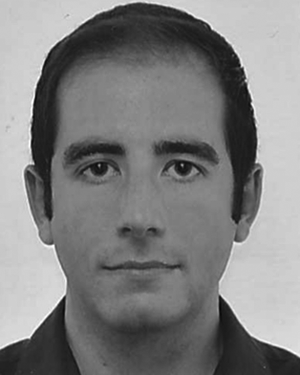 Kevin Kaspar合作论文数1Aleksandr Leysle合作论文数1Oleg Kryukov合作论文数1
 Dmitrii Savkin合作论文数1Andrei Bogdanov合作论文数1Polyakov Vladimir合作论文数1




