Laser beam shaping is a key issue for the photonic integration of VCSEL sources. Most of the techniques proposed to integrate micro-optics elements onto VCSEL devices imply either a hybrid assembly or a photolithography step, whose precision limits the accuracy of lens alignment relatively to the VCSEL source. We present here a new method for self-fabrication of microtips on Vertical-Cavity Surface-Emitting Lasers (VCSELs) by means of Near Infra-Red (NIR) photo-polymerization. This approach is based on a single fabrication step, implementing novel photopolymers sensitive at the lasing wavelength. Consequently the process is triggered by the laser source itself and can be applied easily to VCSEL devices during their electro-optic characterization. The method we have developed for tips fabrication is detailed as well as corresponding optical properties. The applications of this new and simple method concern laser light focusing and collimation for integrated micro-systems, coupling to fibers for optical communications as well as novel micro-probes fabrication for near-field optical microscopy.
The present paper reports on the spatially controlled synthesis of silver nanoparticles (NPs) and silver nanowires by photosensitized reduction. In a first approach, direct photogeneration of silver NPs at the end of an optical fiber was carried out. Control of both size and density of silver NPs was possible by changing the photonic conditions. In a further development, a photochemically assisted procedure allowing silver to be deposited at the surface of a polymer microtip was implemented. Finally, polymer tips terminated by silver nanowires were fabricated by simultaneous photopolymerization and silver photoreduction.The silver NPs were characterized by UV-visible spectroscopy and scanning electron microscopy.
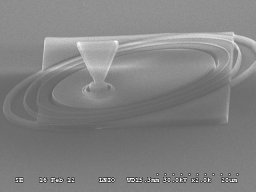
We present the integration of a self-aligned microtip on a vertical-cavity surface-emitting laser (VCSEL) by near infrared photopolymerization. This one-step fabrication process is triggered by the laser source itself. It is based on the use of photopolymers sensitive at the lasing wavelength and can be applied to VCSEL devices after their process fabrication. We have characterized the fabricated microtips and shown that they focus laser light at few micrometers from the device. The applications of this simple method may concern VCSEL beam shaping as well as the fabrication of microprobes for near-field optical microscopy.
A micrometric Fabry-Perot refractometer based on an end-of-fiber polymer tip is proposed. The fiber tip, with a length of 36 mum, was fabricated by self-guiding photopolymerization. The two-wave interferometric operation was achieved by combining the light waves generated at the interface between the single-mode fiber and the polymer tip, and at the fiber tip end (Fresnel reflection). The Fabry-Perot interferometer is coherence addressed and heterodyne interrogated, resulting into a liquid refractive index resolution of approximately 7.5x10(-4).
This paper highlights the potential of atomic force microscopy in the pulsed force mode to investigate the photopatterning of acrylic-based films. The pulsed force mode is a nonresonant mode designed to allow approach curves to be recorded along the scanning path. It thereby provides the topography of the sample and a direct and simple local characterization of adhesion and stiffness. This mode can be used either for imaging or for locally probing the mechanical properties of a surface. In particular, a correlation between stiffness and conversion of the monomer was established. The close examination of the pulsed force mode signal brought accurate information on the photoinduced modification of the film. Polymer films with submicron photopatterning generated by interferometric illumination were analyzed by pulsed force mode. It was established that the gradient of mechanical properties throughout the films was strongly dependant on the irradiation conditions.
We present here a simple method to synthesize organic-dispersible colloids and a scenario for the ultra-fast fabrication of silver/polymer nanocomposite by light-induced crosslinking polymerization. The objective of this work was to apply UV-curing technology for the fabrication of nanocomposite materials containing silver nanoparticles dispersed in a polymer binder. This new route allows processing operations to be simplified and the properties of the final product to be improved. A special attention has been paid to the synthesis and dispersion of metal nanoparticles in various monomers and oligomers and to the photopolymerization kinetics. The silver nanoparticles were generated by reduction of AgNO3 with t-BuONa activated sodium hydride. Ag(0) particles present a narrow size distribution with an average diameter of 6.5 nm. Transmission electron microscopy (TEM) analysis has shown that Ag(0) nanoparticles are well dispersed in the acrylic resin. The curing process was followed quantitatively by FTIR spectroscopy through the decrease upon UV exposure of the IR bands characteristic of the functional groups. The silver nanoparticles have no detrimental effect on the photopolymerization kinetics. The incorporation of metal nanoparticles was found to greatly reduce the gloss of UV-cured coatings. Moreover, the outstanding optical and viscoelastic properties of these UV-cured nanocomposites opens up interesting perspectives in various fields of applications (optics, nanoelectronic, biology...).
Photopolymerizable hybrid sol-gel are extremely interesting for optical and photonic applications. They combine the properties of glasses with the possibility of photopatterning the layer at the micrometer scale. The presented results concern the generation of volume gratings created by transmission and reflection using an interferences pattern at 514 nm. In transmission, the diffraction efficiencies were going from 30 % to 95 % (ratio of the diffracted intensity to the diffracted plus transmitted intensities) for a thickness ranging respectively from 40 mu m to 100 mu m and a spatial frequency of 1000 lines/mm. It corresponded to a refractive index modulation estimated between 4 and 5 x 10(-3) according to Kogelnik's theory. Reflection gratings with fringe spacing of 0.17 or 0.39 mu m were recorded in the material. In normal incidence light beams were highly diffused, whatever the wavelength in the visible range. On the contrary, in oblique incidence, light beams were transmitted through the device without being diffused. This unusual behavior is not yet explained. Applications for information storage can be expected in view of the experimental results, the ease of use and the versatility of this hybrid material.
Organic materials are taking a growing place in the development of new materials for data technologies thanks to the potential of molecular engineering, the flexibility of available chemical compositions, the low costs..., but also because of their unique optical and mechanical properties. In this context, photopolymers present specific advantages particularly interesting for high density optical data storage, based on the possibility of structuring their linear and nonlinear optical properties with a great facility by direct optical patterning.In order to understand and control the physico-chemical aspects of the photopatterning, means of investigation at a micro and nanoscopic scales are required. Not only the 3D imaging of the object is needed, but some structural information on the material is necessary to go further in the investigation of the involved phenomena. AFM used in Pulsed Force Mode (PFM) fulfils these requirements: the PFM mode is a non-resonant mode designed to allow approach curves to be acquired along the scanning path. It thereby provides a recording of the sample topography and extends the possibilities of the prevalent contact and intermittent-contact AFM modes to a direct and simple local characterization of adhesion and stiffiiess.This paper describes the principle of Pulsed Force Mode AFM and illustrates its usefulness for investigating of the photostructuration of polymer matrixes. In a first part, homogeneously irradiated films were characterized in order to demonstrate the sensibility of the PFM analysis. In particular, the PFM signal is correlated to the monomer conversion ratio that was measured by FTIR spectroscopy. In a second step, we illustrate the potential of PFM for the investigation of photopattemed films. Holographic gratings were recorded in an acrylate-based formulation and characterized by PFM. We have successfully assigned the different areas of the film that correspond to different incident intensities. Using the information recorded on homogeneous films, it is possible to obtain an estimation of the conversion of the monomer at sub-micronic scale. Such a study is of primary importance in order to understand the mechanism leading to microstructuration and thus to optimize this process in terms of resolution.
In the present work we report the results of holographic recording with two contra-propagating evanescent waves in photopolymers. The spatial frequency of the recorded permanent grating is 6380 mm−1 (grating step 156.7 nm) and 0.015% diffraction efficiency at 514.5 nm is achieved. The angular selectivity of the recorded evanescent grating is investigated at 632.8 nm. The maximum diffraction efficiency value is obtained at a critical angle of 60.1° ± 0.2° to the boundary with the total internal reflection prism, that determines the average refractive index of the grating of 1.501 ± 0.003. This is in good agreement with independent refractometric measurements and with theoretical expectations. A simple theoretical analysis of the evanescent wave holographic recording is made taking into account weak light absorption by the recording second medium. The close analogy with the attenuated total internal spectroscopic method is emphasized.
When a drop of photosensitive monomer is deposited on top of a cleaved fiber end, the light coming from the fiber can be self-focused if the polymer refraction index is higher that that of the monomer. The ensuing polymerization along the path of the beam shapes a micrometric size polymer tip that is firmly attached to the fiber end. The applications of this waveguiding component are numerous and range from simply enlarging the numerical aperture of the fiber to improving laser diode coupling performances and near field imaging. Those interests are magnified by its very low price and easy manufacturing. This paper is devoted to modelling the buildup process of this component through time-resolved photopolymerisation in order to evidence the experimental parameters that most influence the tip shape and thus its optical functions. A computational series based on experimental results using a standard Beam Propagation Method (BPM) scheme results in showing the critical influence of the growing atmosphere upon the hemispherical shape of the tip.
Dry poly(vinyl alcohol) (PVA) formulations are widely used in the field of micro-optics for holographic recording and fabrication of micro-optical elements, but very little is known about the recording mechanism and even less in systems generating relief elements through a self-developing process. Thus, the recording of relief gratings with pitches ranging from 5 to 120 l/mm was examined with reference to the average weight of PVA and degree of hydrolysis. The lit width to pitch ratio in the amplitude mask used for photopatterning appeared to be also a controlling factor in the response of sensitive materials. A semiquantitative model was introduced to account for the final shape of the photogenerated relief. It determined the respective parts played by diffusion and capillary convection, i.e., convection processes resulting from gradients of chemical potential and surface tension, respectively, and identified the experimental key parameters governing their interrelation. This work sheds new light on the optimization of the patterning conditions of amplitude masks and is expected to open up new vistas in the replication of computer-generated holograms.
Hybrid organic-inorganic sol-gel compounds have been widely used for the design of new optical devices, since they combine the characteristics of both glasses and polymers and improve the properties of the final material. Hybrid precursors in which both phases are chemically grafted are of increasing interest: volume shrinkage is minimized and phase separation can be kept below the level of Rayleigh scattering, thus leading to highly transparent glasses. Polymerizable acrylate or methacrylate functions grafted onto modified silicone alkoxides can react via a free-radical mechanism initiated either by heating or UV-light. Considerable attention has already been focused on the chemical mechanisms involved in the construction of the inorganic network. However, no extensive study of the organic part of the process has so far been conducted. This paper points out the characteristics of the photopolymerization process taking place in hybrid sol-gel materials. In particular, the influence of inorganic moieties on the photopolymerization kinetics was studied by UV and real time FTIR spectroscopy. Particular interest was focused on the incorporation of alkoxymetals that are usually added to improve the optical and physical properties of the final material. The role of the titanium component in the photopolymerization process is emphasized. The results provide insights into processes leading to simultaneous formation of interpenetrating organic-inorganic networks and are of crucial importance for the generation of optical devices.
The fabrication of refractive microlenses with self-developing photopolymers is reported. A spatially controlled illumination of the photosensitive layer induced an inhomogeneous photopolymerization involving formation of 3-D polymer network, mass-transport process of reactive species and bending of the surface. The process exhibited a completely self-processing character without any chemical post-treatment to reveal the relief. The lens arrays displayed diameters ranging from less than 100 mum to 1 mm and focal lengths from 100 mum to a few millimeters, depending on photonic, optical and physico-chemical parameters. The paper focuses on the importance of photonic parameters in the generation of microlens arrays and discusses the flexibility of this technique in the visible range.
In this article, we report a method of free-radical photopolymerization on the top end of a single-mode optical fiber. The process is very simple to carry out and uses the visible light guided in the fiber. It permits one to produce, on the fiber end, a micronic polymer tip which may be viewed as an extension of the fiber core and whose optical properties improve the intrinsic capability of the fiber, particularly in terms of efficiency of coupling with a laser source. Formation of the tip is explained by self-guiding of the light within the material and photophysical response of the material.
Recent results have shown the interest in self-developing photopolymers as optical storage materials. Their main advantage is the absence of a wet chemical post-treatment to reveal the latent Images. The self-generating character of a sensitive layer is studied for the fabrication of refractive microlens arrays in the visible range. The kinetic of radical-induced photopolymerization, the effect of molecular oxygen on the reaction rate and the properties of the final photopolymer are outlined. The results focus on the process of relief development and the role of atmospheric oxygen during the generation of refractive microlenses, A structural characterization of micro-optical elements is investigated. Copyright (C) 2000 John Wiley & Sons, Ltd.
Growing interest in the manufacture of microlenses results from their standard use as optical components with current applications in the telecommunication industry. A number of techniques were developed by using various materials and processes. One approach involved the ability of self-processing photopolymers to generate microlens arrays. Spatially controlled illumination of a photosensitive layer induced an inhomogeneous photopolymerization involving formation of 3-D polymer network, mass-transport process of reactive species and bending of the surface resulting from a gradient of surface free energy. The imaging process that generated as a relief in the photopolymer layer, exhibited a completely self-processing character without any chemical post-treatment. The lens arrays displayed diameters ranging from less than 100μm to 1mm and focal lengths from 100μm to a few millimeters, depending on photonic, optical and physico-chemical parameters.
Photopolymerizable materials are capable of recording high-efficiency volume holograms by changing the refractivity of the layer. An attractive feature of these media is that they allow multiple permanent holographic storage. Chemical composition, conditioning and pre-irradiation of the reactive mixture developed in the Mulhouse laboratory were optimized for the sequential recording of several permanent holograms into the same sample, with fair diffraction efficiency and without degradation of the spatial resolution. Since the species involved in the initiation mechanism are gradually consumed as the hologram builds up, the schedule (i.e., the successive exposure times and incident intensities) must be determined, to take into account the degree of conversion of the different components and reach full completion of the reaction at the end of the ultimate imagewise exposure. Examples of more than twenty multiplexed gratings or holograms of a target will be shown, the images being recorded at the same location in the polymer at ca one degree angular separation intervals. Applications for holographic data storage can be expected in view of these results, the simplicity of use (self-processing and self-fixing material) and the possibility of short single-pulse recording.
 Olivier Soppera合作论文数Département de Photochimie Générale Mulhouse France, CNRS - ENSC Mulhouse12
 C Turck合作论文数12Jeanpierre Fouassier合作论文数9
 Celine Croutxe-Barghorn合作论文数8L. Simonin合作论文数7
 Juan C. Scaiano合作论文数Department of Chemistry and Biomolecular Sciences, University of Ottawa7C. Carré合作论文数5Christiane Carré合作论文数4J. P. Gonnet合作论文数4Lisette Lavielle合作论文数4j j hunsinger合作论文数3C. Ecoffet合作论文数3S. Zissi合作论文数3Linda J. Johnston合作论文数Department of Chemistry and Biomolecular Sciences, University of Ottawa;Steacie Institute for Molecular Science, National Research Centre of Canada3Jean Pierre Fouassier合作论文数3Patrice Jacques合作论文数3A. Espanet合作论文数3
 Serge Corbel合作论文数DCPR3
 Safi Jradi合作论文数CNRS UMR 7525, E.N.S. Chimie3
 Renaud Bachelot合作论文数Laboratoire de Nanotechnologie et d'Instrumentation Optique – CNRS FRE 2671, Université de Technologie de Troyes3
 Pascal Royer合作论文数LNIO3L. Balan合作论文数2P.N. Green合作论文数2e daran合作论文数2christelle heinis合作论文数2C Carre合作论文数2
 T. Camps合作论文数2Reig Beatriu合作论文数2
 Istvan Banyasz合作论文数2J. C. Andre合作论文数GdR “Optical Instrumentation, ENSIC-INPL2Jeanbaptiste Doucet合作论文数2C. Croutxé合作论文数2Véronique Wintgens合作论文数2E. Schuller合作论文数2
 Carole Ecoffet合作论文数2Véronique Bardinal合作论文数LAAS-CNRS2D. Barat合作论文数1G. Kugel合作论文数1Stéphane Roose合作论文数1Loïc Vidal合作论文数1dominique bonvallot合作论文数1
 Raphael Schneider合作论文数1
 Jerome Plain合作论文数1nicolas noiret合作论文数1m feuillade合作论文数1Paulo Caldas合作论文数Technol & Sci, Inst Syst & Comp Engn1Orlando Frazão合作论文数Department of Physics, Faculty of Science, University of Porto;Centre for Applied Photonics, Institute for Systems and Computer Engineering, Technology and Science1
 Suzanna Akil合作论文数Laboratoire de Chimie et Physique, Universite De Lorraine1
 Ley Christian合作论文数LPIM, University of Haute-Alsace1




