In vitro tissue models hold great promise for modeling diseases and drug responses. Here, we used emulsion microfluidics to form micro-organospheres (MOSs), which are droplet-encapsulated miniature three-dimensional (3D) tissue models that can be established rapidly from patient tissues or cells. MOSs retain key biological features and responses to chemo-, targeted, and radiation therapies compared with organoids. The small size and large surface-to-volume ratio of MOSs enable various applications including quantitative assessment of nutrient dependence, pathogen-host interaction for anti-viral drug screening, and a rapid potency assay for chimeric antigen receptor (CAR)-T therapy. An automated MOS imaging pipeline combined with machine learning overcomes plating variation, distinguishes tu-morspheres from stroma, differentiates cytostatic versus cytotoxic drug effects, and captures resistant clones and heterogeneity in drug response. This pipeline is capable of robust assessments of drug response at individual-tumorsphere resolution and provides a rapid and high-throughput therapeutic profiling platform for precision medicine.
2573 Background: Current patient-derived organoid (PDO) models are largely devoid of immune components. We developed a precision microfluidic and membrane platform to generate patient-derived micro-organospheres (MOS) that retain tumor-resident immune and stromal components for personalized immuno-oncology (IO) assays. Methods: MOS were generated from lung, kidney, and colorectal cancer patients. The composition and function of patient tumor-resident immune cells in MOS were characterized by flow cytometry, single-cell RNA-seq, antibody staining, and TCR-seq. High-content and longitudinal imaging with AI analyses were used to quantify tumor cell death and immune cell dynamics inside MOS in response to IO therapies including checkpoint inhibitors, T cell bispecific antibodies, and adoptive tumor infiltrating lymphocyte (TIL) therapies, followed by single-cell analyses. Results: Tumor and stromal cells quickly form tissue niches inside MOS to sustain the viability and function of encapsulated immune cells. MOS derived from lung and kidney cancer patients respond to Nivolumab, indicated by the Annexin V apoptosis marker. ESK1* (TCB antibody targeting HLA-A2/WT1) induces killing in eight lung tumor patients derived MOS. We further developed a MOS T-cell potency assay as autologous TILs or PBMC efficiently infiltrate MOS from lung, kidney and CRC patients and induce tumor cell apoptosis. Adjunctive therapies combining TCB with TILs enhanced the potency of adoptive cell therapy against lung tumor. Based on the data, three ongoing and upcoming personalize IO clinical trials will further validate the ability of the MOS assay to predict patient response to TCB, checkpoint combinations, and adoptive cell therapy. Conclusions: MOS provide a rapid and scalable personalized platform for developing and testing IO therapies such as checkpoint inhibitors, bispecific antibodies, and T cell therapies on patient tumor models that still retain the original tumor microenvironments.
Patient-derived xenografts (PDXs) and patient-derived organoids (PDOs) have been shown to model clinical response to cancer therapy. However, it remains challenging to use these models to guide timely clinical decisions for cancer patients. Here, we used droplet emulsion microfluidics with temperature control and dead volume minimization to rapidly generate thousands of micro-organospheres (MOSs) from low-volume patient tissues, which serve as an ideal patient-derived model for clinical precision oncology. A clinical study of recently diagnosed metastatic colorectal cancer (CRC) patients using an MOS-based precision oncology pipeline reliably assessed tumor drug response within 14 days, a timeline suitable for guiding treatment decisions in the clinic. Furthermore, MOSs capture original stromal cells and allow T cell penetration, providing a clinical assay for testing immuno-oncology (IO) therapies such as PD-1 blockade, bispecific antibodies, and T cell therapies on patient tumors.
e12628 Background: Patient-derived breast cancer (BC) organoids are valuable preclinical models to study patient drug responses, demonstrating good correlations with patients’ clinical outcomes. However, establishment and expansion of such organoids from patient tumors for drug screening is currently a time-consuming and labor-intensive process. A more rapid and high-throughput method will enable broader utility in diagnostics and drug development. Methods: An automated, rapid and scalable microfluidic platform was used to process and develop BC micro-organospheres. Drug sensitivities studies on BC micro-organospheres were performed on day 3 and day 6 using 10-FDA approved drugs, including palbociclib, adriamycin, 5-FU, gemcitabine, methotrexate, everolimus, paclitaxel, docetaxel, ixabepilone, and vinblastine. The responses of micro-organospheres and organoids to the drugs were assessed by CellTiter 3D Glo assay on day 6 after the drug treatment. The growth and establishment of the micro-organospheres by imaging. The drug sensitivity and resistance of the micro-organospheres were analyzed by calculating the percentage cell viability and normalized growth rate inhibition (GRI) and compared to organoids. Results: We successfully established micro-organospheres from eight patient-derived BC organoids with a 100% success rate. The micro-organospheres preserved similar cell morphologies to the bulk organoids. 7/8 micro-organosphere models had similar drug response patterns to organoids between day 3 and day 6 as evident by the GRI heatmap. Specifically, we treated matching micro-organospheres and conventional organoids from two patients with 10 frontline BC chemotherapy drugs, and both showed similar response patterns with GRI heatmap. For the other 6 patient-derived models, the responses of micro-organospheres to docetaxel and everolimus also matched the historical drug responses of in bulk organoid culture with similar GRI heatmap. Conclusions: We have now shown the feasibility of establishing micro-organospheres as a rapid, scalable, and cost-effective platform to study patient-derived BC drug response. This technology has the potential to be used for both diagnostics to guide patient treatment and as a screening platform for new BC drug discovery.
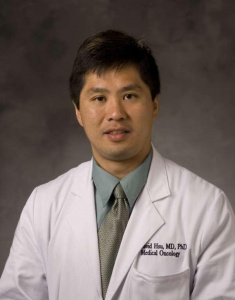 Shiao-Wen David Hsu合作论文数Department of Medicine, Duke University School of Medicine4
 Daniel Delubac合作论文数3Naveen Natesh合作论文数Dept Biomed Engn, Duke Univ3
 Shengli Ding合作论文数Department of Biomedical Engineering, Pratt School of Engineering, Duke University3
 Hans Clevers合作论文数Utrecht University;Hubrecht Institute3Zhaohui Wang合作论文数2Kassandra Spiller合作论文数2Estelle Marrer-Berger合作论文数2Carolyn Hsu合作论文数2Athena Yeung合作论文数2
 Marcos Negrete合作论文数2N. Gjorevski合作论文数2Shree Bose合作论文数Department of Pharmacology and Cancer Biology, Duke University School of Medicine2
 Rosemary Millen合作论文数Sir Peter MacCallum Dept Oncol, Univ Melbourne2Rui Xi合作论文数2Grecia O Rivera合作论文数2
 Antje Walz合作论文数2Ravian L. van Ineveld合作论文数1Gabrielle Rupprecht合作论文数1Tomer Rotstein合作论文数1
 Matteo Giovanni Boretto合作论文数1Jessica DeVilla合作论文数1Haipei Yao合作论文数1
 Nicholas S Giroux合作论文数1Emilio Cortes-Sanchez合作论文数Dept Oncol Sci, Univ Utah1Nicholas Heaton合作论文数1Brook E. Heaton合作论文数1
 Alfred Harding合作论文数1
 Peggy M Randon合作论文数1Else Driehuis合作论文数Royal Netherlands Acad Arts & Sci KNAW, Hubrecht Inst, Utrecht, Netherlands1
 Chongming Jiang合作论文数Dept Med, Baylor Coll Med1
 Anders B Dohlman合作论文数Duke Univ, Dept Biomed Engn, Durham, NC 27710 USA1
 Ian A Williamson合作论文数Dept Biomed Engn, Duke Univ1
 Joep Beumer合作论文数Hubrecht Institute, Royal Netherlands Academy of Arts and Sciences (KNAW) and UMC Utrecht, 3584 CT Utrecht, the Netherlands; Oncode Institute, Hubrecht Institute, 3584 CT Utrecht, the Netherlands.1Daisong Wang合作论文数State Key Laboratory of Cell Biology, CAS Center for Excellence in Molecular Cell Science, Institute of Biochemistry and Cell Biology, Chinese Academy of Sciences, University of Chinese Academy of Sciences, Shanghai 200031, China.1
 Maarten H. Geurts合作论文数Hubrecht Institute, Royal Netherlands Academy of Arts and Sciences (KNAW) and University Medical Center Utrecht, 3584 CT Utrecht, the Netherlands; Oncode Institute, Hubrecht Institute, 3584 CT Utrecht, the Netherlands.1
 Jens Puschhof合作论文数Microbiome and Cancer Division, German Cancer Research Center1James Isaacs合作论文数1Chao Chen合作论文数1
 John Paul Shen合作论文数Univ Texas MD Anderson Canc Ctr, Dept Gastrointestinal Med Oncol, Houston, TX 77030 USA1
 Cait E Hamele合作论文数Department of Medicine, University of Virginia Cancer Center1Carolyn Glass合作论文数Department of Pathology, Duke University School of Medicine1
 David W Jang合作论文数Department of Head and Neck Surgery and Communication Sciences, Duke University School of Medicine1
 Ralph Abi Hachem合作论文数Department of Head and Neck Surgery and Communication Sciences, Duke University School of Medicine1
 Bradley John Goldstein合作论文数Department of Head and Neck Surgery & Communication Sciences, School of Medicine, Duke University1
 Xiling Shen合作论文数Department of Biomedical Engineering, Pratt School of Engineering, Duke University1
 Alana L Welm合作论文数Huntsman Canc Inst, Univ Utah1
 Scott Joseph Antonia合作论文数Duke Cancer Institute, School of Medicine, Duke University;Duke Human Vaccine Institute, School of Medicine, Duke University;Department of Medicine, School of Medicine, Duke University1




