Millimeter-wave (mmWave) radar systems have emerged as a promising technology for object detection, particularly in security screening applications. This study explores the effectiveness of different radar data features, including range azimuth (RA), range Doppler (RD), azimuth elevation (AE), range azimuth elevation (RAE), range Doppler azimuth (RDA), and range Doppler azimuth elevation (RDAE), in improving object detection performance. Using data collected from Texas Instruments’ TIDEP 01212 cascaded mmWave radar system, the study investigates how these radar data features perform across several machine learning models, including LightGBM, random forest, support vector machines (SVM), and logistic regression. The dataset comprises radar scans of a person in both open carry and concealed scenarios, involving different objects such as a phone and scissors. The results show that SVM achieves perfect accuracy, precision, recall, and F1 scores when used with AE or RDAE data features.
The use of artificial intelligence in the agricultural sector has been growing at a rapid rate to automate farming activities. Emergent farming technologies focus on mapping and classification of plants, fruits, diseases, and soil types. Although, assisted harvesting and pruning applications using deep learning algorithms are in the early development stages, there is a demand for solutions to automate such processes. This paper proposes the use of Deep Learning for the classification of trusses and runners of strawberry plants using semantic segmentation and dataset augmentation. The proposed approach is based on the use of noises (i.e. Gaussian, Speckle, Poisson and Salt-and-Pepper) to artificially augment the dataset and compensate the low number of data samples and increase the overall classification performance. The results are evaluated using mean average of precision, recall and F1 score. The proposed approach achieved 91%, 95% and 92% on precision, recall and F1 score, respectively, for truss detection using the ResNet101 with dataset augmentation utilising Salt-and-Pepper noise; and 83%, 53% and 65% on precision, recall and F1 score, respectively, for truss detection using the ResNet50 with dataset augmentation utilising Poisson noise.
Heart rate variability serves as a valuable indicator and biomarker for stress detection and monitoring. Feature selection, which aims to identify relevant features from a large set of variables, is a crucial preprocessing step towards this. However, this task becomes challenging due to high dimensionality and the presence of irrelevant and redundant attributes. The Minimum Redundancy and Maximum Relevance (mRMR) feature selection method addresses this challenge by selecting relevant features while controlling redundancy. This paper presents extensions and evaluated versions of the mRMR feature selection methods for stress detection using Heart Rate Variability (HRV) measures. The proposed feature selection methods extend the traditional mRMR by replacing the Pearson correlation redundancy with non-linear feature redundancy measures capable of capturing more complex relationships between variables. An extensive empirical evaluation is conducted on the proposed mRMR extensions, comparing them with four other baseline feature selection methods using three publicly available datasets. The experimental results demonstrate the effectiveness of incorporating the non-linear feature redundancy measure into the feature selection process.
This study explores the use of Convolutional Neural Networks (CNNs) to classify fear in the context of decision-making. The approach involves developing a CNN model that is trained using hyper-parameter tuning and K-fold cross-validation to accurately classify fear from video footage of participants’ facial expressions during an experiment. The videos are presented along with a map to show the location of the participants along the route. The study reports an overall accuracy of for fear classification. The results show that the model can successfully predict fear levels in different conditions. For example, the most desolate route with the lowest light levels recorded an overall fear detected at , while the safest route with the highest light levels in a densely populated area saw an overall fear detected at . These findings demonstrate the potential for using CNNs to classify fear and provide insight into how fear can be taken into consideration for decision-making in realistic scenarios.
Deep learning constitutes a pivotal component within the realm of machine learning, offering remarkable capabilities in tasks ranging from image recognition to natural language processing. However, this very strength also renders deep learning models susceptible to adversarial examples, a phenomenon pervasive across a diverse array of applications. These adversarial examples are characterized by subtle perturbations artfully injected into clean images or videos, thereby causing deep learning algorithms to misclassify or produce erroneous outputs. This susceptibility extends beyond the confines of digital domains, as adversarial examples can also be strategically designed to target human cognition, leading to the creation of deceptive media, such as deepfakes. Deepfakes, in particular, have emerged as a potent tool to manipulate public opinion and tarnish the reputations of public figures, underscoring the urgent need to address the security and ethical implications associated with adversarial examples. This article delves into the multifaceted world of adversarial examples, elucidating the underlying principles behind their capacity to deceive deep learning algorithms. We explore the various manifestations of this phenomenon, from their insidious role in compromising model reliability to their impact in shaping the contemporary landscape of disinformation and misinformation. To illustrate progress in combating adversarial examples, we showcase the development of a tailored Convolutional Neural Network (CNN) designed explicitly to detect deepfakes, a pivotal step towards enhancing model robustness in the face of adversarial threats. Impressively, this custom CNN has achieved a precision rate of 76.2% on the DFDC dataset.
Modern-day life is driven by electronic devices connected to the internet. The emerging research field of the Internet-of-Things (IoT) has become popular, just as there has been a steady increase in the number of connected devices. Since many of these devices are utilised to perform CV tasks, it is essential to understand their power consumption against performance. We report the power consumption profile and analysis of the NVIDIA Jetson Nano board while performing object classification. The authors present an extensive analysis regarding power consumption per frame and the output in frames per second using YOLOv5 models. The results show that the YOLOv5n outperforms other YOLOV5 variants in terms of throughput (i.e. 12.34 fps) and low power consumption (i.e. 0.154 mWh/frame).
Due to the universal non-verbal natural communication approach that allows for effective communication between humans, gesture recognition technology has been steadily developing over the previous few decades. Many different strategies have been presented in research articles based on gesture recognition to try to create an effective system to send non-verbal natural communication information to computers, using both physical sensors and computer vision. Hyper accurate real-time systems, on the other hand, have only recently began to occupy the study field, with each adopting a range of methodologies due to past limits such as usability, cost, speed, and accuracy. A real-time computer vision-based human-computer interaction tool for gesture recognition applications that acts as a natural user interface is proposed. Virtual glove markers on users hands will be created and used as input to a deep learning model for the real-time recognition of gestures. The results obtained show that the proposed system would be effective in real-time applications including social interaction through telepresence and rehabilitation.
Thermal comfort in shared spaces is essential to occupants’ well-being and necessary in the management of energy consumption. Existing thermal control systems for indoor shared spaces adjust temperature set points mechanically, making it difficult to intelligently achieve thermal comfort for all. Recent studies have shown that thermal comfort in a shared space is difficult to achieve due to individual preferences and the inability of occupants to reach a thermal compromise on temperature set points. This paper proposes a thermal comfort system capable of automatically adjusting the temperature set-points in a shared space whilst recognising individual preferences. The control strategy of the proposed system is based on an algorithm to adjust the temperature set point of the shared space using the individual thermal preferences and predicted thermal comfort value of the occupants. The thermal preferences of the occupants are determined first and used as part of the occupant’s profile, which is mapped to thermal comfort values predicted from the occupants’ measured physiological data and environmental data. A consensus can be reached by the algorithm to find the optimal temperature set-point, which takes into account individual thermal preferences and their physiological responses.
This research aims to present a technical analysis of the Traversal Optimisation Algorithm (TOA) for clustering and K-means clustering algorithm. The goal is to rigorously test this algorithm against different data specifications beyond what has previously been used with K-means without artificially and subjectively setting the initial number of clusters. The experimental evaluation involve the use of diverse cluster optimisation techniques for K-means while applying a wider range of internal validation methods such as Davies-Bouldin Index, Dunn Index and Silhouette Method, for appraising cluster quality of the Traversal Optimisation Algorithm, while at the same time not compromising the configuration of the default algorithm. The findings in this work shows that the optimisation algorithm’s clustering quality as calculated by multiple internal validity indices can be very poor when operating on datasets with varying characteristics. This is owing to the algorithm’s lack of any add-on mechanism for computing the optimal number of clusters that a dataset needs apriori. The results reveal that in a data processing contexts where the number of clusters are specified, the TOA yields a favourable cost-benefit in terms of run-time complexity and clustering quality.
Recent advancements in the Internet of Things and the miniaturisation of low-cost sensing devices allow for the unobtrusive collection of data for human activity recognition and behaviour modelling. A useful application of this in the context of ambient assisted living is in the monitoring of older adults daily for improved wellbeing and quality of life. The existing solutions are based on per-individual monitoring, therefore the systems are managed independently for each ambient intelligent environment. In this paper, we proposed a centralised system for the collective monitoring of individuals in a community. The proposed approach is based on a cloud-based solution where data collection and processing are centralised. Since the data are aggregated for all the residents, the system has the potential of promoting social interaction among the community residents. Additionally, the cost of the in-home monitoring system can be reduced since only the sensing devices are required for data collection, while the processing is carried out on the cloud infrastructure. This also reduces the tedious tasks required in setting up individual home monitoring systems. The role of assistive robots, the possibility of remote monitoring and potential challenges of the proposed approach are explored.
Human activity recognition (HAR) and transfer learning (TL) are two broad areas widely studied in computational intelligence (CI) and artificial intelligence (AI) applications. Much effort has been put into developing suitable solutions to advance the current performance of existing systems. However, challenges are facing the existing methods of HAR. In HAR, the variations in data required in HAR systems pose challenges to many existing solutions. The type of sensory information used could play an important role in overcoming some of these challenges. Vision-based information in 3D acquired using RGB-D cameras is one type. Furthermore, with the successes encountered in TL, HAR stands to benefit from TL to address challenges to existing methods. Therefore, it is important to review the current state-of-the-art related to both areas. This paper presents a comprehensive survey of vision-based HAR using different methods with a focus on the incorporation of TL in HAR methods. It also discusses the limitations, challenges and possible future directions for more research.
Discovering underlying patterns for predicting future actions from spatio-temporal human activity information is a fundamental component of research related to the development of expert systems in human activity recognition and assistive robotics. Current research focuses on classification or learning representations of activities for various applications. However, not much attention is given to the pattern discovery of activities which have a major role in the prediction of unseen actions. This paper proposes a novel Adaptive Segmentation and Sequence Learning (ASSL) framework which aims at segmenting unlabelled observations of human activities from extracted 3D joint information. Learning from these obtained segments provides information about the underlying patterns of activity sequences needed in predicting subsequent actions. In the proposed method, the temporal accumulated motion energy of body parts in an activity is utilised in the segmentation process to obtain key actions from unlabelled activity sequences since body parts show changes in acceleration and deceleration during an activity. Based on the segments obtained, the temporal sequence of transitions across activity segments are learned by employing a Long Short-Term Memory Recurrent Neural Network. This ASSL technique has been evaluated using both an experimental human activity dataset and a public activity dataset, and achieved a better performance when compared with other techniques including an Auto-regressive Integrated Moving Average, Support Vector Regression and Gaussian Mixture Regression Models in learning to predict patterns of activity sequences.
Transfer Learning (TL) aims to learn a problem from a source reference to improve on the performance achieved in a target reference. Recently, this concept has been applied in different domains, especially, when the data in the target is insufficient. TL can be applied across domains or across tasks. However, the challenges related to what to transfer, how to transfer and when to transfer create limitations in the realisation of this concept in day to day applications. To address the challenges, this paper presents an overview of the concept of TL and how it can be applied in human-robot interaction for assistive robots requiring to learn human tasks in Ambient Assisted Living environments. The differences in feature spaces between a human (source domain) and robot (target domain) makes it difficult for tasks to be directly learned by robots. To address the challenges of this task, we propose a model for learning across feature spaces by mapping the features in the source domain to the target domain features.
Data-driven machine learning methods usually require large amounts of annotated data to be able to develop high performance learning systems. In practical situations, such large amounts of data are not easily obtainable. Transfer Learning evolved as one of the solutions to this challenge. It aims to make use of knowledge acquired in one domain to facilitate prediction in a target domain. Transfer learning can be a daunting task when feature spaces which require transfer differ in their distribution of information. A case of this is in the application of assisted robotics, where a robot is required to learn a task by mere observation of a human perform the task. The differences in the feature spaces poses a challenge in the effective transfer of such tasks. In this paper, we propose a method of effective transfer learning across heterogeneous feature spaces for the purpose of learning in assisted living environments. A fuzzy latent space exploration is used to obtain mappings of feature spaces. This approach is used in simplifying the learning for an assistive robot seeking to execute human actions.
There has been an increased interest in the development of models to identify and predict human activities. However, the sparsity of the data gathered from the sensory devices in an ambient living environment creates the challenge of representing activities accurately. Also, such data usually comprise arbitrary lengths of dimensions. Recurrent Neural Networks (RNNs) are one of the widely used algorithms in sequential modelling due to their ability to handle the arbitrary lengths of data. In an attempt to address the above challenges, this paper proposes a method of fuzzy feature representation with Bidirectional Long Short-Term Memory (Bi-LSTM) for human activities modelling and recognition. To obtain optimal feature representation, sensor data are fuzzified and the membership degrees represent the selected features which are then applied to the Bi-LSTM model for activity modelling and recognition. The learning capability of the Bi-LSTM allows the model to learn the temporal relationship in sequential data which is used to identify human activities pattern. The learned pattern is then utilised in the prediction of further activities. The proposed method is tested and evaluated using dataset representing Activity of Daily Living (ADL) for a single user in a smart home environment. The obtained results are also compared with existing approaches that are used for modelling and recognising human activities.
One of the imminent challenges for assistive robots in learning human activities while observing a human perform a task is how to define movement representations (states). This has been recently explored for improved solutions. This paper proposes a method of extracting key frames (or poses) of human activities from skeleton joint coordinates information obtained using an RGB-D Camera (Depth Sensor). The motion energy (kinetic energy) of each pose in an activity sequence is computed and a novel approach is proposed for extracting key pose locations that define an activity using moving average crossovers of computed pose kinetic energy. This is important as not all frames of an activity sequence are key in defining the activity. In order to evaluate the reliability of extracted key poses, Long Short-Term Memory (LSTM) Recurrent Neural Network (RNN) which is capable to learn a sequence of transition from states in an activity is applied in classifying activities from identified key poses. This is important for assistive robots to identify key human poses and states transition in order to correctly carry out human activities. Some preliminary experimental results are presented to illustrate the proposed methodology.
Assisted living homes aim to deploy tools to promote better living of elderly population. One of such tools is assistive robotics to perform tasks a human carer would normally be required to perform. For assistive robots to perform activities without explicit programming, a major requirement is learning and classifying activities while it observes a human carry out the activities. This work proposes a human activity learning and classification system from features obtained using 3D RGB-D data. Different classifiers are explored in this approach and the system is evaluated on a publicly available data set, showing promising results which is capable of improving assistive robots performance in living environments.
Assistive living has gained increased focus in recent years with the increase in elderly population. This has led to a desire for technical solutions to reduce cost. Learning to perform human activities of daily living through the use of assistive technology (especially assistive robots) becomes more important in areas like elderly care. This paper proposes an approach to learning to perform human activities using a method of activity recognition from information obtained from an RGB-D sensor. Key features obtained from clustering and classification of relevant aspects of an activity will be used for learning. Existing approaches to activity recognition still have limitations preventing them from going mainstream. This is part of a project directed towards transfer learning of human activities to enhance human-robot interaction. For test and validation of our method, the CAD-60 human activity data set is used.
Understanding how simple biological entities perform complex tasks (such as moving away from predators, reproduction and seeking for food) is one of the main goals of researchers across the world. The C. elegans nematode is one of the simplest and well characterised biological nervous systems (BNS) and the Si elegans EU FP7 project aims to develop a framework to mimic its functionality and better understand basic functions. This paper presents a small scale emulation environment composed of 8 neurons running on field programmable gate arrays (FPGAs), where each neuron FPGA is interconnected to all of the other neuron FPGAs via an innovative optical synaptic connectivity strategy. This paper evaluates the fidelity of synaptic communication for transmission of spikes using both wired and optical methods.
 Lotfi A. Zadeh合作论文数Department of Electrical Engineering & Computer Sciences, University of California, Berkeley11
 Pedro Machado合作论文数9
 Isibor Kennedy Ihianle合作论文数Department of Computer Science, Nottingham Trent University7
 Robert M. Ranson合作论文数4
 Caroline S. Langensiepen合作论文数Department of Theoretical Physics, The University3
 Richard I Otuka合作论文数Sch Architecture Comp & Engn ACE, Univ East London2
 Francisco de Lemos合作论文数Operat Reasearch Grp, Queen Mary Univ London2
 Salisu Wada Yahaya合作论文数Nottingham Trent Univ, Sch Sci & Technol, Nottingham NG11 8NS, England2
 Kevin Lee合作论文数Murdoch Univ, Sch Informat Technol, Murdoch, WA 6150, Australia2
 Pedro Trindade合作论文数2
 K. Owa合作论文数2OLATUNJI YINKA合作论文数1
 Laura Fontes合作论文数1
 Gadelhag Mohmed合作论文数1
 Nikesh Lama合作论文数Nottingham Trent Univ, Computat Intelligence Lab, Clifton Campus, Nottingham, England1
 Lorenzo Ferrara合作论文数Nanostructures, Istituto Italiano di Tecnologia1
 Mufti Mahmud合作论文数University of Padova, Jahangirnagar University1
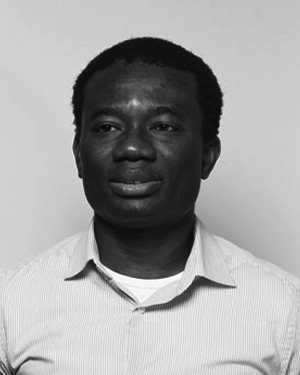 Kofi Appiah合作论文数Department of Computing and Informatics, University of Lincoln1
 Axel Blau合作论文数Science and Technology Consulting Services1Alexey Petrushin合作论文数1
 Thomas Martin McGinnity合作论文数Intelligent Systems Research Centre, Ulster University;School of Computing, Engineering and Intelligent Systems, Ulster University;Nottingham Trent University1




