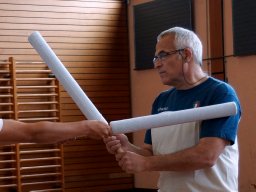
The goal of this study was to compare oxygen uptake (VO2 ) and cardiorespiratory responses during two selected fighting techniques in kendo and judo and to express the effort levels required to those measured during a maximal incremental exercise test. Eight males, aged 22.8 ± 2.9 years, with a moderate level of ability in fighting sport, volunteered for the study. They randomly performed once a week a maximal exercise test on cycle ergometer, and a judo and kendo fighting session, respectively, against the same adversary. VO2 and cardiorespiratory responses were measured at rest, at each minute during 3 min of fighting and during a maximal incremental exercise test, with a Cosmed K2 telemetric gas exchange analyzer. Aerobic energy expenditure was calculated during the 3 fighting minutes as the difference between VO2 determined at each minute and VO2 at rest. The judo technique required a subject wearing the Cosmed K2 to remain upright and throw his adversary down. For the adversary, it consists to raise subject with the Cosmed K2 from ground. The kendo technique consists of fighting with stick according to an adapted federal kendo rule. At rest, there was no difference between judo and kendo in all cardiorespiratory variables including VO2. The VO2 reached a high percentage of the maximal value at the 3rd minute of fighting but did not differ, respectively, between judo and kendo [1st min: 14.79 ± 5.05 (28%) vs. 17.75 ± 3.8 (34%), 2nd min: 35.39 ± 12.85 (68%) vs. 34.38 ±5.54 (66%) and 3rd min: 40.73±4.05 (78%) vs. 34.14±6.13 (65%)ml ‐min−1 ‐kg−1]. Analysis of ventilatory gas exchange lead to similar results with largest percentage for judo and kendo compared with the VO2 max test respiratory variables at the 3rd minute for pulmonary ventilation [1st min: 33.31 ± 10.89 (32%) vs. 38.55±4.2 (37%), 2nd min: 63.78± 16.64 (62%) vs. 59.01 ±11.15 (57%) and 3rd min: 71.51 ±15.87 (69%) vs. 61.68± 12.55 (60%) 1‐min−1], tidal volume [1st min: 1.31 ±0.40 vs. 1.33±0.48, 2nd min: 1.94±0.49 vs. 1.86±0.41, and 3rd min: 2.08 ± 0.5 vs. 1.97 ± 0.39 1], and breathing frequency [1st min: 26.91 ± 8.23 vs. 2.62 ± 7.02, 2nd min: 33.99 ± 6.64 vs. 32.96 ± 5.97, and 3rd min: 35.60 ± 6.64 vs. 32.72 ± 5.73 cycle · min−1]. Cardiac responses also reached high percentages at the 3rd minute but values remain identical for heart rate [1st min: 130±22 (70%) vs. 137±21 (73%), 2nd min: 161±18 (86%) vs. 157± 13 (84%), and 3rd min: 166± 18 (89%) vs. 162±13 (86%) beat‐min−1], and oxygen pulse [1st min: 8±2.1 vs. 9.4±2.4, 2nd min: 15.62±3.88 vs. 15.84±2.60, and 3rd min: 17.85±3.24 vs. 15.22±2.68ml‐kg−1 ‐beat−1]. These results indicate that, in practical conditions, the two selected fighting techniques of judo and kendo require a similar and large oxygen uptake and cardiorespiratory response.
Gilmer and Heinzer have considered the question: For an indexed family of fields oK = { K α } αgEA , under what conditions does there exist a zero-dimensional ring R (always commutative with unity) such that oK is up to isomorphism the family of residue fields { R M α } αgEA of R ? If oK is the family of residue fields of a zero-dimensional ring R , then the associated bijection from the index set A to the spectrum of R (with the Zariski topology) gives A the topology of a Boolean space. The present paper considers the following question: Given a field F , a Boolean space X and a family { K x } xgEX of extension fields of F , under what conditions does there exist a zero-dimensional F -algebra R such that oK is up to F -isomorphism the family of residue fields of R and the associated bijection from X to Spec( R ) is a homeomorphism? A necessary condition is that given x in X and any finite extension E of F in K x , there exist a neighborhood V of x and, for each y in V , an F -embedding of E into K y . We prove several partial converses of this result, under hypotheses which allow the “straightening” of the F -embeddings to make them compatible. We give particular attention to the cases where X has only one accumulation point and where X is countable; and we provide several examples.
This chapter presents examples of first coefficient and stable ideals in dimension 2 and compares the descriptions of the coefficient ideals. It provides examples of coefficient ideals in higher dimensions, as well as two results on the existence of stable ideals in dimension 2. The chapter also proves that the non-negative coefficient-closure of certain monomial ideals in dimension 2 are stable ideals.
Ratliff and Rush show in particular that Ĩ is the largest ideal for which, for sufficiently large positive integers n, (Ĩ) = I and hence that ̃̃ I = Ĩ. We call regular ideals I for which I = Ĩ Ratliff–Rush ideals, and we call Ĩ the Ratliff–Rush ideal associated with I. It is easy to see that an element a of I : I is integral over I, in the sense that there is an equation of the form a + b1a k−1 + . . . + bk = 0, where bi ∈ I for i = 1, . . . , k. Therefore, the ideal Ĩ is always between I and the integral closure I ′ of I, and hence integrally closed ideals are Ratliff–Rush ideals. Ratliff and Rush observe [RR, (2.3.4)] that the powers of an invertible ideal are Ratliff–Rush ideals, so any principal ideal generated by a nonzerodivisor is a Ratliff–Rush ideal. They also prove the interesting fact that for any regular ideal I of R, there is a positive integer n such that for all k ≥ n, Ĩk = I [RR, (2.3.2)], i.e., all sufficiently high powers of a regular ideal are Ratliff–Rush. A regular ideal I is always a reduction of its associated Ratliff–Rush ideal Ĩ, in the sense that I(Ĩ) = (Ĩ) for some positive integer n. For the basic facts on reductions and reduction numbers of ideals, we refer the reader to [NR], [H1], and [H2]. In particular, if there is an element a of an ideal I for which aI = I then aR is called a principal reduction of I and the smallest n for which this equation holds is called the reduction number of I. We will call a regular ideal I stable iff it has a principal reduction with reduction number at most one, i.e., iff there is an element a of I for which
The Ratliff-Rush ideal associated to a nonzero ideal I in a commutative Noetherian domain R with unity is Ĩ = ⋃∞n=1 (In+1:RIn = ⋂ {IS∩R:S∈B(I)}, where B(I) = {R[I/a]P:a∈I−0, P∈Spec(R[I/a])} is the blowup of I. We observe that certain ideals are minimal or even unique in the class of ideals having the same associated Ratliff-Rush ideal. If (R, M) is local, quasi-unmixed, and analytically unramified, and if I is M-primary, then we show that the coefficient ideal I{k} of I, i.e., the largest ideal containing I whose Hilbert polynomial agrees with that of I in the highest k terms, is also contracted from a blowup B(I)(k), which is obtained from B(I) by a process similar to "S2-ification." This allows us to generalise the notion of coefficient ideas. We investigate these ideas in the specific context of a two-dimentional regular local ring, observing the interaction of these notions with the Zariski theory of complete ideals.
Let D D be a Noetherian domain, D ′ D\prime its integral closure, and Int ( D ) \operatorname {Int}(D) its ring of integer-valued polynomials in a single variable. It is shown that, if D ′ D\prime has a maximal ideal M ′ M\prime of height one for which D ′ / M ′ D\prime /M\prime is a finite field, then Int ( D ) \operatorname {Int}(D) is not Noetherian; indeed, if M ′ M\prime is the only maximal ideal of D ′ D\prime lying over M ′ ∩ D M\prime \cap D , then not even Spec ( Int ( D ) ) \operatorname {Spec}(\operatorname {Int}(D)) is Noetherian. On the other hand, if every height-one maximal ideal of D ′ D\prime has infinite residue field, then a sufficient condition for Int ( D ) \operatorname {Int}(D) to be Noetherian is that the global transform of D D is a finitely generated D D -module.
Let D D be a Dedekind domain and R = I n t ( D ) R = Int(D) be the ring of integer-valued polynomials of D D . We relate the ideal class groups of D D and R R . In particular we prove that, if D = Z D = \mathbb {Z} is the ring of rational integers, then the ideal class group of R R is a free abelian group on a countably infinite basis.
We study domains with the property that, in any proper overring, some proper ideal extends to the unit ideal, and domains with the property that, in any proper overring, some proper ideal of a certain type (v-ideal, invertible ideal, or principal ideal) extends to the unit ideal.We characterize the Noetherian domains with these properties, and we show that even the strongest of these properties does not imply the QR-property.0. Introduction.An integral domain D with field of fractions K is said to have the "QR-property" if every subring of K that properly contains D (i.e., every "proper overring" of D) is a ring of fractions of D with respect to some multiplicatively closed set.Robert Gilmer has asked whether a sufficient condition for D to have the QR-property is that, for every proper overring E of D, some nonunit of D is a unit in E. In the present paper we show that the answer is no, essentially because even if D satisfies the latter condition, a ring of fractions over it need not satisfy it.Another way of phrasing the latter condition is: For every proper overring E of D, there is a proper principal ideal of D that "blows up", i.e., extends to the unit ideal, in E. In these terms, it is natural to extend the idea to classes of ideals other than the class of principal ideals; for instance, it is more likely that a maximal ideal will blow up than a principal ideal.Thus, we were led to the following definition: DEFINITION.We call an integral domain D "plosive" if, in every proper overring E of D, some proper ideal of D extends to the unit ideal in E. Letting "blue" denote any of the adjectives "v", "invertible", or "principal", we call D "blue-plosive" if, in every proper overring £ of ΰ, some proper blue ideal of D extends to the unit ideal of E.
Several recent papers, among them [BSSV, Tl, T2], have considered the problem of identifying rings with the property of “pole assignability.” (The definition appears below.) In particular, Bumby, Sontag, Sussmann, and Vasconcelos [BSSV] showed that, while a polynomial ring in one indeterminate over a field has this property, the polynomial ring in two indeterminates over the reals, R[x, y], and the polynomial ring in one indeterminate over the integers, Z[x], do not have this property. Then Tannenbaum [Tl, T23 showed that the polynomial ring in two indeterminates over any field does not have this property. The purpose of this note is to unify the proofs of these two facts in results that we hope will be helpful in identifying the pole assignability property (or its absence) in other rings. Let
A commutative ring with unity “has n-acc” iff every ascending chain of n-generated ideals stabilizes. This paper shows that any polynomial ring or formal power series ring over a Noetherian ring has n-acc for all n. The method involves a sufficient condition for n-acc in the quasilocal case and another for globalizing the n-acc property. Examples are given to show that n-acc does not imply (n + 1)-acc for every positive integer n and that n-acc does not behave well in general under localization, globalization, and passage to a polynomial ring. It is also noted that a Prüfer domain with 2-acc is Dedekind.
1. INTRODUCTION Primary decomposition is a venerable tool in commutative algebra; indeed, Emmy Noether studied rings with the ascending chain condition on ideals because primary decomposition was available there [9 J. Though many results for which it was once used are now proved by other means, primary decomposition itself is still finding new applications [ 15, 161, and provides an often informative representation of ideals [2]. In this paper we study the class of rings (always commutative with unity) in which primary decom- position holds, and related classes. Recall: DEFINITION. Let M be a finitely generated module over ring R. (1) A submodule N is primary if, for any r in R and m in M whose product rm is in N, either m E N or some power rk of r satisfies rkM G N. It is strongly primary if, in addition, the radical P = fl= {r E R : rkM L N for some k} has a power Pk which satisfies PkM E N. (2) M is a (strongly) Laskerian module if every submodule of M is an intersection of a finite number of (strongly) primary submodules. (3) M is a ZD module if, for every submodule N of M, the set Z,(M/N) = {r E R: rm E N for some m E M\N} of zero divisors on M/N in R is the union of a finite number prime ideals in R. Of course, a ring is Laskerian, or strongly Laskerian, or ZD, if it has the property as a module over itself. In Section 2 we prove the ascent of these properties in certain ring extensions; in particular, finite integral extensions.
 William Heinzer合作论文数Purdue University16
 Bernard Johnston合作论文数2Robert Gilmer合作论文数2Kishor Shah合作论文数Department of Mathematics, Southwest Missouri University2
 Said Ahmaidi合作论文数Universitede Picardie Jules Verne1James Brewer合作论文数1
 Pierre Portero合作论文数Service de Rééducation Neuro-Orthopédique, Hôpital Rothschild1Brigitte Marti合作论文数1Gilberte Robain合作论文数1
 Michel Calmet合作论文数1Jean-Pierre Libert合作论文数1Roger Wiegand合作论文数1




