A converse KAM method for 3D vector fields, establishing regions through which passes no invariant 2-tori transverse to a given direction field, is tested on some helical perturbations of an axisymmetric magnetic field in toroidal geometry. It finds regions corresponding to magnetic islands and chaos for the fieldline flow. The minimization of these regions is proposed as a tool to help in the design of plasma confinement devices of tokamak and stellarator type.
The search of high-order periodic orbits has been typically restricted to problems with symmetries that help to reduce the dimension of the search space. Well-known examples include reversible maps with symmetry lines. The present work proposes a new method to compute high-order periodic orbits in twist maps without the use of symmetries. The method is a combination of the parameterization method in Fourier space and a Newton–Gauss multiple shooting scheme. The parameterization method has been successfully used in the past to compute quasi-periodic invariant circles. However, this is the first time that this method is used in the context of periodic orbits. Numerical examples are presented showing the accuracy and efficiency of the proposed method. The method is also applied to verify the renormalization prediction of the residues’ convergence at criticality (extensively studied in reversible maps) in the relatively unexplored case of maps without symmetries.
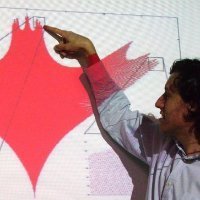
A non-autonomous version of the standard map with a periodic variation of the parameter is introduced and studied. Symmetry properties in the variables and parameters of the map are found and used to find relations between rotation numbers of invariant sets of the autonomous realization of the period-two case of the map. The role of the nonautonomous dynamics on period-one orbits, stability and bifurcation is studied. The critical boundaries for the global transport and the destruction of invariant circles with fixed rotation number are studied in detail using direct computation and a continuation method. In the case of global transport, the critical boundary has a particular symmetrical horn shape. The results are contrasted with similar calculations found in the literature.
Self-consistent chaotic transport is studied in a Hamiltonian mean-field model. The model provides a simplified description of transport in marginally stable systems including vorticity mixing in strong shear flows and electron dynamics in plasmas. Self-consistency is incorporated through a mean-field that couples all the degrees-of-freedom. The model is formulated as a large set of N coupled standard-like area-preserving twist maps in which the amplitude and phase of the perturbation, rather than being constant like in the standard map, are dynamical variables. Of particular interest is the study of the impact of periodic orbits on the chaotic transport and coherent structures. Numerical simulations show that self-consistency leads to the formation of a coherent macro-particle trapped around the elliptic fixed point of the system that appears together with an asymptotic periodic behavior of the mean field. To model this asymptotic state, we introduced a non-autonomous map that allows a detailed study of the onset of global transport. A turnstile-type transport mechanism that allows transport across instantaneous KAM invariant circles in non-autonomous systems is discussed. As a first step to understand transport, we study a special type of orbits referred to as sequential periodic orbits. Using symmetry properties we show that, through replication, high-dimensional sequential periodic orbits can be generated starting from low-dimensional periodic orbits. We show that sequential periodic orbits in the self-consistent map can be continued from trivial (uncoupled) periodic orbits of standard-like maps using numerical and asymptotic methods. Normal forms are used to describe these orbits and to find the values of the map parameters that guarantee their existence. Numerical simulations are used to verify the prediction from the asymptotic methods.
The set of coherent states for a noncommutative quantum Bianchi I anisotropic cosmology were built to circumvent the absence of a simultaneous set of configuration observables. By extending known methods of path integrals with coherent states to their noncommutative analogues allowed us to obtain the formal expression of the propagator of the theory in terms of the covariant Husimi Q-symbol of the quantum constraint. The analysis of the equations of motion resulting from a steepest descent procedure showed the existence of solutions displaying a minimum value of the volume scaling function which are, in turn, compatible with a physically inspired definition for a bounce. More importantly, a lower bound for the volume at the bounce which incorporates quantum mechanical and noncommutativite contributions was established. The asymptotic analysis of the solutions in the vicinity of the bounce was performed by implementing techniques used in boundary-layer problems. The numerical simulations that confirm our results are also presented.