In this paper we present a general integer programming-based approach for the minimal perturbation problem in university course timetabling. This problem arises when an existing timetable contains hard constraint violations, or infeasibilities, which need to be resolved. The objective is to resolve these infeasibilities while minimising the disruption or perturbation to the remainder of the timetable. This situation commonly occurs in practical timetabling, for example when there are unexpected changes to course enrolments or available rooms. Our method attempts to resolve each infeasibility in the smallest neighbourhood possible, by utilising the exactness of integer programming. Operating within a neighbourhood of minimal size keeps the computations fast, and does not permit large movements of course events, which cause widespread disruption to timetable structure. We demonstrate the application of this method using examples based on real data from the University of Auckland.
In this paper the Container Positioning Problem is revisited. This problem arises at busy container terminals and requires one to minimize the use of block cranes in handling the containers that must wait at the terminal until their next means of transportation. We propose a new Mixed Integer Programming model that not only improves on earlier attempts at this problem, but also better reflects reality. In particular, the proposed model adopts a preference to reshuffle containers in line with a just-in-time concept, as it is assumed that data is more accurate the closer to a container’s scheduled departure the time is. Other important improvements include a reduction in the model size, and the ability of the model to consider containers initially at the terminal. In addition, we describe several classes of valid inequalities for this new formulation and present a rolling horizon based heuristic for solving larger instances of the problem. We show that this new formulation drastically outperforms previous attempts at the problem through a direct comparison on instances available in the literature. Furthermore, we also show that the rolling horizon based heuristic can further reduce the solution time on the larger of these instances as well as find acceptable solutions to much bigger, artificially generated, instances.
In this paper we present an integer programming method for solving the Classroom Assignment Problem in University Course Timetabling. We introduce a novel formulation of the problem which generalises existing models and maintains tractability even for large instances. The model is validated through computational results based on our experiences at the University of Auckland, and on instances from the 2007 International Timetabling Competition. We also expand upon existing results into the computational difficulty of room assignment problems.
ABSTRACTThe goal of the crew pairing problem is to partition a flight schedule into sequences of flights called pairings that crew members can operate at minimum cost. It is solved for each crew rank, for example, captains and first officers. In optimised crew pairings, crew often split and join other crew to operate outgoing flights. Because minimum cost pairings contain little buffer time, crew splitting after a delayed flight contributes to the propagation of delay. This effect can be avoided by unit crewing, that is, by keeping crew of different ranks together for as long as possible during a pairing. However, increasing unit crewing increases cost.We investigate sequential and parallel methods for unit crewing, explicitly considering the two objectives of minimising cost and maximising unit crewing. We apply multi‐objective techniques in the sequential approach, where the (minimum cost) pairing problem for one crew rank is solved first and both objectives feature when solving for the second crew rank. Because the quality of the pairings obtained by this method is limited by the solution for the first crew rank, we then propose to solve the two crew pairing problems simultaneously, again using multi‐objective optimisation methods. We introduce a multi‐objective optimisation model for this problem and propose a new heuristic branching technique that favours unit crewed pairings when applied to a scalarised model with an auxiliary objective function. We compare this with a direct approach with management of the number of unit crewing constraints and a Dantzig–Wolfe decomposition approach.Numerical tests on domestic New Zealand data show that the multi‐objective approaches considerably increase the level of unit crewing, without much increase in cost, even in the sequential approach. Moreover, we show that the parallel approach is superior in terms of quality of the pairing solution but computationally more expensive. The heuristic branching technique provides good quality solutions in reasonable time, as compared with the Dantzig–Wolfe method. Copyright © 2014 John Wiley & Sons, Ltd.
Efficiently coordinating the often large number of interdependent, timetabled train movements on a railway junction, while satisfying a number of operational requirements, is one of the most important problems faced by a railway company. The most critical variant of the problem arises on a daily basis at major railway junctions where disruptions to rail traffic make the planned schedule/routing infeasible and rolling stock planners are forced to re-schedule/re-route trains in order to recover feasibility. The dynamic nature of the problem means that good solutions must be obtained quickly. In this paper we describe a set packing inspired formulation of this problem and develop a branch-and-price based solution approach. A real life test instance arising in Germany and supplied by the major German railway company, Deutsche Bahn, indicates the efficiency of the proposed approach by confirming that practical problems can be solved to within a few percent of optimality in reasonable time.
Good and fast solutions to the airline crew pairing problem are highly interesting for the airline industry, as crew costs are the biggest expenditure after fuel for an airline. The crew pairing problem is typically modelled as a set partitioning problem and solved by column generation. However, the extremely large number of possible columns naturally has an impact on the solution time. In the solution method of this work we severely limit the number of allowed subsequent flights, i.e. the subsequences, thereby significantly decreasing the number of possible columns. Set partitioning problems with limited subsequence counts are known to be easier to solve, resulting in a decrease in solution time. The problem though, is that a small number of deep subsequences might be needed for an optimal or near-optimal solution and these might not have been included by the subsequence limitation. Therefore, we try to identify or generate such subsequences that potentially can improve the solution value. We benchmark the subsequence generation approach against a classical column generation approach on real-life test instances. We consider the LP relaxation and compare the quality and the integrality of the solutions. The LP solutions from the subsequence generation approach are less fractional, but it comes at the cost of a worse solution quality. ∗Corresponding author: E-mail: jesla@man.dtu.dk. Address: Department of Management Engineering, Technical University of Denmark, Produktionstorvet, Building 424, DK-2800 Kgs. Lyngby, Denmark. Tel.: +45-45253385. Fax: +45-45933435.
The problem of routing trains through railway junctions is an integral part of railway operations. Large junctions are highly interconnected networks of track where multiple railway lines merge, intersect, and split. The number of possible routings makes this a very complicated problem. We show how the problem can be formulated as a set-packing model with a resource-based constraint system. We prove that this formulation is tighter than the conventional node-packing model, and develop a branch-and-price algorithm that exploits the structure of the set-packing model. A discussion of the variable generation phase, as well as a pricing routine in which these variables are represented by tree structures, is also described. Computational experiments on 25 random timetables show this to be an efficient approach.
A prominent problem in airline crew scheduling is the pairings or Tour-of-Duty planning problem. The objective is to determine a set of pairings (or Tours-of-Duty ) for a crew group to minimise the planned cost of operating a schedule of flights. However, due to unforeseen events the performance in operation can differ considerably from planning, sometimes causing significant additional recovery costs. In recent years there has been a growing interest in robust crew scheduling. Here, the aim is to find solutions that are “cheap” in terms of planned cost as well as being robust, meaning that they are less likely to be disrupted in case of delays. Taking the stochastic nature of delays into account, Yen and Birge (Transp Sci 40:3–14, 2006) formulate the problem as a two-stage stochastic integer programme and develop an algorithm to solve this problem. Based on the contradictory nature of the goals, Ehrgott and Ryan (J Multi-Criteria Decis Anal 11:139–150, 2002) formulate a bi-objective set partitioning model and employ elastic constraint scalarisation to enable the solution by set partitioning algorithms commercially used in crew scheduling software. In this study, we compare the two solution approaches. We improve the algorithm of Yen and Birge (Transp Sci 40:3–14, 2006) and implement both methods with a commercial crew scheduling software. The results of both methods are compared with respect to characteristics of robust solutions, such as the number of aircraft changes for crew. We also conduct experiments to simulate the performance of the obtained solutions. All experiments are performed using actual schedule data from Air New Zealand.
The need to recover a train driver schedule occurs during major disruptions in the daily railway operations. Based on data from the Danish passenger railway operator DSB S-tog A/S, a solution method to the train driver recovery problem (TDRP) is developed. The TDRP is formulated as a set partitioning problem. We define a disruption neighbourhood by identifying a small set of drivers and train tasks directly affected by the disruption. Based on the disruption neighbourhood, the TDRP model is formed and solved. If the TDRP solution provides a feasible recovery for the drivers within the disruption neighbourhood, we consider that the problem is solved. However, if a feasible solution is not found, the disruption neighbourhood is expanded by adding further drivers or increasing the recovery time period. Fractional solutions to the LP relaxation of the TDRP are resolved with a constraint branching strategy using the depth-first search of the Branch & Bound tree. The LP relaxation of the TDRP possesses strong integer properties. We present test scenarios generated from the historical real-life operations data of DSB S-tog A/S. The numerical results show that all but one tested instances produce integer solutions to the LP relaxation of the TDRP and solutions are found within a few seconds.
The double travelling salesman problem (TSP) with multiple stacks (DTSPMS) is a pickup and delivery problem in which all pickups must be completed before any deliveries can be made. The problem originates from a real-life application where a 40-foot container (configured as 11 rows of three columns) is used to transport 33 pallets from a set of pickup customers to a set of delivery customers. The pickups and deliveries are performed in two separate trips, where each trip starts and ends at a depot and visits a number of customers. The aim of the problem is to produce a packing plan for the pallets that minimizes the total transportation cost given that the container cannot be repacked at any stage. In this paper we present an exact solution method based on matching k-best tours to each of the separate pickup and delivery TSPs. The approach is shown to outperform the only known previous exact method for this problem in that solutions can be obtained faster and previously unsolved instances containing as many as 18 customers can now be solved to optimality.
This paper describes a new approach for easily creating customised staff rostering column generation programs. In previous work, we have built a large very flexible software system which is tailored at run time to meet the particular needs of a client. This system has proven to be very capable, but is difficult to maintain, and incurs the time penalties of run-time customisation. Our new approach is to customise the software at compile time, allowing compiler optimisations to be fully exploited to give faster code. The code has also proven to be easier to read and debug.
In airline scheduling a variety of planning and operational decision problems have to be solved. We consider the problems aircraft routing and crew pairing: aircraft and crew must be allocated to flights in a schedule in a minimal cost way. Although these problems are not independent, they are usually formulated as independent mathematical optimisation models and solved sequentially. This approach might lead to a suboptimal allocation of aircraft and crew, since a solution of one of the problems may restrict the set of feasible solutions of the problem solved later. Also, when minimal cost solutions are used in operations, a short delay of one flight can cause very severe disruptions of the schedule later in the day. We generate solutions that incur small costs and are also robust to typical stochastic variability in airline operations. We solve the two original problems iteratively. Starting from a minimal cost solution, we produce a series of solutions which are increasingly robust. Using data from domestic airline schedules we evaluate the benefits of the approach as well as the trade-off between cost and robustness. We extend our approach considering the aircraft routing problem together with two crew pairing problems, one for technical crew and one for flight attendants.
Consider a forest containing units of various sizes for which a maximum clearfell area has been specified along with an associated green-up time period. For such an application it is customary to use adjacency constraints to produce a harvesting plan. These constraints control the availability for harvest of specific units relative to the harvesting of certain adjacent units. However, such constraints are difficult to formulate and often precipitate major difficulties in the implementation of the solution algorithm. A new concept, a nuclear set, is introduced. This concept allows the unit-specific aspects of the problem to be analyzed in an insightful manner. Any adjacency violation can be detected in relation to these nuclear sets. Suitable adjacency branches can be implemented to remove these violations. The form of these branches derives from the same nuclear sets. A remarkably small number of these branches are required to obtain a feasible solution. These ideas are incorporated into a column generation and constraint generation model. This new forest harvesting model solves the clearfell area restriction problem in an exact sense. Results are included for numerical trials involving simulated data representing moderately sized applications with a planning horizon of up to one rotation. The output from these trials suggests that this algorithm is suitable for large commercial applications. Several applications of 1,600 units are solved over 25 time periods with multiple green-up.
Yen and Birge (2006) formulate the airline crew scheduling problem as a two-stage stochastic integer programme with recourse. They develop an algorithm, the flight-pair branching algorithm, to solve the problem. In this note we show, by means of an example, that the algorithm does not necessarily terminate with an optimal solution.
In airline scheduling a variety of planning and operational decision problems have to be solved. We consider the problems aircraft routing and crew pairing: Aircraft and crew must be allocated to flights in a schedule in a minimal cost way. Although these problems are not independent, they are usually formulated as independent mathematical optimisation models and solved sequentially. This approach might lead to a suboptimal allocation of aircraft and crew, since a solution of one of the problems may restrict the solution of the problem solved later. Also, when minimal cost solutions are used in operations, a short delay of one flight can cause very severe disruptions of the schedule later in the day. We generate solutions that incur small costs and are also robust to typical stochastic variability in airline operations. We solve the two original problems iteratively. Starting from a minimal cost solution, we produce a series of solutions which are increasingly robust. Using data from domestic airline schedules we evaluate the benefits of the approach as well as the trade-off between cost and robustness. We extend our approach considering the aircraft routing problem together with two crew pairing problems, one for technical crew and one for flight attendants.
Changes in the train schedule affect the train driver duties. If a train is cancelled or delayed, the driver assigned to the train task might not be able to reach the station of his next train departure in time. In practice, if a driver is not available for the train departure, another driver, for instance, a reserve, is assigned to the task. If there are no drivers available to cover the task on time, the train is delayed or cancelled, causing further disruptions.
Forest Harvest Scheduling problems incorporating area-based restrictions have been of great practical interest for several years, but only recently have advances been made that allow them to be efficiently solved. One significant development has made use of formulation strengthening using the Cluster Packing Problem. This improved formulation has allowed medium sized problems to be easily solved, but when restrictions on volume production over time are added, problem difficulty increases substantially. In this paper, we study the degrading effect of certain types of volume constraints and propose methods for reducing this effect. Developed methods include the use of constraint branching, the use of elastic constraints with dynamic penalty adjustment and a simple integer allocation heuristic. Application results are presented to illustrate the computational improvement afforded by the use of these methods.
This chapter discusses an application of advanced planning support in designing a sea-transport system. The system is designed for Norwegian companies who depend on sea-transport between Norway and Central Europe. They want to achieve faster and more frequent transport by combining tonnage. This requires the possible construction of up to 15 new ships with potential investments of approximately 150 mill US dollars. The problem is a variant of the general pickup and delivery problem with multiple time windows. In addition, it includes requirements for recurring visits, separation between visits and limits on transport lead-time. It is solved by a heuristic branch-and-price algorithm.
 Matthias Ehrgott合作论文数Management Science, Lancaster University13
 Jesper Larsen合作论文数Institut for Teknologi, Ledelse og Økonomi, Technical University of Denmark8
 Richard Lusby合作论文数8
 Mikael Rönnqvist合作论文数Norwegian School of Economics and Business Administration, The5
 Golbon Zakeri合作论文数3Matias Sevel Rasmussen合作论文数3Oliver Weide合作论文数3Bassy Tam合作论文数3Andrew J. Mason合作论文数3
 Thomas L. Riechel合作论文数3Alastair Mcnaughton合作论文数3michael d d clarke合作论文数2Curt Hjorring合作论文数2Andrew Philpott合作论文数2
 Antony E. Phillips合作论文数2
 Tom Welton合作论文数Department of Chemistry, Faculty of Natural Sciences, Imperial College London2Myrna Palmgren合作论文数2Bjørn Nygreen合作论文数2Natalia J. Rezanova合作论文数2Mikkel Sigurd合作论文数2Cameron Walker合作论文数2thomas l riechel合作论文数1John C. Nardi合作论文数1Bj Piersma合作论文数1R.A. Marsh合作论文数1
 Juan Pablo Vielma合作论文数Google Research1
 Fred Glover合作论文数Entanglement, Inc.;Renewable & Sustainable Energy Institute, College of Engineering & Applied Science, University of Colorado Boulder;University of Colorado, Denver1John Holt合作论文数1
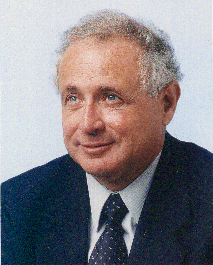 Andres Weintraub合作论文数Department of Industrial Engineering
University of Chile1
Andres Weintraub合作论文数Department of Industrial Engineering
University of Chile1 Alan Murray合作论文数Department of Geography, University of California at Santa Barbara;Department of Geography, San Diego State University1Peter Wark合作论文数1Chris A. Wallace合作论文数1Jeff A. Meyer合作论文数1Hamish Waterer合作论文数University of Newcastle, Monash University1Nina L. Ulstein合作论文数1David Panton合作论文数1E. Rod Butchers合作论文数1
 Anders Dohn合作论文数1Paul R. Day合作论文数1




