Vehicle-to-vehicle (V2V) channels exhibit unique properties due to the highly dynamic environment and low elevation of the antennas at both ends of the link. Of particular importance for the behavior of V2V channels, and consequent reliability of the communication link, is the severity and dynamics of blockage of both the line-of-sight and other multipath components (MPCs). The characteristics of blockage become more important as the carrier frequency increases, and the ability of the signal to penetrate through objects diminishes. To characterize the effects of vehicle blockage, we performed V2V channel measurements in four different frequency bands (6.75, 30, 60, and 73 GHz) in urban and highway scenarios. We analyzed the impact of the blocker size and position on the received power and fast fading parameters, as well as the frequency dependence of these parameters under blockage. Our results show that there is a strong influence of the size of the blocking vehicle on the blockage loss and the angular/delay spread. The position of the blocker relative to the transmitter and receiver also plays an important role. On the other hand, the frequency dependence is quite limited, with the blockage loss increasing slightly and the number of scattered MPCs reducing slightly as frequency increases. The main conclusion of this paper is that V2V communication will be possible in high (millimeter-wave) frequencies, even in the case of blockage by other vehicles.
4,768,218 8/1988 Yorita ................................... 379/6 4,868,811 9/1989 Suzuki ................................... 370/50 5,020,051 5/1991 Beesley et al......................... 370/24 5,088,094 2/1992 Grauel et al. .... 370/95.1 5,124,985 6/1992 Hoshikawa ........................ 37O/95.3 5,134,710, 7/1992 Akerberg ........................... 370/95.3 Primary Examiner-Douglas W. Olms Assistant Examiner-Ajit Patel Attorney, Agent, or Firm-Jean-Pierre Fortin
This paper investigates the large scale parameters (LSPs) of wireless channels with measurements at frequencies of 7.5 GHz, 28 GHz and 73 GHz for indoor light-of-sight (LOS) and non-light-of-sight (NLOS) scenarios. Comparison of the measured LSPs (RMS-DS, ASA, ESA) of these channels at different frequencies shows some differences between high and low frequency measurements. These studies indicate that more measurements will be needed for a full understanding of high-frequency millimeter-wave (mmWave) channels. This understanding is critically important for the successful application of high-frequency technologies in future 5G communication systems.
Traditional mobile radio communications system designs are largely based on the principles of engineering an independent radio link for each user. Recent developments with small cells and multiple antennas have further improved the capacity of the radio channel through high density frequency reuse. Such techniques achieve an increase in capacity (i.e. number of users and their traffic) that is linearly proportional to the number of additional antennas and the associated cells or cell sectors. However, as the volume of users and their traffic increases there is a need for a massive increase in system capacity. Examples of such massive traffic loads include stadiums and similar events attended by large crowds of connected users. In this paper we outline concepts of radio aperture synthesis and illustrate their application to a high density communications scenario. The aperture synthesis approach augments the engineering of multiple individual radio links with an arrangement of massively parallel cells (MPC). The advantage of the aperture synthesis technique for communications systems is that very high frequency reuse can be achieved and the system capacity increases approximately as the square of the number of antennas in the synthesis array.
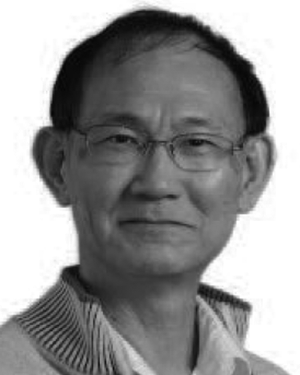 Koon Hoo Teo合作论文数Mitsubishi Elect Res Labs, Cambridge, MA 02139 USA14
 adrian smith合作论文数8Shalini Periyalwar合作论文数Centre Dept . of Systems & Computer Engineering|Carleton University|Nortel Networks7Bassam Hashem合作论文数was lucky. He had just come home from taking the children to school5Chandra Sekhar Bontu合作论文数carleton university5Sophie Vrzic合作论文数3HUDSON JOHN E合作论文数2
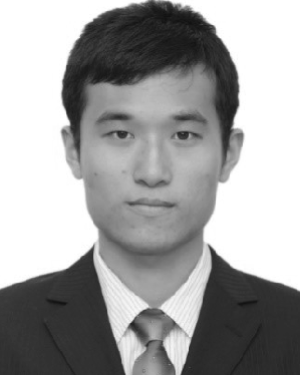 Ziming Yu合作论文数Huawei Technol Co Ltd, Shanghai, Peoples R China2
 Mark Pecen合作论文数2ASTHANA ATUL合作论文数1yoon chae cheong合作论文数1boudreau daniel合作论文数1Yanshen Du合作论文数1
 Guangjian Wang合作论文数1
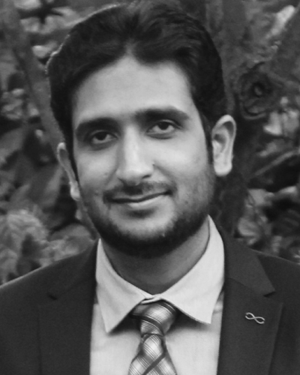 Naveed Iqbal合作论文数1Xiongfei Zou合作论文数1Jian Li合作论文数1Diego Andres Dupleich合作论文数Technische Universitat Ilmenau1
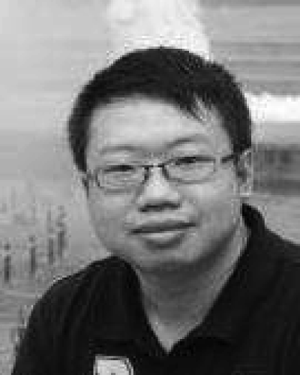 Hua Yan合作论文数1
 Robert Müller合作论文数1
 Jian Luo合作论文数Eur. Res. Center (ERC),, Huawei Technol. Duesseldorf GmbH;c1
 Mate Boban合作论文数Huawei Technol Dusseldorf GmbH1
 Christian Schneider合作论文数1James Earl Womack合作论文数1
 Reiner S. Thomä合作论文数Fachgebiet Elektronische Messtechnik und Signalverarbeitung, Fakultät für Elektrotechnik und Informationstechnik, Technische Universität Ilmenau1
 Roshdy H. M. Hafez合作论文数Dept of System and Computer Engineering, Carleton University1
 Jia He合作论文数1
 Tommi Jämsä合作论文数Elektrobit Corporation1




