This publication discusses the current management and cultural practices for peanut production. This article is intended to share the latest information about peanut production and management with farmers, crop consultants, and Extension agents. Written by S. S. Sidhu, D. L. Wright, B. Tillman, N. Dufault, I. M. Small, I. L. Esquivel, Z. Grabau, H. Singh, E. Matcham, E. A. Borgato, J. Capasso, S. Kumar, and E. Carter, and published by the UF/IFAS Department of Agronomy, January 2026.
This publication aims to help growers and researchers understand the role of cover crops in improving soil health. The document provides recommendations on managing cover crops and describes the benefits of growing cover crops. Written by R. Seepaul, S. George, J. Love, D. W. Wright, C. Mackowiak, and A. Blount, and published by the UF/IFAS Agronomy Department, revised January 2023.
The Cropping System Model (CSM)‐CROPGRO‐Cotton model simulates growth, development, and yield for cotton ( Gossypium hirsutum L.) and requires a large number of parameters and inputs. It is practically impossible to estimate all the parameters with a high level of accuracy. The objectives of this study were to estimate values and uncertainties of the CSM‐CROPGRO‐Cotton model genotype parameters and resulting uncertainties in the cotton growth and development model and to evaluate the model performance by comparing model predictions based on the estimated parameters using generalized likelihood uncertainty estimation (GLUE) with those based on a prior distribution and the default model parameters. Observations for this study were collected from four experiments at Quincy, FL, Citra, FL, and Griffin, GA, for Delta Pine 555 cotton. The results show that the estimated parameters improved model performance compared with default parameters. There was a noticeable reduction in parameter uncertainties and resulting model output uncertainties. Resulting uncertainty in model predictions of leaf area index, leaf weight, stem weight, and boll weight were reduced to 4 to 13% with posterior and 29 to 56% prior parameters, partially due to improved estimates and a considerable reduction in the uncertainty of the important model parameters such as the light extinction coefficient and specific leaf area. The GLUE technique improved the model performance by improving estimated values of model parameters, reducing model parameter uncertainties, and reducing model output uncertainties.
A sod-based rotation is when a producer adapts a conventional peanut/cotton rotation by growing a perennial grass, such as bahiagrass, during two years of the rotation. The perennial grass can be grazed, cut for hay or harvested for seed for additional income. Using a sod-based rotation can improve soil water-holding capacity and potentially reduce impacts of dry spells and droughts. This 4-page fact sheet was written by David Wright, Jim Marois, Clyde Fraisse, and Daniel Dourte, and published by the UF Department of Agricultural and Biological Engineering, August 2012.
Preparation for planting cotton can be done by strip-tilling rows 4 to 6 weeks before planting into a cover crop or old crop residue to warm the soil. Strip-till planting can also be made a one-pass operation by running rows and planting at the same time. Bedding in the fall and knocking off beds to plant into moist soils in the spring has become more popular with conservation tillage. Tilling and bedding rows 4 to 6 weeks ahead of planting, followed by knocking off tops of beds to plant into moist and warmer soils, is a widely accepted practice on non-irrigated fields. Bedding with early planting may be the best way of ensuring stands in non-irrigated fields. Where irrigation is available, neither bedding nor subsoiling is as critical; however, ripping rows ahead of strip tillage or bedding usually results in warmer soils, which may be critical to reduce stand loss due to seedling disease in early planted cotton. Most soils in Florida have a natural compaction layer 6 to 14 inches deep and must be subsoiled or follow perennial grass sods that leave root channels through the compaction layer to allow cotton roots to grow through. Soil moisture is usually adequate for planting in late March to early April; it dries out in late April to May.
 Jim Rich合作论文数1
 Tapan Pathak合作论文数1
 sudeep s sidhu合作论文数Univ. of Florida1
 Hardeep Singh合作论文数Dept Plant & Soil Sci, Oklahoma State Univ1Shivendra Kumar合作论文数1
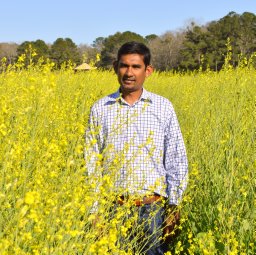 Ramdeo Seepaul合作论文数North Florida Research and Education Center1
 George Sheeja合作论文数1
 James W. Jones合作论文数Department of Agricultural and Biological Engineering, University of Florida1
 Gerrit Hoogenboom合作论文数Department of Agricultural and Biological Engineering, University of Florida;Global Food Systems Institute, University of Florida;Institute for Sustainable Food Systems, University of Florida1
 Clyde Fraisse合作论文数Department of Agricultural and Biological Engineering, University of Florida1Jim Marois合作论文数1
 Ann Blount合作论文数1
 Cheryl Mackowiak合作论文数IFAS North Florida Research and Education Center, University of Florida1




