Modern radars employing wideband signals and extremely large (XL) multiple-input multiple-output (MIMO) arrays can significantly improve range and angular resolution. However, when large bandwidth and array aperture are used simultaneously, the spatial delay across the array becomes comparable to the radar range resolution, leading to the spatial wideband effect (SWE). The SWE introduces several distortions including range migration (range squint), beam squint, and range-angle coupling (RAC), which spread the target response in the range-angle domain and may cause physically separated targets to overlap and mask each other. In this work, we propose a decoupling-based target detection and parameter estimation framework for MIMO frequency modulated continuous wave (FMCW) radar. The proposed method reformulates the joint range-angle estimation problem as a decoupled sequential frequency estimation problem, where the two-dimensional (2D) estimation is carried out through successive one-dimensional (1D) super-resolution estimations. Specifically, we employ orthogonal matching pursuit (OMP) to perform sparse recovery-based range and angle estimation with high resolution. The proposed decoupling strategy is further extended to spatial wideband XL-MIMO FMCW radar systems, enabling reliable detection and separation of targets even when their responses overlap due to severe RAC. Simulation results demonstrate that the proposed approach accurately detects multiple targets and successfully resolves overlapping target responses in the presence of SWE, outperforming conventional Fourier transform and clustering-based methods.
Terahertz (THz) communications, utilizing ultra-wide bandwidths of hundreds of GHz, are essential for meeting the surging data demands of sixth-generation (6G) networks. However, the integration of wideband THz signals with ultra-massive multiple-input multiple-output (UM-MIMO) arrays introduces dual wideband effects (delay squint and beam squint) and spatial non-stationarity (SNS) alongside challenges such as line-of-sight (LoS) blockage, which degrade channel estimation accuracy and system performance. To address these challenges, this paper proposes a gridless iterative atomic norm minimization (GI-ANM)-based channel estimator (CE), formulating a convex optimization framework that operates in the continuous parameter space, enabling joint estimation of delays, frequency-dependent gains, and angular variations, effectively handles dual wideband effects and SNS. By eliminating grid mismatch errors inherent in conventional compressed sensing methods, such as orthogonal matching pursuit (OMP), generalized simultaneous OMP, and sparse Bayesian learning, the proposed CE achieves superior accuracy and robustness under 100% LoS blockage, SNS, and dual wideband effects, even in low signal-to-noise ratio environments. Simulation results demonstrate significant improvements in normalized mean square error (NMSE) and bit error rate (BER) performance for THz UM-MIMO systems compared to state-of-the-art methods, including in joint subcarrier correlation and the near-field scenario. The proposed GI-ANM-based CE offers a scalable, high-performance solution for advancing reliable and efficient ultra-wideband THz UM-MIMO systems in 6G networks.
Terahertz (THz) ultra-massive multiple-input multiple-output (UM-MIMO) systems promise unprecedented data rates for sixth-generation (6G) wireless networks. However, the combination of ultra-wide bandwidth and extremely large antenna arrays introduces fundamental challenges such as dual wideband effects and near-field spherical wavefront propagation. This letter provides the Cram & eacute;r-Rao lower bound (CRLB) analysis for the multipath channel parameter estimation of uplink near-field THz UM-MIMO systems under dual wideband effects, considering a uniform circular array at the user and base station with true-time-delay (TTD)-assisted hybrid architectures. The analysis accounts for frequency-dependent near-field steering vectors using the Fresnel approximation and Jacobi-Anger expansion, along with molecular absorption. A high signal-to-noise ratio approximation is employed to obtain interpretable closed-form expressions for the CRLB and the corresponding weighted average CRLB on the normalized mean squared error. Simulation results reveal that multipath channel parameter estimation benefits from TTD-assisted hybrid architectures, demonstrating the feasibility of enabling hardware-efficient designs for near-field channel estimation, localization, and sensing in 6G communications.
The rapid growth of modern mobile electronic platforms requires reliable and seamless wireless communication links for uninterrupted data exchange for which Orthogonal Time Frequency Space (OTFS) modulation has emerged as a robust waveform due to its resilience in the delay-Doppler domain and N-dimensional (N-D) mapper improves performance by increasing the minimum Euclidean distance between constellation points, thereby reducing bit error rate (BER). To enhance the spectral efficiency in doubly dispersive channel, Orbital Angular Momentum (OAM) multiplexing is employed. This letter analyzes the joint effects of platform acceleration and imperfect Channel State Information on ND-OTFS-OAM systems using simulation-based BER evaluation.
This letter presents the Gridless Iterative Near-field Terahertz Channel Estimation (GLINT-CE) technique, tailored for Full-dimensional Ultra-massive Spatial non-stationary Extensible Dual-wideband multiple-input-multiple-output (FUSED-MIMO) systems, addressing dual wideband effects and spatial non-stationarity (SNS) for scalable sixth-generation (6G) communications. Utilizing uniform planar arrays at both the base station and user equipment to support the system's full-dimensional architecture, the channel is described as a function of frequency-dependent gains, dual-wideband near-field steering vectors, and SNS. By formulating the CE as a convex optimization problem leveraging joint subcarrier atomic norm minimization, the GLINT-CE achieves superior estimation accuracy, as validated by simulation results outperforming existing methods.
With the growth of the 5G network, a wide range of heterogeneous systems have become an integral part of it. The perspective of heterogeneity has made the 5G new radios (NRs) waveform-hungry to meet the system capacity and reliability in highly mobile environments. Conventional NR systems use orthogonal frequency division multiplexing (OFDM), which suffers from the Doppler effect in high-mobility environments. This paper presents the novel waveforms for the NR system using orbital angular momentum (OAM) modes to make the MIMO system even more spectral efficient. The waveforms are orthogonal time-frequency space mode (OTFSM) and orthogonal time-sequency mode multiplexing (OTSMM). In OTFSM, the symbols are in the delay-Doppler-mode domain, and in OTSMM, they are in the delay-sequency-mode domain. Further, we significantly improve the system's performance in terms of bit error rate at higher modulation orders by incorporating the N-dimensional (N-D) mapper into the OTFSM and OTSMM modulation methods. A low-complex detector is also designed for these waveforms, and its performance is compared with that of the orthogonal frequency mode division multiplexing waveforms. The simulation results depict the superiority of our novel waveforms in terms of enhanced system capacity and reliability in high-mobility environments.
The development of 6G communication systems presents major obstacles for an effective network model, primarily due to the elevated costs and complexities associated with measurements across various scenarios and frequency ranges. Predictive channel modeling has surfaced as a viable and practical approach to tackle these issues. This research introduces an innovative framework, the Feedforward convolutional graph attention network with Groupers and Moray Eels (FCAGME), which is integrated with a gated recurrent unit. This framework is specifically designed to capture both spatial and temporal dependencies within the frequency domain. As a result, it facilitates accurate predictions of unknown frequency band characteristics by utilizing insights derived from existing channel measurements. Furthermore, this approach incorporates a Groupers and Moray Eels optimization algorithm to refine the parameters of FCAGME, thereby enhancing training stability and efficiently optimizing loss and error parameters. The proposed methodology demonstrates exceptional performance, achieving a channel prediction rate of 97.8
Ensuring connectivity and reliability in dense wireless networks is critical for the evolution toward 6G and beyond (B6G). A promising approach to meet these demands is the integration of aerial base stations (ABSs) with existing terrestrial infrastructure, enabling more flexible and efficient network planning, particularly in urban and high-traffic scenarios. This paper presents a comprehensive analysis of coverage probability and average capacity in integrated aerial–ground networks, based on a maximum signal-to-interference and noise ratio (max-SINR) association policy. Leveraging tools from stochastic geometry, we derive the coverage probability as a function of key system parameters under Nakagami-m fading with arbitrary interference distributions. We also formulate the average capacity under coverage, highlighting the influence of ABS and ground base station (GBS) densities. For the special case of Rayleigh fading and exponentially distributed interference, we obtain explicit and tractable closed-form expressions for coverage and capacity. Our analysis reveals that a change in base station densities introduces significant interference, adversely impacting coverage probability and network capacity. The proposed analytical framework is validated through simulations and provides key insights into how fading characteristics, the SIR threshold, and transmit power affect overall network performance.
Spatial and temporal delays in a wireless multi-antenna system, paired with an orthogonal frequency division multiplexing (OFDM) waveform, can be utilized to estimate the Angle of Arrival (AoA) and Time of Arrival (ToA) of scatterers in the radio channel through spectral estimation techniques. However, in millimeter-wave (mmWave) and TeraHertz (THz) systems, the spatial delays across the aperture of massive array elements are comparable to the inverse of the signal bandwidth. As a result, these delays cannot be approximated solely by phase terms, necessitating consideration of the Spatial Wideband Effect (SWE). The SWE in the mmWave/THz system causes migration of the actual AoA-ToA coarse bins. Moreover, a finite grid measurement of complex sinusoidal signals of continuous frequencies results in spectral leakage whenever there is a grid mismatch. In this work, given the Discrete Fourier Transform's computational efficiency and broad practical applicability, we propose utilizing the inverse Discrete Fourier Transform (DFT) for the initial 2-D spectrum estimation of the channel response. Further, in this paper, we propose a two-stage efficient rotation-based algorithm for fine-tuned signature estimation of spatial wideband systems with uniform linear arrays. Specifically, we utilize the rotation-based method to identify the correct coarse bin in the first stage followed by 2D-rotation based fine-tuning around the corrected coarse bin in the second stage. The proposed technique in this work can be used for handling beam squint effect in different applications like near-filed communications, wideband Multiple Input Multiple Output (MIMO) radar, channel estimation in Extremely Large (XL)-MIMO for 6G and beyond systems etc. The effectiveness of our proposed algorithm over the existing narrowband super-resolution estimation algorithms is established numerically through computer simulations.
Accurate direction of arrival (DoA) and time of arrival (ToA) estimation is an stringent requirement for several wireless systems like sonar, radar, communications, and dual-function radar communication (DFRC). Due to the use of high carrier frequency and bandwidth, most of these systems are designed with multiple antennae and subcarriers. Although the resolution is high in the large array regime, the DoA-ToA estimation accuracy of the practical on-grid estimation methods still suffers from estimation inaccuracy due to the spectral leakage effect. In this article, we propose DoA-ToA estimation methods for multi-antenna multi-carrier systems with an orthogonal frequency division multiplexing (OFDM) signal. In the first method, we apply discrete Fourier transform (DFT) based coarse signature estimation and propose a low complexity multistage fine-tuning for extreme enhancement in the estimation accuracy. The second method is based on compressed sensing, where we achieve the super-resolution by taking a 2D-overcomplete angle-delay dictionary than the actual number of antenna and subcarrier basis. Unlike the vectorized 1D-OMP method, we apply the low complexity 2D-OMP method on the matrix data model that makes the use of CS methods practical in the context of large array regimes. Through numerical simulations, we show that our proposed methods achieve the similar performance as that of the subspace-based 2D-MUSIC method with a significant reduction in computational complexity.
Millimeter-wave (mmWave) massive Multiple Input Multiple Output (MIMO) systems encounter both spatial wideband spreading and temporal wideband effects in the communication channels of individual users. Accurate estimation of a user's channel signature – specifically, the direction of arrival and time of arrival – is crucial for designing efficient beamforming transceivers, especially under noisy observations. In this work, we propose an Artificial Intelligence (AI)-enabled framework for estimating the channel signature of a user's location in mmWave massive MIMO systems. Our approach explicitly accounts for spatial wideband spreading, finite basis leakage effects, and significant unknown receiver noise. We demonstrate the effectiveness of a denoising convolutional neural network with residual learning for recovering channel responses, even when channel gains are of extremely low amplitude and embedded in ultra-high receiver noise environments. Notably, our method successfully recovers spatio-temporal diversity branches at signal-to-noise ratios as low as -20 dB. Furthermore, we introduce a local gravitation-based clustering algorithm to infer the number of physical propagation paths (unknown a priori) and to identify their respective support in the delay-angle domain of the denoised response. To complement our approach, we design tailored metrics for evaluating denoising and clustering performance within the context of wireless communications. We validate our framework through system-level simulations using Orthogonal Frequency Division Multiplexing (OFDM) with a Quadrature Phase Shift Keying (QPSK) modulation scheme over mmWave fading channels, highlighting the necessity and robustness of the proposed methods in ultra-low SNR scenarios.
This paper presents a novel Wideband BeamDomain Channel Model (BDCM) tailored for cellular communication systems using massive multiple-input multiple-output (MIMO) with Uniform Circular Arrays (UCAs) in accelerating vehicular scenarios. The proposed model transforms the Geometry-Based Stochastic Model (GBSM) into the BDCM framework using beamforming matrices to enable efficient beam sampling. The derived channel model incorporates Doppler shifts, delays, and acceleration-induced effects to capture dynamic vehicular environments accurately. The paper further derives steering vectors, beam sampling vectors, and Orbital Angular Momentum (OAM) wave vectors specific to UCA configurations, employing far-field assumptions and Bessel function approximations. Simulation results validate the model's performance, highlighting its potential for next-generation communication systems involving dynamic and high-mobility scenarios.
The 5G and beyond networks aim to outperform their predecessors in terms of data rate, quality of service (QoS), and latency reduction. Visible light communication (VLC) frequencies are widely explored to enable future-generation communications because of their large, license-free bandwidth. VLC-enabled unmanned aerial vehicles can serve as VLC-enabled flying base stations (V-FBSs) and can significantly contribute towards the increase in coverage and improve the network throughput. However, most studies on VLC-enabled unmanned aerial vehicles have neglected the effect of random receiver orientation in their performance analysis of the networks in terms of outage and data rates. In this paper, we analyze the impact of receiver device orientation on the QoS within the V-FBS network. We thoroughly analyze the permissible degrees of freedom for receiver movement, exploring how it influences the angle of incidence and, consequently, the line of sight (LoS) link between the V-FBS and user equipment (UE).
This letter presents a novel hybrid beamforming design for MIMO-orthogonal time-frequency space (OTFS) systems, integrating active antenna systems (AAS) with OTFS modulation to enhance 5G network performance. AAS enables adaptive beamforming and massive MIMO, improving signal-to-noise ratio in time-varying channels. Unlike existing methods focusing on antenna selection, our approach introduces UE-centric beamforming with pre-defined antenna structures in uniform planar arrays, reducing processing complexity. By leveraging OTFS modulation's robustness in the delay-Doppler domain, the proposed system enhances reliability and efficiency in dynamic environments, offering significant improvements for next-generation wireless communication.
The role of information and communication technology infrastructure is very crucial and perhaps most important during and post disaster (DPD) scenarios where thousands of lives are at risk. Communication services are expected to operate effectively in such demanding situations with restricted resources while fulfilling their core functionalities. The absence of coordinated cell planning taking the vulnerability of the geographical zone into account is a drawback that inhibits system operations and rescue efforts of public protection and disaster relief (PPDR) units. In this paper, the major issues of cell planning are encountered, and new algorithms for optimum LTE cell planning based on the hybrid dragonfly algorithm with differential evolution (DADE) are proposed under user coverage, user association, and capacity constraints. Thereafter, the feasibility of deployment and operation of an operator-independent emergency system (ES) integrated with balloon-based lightweight LTE eNodeB is analyzed to mitigate the DPD communication challenges. Then evaluate the optimal location for the deployment of ESs to cater to the users under the aforementioned constraint. Finally, optimum cell planning considering the vulnerability of the zone is discussed. The comparative comprehensive analysis of the results shows that the proposed algorithm offers superior convergence characteristics as well as time complexity as compared to the other state-of-the-art algorithms. Comparative results of normalized sum utility depict that the proposed algorithm outperforms the grey wolf optimizer (GWO), salp swarm algorithm (SSA), differential evolution (DE), whale optimization algorithm (WOA), and particle swarm optimization (PSO) based hybrid algorithms, respectively, by 0.5
The design and development of sub-Terahertz (THz) communication systems entail the need for new channel models that can precisely predict channel characteristics at such frequencies (>100 GHz) in outdoor and dynamic environments. This work proposes a novel hybrid-stochastic ultra-wideband channel model for sub-THz bands, developed within the framework of a class of spatio-temporal stochastic processes called ambit-process. The proposed model is capable of supporting bandwidths of upto 10 GHz. The spatio-temporal evolution of the ambit framework allows for a reasonably accurate and tractable characterization of the fading statistics and multipath propagation of a cellular channel with good spatial consistency. We leverage a recently proposed low-complexity ambit-process based channel simulation algorithm with necessary modifications to study key features of the outdoor sub-THz channel like associated diffused scattering, molecular absorption, spatio-temporal correlations, and consistency between the time-evolving delay and Doppler of the multipaths. Simulation results on path loss, delay spread, and channel correlation indicate that the ambit model accurately captures the typicalities of an urban microcellular sub-THz channel and agrees well with the measurement results reported in the literature.
Next-generation communication systems operating in the mm-Wave and sub-THz bands face high path loss, which can be mitigated by ultra-massive antenna arrays. However, high-resolution quantization in these systems is often impractical, leading to a growing interest in low-resolution, particularly 1-bit ADCs. This letter addresses joint angle and range estimation using 1-bit massive uniform linear arrays (ULA) in wideband near-field systems. We propose a MUSIC-based 1-bit joint angle-range estimation algorithm (JARE-MUSIC) over a near-field tapped-delay line channel model, thus, demonstrating that existing MUSIC-based methods can be adapted for effective wideband near-field localization even under extreme quantization.
Terahertz (THz) band communications, renowned for their ultra-wide bandwidth of several hundred gigahertz (GHz), are pivotal for meeting the growing demands of wireless data traffic in the upcoming sixth-generation (6G) wireless communication era. However, the utilization of extensive bandwidth and large antennas in THz communications introduce challenges, including delay and beam squint effects, collectively termed dual wideband effects. In this work, we explore an iterative atomic norm minimization (ANM)-based gridless frequency-selective channel estimation tailored for THz ultra-massive multiple-input multiple-output orthogonal frequency division multiplexing (UM-MIMO-OFDM) systems under dual wideband effects. Unlike prevailing research focused on on-grid compressed sensing (CS)-based channel estimation, this approach surpasses on-grid CS-based methods such as sparse Bayesian learning (SBL), orthog-onal matching pursuit (OMP), generalized simultaneous orthog-onal matching pursuit (GSOMP), and classical least squares (LS) channel estimators. Its superiority lies in overcoming the grid mismatch problem, a prevalent issue in on-grid CS-based methods, as demonstrated through evaluation using normalized mean square error (NMSE) as a key metric.
Terahertz (THz) communication, with its ultra-wide bandwidth of tens of GHz, holds promise for 6th generation networks. However, employing large bandwidth and massive antennas can lead to delay and beam squint effects (together called dual wideband effects), which are not extensively explored in THz massive multi-input multi-output (MIMO) systems. These effects can cause significant array gain loss and degrade the performance of the system, necessitating the design of transceiver algorithms to address these issues. Also, due to the beam squint effect, analog beamforming/combining will become frequency-dependent. In this paper, we have proposed a sparse Bayesian learning (SBL)-based frequency-selective uplink channel estimation method and an orthogonal matching pursuit-based hybrid combiner for THz massive MIMO systems under dual wideband effects. In addition to the signal propagation loss, THz signal strength varies due to mobility. Furthermore, taking double selectivity (both time and frequency selectivity) into account, we have designed an extended Kalman filter (EKF)-based frequency dependent-phase estimator for the THz massive MIMO systems. The performance of the designed channel and phase estimators is assessed using normalized mean square error and bit error rate. Additionally, the performance of an SBL–EKF-based downlink channel estimator is analyzed for doubly selective THz massive MIMO systems under dual wideband effects. This involves estimating channel gains with SBL and frequency-dependent phases with EKF. Simulation results are presented to compare the performance of the proposed and conventional methods.
 Wasim Arif合作论文数27
 Saswat Chakrabarti合作论文数G. S. Sanyal School of Telecommunications, Indian Institute of Technology24
 Vijaya Kumar Rayavarapu合作论文数17
 Chakraborty Sucharita合作论文数National Institute of Oceanography (CSIR), Dona Paula, Goa 403004, India.13
 Srimanta Baishya合作论文数Department of Electronics and Telecommunication Engineering, Jadavpur University12
 Shrayan Das合作论文数Indian Inst Engn Sci & Technol, Elect & Telecommun Dept, Sibpur, Howrah, India11
 Sanjoy Debnath合作论文数11
 Khushboo Mawatwal合作论文数Indian Inst Technol Kharagpur10
 Ch Santosh Reddy合作论文数8
 Kirtan Gopal Panda合作论文数8
 Sandip Chakraborty合作论文数Department of Computer Science and Engineering, Indian Institute of Information Technology;UbiNet: Ubiquitous Networked Systems Lab8
 Shanidul Hoque合作论文数7
 Preety Priya合作论文数G S Sanyal School of Telecommunications, Indian Institute of Technology Kharagpur7
 Rakesh Rt合作论文数Indian Inst Technol, GS Sanyal Sch Telecommun, Kharagpur 721302, W Bengal, India6
 Jinesh P. Nair合作论文数SAIT India Lab, Samsung Electronics India Pvt. Ltd6
 Goutam Das合作论文数National Metallurgical Laboratory6
 Saswati Ghosh合作论文数Department of Electronics & Electrical Communication Engineering;Indian Institute of Technology Kharagpur;Department of Electronics & Electrical Communication Engineering, Indian Institute of Technology Kharagpur6
 Shajahan Kutty合作论文数Indian Institute of Technology, India5Arun Naniyat合作论文数5Chandrashekhar Rai合作论文数4
 Boddupelly Srinivas合作论文数4
 Venu Balaji Vinnakota合作论文数GSSST, Indian Institute of Technology Kharagpur4Sujit Jos合作论文数Dept. of Electronics and Electrical Communication Engineering4Ankana Das合作论文数3Chetna Singhal合作论文数Indian Institute of Technology Kharagpur3
 Bharat Dwivedi合作论文数3
 Emanuele Viterbo合作论文数Department of Electrical and Computer Systems Engineering, Faculty of Engineering, Monash University3
 Soumyasree Bera合作论文数3
 Sourav Roy合作论文数2
 Amit Kumar Dutta合作论文数2
 Mostafizur Rahaman Laskar合作论文数GS Sanyal School of Telecommunications, Indian Institute of Technology Kharagpur2
 Praveenkumar Korrai合作论文数Interdisciplinary Centre for Security, Reliability and Trust, University of Luxembourg2Diwakar Sharma合作论文数2
 Ashok Kumar Reddy Chavva合作论文数Samsung R&D Institute, Bangalore, India2
 anshuman nigam合作论文数2Kiran Bynam合作论文数2
 Parthajit Mohapatra合作论文数Dept. of ECE, Indian Institute of Science2
 E. Viterbo合作论文数Dipartimento di Elettronica2Ratnam V. Raja Kumar合作论文数1Kunal Singh合作论文数1Han Deog-Su合作论文数1
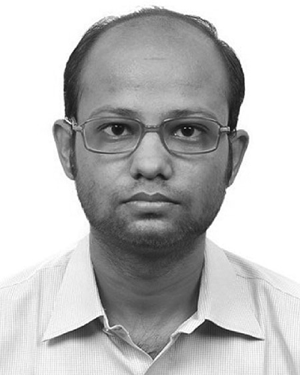 Shashank Shekhar合作论文数1
 Naga V. Irukulapati合作论文数1
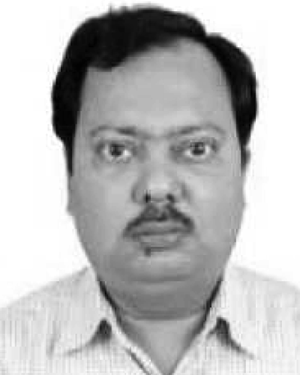 Mrinal Kanti Mandal合作论文数1Chitradeep Majumdar合作论文数1
 jaedeok lim合作论文数1
 Arcade Nshimiyimana合作论文数Ipca Laboratories1
 Amulya Wilson合作论文数1




