The soybean aphid, Aphis glycines Matsumura, has become a serious pest of soybean [Glycine max (L.) Merr.] in North America, and host-plant resistance is one potential management tool. In the current study, various F2-derived soybean selections with the Rag1 gene for resistance to soybean aphid were evaluated among F2-derived soybean selections without Rag1 and among contemporary soybean lines in a two-year field test. Overall, aphid levels per plant were over tenfold greater in 2006 than in 2005, but lines generally performed similarly relative to one another between years with regard to aphid-infestation levels. In both years, the Rag1 selections ILL4, ILL27, ILL35, ILL37, ILL64RR, ILL76RR, and ILL77RR had the lowest mean number of soybean aphids per plant. In 2005, three putative Rag1 selections—ILL26, ILL67RR, and ILL87—had intermediate aphid infestation levels greater than those of other Rag1 selections, and in 2006 ILL26 and ILL67RR also had intermediate aphid levels that did not differ from all other lines. Irrespective of the Rag1 gene, all soybean lines tested in 2006 had potentially injurious infestations ( 799 soybean aphids per plant) that exceeded action thresholds for this pest. These results show varying levels of resistance among lines homozygous for the Rag1 resistance allele and that protection may be equivocal in years of heavy infestation by soybean aphid. Implications for testing putatively aphid-resistant soybean selections in the field and the potential for field deployment of aphid-resistant lines are discussed.
Current methods of screening maize ( Zea mays L.) germplasm for susceptibility or resistance to corn rootworms (Coleoptera: Chrysomelidae) rely primarily on information from large‐scale field experiments. Due to labour and cost constraints associated with field trials, alternative evaluation methods are desirable. We used a previously developed behavioural bioassay to: (1) investigate the host search behaviour of rootworm larvae after contact with 14 maize genotypes, (2) compare the behaviour of non‐diapausing Diabrotica virgifera virgifera LeConte, diapausing D. v. virgifera , and diapausing D. barberi Smith & Lawrence and (3) determine if this technique can be used to separate susceptible vs. resistant maize genotypes. The majority of rootworm larvae engaged in intensive (local search) behaviour after exposure to maize roots, whereas larvae continued to exhibit extensive (ranging) behaviour after contact with negative controls. Even though a transgenic hybrid with resistance to D. v. virgifera was included in analyses, quantitative path measurements were similar among genotypes and only differed between specific maize lines and controls. Notably, there were differences in host search behaviour among rootworm groups, with non‐diapausing D. v. virgifera having more convoluted paths and engaging in intensive search more frequently than diapausing rootworms. Correlations between larval path measurements and historic root damage ratings were not significant, although there were weak positive correlations between historic adult emergence densities and measures of path linearity. However, due to the lack of significant behavioural differences among maize lines with a range of susceptibility levels, we concluded that this bioassay is not useful in screening maize germplasm for rootworm resistance.
Maize ( Zea mays L.) is a valuable commodity throughout the world, but corn rootworms (Chrysomelidae: Diabrotica spp.) often cause economic damage and increase production costs. Current rootworm management strategies have limitations, and in order to create viable management alternatives, researchers have been developing novel maize lines using Eastern gamagrass ( Tripsacum dactyloides L.) germplasm, a wild relative of maize that is resistant to rootworms. Ten maize Tripsacum ‐introgressed inbred lines derived from recurrent selection of crosses with gamagrass and teosinte ( Zea diploperennis Iltis) recombinants and two public inbred lines were assessed for susceptibility to western corn rootworm ( Diabrotica virgifera virgifera LeConte) and yield in a two‐year field study. Two experimental maize inbred lines, SDG11 and SDG20, had mean root damage ratings that were significantly lower than the susceptible public line B73. Two other experimental maize inbred lines, SDG12 and SDG6, appeared tolerant to rootworm damage because they exhibited yield increases after rootworm infestation in both years. In the majority of cases, mean yield per plant of experimental maize lines used in yield analyses was equal to or exceeded that of the public inbred lines B73 and W64A. Our study indicates that there is potential to use Tripsacum ‐introgressed maize germplasm in breeding programs to enhance plant resistance and/or tolerance to corn rootworms, although further research on insect resistance and agronomic potential of this germplasm needs to be conducted in F 1 hybrids.
In the hopes of lessening the current reliance on soil insecticides, developing a viable alternative for transgenic maize hybrids, and providing sustainable options for Europe, researchers recently have been developing novel maize lines that exhibit resistance and/or tolerance to corn rootworm larvae. Here we report the results of a 2-year field experiment in a northern growing region assessing the resistance and tolerance of 10 experimental synthetic maize populations selected for varying levels of damage from western corn rootworm larvae, Diabrotica virgifera virgifera LeConte (Col.: Chrysomelidae) and four maize hybrids. Maize non-preference, antibiosis and tolerance to rootworms was evaluated using previously established methods, including: the Iowa 1-6 root damage rating scale, root fresh weight, compensatory root growth ratings and adult rootworm emergence. Among the experimental synthetic maize populations, BS29-11-01 was the most susceptible, and had a mean root damage rating that was greater than the highly susceptible maize hybrid B37 x H84. This line also had the lowest mean root fresh weight and one of the lowest mean compensatory root growth ratings. In contrast, CRW8-3 appeared to be tolerant to western corn rootworms, and had the lowest mean root damage rating, which was comparable with that of the non-transgenic hybrid DeKalb((R)) 46-26.
In 2001 and 2002, we monitored densities of western grape leafhopper, Erythroneura elegantula Osborn, and Virginia creeper leafhopper, Erythroneura ziczac Walsh (Homoptera: Cicadellidae), eggs front June through September in managed and nonmanaged vineyards in Washington state. Anagrus parasitoids (Hymenoptera: Mymaridae) were reared from sampled parasitized leafhopper eggs. Densities of nonparasitized and parasitized E. elegantula eggs, and nonparasitized E. ziczac eggs, were significantly higher in nonmanaged grapevines, although this pattern was not consistent for the latter two groups. Densities of parasitized E. ziczac eggs were consistently low across management regimes. Anagrus erythroneurae S. Trjapitzin & Chiappini, Anagrus daanei S. Triapitsyn, and Anagrus tretiakovae S. Triapitsyn emerged from parasitized E. elegantula eggs, whereas latter two mymarid species also parasitized E. ziczac eggs. Of these species, A. tretiakovae was the most common parasitoid of Erythroneura leafhopper eggs within sampled vineyards. From 2001-2003, we used yellow sticky traps to collect Anagrus wasps and potential leafhopper hosts from blackberry, grape, and wild rose sites, because these habitats might serve as refugia for the wasps. All three Anagrus species collected within vineyards and a fourth species, A. atomus L., were found on traps in these plant habitats. Several leafhopper taxa that could serve as potential alternative hosts for Anagrus spp. also were collected. Our collection of A. daanei, A. tretiakovae, and A. atomus in Washington represents range extensions for these species, revealing several novel candidate species for conservation. Because we consistently found Anagrus species of agricultural importance within rose and blackberry patches, cultivation of these plants close to vineyards may enhance colonization by Anagrus and thus improve grape leafhopper biocontrol.
 k e dashiell合作论文数4David J Schneider合作论文数2
 Bruce E Hibbard合作论文数Curtis Hall, University Of Missouri2LC WRIGHT合作论文数1Scott Roy A合作论文数1
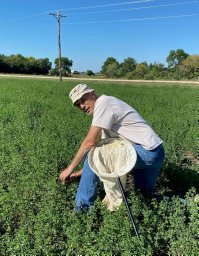 Louis S. Hesler合作论文数Agricultural Research Service, North Central Agricultural Research Laboratory1
 Bill Snyder合作论文数Department of Entomology, College of Agricultural and Environmental Sciences, University of Georgia1
 Brian Diers合作论文数Department of Crop Sciences, College of Agricultural, Consumer and Environmental Sciences, University of Illinois at Urbana-Champaign1
 David G. James (David James)合作论文数Department of Entomology, College of Agricultural, Human, and Natural Resource Sciences, Washington State University1




