Ships inside the Arctic basin require high-resolution (1-5 km), near-term (days to semimonthly) forecasts for guidance on scales of interest to their operations where forecast model predictions are insufficient due to their coarse spatial and temporal resolutions. Deep learning techniques offer the capability of rapid assimilation and analysis of multiple sources of information for improved forecasting. Data from the National Oceanographic and Atmospheric Administration's Global Forecast System, Multi-scale Ultra-high Resolution Sea Surface Temperature (MEaSUREs), and the National Snow and Ice Data Center's Multisensor Analyzed Sea ice Extent (MASIE) were used to develop the sea ice extent deep learning forecast model, over the freeze-up periods of 2016, 2018, 2019, and 2020 in the Beaufort Sea. Sea ice extent forecasts were produced for 1-7 days in the future. The approach was novel for sea ice extent forecasting in using forecast data as model input to aid in the prediction of sea ice extent. Model accuracy was assessed against a persistence model. While the average accuracy of the persistence model dropped from 97% to 90% for forecast days 1-7, the deep learning model accuracy dropped only to 93%. A k-fold (fourfold) cross-validation study found that on all except the first day, the deep learning model, which includes a U-Net architecture with an 18-layer residual neural network (Resnet-18) backbone, does better than the persistence model. Skill scores improve the farther out in time to 0.27. The model demonstrated success in predicting changes in ice extent of significance for navigation in the Amundsen Gulf. Extensions to other Arctic seas, seasons, and sea ice parameters are under development.
Earth and Space Science Open Archive PosterOpen AccessYou are viewing the latest version by default [v1]Short-Term Sea Ice Extent Forecasting with Deep LearningAuthorsMaryKelleriDChristinePiatkoMaryClemens-SewallRebeccaEagerKevinFosterChristopherGiffordiDDerekRollendiDJenniferSleemanSee all authors Mary KelleriDCorresponding Author• Submitting AuthorJohns Hopkins University Applied Physics LaboratoryiDhttps://orcid.org/0000-0003-0669-1298view email addressThe email was not providedcopy email addressChristine PiatkoThe Johns Hopkins University/Applied Physics Laboratoryview email addressThe email was not providedcopy email addressMary Clemens-SewallThe Johns Hopkins University/Applied Physics Laboratoryview email addressThe email was not providedcopy email addressRebecca EagerThe Johns Hopkins University/Applied Physics Laboratoryview email addressThe email was not providedcopy email addressKevin FosterThe Johns Hopkins University/Applied Physics Laboratoryview email addressThe email was not providedcopy email addressChristopher GiffordiDThe John Hopkins University/Applied Physics LaboratoryiDhttps://orcid.org/0000-0002-3848-6267view email addressThe email was not providedcopy email addressDerek RollendiDJohns Hopkins University Applied Physics LaboratoryiDhttps://orcid.org/0000-0003-0826-859Xview email addressThe email was not providedcopy email addressJennifer SleemanThe Johns Hopkins University/Applied Physics Laboratoryview email addressThe email was not providedcopy email address
Retinal prosthetic devices can significantly and positively impact the ability of visually challenged individuals to live a more independent life. We describe a visual processing system which leverages image analysis techniques to produce visual patterns and allows the user to more effectively perceive their environment. These patterns are used to stimulate a retinal prosthesis to allow self guidance and a higher degree of autonomy for the affected individual. Specifically, we describe an image processing pipeline that allows for object and face localization in cluttered environments as well as various contrast enhancement strategies in the "implanted image." Finally, we describe a real-time implementation and deployment of this system on the Argus II platform. We believe that these advances can significantly improve the effectiveness of the next generation of retinal prostheses.
Event Abstract Back to Event Multiplexed, data structure-based enriched physiological event marker system Derek Rollend1* and Marcos Osorno1 1 JHU/APL, United States "As has been stressed by international scientific standards committees, event markers allow for the alignment of experiment events with their associated physiological data in the post-processing phase of an experiment and are crucial for providing context in recorded measurements [1]. Current physiological data file formats only afford rudimentary event encoding schemes, including hexadecimal event codes with a separate user-defined lookup table file, and time-stamped experiment annotations [2, 3]. The latter requires synchronizing the data acquisition system and annotation-generating software. It becomes desirable then to simultaneously generate and record both experiment events and metadata (annotations) from multiple subjects in a unified form that is compatible with existing physiological data file formats. To meet these goals, an alternative event marker method was developed. A data structure, loosely based on standard transmission protocol structures, was used in order to contain both an event description and a payload of associated event metadata or experiment behavioral data. This event marker system has been successfully demonstrated in an ongoing psychophysiological experiment where the total expected number of participants is between 100-200 volunteers. To alleviate the bookkeeping burden during the analysis phase of the experiment, participant identification, experiment identification, participant roles, and behavioral metadata have been packaged within event markers. This has enabled 1) human-readable, meaningful event descriptions to be overlaid on recorded EEG, ECG, EOG, and GSR signals, 2) quantifiable behavioral data for post-processing and machine learning based analysis, and 3) backup participant meta-data contained within the data file for information consistency checking during analysis. 1. Nuwer, Marc R. et al. "FCN Standards IFCN standards for digital recording of clinical EEG." Electroencephalography and Clinical Neurophysiology, Volume 106, Issue 3, 1998, Pages 259-261, ISSN 0168-5597. 2. Velde, Maarten van de et al. "Digital archival and exchange of events in a simple format for polygraphic recordings with application in event related potential studies." ISSN 0013-4694, http://dx.doi.org/10.1016/S0013-4694 (98)00029-7. 3. Kemp, B. Olivan, J. "European data format 'plus' (EDF+)." ISSN 1388-2457, 10.1016/S1388-2457(03)00123-8." Keywords: Electrophysiology, method development, event marker system, Software Development, computational neuroscience Conference: 5th INCF Congress of Neuroinformatics, Munich, Germany, 10 Sep - 12 Sep, 2012. Presentation Type: Poster Topic: Neuroinformatics Citation: Rollend D and Osorno M (2014). Multiplexed, data structure-based enriched physiological event marker system. Front. Neuroinform. Conference Abstract: 5th INCF Congress of Neuroinformatics. doi: 10.3389/conf.fninf.2014.08.00096 Copyright: The abstracts in this collection have not been subject to any Frontiers peer review or checks, and are not endorsed by Frontiers. They are made available through the Frontiers publishing platform as a service to conference organizers and presenters. The copyright in the individual abstracts is owned by the author of each abstract or his/her employer unless otherwise stated. Each abstract, as well as the collection of abstracts, are published under a Creative Commons CC-BY 4.0 (attribution) licence (https://creativecommons.org/licenses/by/4.0/) and may thus be reproduced, translated, adapted and be the subject of derivative works provided the authors and Frontiers are attributed. For Frontiers’ terms and conditions please see https://www.frontiersin.org/legal/terms-and-conditions. Received: 21 Mar 2013; Published Online: 27 Feb 2014. * Correspondence: Dr. Derek Rollend, JHU/APL, Laurel, United States, derek.rollend@jhuapl.edu Login Required This action requires you to be registered with Frontiers and logged in. To register or login click here. Abstract Info Abstract The Authors in Frontiers Derek Rollend Marcos Osorno Google Derek Rollend Marcos Osorno Google Scholar Derek Rollend Marcos Osorno PubMed Derek Rollend Marcos Osorno Related Article in Frontiers Google Scholar PubMed Abstract Close Back to top Javascript is disabled. Please enable Javascript in your browser settings in order to see all the content on this page.
 Kevin Foster合作论文数Applied Physics Laboratory, Johns Hopkins University2Mary R. Keller合作论文数2
 Christopher M. Gifford合作论文数2
 Christine Piatko合作论文数Department of Computer Science Johns Hopkins University2
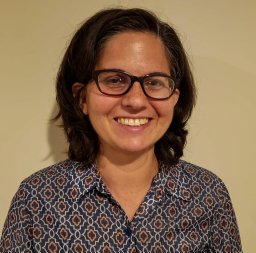 Jennifer Sleeman合作论文数The Johns Hopkins University Applied Physics Laboratory;University of Maryland Baltimore County2marcos osorno合作论文数1Paul E. Rosendall合作论文数Appl Phys Lab, Johns Hopkins Univ1
 Arup Roy合作论文数1
 Helder John B合作论文数1Billings Seth合作论文数Department of Computer Science, Johns Hopkins University1
 Philippe Burlina合作论文数Department of Computer Science, Whiting School of Engineering, Johns Hopkins University;The Malone Center for Engineering in Healthcare, Johns Hopkins University;Intelligent Systems Center, Applied Physics Laboratory, Johns Hopkins University1Dean Kleissas合作论文数1
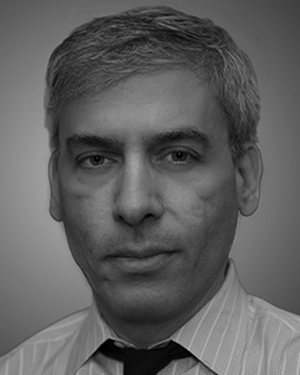 Robert J. Greenberg合作论文数1
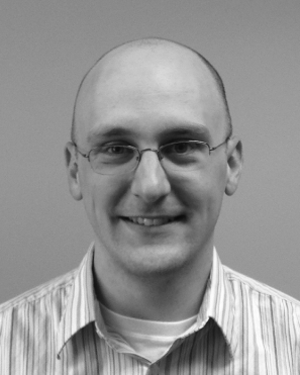 Kevin C. Wolfe合作论文数1
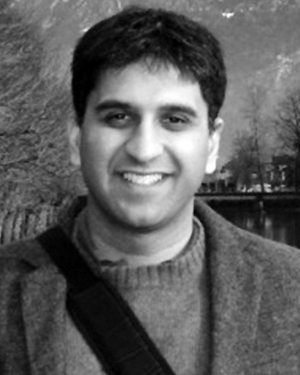 Kapil D. Katyal合作论文数1Francesco Tenore合作论文数Johns Hopkins University1




