Reptiles, and turtles in particular, are disproportionately represented in the illegal wildlife trade. Chemical analysis of animal tissues is a powerful tool to combat wildlife laundering, which is the act of disguising animals poached from the wild as legally raised in captivity by means of counterfeit import or export documentation. We used stable isotope ratios and trace element concentrations derived from the claw tips of 449 wood ( Glyptemys insculpta ), spotted ( Clemmys guttata ), and Blanding's turtles ( Emydoidea blandingii ) from the eastern United States to develop a multispecies statistical model for determining the probability that a confiscated turtle was poached from the wild. During model development, our simple model that used 4 stable isotope ratios (δ 13 C, δ 15 N, δ 18 O, δ 2 H) and 4 trace elements (Ti‐47, Fe‐57, Cu‐63, Ba‐137) misclassified only 2 turtles out of 449, yielding a predictive accuracy rate of 99.55%. We further validated the predictive accuracy of our multispecies model by calculating the probability of being wild for 9 eastern box turtles ( Terrapene carolina ) and a replicate sample of 5 wood turtles, all with known classifications of being wild or captive. We now aim to promote our model to aid conservation law enforcement in combating the illegal turtle trade by helping to close the wildlife laundering loophole. We also hope to provide a forensic framework for developing a conservation tool for other taxa of conservation interest.
Landscape context is integral to population ecology, affecting a range of life history parameters, yet very little is known about how landscape structure influences many taxa. We sampled wetlands at 531 sites across 16 states in the eastern U.S. to examine the influence of landscape heterogeneity and anthropogenic land use on the relative abundance of freshwater turtles, one of the most endangered vertebrate clades in the world. Specifically, we aimed to understand how two components of landscape structure - compositional heterogeneity (wetland di-versity) and configurational heterogeneity (wetland aggregation) - influence turtles with varying life history traits. Our results suggest that wetland configuration can modulate the relationship between relative abundance and anthropogenic land use. For example, spotted turtle (Clemmys guttata) was negatively associated with hay/ pasture cover when wetlands were less aggregated, but this relationship subsided as aggregation increased. Notably, the way wetland aggregation modulated land use relationships varied across species. These results suggest that some anthropogenic cover types are not strictly positive or negative for certain species, but are instead context-dependent. Relative abundance also generally increased with higher wetland diversity, indi-cating the potential importance of landscape supplementation for turtles. We report a range of responses to roads that did not strictly correspond with well-established predictions related to body size and terrestrial activity patterns, including positive associations for certain species. Overall, our study supports the use of context-driven approaches to land use-related conservation and management decisions rather than blanket prescriptions, and further emphasizes that effective conservation of freshwater systems requires a landscape-level perspective.
Climate change and land-use change are leading drivers of biodiversity decline, affecting demographic parameters that are important for population persistence. For example, scientists have speculated for decades that climate change may skew adult sex ratios in taxa that express temperature-dependent sex determination (TSD), but limited evidence exists that this phenomenon is occurring in natural settings. For species that are vulnerable to anthropogenic land-use practices, differential mortality among sexes may also skew sex ratios. We sampled the spotted turtle (Clemmys guttata), a freshwater species with TSD, across a large portion of its geographic range (Florida to Maine), to assess the environmental factors influencing adult sex ratios. We present evidence that suggests recent climate change has potentially skewed the adult sex ratio of spotted turtles, with samples following a pattern of increased proportions of females concomitant with warming trends, but only within the warmer areas sampled. At intermediate temperatures, there was no relationship with climate, while in the cooler areas we found the opposite pattern, with samples becoming more male biased with increasing temperatures. These patterns might be explained in part by variation in relative adaptive capacity via phenotypic plasticity in nest site selection. Our findings also suggest that spotted turtles have a context-dependent and multi-scale relationship with land use. We observed a negative relationship between male proportion and the amount of crop cover (within 300 m) when wetlands were less spatially aggregated. However, when wetlands were aggregated, sex ratios remained consistent. This pattern may reflect sex-specific patterns in movement that render males more vulnerable to mortality from agricultural machinery and other threats. Our findings highlight the complexity of species' responses to both climate change and land use, and emphasize the role that landscape structure can play in shaping wildlife population demographics.
The diets and environments that individuals experience can vary greatly within and among wildlife populations. These individual experiences can be compared using the chemical signatures of animal tissues, which can differentiate animals into groups, including those raised in the wild versus those held in captive facilities. In this study, we compared different combinations of four stable isotope ratios and 15 trace elements derived from the claw tips of captive wood turtles throughout the eastern U.S. and wild wood turtles (Glyptemys insculpta) from Maine to develop predictive models used to determine their origins. The purpose of this work is to develop an objective statistical tool that law enforcement can use to help prosecute poachers. We found that the chemical signatures of 14 (12 trace elements and 2 stable isotope ratios) of the 19 markers we explored were different between wild and captive wood turtles, thus reflecting the differences in their diets and environments. We found that our stable isotope ratio model had nearly perfect predictive accuracy in classifying wild wood turtles as wild and captive wood turtles as captive, whereas our trace element and combined model were 100% accurate, thus validating this statistical approach for determining the origins of confiscated wood turtles from Maine.
Turtles are among the most threatened vertebrate groups, and reconstruction of population and distributional trends can be important for evaluating their status and defining conservation targets. Using a two-phase modeling approach along with occurrence records and field surveys, our objectives were to: estimate the potential and current distributions of the wood turtle (Glyptemys insculpta), a semi-terrestrial fluvial specialist of range-wide conservation concern; assess how climate, geomorphology, and land-use relate to its distribution; and estimate habitat loss. Using 1061 occurrences in the northeastern US with stream geomorphology and climate data, we created distribution models at sub-regional scales to estimate that 24% of stream km in the region are potentially suitable for wood turtles. Suitable stream habitat is generally lower gradient, higher sinuosity, and higher flow than random, but varies significantly by subregion, suggesting that distribution or habitat models built at the regional or range-wide level may miss important local variation in habitat and climatic needs at finer scales. We then used landscape composition at multiple spatial scales to predict results from standardized field surveys from 78 sites across 9 states to estimate habitat loss. We estimate that 58% of potential habitat is degraded based on landscape composition. Results support previous observations of decline and habitat loss in the wood turtle, driven by landscape degradation at scales larger than the typical home range, necessitating conservation intervention at multiple spatial scales, and underscoring the importance of models that address locally varying and scale-dependent relationships between species and habitats.
Wildlife traffickers often claim that confiscated animals were captive-bred rather than wild-caught to launder wild animals and escape prosecution. We used stable isotopes (δ13C and δ15N) derived from the claw tips of wild wood turtles from Maine and captive wood turtles throughout the eastern U.S. to develop a predictive model used to classify confiscated wood turtles as wild or captive. We found that the claw tips of wild and captive wood turtles (Glyptemys insculpta) were isotopically distinct. Captive turtles had significantly higher δ13C and δ15N values than wild turtles. Our model correctly classified all wild turtles as wild (100%) and nearly all captive turtles as captive (94%). All but two of the 71 turtles tested were successfully predicted as wild or captive (97.2% accuracy), yielding a misclassification rate of 2.8%. In addition to our model being useful to law enforcement in Maine, we aim to develop a multi-species model to assist conservation law enforcement efforts to curb illegal turtle trafficking from locations across the eastern United States and Canada.
Freshwater turtles and tortoises are declining worldwide and currently represent one of the most imperiled major vertebrate groups. Identifying the conditions that promote long-term viable populations is a critical conservation need. However, for most species, there is relatively little or no empirical information about the factors influencing population demographics. Large-scale population monitoring efforts necessary to acquire such information remain rare due to the logistic challenges associated with low and variable detectability, which generally preclude large monitoring initiatives by any single entity. The development of collaborative population monitoring programs represents one potential strategy for overcoming these challenges. Our goal was to leverage partnerships to identify the potential factors and relevant scales affecting wood turtle (Glyptemys insculpta) population demographics. Through a large-scale collaborative multi institutional monitoring effort, we conducted 983 spring stream surveys at 293 sites across the northeastern United States. Wood turtle abundance was negatively associated with agriculture (300 m and 5500 m) and road traffic (5500 m) and positively associated with mature forest (5500 m). Juvenile proportion displayed strong negative relationships with stream gradient and imperviousness (300 m). Sex ratios were more male-skewed with higher mature forest cover (90 m) and road density (5500 m) and less undeveloped land (300 m). These findings suggest that effective conservation of demographically robust turtle populations will require consideration of multiple spatial scales. Landscape-level conservation may be particularly important for ensuring long-term viable populations. This study highlights the valuable role that collaboration across institutions and jurisdictions can play in the conservation of cryptic taxa.
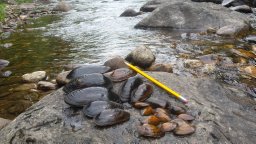
Dispersal of freshwater mussels (order Unionida) is primarily as glochidia on the fins and gills of host fish. Adult mussels are more sessile, generally moving short distances (<2 m/week) along lake and river beds. Between 2007 and 2016, we observed seven instances of adult Eastern Elliptio (Elliptio complanata) and one instance of a fingernail clam (Sphaerium sp.) attached to the feet of freshwater turtles in streams and ponds of New England, United States. Observations included five instances of mussels attached to Wood Turtles (Glyptemys insculpta) in Maine and Massachusetts, one instance of a mussel attached to the fingernail of an Eastern Painted Turtle (Chrysemys picta) in Massachusetts, one instance of a mussel attached to a Snapping Turtle (Chelydra serpentina) in Massachusetts, and one instance of a fingernail clam attached to the fingernail of an Eastern Painted Turtle in Massachusetts. We suggest that Eastern Elliptio may be susceptible to transport by freshwater turtles foraging in mussel beds and that transport of adult mussels by freshwater turtles could result in otherwise atypical long-distance, upstream, or overland dispersal between waterbodies.
 Michael T. Jones合作论文数Natural Heritage and Endangered Species Program, Massachusetts Division of Fisheries and Wildlife5
 Lisabeth Willey合作论文数5
 Katharine D. Gipe合作论文数4Brian Zarate合作论文数4Lori Erb合作论文数4
 G. Johnson合作论文数4John Kleopfer合作论文数4Thomas Akre合作论文数4
 Patrick Roberts合作论文数School of Archaeology, University of Oxford;School of Archaeology, University of Oxford4Phillip deMaynadier合作论文数4Joshua Megyesy合作论文数3Jonathan D. Mays合作论文数3Paul R. Sievert合作论文数3
 Nathan Nazdrowicz合作论文数2Jessica R Meck合作论文数2Jeffrey Dragon合作论文数2Joel L. Mota合作论文数2
 Kevin Oxenrider合作论文数2Lori Johnson合作论文数2Molly Parren合作论文数2Lindsay Rohrbaugh合作论文数2angelena m ross合作论文数2Michael Marchand合作论文数2
 Scott W. Buchanan合作论文数Rhode Island Department of Environmental Management, Division of Fish and Wildlife2
 Scott A. Smith合作论文数2
 Houston C. Chandler合作论文数Orianne Soc, Tiger, GA 30576 USA2
 Hopkins John B合作论文数Department of Ecology, Montana State University2Pollock Erik D合作论文数University of Arkansas Stable Isotope Laboratory, University of Arkansas2
 Matthew Chatfield合作论文数2
 Eric B. Liebgold合作论文数Department of Biology, University of Virginia2
 Donald E. Brown合作论文数Translation Health Institute of Virginia, University of Virginia;Data Science Institute, University of Virginia;School of Engineering and Applied Science, University of Virginia2
 David I. King合作论文数University of Massachusetts USDA Forest Service Northeastern Research Station2Cheryl A. Frederick合作论文数2Tami S Ransom合作论文数2Steve Parren合作论文数1Christopher Raithel合作论文数1Ellery Lassiter合作论文数1
 Peter D Hazelton合作论文数Warnell School of Forestry and Natural Resources, University of Georgia1
 Scott Jackson合作论文数1
 Jeffrey W. Tamplin合作论文数1




