Wind speed distribution has many applications, such as the assessment of wind energy and building design. Applying an appropriate statistical distribution to fit the wind speed data, especially on its heavy right tail, is of great interest. In this study, we introduce a novel four-parameter class of generalized Lindley distribution, called the beta-generalized Lindley (BGL) distribution, to fit the wind speed data, which are derived from the annual and long-term measurements of the Flatirons M2 meteorological tower from the years 2010 to 2020 at heights of 10, 20, 50, and 80 meters. In terms of the density fit and various goodness-of-fit metrics, the BGL model outperforms its submodels (beta-Lindley, generalized Lindley, and Lindley) and other reference distributions, such as gamma, beta-Weibull, Weibull, beta-exponential, and Log-Normal. Furthermore, the BGL distribution is more accurate at modeling the long right tail of wind speed, including the 95^th and 99^th percentiles and Anderson-Darling statistics at different heights. Therefore, we conclude that the BGL distribution is a strong alternative model for the wind speed distribution.
With the rapid development of digital medical technology, the application of the Internet and cloud platforms in electrocardiogram (ECG) management has gradually become an important means to enhance the quality of medical services. This paper takes Zhuhai People's Hospital as the experimental example, relying on 5 G network, to realize the networking of ECG and blood pressure data and establish a municipal-level remote ECG and blood pressure center platform. This platform can handle over 1,000 cases of ECG and blood pressure diagnosis diagnoses per day, providing remote monitoring and early warning services for patients in the main hospital, Gaolan Port Hospital, High-tech Zone Hospital, and township community hospitals. Since the establishment of the platform, the system has processed over $\mathbf{1. 0 6}$ million image judgments, using AI technology for pre-diagnosis, aiming to solve the problem of uneven distribution of medical resources and promote the longitudinal flow of high-quality medical resources. It has achieved three breakthroughs: (1) Developed a distributed AI diagnosis system supporting millions of concurrent terminals (peak processing capacity of 1,200 cases/minute); (2) Established a resource dynamic scheduling model based on risk prediction (optimization rate of Markov decision process 38.7%); (3) Designed a cross-border data channel in compliance with GDPR-PIPL dual compliance framework. Empirical evidence shows that the system has reduced the door-to-needle time (D2N) for patients with acute ST-segment elevation myocardial infarction (STEMI) from (71.2 ± 12.3) minutes to (53.5 ± 9.8) minutes ($\mathbf{p}<0.001$, Cohen's $\mathbf{d}=1.63$), and reduced the base-level misdiagnosis rate by 72.9 % (95 % CI $68.4-76.8$). The research results indicate that this system effectively improves the coverage and diagnostic efficiency of ECG monitoring, providing new ideas for regional medical development and cooperation.
The performance of existing traditional Chinese medicine (TCM) recommendation models is generally poor because of their weak generalization ability, overfitting, and inability to use known biological networks. Therefore, building a TCM recommendation model based on artificial intelligence has currently become an important bioinformatics task. This study aimed to design a multitask meta-learning model with good biological interpretation for TCM formula recommendation (MBI-TCMR) for deep learning regularization. This method was based on the known biological network structure to sparse the deep learning network, solve the overfitting problem of the model, and enhance the biological interpretability of the model. Furthermore, a multi-learning framework based on meta-learning was also proposed. The framework allowed the MBI-TCMR model to mine knowledge of TCM formulas and quickly adapt to different types of TCM formula recommendation tasks. Finally, we used a gradient-based deep learning feature backtracking method to calculate the feature weight for each neuron. This weight could provide valuable explanatory information for researchers to study how the model made its medicine recommendations. We designed three independent experiments. The experimental results showed that the hit ratio (HR), AUC, and recall and precision value of the MBI-TCMR model outperformed the existing TCM formula recommendation models. The MBI-TCMR model's HR of top 1-10 reached 0.15-0.9 (Gynecologic Disease Dataset). HR was 10 for the MBI-TCMR model, which was an improvement of 11.1% compared with the best baseline model. The bio-enrichment analysis showed that the model exhibited good bio-interpretation. In summary, this study proposed a novel TCM formula recommendation model, which expanded the application of the artificial intelligence model and achieved good results.
Thyroid Cancer (TC) is a common malignant tumor, head and neck in the incidence of malignant tumors in the seventh, ranked fourth in the incidence in women. There are several methods to diagnose and recognize TC, such as ultrasonic, computed tomography (CT) and other means. While, it is an important role for CT examination in the diagnosis of TC, because it has the characteristics of objectivity, repeatability, and multi-dimensional imaging, and can clearly understand the scope and spatial characteristics of the lesion. CT has unique advantages in showing lymph nodes and distant metastases, such as coarse-walled or thick-walled ring calcification. The early diagnosis of TC mainly relies on manual labor, which is very inefficient. With the continuous development of information science, the construction of TC diagnosis and recognition models based on artificial intelligence (AI) has gradually become a research hotspot. At present, research on AI-based thyroid screening models mainly focuses on four aspects: first, thyroid region segmentation and image denoising based on image-omics; second, the establishment of a high-precision TC risk prediction model based on multi-omics data; third, screening of biomarkers of TC for clinical diagnosis; fourth, establish the early screening model of TC based on AI. This paper reviews the research status of the AI-based thyroid screening model based on the above four aspects. In addition, this paper also summarizes the main challenges faced by the current AI -based TC recognition and detection model and it proposes a new research idea for the future TC early screening research based on enhanced CT.
Densely connected convolutional networks (DenseNet) behave well in image processing. However, for regression tasks, convolutional DenseNet may lose essential information from independent input features. To tackle this issue, we propose a novel DenseNet regression model where convolution and pooling layers are replaced by fully connected layers and the original concatenation shortcuts are maintained to reuse the feature. To investigate the effects of depth and input dimensions of the proposed model, careful validations are performed by extensive numerical simulation. The results give an optimal depth (19) and recommend a limited input dimension (under 200). Furthermore, compared with the baseline models, including support vector regression, decision tree regression, and residual regression, our proposed model with the optimal depth performs best. Ultimately, DenseNet regression is applied to predict relative humidity, and the outcome shows a high correlation with observations, which indicates that our model could advance environmental data science.
In recent years, affective computing based on electroencephalogram (EEG) data has attracted increased attention. As a classic EEG feature extraction model, Granger causality analysis has been widely used in emotion classification models, which construct a brain network by calculating the causal relationships between EEG sensors and select the key EEG features. Traditional EEG Granger causality analysis uses the L 2 norm to extract features from the data, and so the results are susceptible to EEG artifacts. Recently, several researchers have proposed Granger causality analysis models based on the least absolute shrinkage and selection operator (LASSO) and the L 1/2 norm to solve this problem. However, the conventional sparse Granger causality analysis model assumes that the connections between each sensor have the same prior probability. This paper shows that if the correlation between the EEG data from each sensor can be added to the Granger causality network as prior knowledge, the EEG feature selection ability and emotional classification ability of the sparse Granger causality model can be enhanced. Based on this idea, we propose a new emotional computing model, named the sparse Granger causality analysis model based on sensor correlation (SC-SGA). SC-SGA integrates the correlation between sensors as prior knowledge into the Granger causality analysis based on the L 1/2 norm framework for feature extraction, and uses L 2 norm logistic regression as the emotional classification algorithm. We report the results of experiments using two real EEG emotion datasets. These results demonstrate that the emotion classification accuracy of the SC-SGA model is better than that of existing models by 2.46–21.81%.
The use of flying platforms such as unmanned aerial vehicles (UAVs), popularly known as drones, is rapidly growing. UAVs can greatly support data collecting and processing for Internet of Things devices (IoTDs) in mobile edge computing (MEC) systems due to their advantages of high environmental flexibility. This paper focuses on the scenario where multiple heterogeneous rotary-wing UAVs complete data collection and processing missions cooperatively. This paper introduces an energy minimization problem for UAV-assisted MEC system which attempts to optimize route planning and task allocation of UAVs. The energy consumption of a UAV includes hovering energy and flight energy depending on its configuration. By jointly choosing optimal UAVs for tasks and routes, we aim to obtain a sub-optimal solution of allocating IoTD tasks to UAVs and UAV flying route design while minimizing energy consumption. The Ant Colony System (ACS) algorithm is employed to obtain a high-quality near-optimal solution to solve this optimization problem. Finally, the simulation results show the effectiveness and efficiency of our proposed solution.
Emotion recognition based on electroencephalography (EEG) signals is a current focus in brain-computer interface research. However, the classification of EEG is difficult owing to large amounts of data and high levels of noise. Therefore, it is important to determine how to effectively extract features that include important information. Regularization, one of the effective methods for EEG signal processing, can effectively extract important features from the signal and has potential applications in EEG emotion recognition. Currently, the most popular regularization technique is Lasso (L1) and Ridge Regression (L2). In recent years, researchers have proposed many other regularization terms. In theory, Lq-type regularization has a lower q value, which means that it can be used to find solutions with better sparsity. L1/2 regularization is of Lq type (0 < q < 1) and has been shown to have many attractive properties. In this work, we studied the L1/2 penalty in sparse logistic regression for three-classification EEG emotion recognition, and used a coordinate descent algorithm and a univariate semi-threshold operator to implement L1/2 penalty logistic regression. The experimental results on simulation and real data demonstrate that our proposed method is better than other existing regularization methods. Sparse logistic regression with L1/2 penalty achieves higher classification accuracy than the conventional L1, Ridge Regression, and Elastic Net regularization methods, using fewer but more informative EEG signals. This is very important for high-dimensional small-sample EEG data and can help researchers to reduce computational complexity and improve computational accuracy. Therefore, we propose that sparse logistic regression with the L1/2 penalty is an effective technique for emotion recognition in practical classification problems.
Deep learning plays a key role in the recent developments of machine learning. This paper develops a deep residual neural network (ResNet) for the regression of nonlinear functions. Convolutional layers and pooling layers are replaced by fully connected layers in the residual block. To evaluate the new regression model, we train and test neural networks with different depths and widths on simulated data, and we find the optimal parameters. We perform multiple numerical tests of the optimal regression model on multiple simulated data, and the results show that the new regression model behaves well on simulated data. Comparisons are also made between the optimal residual regression and other linear as well as nonlinear approximation techniques, such as lasso regression, decision tree, and support vector machine. The optimal residual regression model has better approximation capacity compared to the other models. Finally, the residual regression is applied into the prediction of a relative humidity series in the real world. Our study indicates that the residual regression model is stable and applicable in practice.
With the dramatic increase in the number of IOT devices the network access protocol of the devices has also become diverse., which has led to the need for IoT platform to support heterogeneous network access. However, the existing IoT platform framework does not support heterogeneous network access well. Therefore, to solve the issue mentioned above, in this paper, we propose a Flexi-IoT platform, a novel IoT framework for heterogeneous network access specially. Flexi-IoT platform overcomes the drawbacks of the existing IoT platform framework in supporting heterogeneous network access. Furthermore, the paper also designs a method for controlling devices via fuzzy logic. And the implementation procedure of Flexi-IoT platform is demonstrated with an application example.
At present, in the field of electroencephalogram (EEG) signal recognition, the classification and recognition in complex scenarios with more categories of EEG signals have gained more attention. Based on the joint fast Fourier transform (FFT) and support vector machine (SVM) methods, this study proposed a novel EEG signal-processing joint method for the complex scenarios with 10 classifications of EEG signals. Moreover, a comprehensive efficiency formula was put forward. The formula considered the accuracy and time consumption of the joint method. This new joint method could improve the accuracy and comprehensive efficiency of multiclass EEG signal recognition. The new joint approach used standardization for data preprocessing. Feature extraction was performed by combining FFT and principal component analysis methods. EEG signals were classified using the weighted k-nearest nenighbour method. In this study, experiments were conducted using public datasets of brainwave 0-9 digits classification. The result demonstrated that the accuracy and comprehensive efficiency of the novel joint method were 84% and 87%, respectively, which were better than those of the existing methods. The precision rate, recall rate, and F1 score of the novel joint method were 89%, 85%, and 0.85, respectively. In conclusion, the proposed joint method was effective in a complex scenario for multiclass EEG signal recognition.
This paper considers a UAV-enabled mobile edge computing (MEC) system, where a UAV first powers the Internet of things device (IoTD) by utilizing Wireless Power Transfer (WPT) technology. Then each IoTD sends the collected data to the UAV for processing by using the energy harvested from the UAV. In order to improve the energy efficiency of the UAV, we propose a new time division multiple access (TDMA) based workflow model, which allows parallel transmissions and executions in the UAV-assisted system. We aim to minimize the total energy consumption of the UAV by jointly optimizing the IoTDs association, computing resources allocation, UAV hovering time, wireless powering duration and the services sequence of the IoTDs. The formulated problem is a mixed-integer non-convex problem, which is very difficult to solve in general. We transform and relax it into a convex problem and apply flow-shop scheduling techniques to address it. Furthermore, an alternative algorithm is developed to set the initial point closer to the optimal solution. Simulation results show that the total energy consumption of the UAV can be effectively reduced by the proposed scheme compared with the conventional systems.
In this paper, we study a general Near-Far Computing Enhanced C-RAN (NFC-RAN), in which users can offload the tasks to the near edge cloud (NEC) or the far edge cloud (FEC). We aim to propose a profit-aware task allocation model by maximizing the profit of the edge cloud operators. We first prove that this problem can be transformed to a Multiple-Choice Multi-Dimensional 0-1 Knapsack Problem (MMKP), which is NP-hard. Then, we solve it by using a low complexity heuristic algorithm. The simulation results show that the proposed algorithm achieves a good tradeoff between the performance and the complexity compared with the benchmark algorithm.
Feature extraction of electroencephalography (EEG) signals plays a significant role in the wearable computing field. Due to the practical applications of EEG emotion calculation, researchers often use edge calculation to reduce data transmission times, however, as EEG involves a large amount of data, determining how to effectively extract features and reduce the amount of calculation is still the focus of abundant research. Researchers have proposed many EEG feature extraction methods. However, these methods have problems such as high time complexity and insufficient precision. The main purpose of this paper is to introduce an innovative method for obtaining reliable distinguishing features from EEG signals. This feature extraction method combines differential entropy with Linear Discriminant Analysis (LDA) that can be applied in feature extraction of emotional EEG signals. We use a three-category sentiment EEG dataset to conduct experiments. The experimental results show that the proposed feature extraction method can significantly improve the performance of the EEG classification: Compared with the result of the original dataset, the average accuracy increases by 68%, which is 7% higher than the result obtained when only using differential entropy in feature extraction. The total execution time shows that the proposed method has a lower time complexity.
In this paper, we investigated the cross correlations among non-stationary passive scalars series. Based on the detrended cross correlation analysis (DCCA), we found that there existed long-range cross correlations among these series. The DCCA exponents for each pair of passive scalars are all greater than 0.5. This implies that the cross correlation is persistent. Moreover, the degree of cross correlation between H2O and PM2.5 is greater compared to CO2 and PM2.5 as well as CO2 and H2O. The same analysis is also performed on randomly shuffled series. The calculated DCCA exponents fluctuate slightly over 0.5, which verifies that there indeed exist cross correlations among original series.
Ramp structures widely exist in scalar turbulence, such as temperature, water vapor, and carbon dioxide (CO2), which refer to the phenomenon that the physical quantity increases slowly with time and then suddenly drops. ramp structures lead to large gradients on a small scale and result in intermittency and anisotropy of turbulent flows. in this paper, wavelet analysis is used to analyze observed data from the beijing 325-m meteorological tower to extract ramp structures in temperature, water vapor, and CO2 signals. ramp structures in CO2 signals are different from those in temperature and water vapor in terms of the averaged temporal scale and normalized amplitude, and the ramp duration almost equals the cliff duration, which means ramp structures in CO2 signals are not easy to generate and different physical mechanisms may exist. in addition, both the ascending and descending part of ramp structures are linearly fitted. it is found that a scaling law exists between the slope and duration in the ascending part in the three scalar signals. the corresponding power exponents are slightly different. furthermore, the same rule exists in the descending part of ramp structures, which indicates that self-similarity may be a universal law in scalar turbulence. moreover, the maxima of selected ramp structures show the same pattern, i.e. there are ramp structures in the maximum sequence, which proves that small-scale ramp structures are superimposed on large-scale ramp structures.
在基于快速傅里叶变换(FFT)的联合算法和基于支持向量机(SVM)的联合算法的基础之上,文中提出了一种复杂场景下针对5类以上脑电图(EEG)信号处理的新型联合算法.目的在于提升脑电信号处理与分析的精度与综合效率.新型联合算法首先采取归一化进行数据预处理,然后融合FFT和主成分分析(PCA)进行特征提取,最终以加权k近邻(k-NN)分类算法进行特征分类,应用于被试观察0~9数字时产生的脑电信号分类.结果证明:新型联合算法的精度和综合效率分别为84%和87%,可被用于复杂场景下的脑电信号处理.
With the advent of brain-computer interface (BCI) technology, mind control has become an inevitable development trend in the field of Electroencephalography (EEG) control. This paper proposes an effective idea and control method for improving the accuracy of EEG signal recognition. We first use the single-channel EEG sensor mindset to collect the brainwave raw data and then use the wavelet transform as the data preprocessing method to decompose the acquired EEG signals. The purpose is to judge the state of attention of the brain from the perspective of the energy of the brain wave rhythm. Finally, through the perceptron criterion algorithm, we proposed a new feature extraction method by the coefficient plus sub-band energy, which realizes the detection of eye sway by brain wave data. The algorithm proposed in this paper sends precise attention to its speed and direction by sending the attention state of the brain and the intensity of eye movement to the smart car. The result demonstrates that accuracy of the proposed method using the coefficient data of rhythm Delta and the average energy value of the band in the blink test is 94%, improved 56.7% compared to the method using only the coefficient data of rhythm Delta. The experimental results show that this algorithm provides a real idea control method for smart car control.
The effective connectivity among overlapped core regions recruited by motor imagery (MI) was explored by means of Granger causality and graph-theoretic method, based on Electroencephalography (EEG) data. In this paper, causal connectivity brain network (CCBN) was proposed for the classification of motor imagery for brain-Ccomputer interface applications, by means of source analysis of scalp-recorded EEGs and effective connectivity networks. A classification rate of about 90% was achieved in the human subject studied using both the equivalent dipole analysis and the granger causality analysis. The present promising results suggest that the CCBN could manifest a clearer picture on the cortical activity and explore the causal relation among the independent sources, and thus facilitate the classification of MI tasks from scalp EEGs for brain-computer interface (BCI).
Data oriented parsing is an empiricism method based on a large number of tagging corpora whose purpose is to find the optimal solution to syntactic analysis based on statistics. In this paper, Data oriented parsing technology is used in Chinese syntactic structure analysis to achieve good results. There are 171 training texts in the experiment which are all cited from Tsinghua Chinese Treebank and test accuracy is up to 73.0%. Meanwhile, the parsing accuracy of interrogative sentence is higher than declarative sentences. © 2011 by Binary Information Press.
 Na Han合作论文数7
 Rui Miao合作论文数Inst Syst Engn, Macau Univ Sci & Technol5Chunjian Deng (邓春健)合作论文数5
 Kun Yang合作论文数School of Computer Science and Electronic Engineering, University of Essex4Wei-Qi Yang合作论文数3
 Lan Huang合作论文数3
 Yong Liang (梁勇)合作论文数Institute of Systems Engineering, Macau University of Science and Technology3
 Kezhi Wang合作论文数Department of Computer Science, College of Engineering, Design and Physical Sciences, Brunel University London2Zhao-Yong Deng合作论文数2
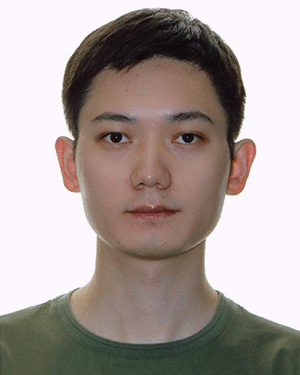 Yao Du合作论文数china university of mining and technology2Jingjing Xu合作论文数2Junjie Chen (陈俊杰)合作论文数College of Computer Science and Technology, Taiyuan University of Technology2
 Fei Hu (胡非)合作论文数Institute of Atmospheric Physics, Chinese Academy of Sciences;University of Chinese Academy of Sciences2Guokui Nian合作论文数1Yizhe Zhao合作论文数1Yue-Yue Lu合作论文数1Hao-Heng Chen合作论文数1Jinrui Fan合作论文数1Canchen Jiang合作论文数1Shanghui Lu合作论文数1
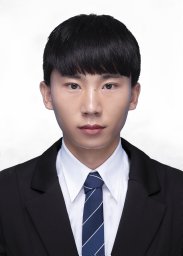 Dong Ouyang合作论文数Fac Informat Technol, Macau Univ Sci & Technol1
 Yang Wang合作论文数Microsoft Research Asia1
 Kuo Yang (杨扩)合作论文数School of Computer and Information Technology, Beijing Jiaotong University1
 Tiantian Yang合作论文数Sch Math & Stat Sci, Clemson Univ1Rui MIAO (缪睿)合作论文数1yanli yang合作论文数1
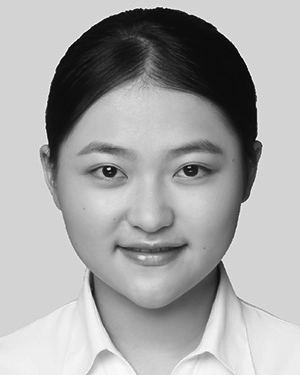 Hui Xiao合作论文数1RenLi Deng (邓仁丽)合作论文数1
 Lei Liu (刘磊)合作论文数Chinese Academy of Sciences Chinese Academy of Sciences Beijing China1
 Yang Cai合作论文数1
 Guopeng Zhang (张国鹏)合作论文数School of Computer Science Technolog, China University of Mining and Technology1Hao Guo合作论文数1
 Guofu Zhou (周国富)合作论文数South China Academy of Advanced Optoelectronics, South China Normal University1
 Zichuan Yi (易子川)合作论文数1Nan Li (李楠)合作论文数1
 Haifang Li (李海芳)合作论文数College of Computer Science and Technology, Taiyuan University of Technology1
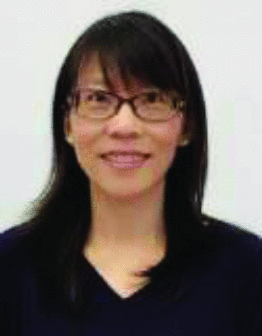 Xu Yang合作论文数1
 J. L. Zhang合作论文数Institute of High Energy Physics1
 Yuan-Sheng Luo合作论文数School of Electronic and Information Engineering, Xi'an Jiaotong University1
 Zhigang Hu (胡志刚)合作论文数Central South University1
 Lingling Shui (水玲玲)合作论文数School of Information and Optoelectronic Science and Engineering, South China Normal University;South China Academy of Advanced Optoelectronics, South China Normal University1
 Yapeng Wang合作论文数Department of Electronic Engineering;Queen Mary, University of London;Department of Electronic Engineering|Queen Mary, University of London1




