Potentialities of exclusive electrodisintegration of few-body nuclear systems as source of information on\({\mathcal{N}}{\mathcal{N}}\) potential and on interaction effects like meson exchange currents (MEC) and isobar configurations (IC) are discussed. Results obtained at the Saclay electron linear accelerator on the (e, e′p) reaction on deuteron and3He are reviewed.
We have measured the deep inelastic electron scattering from carbon up to and including the Δ region at 36°, 60°, 90° and 145°. The systematic decomposition of the transverse and longitudinal response functions has been obtained by means of a Rosenbluth-type analysis of the data in the momentum transfer interval 200 MeV/c<|q|<550 MeV/c. A comparison with theoretical calculations which extend over the quasi-elastic and Δ peak regions is presented. A reduction of the differences between our data and theory seems obtainable through the introduction of meson exchange currents, resonant and nonresonant meson production and the use of the shell model. Our experimental Coulomb sum rule estimates at higher |q| agree with independent-particle model predictions.
The proton momentum distribution of $^{3}\mathrm{He}$ has been determined up to momenta of 310 MeV/c by use of the reaction $^{3}\mathrm{He}(e, {e}^{\ensuremath{'}}p)$. The experimental missing-energy resolution, $\ensuremath{\delta}{E}_{m}=1.2$ MeV, was sufficient to separate the two- and three-body breakup channels. Results for the three-body disintegration have been obtained up to missing-energy values of 80 MeV. The resulting spectral function is compared to the predictions of Faddeev and variational calculations.
Electroexcitation of the singlet $S$ state of the deuteron has been measured for the range of momentum transfer ${q}^{2}=6\ensuremath{-}19$ ${\mathrm{fm}}^{\ensuremath{-}2}$, where meson-exchange current contributions dominate the cross section.
Deep-inelastic electron scattering from 12C was measured at 60°, 90°, 130° and 145° until 560 MeV incident electron energy. Longitudinal-transverse separation was achieved for ¦q2μ¦ < 6 fm−2 and energy-loss ω < 360 MeV. The longitudinal sum rule exhibits 80 % of the strength predicted by single particle model. The measured cross section between the quasi-elastic peak and the free Δ peak is compared to different theoretical models. Mesonic exchange current in proton-neutron pairs seems to play an important role.
The nucleon momentum distribution in the deuteron has been determined up to 340 MeV/c by measuring the d(e, e′p)n reaction at an incident electron energy of 500 MeV. The data are well described even above p = 200 MeV/c by the most recent deuteron wave functions, in contrast with previous (e, e′p) and (p, 2p) results.
 Guido Capitani合作论文数7
 Salvatore Frullani合作论文数7Jean Mougey合作论文数7Marc Bernheim合作论文数7S. Turck-Chieze合作论文数6J. Morgenstern合作论文数5P. Barreau合作论文数5Deborah K Tarnowski合作论文数5Franco Garibaldi合作论文数5E DESANCTIS合作论文数4
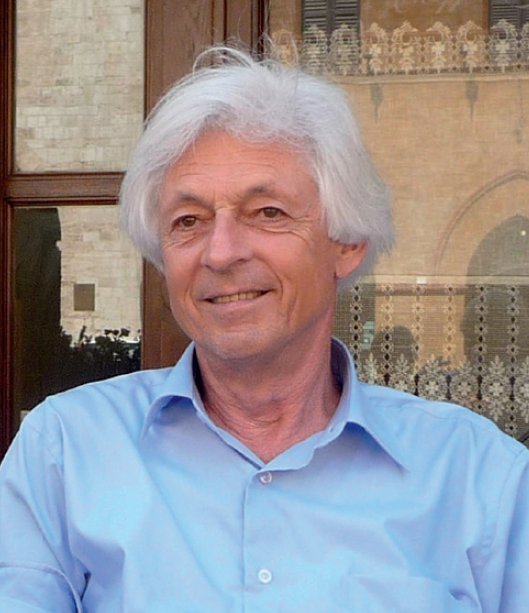 Ingo Sick合作论文数Department of Physics, Faculty of Science, University of Basel4
 Enzo De Sanctis合作论文数3
 Zein-Eddine Meziani合作论文数Physics Division, Argonne National Laboratory, U.S. Department of Energy Office of Science3D. Royer合作论文数3
 John M Finn合作论文数College of William and Mary, The College of William and Mary3PD ZIMMERMAN合作论文数2
 Morton K. Brussel合作论文数2p bradu合作论文数2Bijnnan Saghaï合作论文数2J. Duclos合作论文数2A. Bussiere合作论文数1D. Isabelle合作论文数1M Van Brussel合作论文数1
 Sylvaine Turck-Chieze合作论文数1d b isabelle合作论文数1




