Marine litter is composed mainly of plastics and is recognized as a serious threat to marine ecosystems. Ecotoxicological approaches have started elucidating the potential severity of microplastics (MPs) in controlled laboratory studies with pristine materials but no information exists on marine environmental microlitter as a whole. Here, we characterized the litter in the coastal Northern Tyrrhenian sea and in the stomach of two fish species of socio-economic importance, and exposed primary cell cultures of mucosal and lymphoid organs to marine microlitter for evaluating possible cytotoxic effects. An average of 0.30 ± 0.02 microlitter items m-3 was found in water samples. μFT-IR analysis revealed that plastic particles, namely HDPE, polyamide and polypropylene were present in 100% and 83.3% of Merluccius merluccius and Mullus barbatus analyzed, which overall ingested 14.67 ± 4.10 and 5.50 ± 1.97 items/individual, respectively. Moreover, microlitter was confirmed as a vector of microorganisms. Lastly, the apical end-point of viability was found to be significantly reduced in splenic cells exposed in vitro to two microlitter conditions. Considering the role of the spleen in the mounting of adaptive immune responses, our results warrant more in-depth investigations for clarifying the actual susceptibility of these two species to anthropogenic microlitter.
Marine litter is a serious global environmental threat that has received increasing attention in the last decades from the academic world, intergovernmental organizations and agencies due to its impact on ecosystems, fisheries and, ultimately, human health. The Mediterranean Sea is characterized by one of the highest densities of marine litter in the world: although much research has been conducted on floating litter, little data exist on benthic litter and its associated macrozoobenthic fauna and only one study has investigated the matter in Italian waters. In the present work, marine litter was collected through demersal trawl nets in the coastal sector of Civitavecchia (northern Tyrrhenian sea, GSA 9) at 50-120 m of depth with the aim of (i) describing the marine litter-associated macrozoobenthic community, (ii) identifying the associations between macrozoobenthic species and litter categories and (iii) evaluating the presence of unrecorded and/or non-indigenous species (NIS) associated with marine litter. Marine litter was recovered from all hauls, confirming its ubiquity and global dispersion in coastal areas, with plastic materials being the most frequently retrieved category. The highest and lowest litter items density were 2125 and 312.50 items/km(2). A total of 656 litter items weighing 15.8 kg were classified according to the MSFD Technical Group on Marine Litter categories and analyzed. Their associated fauna consisted of 1536 benthic organisms belonging to 62 species. Species abundance-wise, Bryozoans were the dominant taxon followed by Polychaeta, Bivalvia, Ascidiacea and Anthozoa. Six non-indigenous species (NIS) were retrieved on anthropogenic substrates and, among them, two bryozoans species previously unreported in Italian waters were herein recorded. At last, our results highlight the possible selective association between some sessile species and specific marine litter categories, even though further validation is needed. (C) 2021 Elsevier B.V. All rights reserved.
Marine litter, which is composed mainly of plastics, is recognized as one of the most serious threats to marine ecosystems and a global environmental concern. Microplastics (MPs) densities were estimated in all environmental compartments: marine organisms are highly exposed to and ingest them, resulting in disruption of biological functions. Ecotoxicological approaches have also started elucidating the potential severity of MPs in controlled laboratory studies, but the commercially-available and pristine materials employed hardly reflect the actual composition of the environmental litter, which can be contaminated by chemical pollutants or biological agents. Building on the lack of research employing marine environmental MPs or microlitter as a whole, we characterized the quantity and quality of litter in the coastal epipelagic and in the digestive tract of two commercially-relevant fish species, and exposed primary cell cultures of mucosal and lymphoid organs to marine microlitter. A concentration of 0.30 ± 0.02 microlitter items m-3 was found in the water column of the Northern Tyrrhenian sea. μFT-IR analysis revealed that particles of plastic origin, namely polypropylene, HDPE and polyamide, were present in 100% and 83.3% of M. merluccius and M. barbatus stomachs, respectively, which overall ingested 14.67 ± 4.10 and 5.50 ± 1.97 items. Microlitter was confirmed as a vector of bacteria, fungi and flagellates. Lastly, and for the first time, the apical end-point of viability was significantly reduced in splenic cells exposed in vitro to two microlitter conditions. Considering the role of the spleen in the mounting of adaptive immune responses, our results warrant more in-depth investigations for clarifying the actual susceptibility of the biota to anthropogenic microliter. Highlights 0.30 ± 0.02 microlitter items m-3 was found in the coastal epipelagic Northern Tyrrhenian sea 14.67 ± 4.10 and 5.50 ± 1.97 items were retrieved from hake and mullet stomach contents A subsample of the ingested microlitter was of plastic origin Microlitter was validated as a carrier of bacteria, fungi and flagellates Splenic cells exposed to both microlitter conditions for 72 hours suffered cytotoxicity
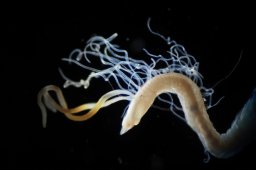
The genus Acromegalomma has been recently introduced as nomen novum for the polychaete genus Megalomma. Recently specimens of A. messapicum were collected from the coastal area of Civitavecchia (Tyrrhenian Sea, Italy) and re-collected from the type locality (Brindisi, Adriatic Sea, Italy) allowing us to examine additional fresh material and to add some useful morphological and biological information to the original description. The present data widens the distribution of the species. The possibility to examine several specimens of A. messapicum collected in different areas allowed us to state with certainty the absence of variability as concerns both the distribution of the radiolar eyes and the collar shape. The new findings revealed a colouration pattern present in the thorax and in the branchial crown, as well as the presence of large pygidial eyes previously not reported. Specimens have very broadly hooded chaetae, especially at the beginning of the abdomen, becoming more slender and therefore narrowly hooded, proceeding towards the end of the abdomen. This could explain the incorrect statement in the original description, of the presence of narrowly hooded abdominal chaetae as characterising A. messapicum. The present data also allowed some biological observations. Acromegalomma messapicum is gonocoric with eggs measuring about 120 mm in diameter. Most of the specimens were collected in cold months but ripe specimens were found in warm months. In addition a scheme of groups of Acromegalomma species modified from that previously proposed by different authors is given, where some taxa have been moved to different groups on the basis of a new interpretation of the collar features.
The “New Mediterranean Biodiversity Records” series includes new records of marine species found in the Mediterranean basin and/or information on the spatial distribution of already established species of particular interest. The current article presents information on 20 marine taxa classified per country according to their geographic position in the Mediterranean, from west to east. The new records per ecoregion are as follows: Algeria: the first record of the fish Etrumeus golanii is reported along the Algerian coast. Tunisia: the alien jellyfish Phyllorhiza punctata is reported for the first time in the Gulf of Gabès. Italy: the first record of Siganus rivulatus in the Strait of Sicily and a new record of Katsuwonus pelamis from the central Tyrrhenian Sea are reported. The establishment of the isopod of the genus Mesanthura in the northern Tyrrhenian with some notes on its ecology are also included. Croatia: signs of establishment of the Lessepsian Siganus luridus and the occurrence of the alien mollusc Rapana venosa are reported. Albania: the first record of the elasmobranch Alopias superciliosus and a recent sighting of the rare monk seal Monachus monachus in Albanian waters are given. Greece: signs of the establishment of the fish Parupeneus forsskali and of the ascidian Hermania momus in Hellenic Aegean waters are reported. Turkey: a new record of the fish P. forsskali and of the Acarea of the genus Acaromantis and Simognathus are given, while the first case of Remora australis in association with delphinids and the occurrence of the sea star Coscinasterias tenuispina are reported. Also, the establishment of the two alien species Isognomon legumen and Viriola sp. [cf. corrugata] are presented. Egypt: the fish Bathygobius cyclopterus is reported for the first time in Mediterranean Sea waters. Also, a new record of Pagellus bogaraveo and a first record of Seriola fasciata in Egyptian Mediterranean waters are reported. Lebanon: the first record of Dondice banyulensis is presented.
This contribution forms part of a series of collective articles published regularly in Mediterranean Marine Science that report on new biodiversity records from the Mediterranean basin. The current article presents 51 geographically distinct records for 21 taxa belonging to 6 Phyla, extending from the western Mediterranean to the Levantine. The new records, per country, are as follows: Spain: the cryptogenic calcareous sponge Paraleucilla magna is reported from a new location in the Alicante region. Algeria: the rare Atlanto-Mediterranean bivalve Cardium indicum is reported from Annaba. Tunisia: new distribution records for the Indo-Pacific lionfish Pterois miles from Zembra Island and Cape Bon. Italy: the ark clam Anadara transversa is reported from mussel cultures in the Gulf of Naples, while the amphipod Caprella scaura and the isopods Paracerceis sculpta and Paranthura japonica are reported as associated to the –also allochthonous–bryozoan Amathia verticillata in the Adriatic Sea; in the latter region, the cosmopolitan Atlantic tripletail Lobotes surinamensisis also reported, a rare finding for the Mediterranean. Slovenia: a new record of the non-indigenous nudibranch Polycera hedgpethi in the Adriatic. Greece: several new reports of the introduced scleractinian Oculina patagonica, the fangtooth moray Enchelycore anatina, the blunthead puffer Sphoeroides pachygaster (all Atlantic), and the lionfish Pterois miles (Indo-Pacific) suggest their ongoing establishment in the Aegean Sea; the deepest bathymetric record of the invasive alga Caulerpa cylindracea in the Mediterranean Sea is also registered in the Kyklades, at depths exceeding 70 m. Turkey: new distribution records for two non indigenous crustaceans, the blue crab Callinectes sapidus (Atlantic origin) and the moon crab Matuta victor (Indo-Pacific origin) from the Bay of Izmir and Antalya, respectively; in the latter region, the Red Sea goatfish Parupeneus forsskali, is also reported. Lebanon: an array of records of 5 alien and one native Mediterranean species is reported by citizen-scientists; the Pacific jellyfish Phyllorhiza punctata and the Indo-Pacific teleosteans Tylerius spinosissimus, Ostracion cubicus, and Lutjanus argentimaculatus are reported from the Lebanese coast, the latter notably being the second record for the species in the Mediterranean Sea since 1977; the native sand snake-eel Ophisurus serpens, rare in the eastern Mediterranean, is reported for the first time from Lebanon, this being its easternmost distribution range; finally, a substantial number of sightings of the lionfish Pterois miles further confirm the current establishment of this lessepsian species in the Levantine.
 Francesco Tiralongo合作论文数Department of Biological, Geological and Environmental Science, University of Catania4
 Andrea Miccoli合作论文数Department of Life and Environmental Sciences, Polytechnic University of Marche3
 Paolo Roberto Saraceni合作论文数3
 Simona Picchietti合作论文数Dipartimento per La Innovazione Nei Sistemi Biologici, Agroalimentari E Forestali, Università degli Studi della Tuscia3
 C. Stamouli合作论文数Hellen Ctr Marine Res, Inst Marine Biol Resources & Inland Waters2
 Fabio Crocetta合作论文数Museo di Biologia Marina;Paleontologia di Reggio Calabria;Museo di Biologia Marina, Paleontologia di Reggio Calabria2C. Turan合作论文数1F. Hemida合作论文数1M. Bariche合作论文数1A Bonifazi合作论文数1M. Sini合作论文数1F. Durucan合作论文数1S. I. Rizkalla合作论文数1Y. O. Boyaci合作论文数1s yapici合作论文数1Ch. Mytilineou合作论文数1P. Ovalis合作论文数1
 Deniz Erguden合作论文数1
 Maria Corsini-Foka合作论文数1e h kh akel合作论文数1Serkan Teker合作论文数Akdeniz University1
 Dario Vrdoljak合作论文数Inst Oceanog & Fisheries1
 Michail Ragkousis合作论文数Univ Aegean, Univ Hill1
 Abderrahmane Kassar合作论文数Département des Ressources Vivantes, Ecole Nationale Supérieure des Sciences de la Mer et de l'Aménagement du Littoral - ENSSMAL1
 Francesco Paladini de Mendoza合作论文数1N. Babali合作论文数1
 Domen Trkov合作论文数1r ghanem合作论文数1
 Fabio Giardina合作论文数MarEco Osservatorio Nat Assoc1
 Miso Pavicic合作论文数Inst Oceanog & Fisheries1
 Ounifi Ben Amor Khadija合作论文数1
 Gerasimos Kondylatos合作论文数Hellen Ctr Marine Res, Hydrobiol Stn Rhodes1Daniele Piazzolla合作论文数Ocean Predict & Applict Div, Ctr Euromed Cambiamenti Climat1
 Ioannis Giovos合作论文数iSea, Environmental Organization for the Preservation of the Aquatic Ecosystems1
 Onur Gönülal合作论文数Fac Aquat Sci, Istanbul Univ1
 Andrés Izquierdo-Muñoz合作论文数Marine Biol Lab Santa Pola CIMAR, Univ Alicante1
 Radhouan El Zrelli合作论文数Corresponding author.1
 M. Marcelli合作论文数Laboratory of Experimental Oceanology and Marine Ecology, DEB-University of Tuscia1
 Armando Macali合作论文数Dipartimento di Scienze, Università "Roma Tre", Rome, Italy.;Dipartimento di Scienze, Università "Roma Tre"1
 Marco Lezzi合作论文数Dipartimento di Scienze e Tecnologie Biologiche ed Ambientali (Di.S.Te.B.A.), Via Prov. Lecce-Monteroni, 73100 Lecce, Italy.1Rubio-Portillo Esther合作论文数Dpto. Ciencias del Mar y Biología Aplicada, Universidad de Alicante1
 Vasilis Gerovasileiou合作论文数1
 Rigers Bakiu合作论文数1
 Adriana Giangrande合作论文数Dipartimento di Scienze e Tecnologie Biologiche ed Ambientali, Universita del Salento1
 Giancarlo Della Ventura合作论文数Dipartimento di Scienze Geologiche, Università degli Studi di Roma Tre1
 Jakov Dulčić合作论文数Laboratory of Ichtyology and Coastal Fishery, Institute of Oceanography and Fisheries1
 Thanos Dailianis合作论文数Hellenic Centre for Marine Research (HCMR) Institute of Marine Biology and Genetics (IMBG) Thalassocosmos P.O. Box 2214 715 00 Heraklion Crete Greece1
 Aytac Ozgul合作论文数1
 Okan Akyol合作论文数Ege University;Faculty of Fisheries;Faculty of Fisheries, Ege University1




