In this paper we introduce the Fourier tag, a synthetic fiducial marker used to visually encode information and provide controllable positioning. The Fourier tag is a synthetic target akin to a bar-code that specifies multi-bit information which can be efficiently and robustly detected in an image. Moreover, the Fourier tag has the beneficial property that the bit string it encodes has variable length as a function of the distance between the camera and the target. This follows from the fact that the effective resolution decreases as an effect of perspective. This paper introduces the Fourier tag, describes its design, and illustrates its properties experimentally.
In this thesis, we present an approach to finding a procedural representation of a texture to replicate a given texture image which we call image-based procedural texture matching. Procedural representations are frequently used for many aspects of computer generated imagery, however, the ability to use procedural textures is limited by the difficulty inherent in finding a suitable procedural representation to match a desired texture. More importantly, the process of determining an appropriate set of parameters necessary to approximate the sample texture is a difficult task for a graphic artist. The textural characteristics of many real world objects change over time, so we are therefore interested in how textured objects in a graphical animation could also be made to change automatically. We would like this automatic texture transformation to be based on different texture samples in a time-dependant manner. This notion, which is a natural extension of procedural texture matching, involves the creation of a smoothly varying sequence of texture images, while allowing the graphic artist to control various characteristics of the texture sequence. Given a library of procedural textures, our approach uses a perceptually motivated texture similarity measure to identify which procedural textures in the library may produce a suitable match. Our work assumes that at least one procedural texture in the library is capable of approximating the desired texture. Because exhaustive search of all of the parameter combinations for each procedural texture is not computationally feasible, we perform a two-stage search on the candidate procedural textures. First, a global search is performed over pre-computed samples from the given procedural texture to locate promising parameter settings. Secondly, these parameter settings are optimised using a local search method to refine the match to the desired texture. The characteristics of a procedural texture generally do not vary uniformly for uniform parameter changes. That is, in some areas of the parameter domain of a procedural texture (the set of all valid parameter settings for the given procedural texture) small changes may produce large variations in the resulting texture, while in other areas the same changes may produce no variation at all. In this thesis, we present an adaptive random sampling algorithm which captures the texture range (the set of all images a procedural texture can produce) of a procedural texture by maintaining a sampling density which is consistent with the amount of change occurring in that region of the parameter domain. Texture transformations may not always be contained to a single procedural texture, and we therefore describe an approach to finding transitional points from one procedural texture to another. We present an algorithm for finding a path through the texture space formed from combining the texture range of the relevant procedural textures and their transitional points. Several examples of image-based texture matching, and texture transformations are shown. Finally, potential limitations of this work as well as future directions are discussed.
This report discusses the application of procedural modeling and texturing techniques for creating animations of plant growth. In particular, we examine how tDOL-Systems can be used to simulate changes in plant geometry and topology over time. Procedural textures are used to enhance the appearance and believability of plants and are based on Pixar’s RenderMan shading language.
This paper describes an approach to automatically select a procedural texture and associated parameters to replicate a given sample texture from an input image or sketch. In general, selecting a procedural texture from a library or setting the parameters for one can be complex and time consuming. We propose a strategy for automating this process. While, superficially, the problem appears intractable for both humans and computational systems, its natural characteristics make a computational solution feasible. We present an algorithm and experimental results showing the feasibility of our approach which we call image-based procedural texturing.
In this paper we describe an approach to the automated specification of procedural textures to be used in rendering, based on representative samples. Procedural textures exhibit many advantages over traditional surface texturing techniques, but unfortunately finding the correct procedural texture and appropriate parameters to create the desired texture can be a daunting task for even the most experienced computer graphics artists. The method we propose here, which we refer to as image-based procedural texturing, allows the specification of the desired texture in the form of a digital input image. From this sample texture, a corresponding procedural texture is found which produces a texture which is perceptually similar to the input sample.
This paper describes an approach to the automated creation of virtual realities (or virtual maps) of an a priori unknown environment by using a mobile robot. The method we propose is aimed at the creation of an image-based or iconic map, rather than a representation in terms of 2D or 3D spatial occupancy. A key aspect of this is having a mobile robot automatically select points and views of interest that can be used to exemplify the appearance of the environment. This paper develops the use of alpha-backtracking as a technique to efficiency select these points of estimated globally maximum interest.
For many tasks, we wish to record or recover thedescription of a remote environment so that it can be inspected by aperson. This is the problem we address in this paper. Rather thanrecovering a geometric description of an environment, as manyrobotics systems attempt to do, we seek to recover a model of anenvironment in terms of its appearance from a set of carefullyselected viewpoints. Our hope is that this type of model isboth more accessible to humans for many realistic tasks, and also morereadily achieved with automated systems. These viewpoints arelocations in the environment associated with views containing maximalvisual interest. This approach to environment representation isanalogous to image compression. Our goal is to obtain a set ofrepresentative views resembling those that would be selected by ahuman observer given the same task. Our computational procedure isinspired by models of human visual attention appearing in theliterature on human psychophysics. We make use of the underlyingedge structure of a scene, as it is largely unaffected by variationsin illumination. Our implementation uses a mobile robot to traversethe environment, and then builds an image-based virtualrepresentation of the environment, only keeping the views whoseresponses were highest. We demonstrate the effectiveness of ourattention operator on both single images, and in viewpoint selectionwithin an unknown environment.
We describe an approach to the automated construction of visual maps of an unknown environment. These maps take the form of image-based “walk-throughs” rather than 2D or 3D models. Our approach is based on the selection of informative viewpoints within the environment. These viewpoints are locations in the environment associated with views containing maximal visual interest. This approach to environment representation is analogous to image compression. Our goal is to obtain a set of representative views resembling those that would be selected by a human observer given the same task. Our computational procedure is inspired by models of human visual attention appearing in the literature on human psychophysics. We make use of the underlying edge structure of a scene, as it is largely unaffected by variations in illumination. Our implementation uses a mobile robot to traverse the environment, and then builds an image-based virtual representation of the environment, only keeping the views whose responses were highest. We demonstrate the effectiveness of our attention operator on both single images, and in viewpoint selection within an unknown environment.
Mobile robotic systems offer an ideal platform for testing and implementing many of the concepts developed in more abstract artificial intelligence. Robotic systems embody a complex interaction of computation, perception and actuation that depend upon such familiar tasks as recognition and reaction. In order for robots to perform real-world tasks such as navigation, localization and exploration, the subsystems of motion, sensing and computation must be merged into a single, realizable unit that uses the different techniques together. Our group is investigating problems in the domain of computational perception, in the context of mobile robotics. In particular, we are concerned with environment exploration, and map construction. We are using the AAAI 1997 Mobile Robot competition as an opportunity to test a number of implementations of systems in navigation, spatial reasoning and perception.
This thesis presents an approach to the automated construction of visual maps, in the form of walk-throughs, of an unknown environment. Our approach is based on the selection of informative viewpoints within the environment. These viewpoints are locations in the environment which correspond to views containing maximal visual interest. This approach to environment representation is analogous to image compression. Our goal is to obtain a set of selections resembling those made by a human observer given the same task. Our computational procedure is inspired by models of human visual attention outlined in the literature on human psychophysics. We make use of the underlying edge structure of a scene, as it is largely unaffected by variations in illumination. Our implementation uses a mobile robot to traverse the environment, and then builds an image-based virtual representation of the environment, only keeping the views whose responses were highest. We demonstrate the effectiveness of our attention operator on both single images, and in viewpoint selection within an unknown environment.
This paper describes the fully automatic creation of an environment's description using an image-based representation. This representation is a collection of cylindrical sample images combined into an "image-based virtual reality". The locations at which the environment will be sampled are chosen automatically using an operator inspired by models of human visual attention and saccadic motion. The image acquisition is performed by a mobile robot. The selection of vantage points is based on an analysis of the edge structure of sampled panoramic images. In order to trade off the optimality of the generated description of the navigation effort required in solving the online problem, a concept referred to as alpha-backtracking is introduced. The paper illustrates sample data acquired by the procedure.
Describes an integrated system for the automatic construction of image-based virtual realities to describe a real environment. A mobile robot autonomously navigates through the environment and uses a camera to make observations. At locations that are deemed sufficiently interesting, panoramic images are collected that are used to construct a multi-node VR movie. Images of the environment are classified in terms of two features related to human attention: edge element density and edge orientation. The system deems locations interesting if they are sufficiently different from the surrounding environment. The parameterization of the surrounding environment is computed either in a pre-computation pass, or online using a technique termed alpha-backtracking. The panoramic images that describe the environment are automatically joined together in a navigable movie that simulates motion in the real environment.
While virtual reality is a powerful tool for a range of applications, it has the following two associated overheads that fundamentally limit its usefulness: (1) The creation of realistic synthetic virtual environment models is difficult and labor intensive; (2) The computing resources needed to render realistic complex environments in real time are substantial. In this paper, we describe an approach to the fully automated creation of image based virtual reality (VR) models: collections of panoramic images (cylindrical or spherical images) that illustrate an environment. Traditionally, a key bottleneck for this kind of modeling is the selection and acquisition of sample data. Our approach is based on using a small mobile robot to navigate in the environment and collect the image data of interest. A critical issue is selecting the appropriate sample locations of the modeling process: this is addressed using a computational mechanism that resembles human attention. Our objective is to select regions that differ from the surrounding environment. We do this using statistical properties of the output of an edge operator. Specifically, we guide a camera-carrying mobile robot through an environment and have it acquire data with which we construct a VR model. We then demonstrate the effectiveness of our approach using real data.
Mobile robotic systems offer an ideal platform for testing and implementing many of the concepts developed in more abstract artificial intelligence. Robotic systems embody a complex interaction of computation, perception and actuation that depend upon such familiar tasks as recognition and reaction. In order for robots to perform real-world tasks such as navigation, localization and exploration, th e subsystems of motion, sensing and computation must be merged into a single, realizable unit that uses the differen t techniques together. Our group is investigating problems in the domain of computational perception, in the context of mobile robotic s. In particular, we are concerned with environment exploration, and map construction. We are using the AAAI 1997 Mobile Robot competition as an opportunity to test a number of implementations of systems in navigation, spatial reasoning and perception.
 G. Dudek合作论文数Department of Electrical and Computer Engineering, School of Computer Science, McGill University;Center for Intelligent Machines, McGill University;Independent Robotics Inc.11
 Marc Bolduc合作论文数2
 Robert Sim合作论文数Microsoft2Ciaravola, P.合作论文数1
 Nicholas Roy合作论文数Department of Aeronautics and Astronautics, School of Engineering, Massachusetts Institute of Technology;Zoox1
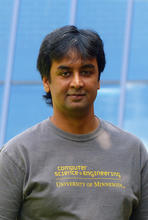 Junaed Sattar合作论文数Department of Computer Science and Engineering, University of Minnesota1
 Philippe Giguere合作论文数Department of Computer Science and Software Engineering, Laval University;Northern Robotics Laboratory1




