The corrosion rates of alloys that will be present in spent fuel waste packages are being measured to represent the generation rates of H2 in a breached package under a range of Eh-pH conditions. The H2 concentration is a crucial parameter in repository performance analyses because the presence of even small amounts of H2 in a breached waste container can significantly decrease the oxidative-dissolution rate of directly-disposed spent UO2 fuel. Potentiostatic tests are being conducted in pH 4, 7, and 10 buffer solutions spiked with NaCl at several potentials that span the ranges of redox and chemical conditions that could occur in a breached waste package. The corrosion currents are monitored as the alloys corrode and changes in the electrical properties of the metal surfaces are measured using electrochemical impedance spectroscopy. Results of tests with 316L stainless steel, Zircaloy-4, and 4320 low alloy carbon steel conducted at several voltages in pH 10 solutions with added NaCl are presented as examples. The dependencies of alloy corrosion rates on these variables and the sensitivity of the fuel dissolution rate are discussed.
We demonstrate a video 360 navigation and streaming system for Mobile HMD devices. The Navigation Graph (NG) concept is used to predict future views that use a graph model that captures both temporal and spatial viewing behavior of prior viewers. Visualization of video 360 content navigation and view prediction algorithms is used for assessment of Quality of Experience (QoE) and evaluation of the accuracy of the NG-based view prediction algorithm.
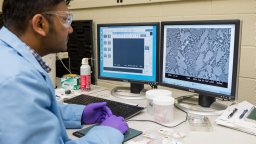
The degradation rate of spent oxide fuel in a disposal facility will depend on the surface potential, which may be strongly affected by the concentration of dissolved H2 within a breached waste container. The H2 generation rate due to anoxic metal corrosion is a key variable in the fuel degradation model being developed for use in performance analyses of waste disposal facilities. We are using electrochemical methods to measure the corrosion rates of low alloy steel, stainless steel, and Zircaloy-4 to represent H2 generation rates under solution redox (Eh) and pH conditions spanning the ranges that could occur in disposal systems. Potentiostatic tests are conducted to measure corrosion rates at fixed Eh and pH conditions and Electrochemical impedance spectroscopy is performed periodically during those tests to quantify changes in the surface electrical properties as the material attains a constant corrosion rate. The corroded surfaces are examined with scanning electron microscopy after the test to relate the electrochemical measurements to physical changes. Results of tests with 4320 steel in acidic and alkaline brine solutions at an imposed potential of 0.25 VSCE are presented as an example of the experimental method and how the fuel corrosion rate varies with the H2 generation rate.
 V. K. Gattu合作论文数Chem & Fuel Cycle Technol Div, Argonne Natl Lab2
 J Ernesto Indacochea合作论文数2James L Jerden合作论文数2W. L. Ebert合作论文数1
 John Murray合作论文数TU Dublin1Arielle Rosenthal合作论文数University of Massachusetts Amherst, Amherst, MA, USA1William L. Ebert合作论文数1
 Kevin Spiteri合作论文数UMass Amherst1
 Mingyuan Wu合作论文数Meta;University of Illinois Urbana Champaign1
 Klara Nahrstedt合作论文数Siebel School of Computing and Data Science, The Grainger College of Engineering, University of Illinois Urbana-Champaign1
 Ramesh K. Sitaraman合作论文数College of Information and Computer Sciences, University of Massachusetts Amherst;Laboratory for Internet-Scale Distributed Systems, University of Massachusetts Amherst;Akamai Technologies1
 Yash Shah合作论文数VA Hosp Philadelphia1
 Jounsup Park合作论文数1
 Michael Zink合作论文数Computer Science Department1




