ABSTRACTLight‐saturated net leaf photosynthesis (Asat), CO2 response curves (A/Ci), current photochemical capacity (Fv/Fm) and pigment contents were measured in leaves of Populus nigra (Clone T107) which had been exposed to ozone stress in open‐top chambers for the entire growth period. Surprisingly, not only elevated (ao+, i.e. ambient air + 50 mm3 m−3 ozone) but also ambient (aa) ozone concentrations led to a reduction in Asat, in comparison with leaves exposed to air containing almost no ozone (cf−, i.e. charcoal filtered ambient air). The very small change in leaf conductance (g1) indicated that the decrease in Asat was not due to stomatal limitation. This finding was supported by the fact that, a decrease in carboxylation efficiency (CE) correlated with a loss in Asat. In comparison to cf− leaves, aa leaves showed no change in current photochemical capacity (Fv/Fm) throughout the whole experiment. However, a marked decline in Fv/Fm in ao+ leaves was observed at a time when Asat and CE were already decreased by about 45% and 60% respectively.As the chlorophyll b content of leaves is known to correlate with the amount of LHC and PSII centres, it was used to normalize fluorescence parameters in relation to PSII centres present. The normalized values for Fm and F0 increased with the dosage of ozone in ao+ leaves but not in aa leaves, indicating a change of the pigment content of PSII in the former, but not in the latter.These data led to the conclusion that ozone interacts primarily with components of the Calvin cycle, which results in a decrease in Asat, with subsequent feedback on the current photochemical capacity of PSII centres.
Summaries English The article outlines and exemplifies a number of principles derived from developmental psychology in relation to their applicability in science education. It is shown that these principles are at variance with those derived from the classical schema of the scientific method. Their application in syllabus and curriculum design, teacher training and lesson preparation should help to improve science education. Der Artikel umreisst und veranschaulicht eine Reihe von der Entwicklungspsychologie abgeleiteter Prinzipien in bezug auf ihre Anwendbarkeit im wissenschaftlichen Unterricht. Es wird gezeigt, daß diese Prinzipien von denen vom klassischen Schema der wissenschaftlichen Methode abgeleiteten abweichen. Ihre Anwendung in der Ausarbeitung von Lehrstoffen un Lehrplänen, in der Lehrerausbildung und in der Unterrichtsvorbereitung dürfte zu einer Verbesserung des wissenschaftlichen Unterrichts beitragen. L'article résume et explique par des exemples un certain nombre de principes de psychologie expérimentale dans le cadre de leurs possibilités d'application à l'enseignement des sciences. Il montre que ces principes sont différents de ceux provenant du schéma classique de la méthode scientifique. Leur application à la conception des programmes d'étude, à la formation des enseignants et à la préparation des leçons devrait aider à améliorer l'enseignement des sciences.
An «embedding scheme» is proposed for the elementary-particle physics, in the frame of the conformal groupSO4,2≈SU2,2, which contains as subgroups (and is completely generated by) the de Sitter groupSO4.1—which is looked at as accounting for the dynamical features (as it admits the Poincaré group as a contraction limit)—and the groupSU2,1—which is a noncompact form ofSU3 and is able to classify the particles according the isospin and hypercharge. A mass splitting procedure is derived from this scheme, which introduces the «symmetry breaking» in accordance with an exact conformal invariance.
Using a Lie algebra method based on works byHarish-Chandra, several series of unitary, irreducible representations of the groupSU(2,2) are obtained.
A simple classical picture, deriving from Weyssenhoff’s model, is proposed, which generates Dirac’s formalism through a generalized Hamiltonian procedure.
This paper is dealing with the relativistic rotator theory recently proposed for representting the elementary particles. A comparison is established between the “internal” invariance group which lies at the basis of this theory, and the Dirac spin group used in the “external” treatment. It is shown, in the frame of Yukawa's scheme, that the external group is the connected Dirac group, which can be split into two complexified Pauli groups. In this frame, an internal Hamiltonian can be built. This Hamiltonian yields all observed strong interactions, besides unobserved ones, which would take place with the new unstable baryons introduced by the theory. From this Hamiltonian, the proper energies are derived in the usual way, and this treatment yields between the masses of the four known baryon multiplets a numerical relation which fits in exactly with the experimental data.
The recent discovery of a second neutrino and of a K- charge exchange with strangeness +1 suggests a generalization of Sakata’s scheme for elementary particles and resonances, withfour basic particle states. This is provided by the De Broglie, Vigier, Yukawa scheme based on the theory of the relativistic rotator.
In this paper, we examine new consequences of the idea that particles are extended structures in real space-time. Starting from the general quantum equations for stable states established in paper I, we discuss the general form of solutions satisfying simultaneously the internal state equations and the external wave equations. One sees in particular that the external part depending on the particle's position ${x}_{\ensuremath{\mu}}$ necessarily corresponds to state vectors belonging to irreducible finite-dimensional representations of the Lorentz group ${\mathcal{L}}_{4}$. Assuming then that the general interaction Hamiltonians are invariant under ${\mathcal{L}}_{4}$ and our new internal isobaric spin group $G$, one justifies the usual semiempirical scheme of strong interactions (invariant under $S{O}_{3}$) and introduce weak interactions in isobaric spin space. The theory also implies couplings between external and internal motions and breaks automatically the symmetries of strong interactions, in a natural development of Sakurai's ideas.
 Jeanpierre Vigier合作论文数14Jp Vigier合作论文数5Pierre Hillion合作论文数5M Mebkhout合作论文数3Vf Muller合作论文数2G. Lochak合作论文数2Moshe Flato合作论文数2David Bohm合作论文数Birbeck College, University of London2J. M. Souriau合作论文数2A KIHLBERG合作论文数2h r bolharnordenkampf合作论文数1f piperno合作论文数1Ld Broglie合作论文数1Takehiko Takabayasi合作论文数1
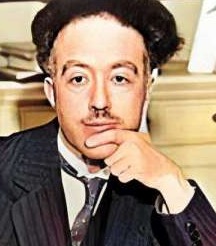 Louis Victor de Broglie (路易·维克多·德布罗意)合作论文数巴黎大学理学院1A. Torunczyk合作论文数1W. F. Postl合作论文数1Ute Ehrlich合作论文数1
 Thomas Gerhard Reichenauer合作论文数Department of Environmental Research, Austrian Research Centers GmbH1
 Gerhard Soja合作论文数1




