Major role of peroxidases in plant biomass degradation is well-established in the white rot basidiomycetes. On the contrary, peroxidases are not used for this purpose by brown rot basidiomycetes, which use instead a non-enzymatic mechanism. In the case of the ascomycetes, not much is known although these fungi have peroxidase genes. Here, we identify and characterize the peroxidase genes of Podospora anserina (Rabenh.) Niessl, an ascomycete used to study development and lignocellulose degradation. We show that this fungus has one class II peroxidase, one hybrid B peroxidase, one haloperoxidase, four functional aromatic peroxygenases, one glutathione peroxidase, one cytochrome C peroxidase and one alkyl peroxidase, but lacks a dye peroxidase. We show that potentially secreted peroxidases (i.e., the class II, hybrid B, haloperoxidase and aromatic peroxygenase peroxidases) present a patchy phylogenetic distribution compatible with an accessory role in finely adapting the different fungal species to their ecological niche, rather than being involved in fundamental roles in fungal biology. Accordingly, targeted gene deletions of the different P. anserina peroxidase genes identified only one phenotype, seemingly an alteration of the timing of ascospore maturation at intermediate concentration of vanillic acid. However, direct measure of peroxidase activity did not show drastic loss of activity in the tested mutants, suggesting compensation between the enzymes. Hence, in P. anserina peroxidases appears to have a minor role in biomass degradation, unlike what has been described in white rot fungi, and thus in this regard appears to be similar to the brown rot fungi.
The regulation of ascospore germination in filamentous fungi has been poorly investigated so far. To unravel new genes involved in this regulation pathway, we conducted a genetic screen in Podospora anserina , and we isolated 57 mutants affected in ascospore germination.
In nature, it is often surmised that lignin is degraded almost exclusively by basidiomycetes, with minor contributions from bacteria and even fewer from ascomycetes. Yet, numerous studies underscore the ability of many ascomycetes from a wide range of taxonomic classes to degrade newly-formed and ancient lignin, sometime more efficiently than basidiomycetes. Few genomes from ascomycetes have been analyzed in relation with their potential ability to breakdown lignin; yet, these also point out a rich repertoire of enzymes with auxiliary activities suspected to participate in lignin lysis. Not surprisingly, the molecular mechanisms used by ascomycetes to break down lignin are largely unknown. Here, we review the literature on this topic. We also present potential mechanisms by which Podospora anserina, a model ascomycete well-suited to decipher how ascomycetes breakdown lignin, may do so. Owing to their huge biomass, which dominates in soils, and despite the fact that they usually are less efficient than basidiomycetes, it is most likely that ascomycetes actually play important roles in ensuring the recycling of lignin in nature.
The filamentous fungus Podospora anserina is a good model to study the breakdown of lignocellulose, owing to its ease of culture and genetical analysis. Here, we show that the fungus is able to use a wide range of lignocellulosic materials as food sources. Using color assays, spectroscopy and pyrolysis–gas chromatography mass spectrometry, we confirm that this ascomycete is able to degrade lignin, primarily by hydrolyzing β–O-4 linkages, which facilitates its nutrient uptake. We show that the limited weight loss that is promoted when attacking Miscanthus giganteus is due to a developmental blockage rather than an inefficiency of its enzymes. Finally, we show that lignin, and, more generally, phenolics, including degradation products of lignin, greatly stimulate the growth and fertility of the fungus in liquid cultures. Analyses of the CATΔΔΔΔΔ mutant lacking all its catalases, pro-oxidants and antioxidants indicate that improved growth and fertility of the fungus is likely caused by augmented reactive oxygen species levels triggered by the presence of phenolics.
Oxylipins are secondary messengers used universally in the living world for communication and defense. The paradigm is that they are produced enzymatically for the eicosanoids and non-enzymatically for the isoprostanoids. They are supposed to be degraded into volatile organic compounds (VOCs) and to participate in aroma production. Some such chemicals composed of eight carbons are also envisoned as alternatives to fossil fuels. In fungi, oxylipins have been mostly studied in Aspergilli and shown to be involved in signalling asexual versus sexual development, mycotoxin production and interaction with the host for pathogenic species. Through targeted gene deletions of genes encoding oxylipin-producing enzymes and chemical analysis of oxylipins and volatile organic compounds, we show that in the distantly-related ascomycete Podospora anserina, isoprostanoids are likely produced enzymatically. We show the disappearance in the mutants lacking lipoxygenases and cyclooxygenases of the production of 10-hydroxy-octadecadienoic acid and that of 1-octen-3-ol, a common volatile compound. Importantly, this was correlated with the inability of the mutants to repel nematodes as efficiently as the wild type. Overall, our data show that in this fungus, oxylipins are not involved in signalling development but may rather be used directly or as precursors in the production of odors against potential agressors.SIGNIFICANCE:We analyzse the role in inter-kingdom communication of lipoxygenase (lox) and cyclooxygenase (cox) genes in the model fungus Podospora anserina. Through chemical analysis we define the oxylipins and volatile organic compounds (VOCs)produce by wild type and mutants for cox and lox genes, We show that the COX and LOX genes are required for the production of some eight carbon VOCs. We show that COX and LOX genes are involved in the production of chemicals repelling nematodes. This role is very different from the ones previously evidenced in other fungi.
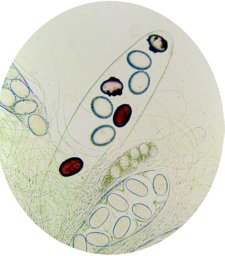
The Podospora anserina genome contains a large family of 15 multicopper oxidases (MCOs), including three genes encoding a FET3-like protein, an ABR1-like protein and an ascorbate oxidase (AO)-like protein. FET3, ABR1 and AO1 are involved in global laccase-like activity since deletion of the relevant genes led to a decrease of activity when laccase substrate (ABTS) was used as substrate. However, contrary to the P. anserina MCO proteins previously characterized, none of these three MCOs seemed to be involved in lignocellulose degradation and in resistance to phenolic compounds and oxidative stress. We showed that the bulk of ferroxidase activity was clearly due to ABR1, and only in minor part to FET3, although ABR1 does not contain all the residues typical of FET3 proteins. Moreover, we showed that ABR1, related to the Aspergillus fumigatus ABR1 protein, was clearly and specifically involved in pigmentation of ascospores. Surprisingly, phenotypes were more severe in mutants lacking both abr1 and ao1. Deletion of the ao1 gene led to an almost total loss of AO activity. No direct involvement of AO1 in fungal developmental process in P. anserina was evidenced, except in a abr1Δ background. Overall, unlike other previously characterized MCOs, we thus evidence a clear involvement of ABR1 protein in fungal development.
In a previous study, it was demonstrated that the toxic impact of titanium dioxide nanoparticles on Escherichia coli starts at 10 ppm and is closely related to the presence of little aggregates. It was also assumed that only a part of the bacterial population is able to adapt to this stress and attempts to survive. Proteomic analyses, supported by results from metabolomics, reveal that exposure of E. coli to nano-TiO2 induces two main effects on bacterial metabolism: firstly, the up-regulation of proteins and the increase of metabolites related to energy and growth metabolism; secondly, the down-regulation of other proteins resulting in an increase of metabolites, particularly amino acids. Some proteins, e.g. chaperonin 1 or isocitrate dehydrogenase, and some metabolites, e.g. phenylalanine or valine, might be used as biomarkers of nanoparticles stress. Astonishingly, the ATP content gradually rises in relation with the nano-TiO2 concentration in the medium, indicating a dramatic release of ATP by the damaged cells. These apparently contradictory results accredit the thesis of a heterogeneity of the bacterial population. This heterogeneity is also confirmed by SEM images which show that while some bacteria are fully covered by nano-TiO2, the major part of the bacterial population remains free from nanoparticles, resulting in a difference of proteome and metabolome. The use of combined-omics has allowed to better understand the heterogeneous bacterial response to nano-TiO2 stress due to heterogeneous contacts between the protagonists under environmental conditions.
The effects of hydrodynamic shear stress on the growth rate of cyanobacteria Synechocystis sp. and Chlamydomonas reinhardtii microalgae cells were studied in agitated photobioreactors, since they have different motility rates and sizes. An experimental setup was designed and constructed to monitor the growth rate of the micro-organisms versus the shear rate; experiments were carried out in a well controlled environment, under constant atmospheric pressure and 20 °C temperature. Digitally controlled magnetic agitator-photobioreactors were placed inside a closed chamber with air flow for 4 weeks, under a uniform full-time light intensity provided by two 6-watt white fluorescent light sources. To study the effects of shear stress produced by mechanical agitation on the growth rate of a micro-organism, different agitation frequencies were tested. All reactors were filled with 150 ml of culture medium and micro-organism suspension, with initial dilution factors (mlsuspenion/mltotal volume) of 1/30 and 1/300 for Synechocystis and C. reinhardtii respectively. The vessels were placed on different agitating systems at the desired agitator rotation speed, and were sealed with a cotton membrane from the top in order to permit air exchange with the external environment. The micro-organisms’ growth was monitored daily by measuring the optical density of the suspensions using a spectrophotometer and was then correlated with the cellular concentration, which was measured in turn using a microscopic cell counter. Throughout the experiments pH levels and temperature were measured regularly and adjusted to 7 and 20 °C respectively in order to maintain the photosynthetic activity of the species. In addition, to measure the shear stress inside the agitated reactors, a mathematical model was derived to determine the global shear stress magnitude. To determine the local shear stress distribution, the velocity field in the reactor was measured for different agitation frequencies using PIV. Different zones of high and low shear stress were identified. The results showed that the growth rate is independent of the shear stress magnitude for Synechocystis; Synechocystis showed strong resistance, unlike C. reinhardtii, which showed linear dependence of growth rate and shear stress.
The gram-negative bacteria Escherichia coli (E. coli) is a very useful prokaryotic model for testing the toxicity of ZnO nanoparticles (nano-ZnO). This toxicity is often linked to Zn2+ released from nanoparticles in the culture medium, and nano-ZnO dissolution in different media is clearly established. Here, two model E. coli strains MG1655 and W3110 both descendant from the original K-12 showing slight differences in their genome were submitted to nano-ZnO or Zn2+ in order 1> to refine the nano-ZnO toxicity mechanisms to E. coli, and 2> to investigate whether toxicity resulted from a real nanoparticle effect or from the release of Zn2+ in solution. To do so, both strains were submitted to various concentrations (i.e., 0.1-1mM) of nano-ZnO or Zn2+ in Luria Bertani (LB) medium. These toxicity studies take into account the nano-ZnO solubility in the culture medium by specifically monitoring the Zn2+ release in our experimental systems. In our experimental conditions, differences in tolerance to nano-ZnO or Zn2+ between both strains were clearly evidenced. W3110 is generally more tolerant to metal than MG1655, the latter showing no real difference in its sensitivity to the two zinc added forms unlike W3110. The differences in behavior between both strains could be attributed to differences in the two genomes as a mutation named amber in W3110. Moreover, by using these two closely E. coli strains, a real nano effect is here clearly demonstrated providing a model to study the toxicity of ZnO nanoparticles.
The increasing production of nanoparticles has raised strong concerns regarding their environmental release. In life cycle scenarios of nanoparticles, marine systems constitute one of the main final compartments, and the fate of nanoparticles in marine environments needs to be assessed. The dissolution kinetics of commercial uncoated and organic‐coated ZnO nanoparticles in synthetic seawater were investigated using the Donnan membrane technique and 1000‐Da pore size ultrafiltration. Uncoated nanoparticles reach a maximum dissolution within the first hour, approximately 24% of total ZnO at pH 8.2, and 4% at pH 7.7, followed by secondary carbonated phase precipitation (hydrozincite) until the system reaches a steady state after 30 d of interaction. Assuming a pseudo first‐order kinetics for hydrozincite precipitation allowed calculation of kinetics constant values k′p of −208 × 10−4 mol L−1 h−1 ± 15 × 10−4 mol L−1 h−1 (standard deviation) at pH 7.7, and −57 × 10−4 mol L−1 h−1 ± 11 × 10−4 mol L−1 h−1 at pH 8.2. The presence of an organic coating drastically modifies the life cycle of nanoparticles, with a maximum dissolution reached after 7 d of interaction, followed by a stationary phase lasting from 1 wk to 3 wk, and a subsequent Zn carbonate precipitation until a steady state is reached after 1.5 mo. Monitoring changes in the physicochemical parameters of nanoparticles after exposure to synthetic seawater constitutes an important step in predicting their fate in environmental systems, with major implications for ecotoxicological studies in which metallic speciation is required for toxicity evaluation. Environ Toxicol Chem 2014;33:341–349. © 2013 SETAC
Seine River water was used as a natural environmental medium to quantify the ecotoxicological impact of three types of manufactured titanium dioxide (TiO2) nanoparticles toward the model bacterium Escherichia coli. Under ambient light, a significant toxicity starting at 10 ppm of TiO2 in water was observed. Presence of the anatase polymorph slightly increased the toxicity in comparison to pure rutile samples. Furthermore, the toxicity was found to be lower at pH 5 compared to Seine water (pH 8). To assess the nanoparticles state of dispersion and their interactions with bacteria, cryogenic transmission electron microscopy (TEM) and zeta potential measurements were performed. A higher sorption of nanoparticle aggregates on cells is observed at pH 5 compared to Seine water. This allows concluding that the observed toxicity is not directly linked to the particles sorption onto the cell surfaces. In spite of stronger interaction between cells and nanoparticles at pH 5, a bacterial subpopulation apparently non-interacting with nanoparticles is evidenced by both TEM and zeta potential measurements. Such heterogeneities in cell populations can increase global bacterial resistance to TiO2 nanoparticles.
L'obtention de nanoparticules (NPs) manufacturees et les proprietes physico-chimiques specifiques qu'elles presentent autorisent aujourd'hui des applications de plus en plus nombreuses et innovantes. La quantite de nanoparticules manufacturees mises sur le marche est en constante augmentation et elles sont aujourd'hui presentes dans de nombreux produits de consommation courante. Cela alimente un debat croissant sur les couts environnementaux et societaux qui pourraient depasser les benefices escomptes par l'utilisation des nanotechnologies en general et des nanomateriaux ou nanoparticules (i.e. taille < 100 nm) en particulier. Elles sont devenues un enjeu majeur de sante publique du point de vue de la toxicite potentielle qu'elles pourraient engendrer dans les ecosystemes. Les nanoparticules peuvent en effet presenter un risque ecotoxicologique (dispersion et degradation dans l'environnement) et un risque en termes de sante humaine (exposition au poste de travail par exemple). Il est donc necessaire d'evaluer la persistance, le devenir et l'impact de ces nouveaux polluants sur les ecosystemes et sur la qualite des ressources naturelles (eaux, cultures, etc...). Dans ce contexte, l'objectif de cette etude etait de mieux cerner l'etat physique et chimique des NPs dans des concentrations representatives des niveaux de toxicite observes et dans des conditions proches de celles des milieux naturels. Elle s'est focalisee sur l'eau de Seine, representative des eaux naturelles de surface qui sont un des vecteurs principaux de la dispersion de ces NPs manufacturees. Les NPs etudiees ici sont produites en grande quantite et largement utilisees dans differents domaines industriels : il s'agit de NPs d'oxydes de zinc (ZnO) et de dioxyde de titane (TiO2). L'analyse des NPs de ZnO par XPS a mis en evidence l'existence d'un cœur de ZnO et d'un coquille de Zn(OH)2 en surface. Parallelement, des NPs enrobees ont ete etudiees et caracterisees, afin de mettre en evidence le role de l'enrobage organique sur la solubilite des NPs. Les experiences de mesures de solubilite des nanoparticules manufacturees en milieu naturel ont ete realisees par utilisation combinee des techniques de DMT et d'UF, associee a des calculs thermodynamiques. Il s'avere que la forme nanoparticulaire du TiO2 n'est pas davantage soluble que ses homologues microparticulaire ou macroparticulaire. A l'inverse, une fraction non negligeable des nanoparticules d'oxydes de zinc est rapidement dissoute dans l'eau de Seine. Puis les NPs sont "piegees" dans des phases secondaires carbonatees, ce qui peut signifier leur isolement par rapport au milieu et donc l'arret des reactions impliquant les NPs, soit une forme de passivation des nanoparticules. Le comportement des NPs dans le milieu est donc en grande partie controle par la couche directement a leur surface (Gelabert et al., 2014; Sivry et al., 2014) : la couche d'hydroxydes de zinc controle le Ks apparent, l'enrobage organique augmente la vitesse et le taux de dissolution des NPs et, enfin, la formation d'une gangue carbonatee emprisonne les NPs et provoque potentiellement leur passivation.
 Marc F. Benedetti合作论文数Institut de Physique du Globe de Paris, Université Paris Cité6
 Gélabert Alexandre合作论文数6
 Philippe Silar合作论文数6
 Nicolas Menguy合作论文数IPG Paris, Université de Paris 6 et 74
 Yann Sivry合作论文数Laboratoire des Mecanismes et Transferts en Geologie, Université Paul Sabatier Toulouse 34Planchon Mariane合作论文数3Olivier Spalla合作论文数Commissariat à l’Energie Atomique (CEA), DSM/DRECAM/SCM, Bât 125, F-91191 Gif-sur-Yvette, France3
 Narumon Tangthirasunun合作论文数2
 Isabelle Lacaze合作论文数2
 Lalanne Christophe合作论文数Department of Adolescent and Young Adult Psychiatry, Institut Mutualiste Montsouris;Department of Clinical Research, Saint-Louis Hospital;Saint-Louis Hospital, Institut Mutualiste Montsouris2Tong Laetitia Chan Ho合作论文数2
 Laure Cordier合作论文数2Akrout Assia合作论文数2
 Francois Guyot合作论文数Muséum National d'Histoire Naturelle;Institut Universitaire de France2Farid Juillot合作论文数Université Paris Diderot, Université Pierre et Marie Curie2
 Valerie Gauthier合作论文数HEC Paris2
 Eric Herbert合作论文数Laboratoire de Physique Statistique de l'École Normale Supérieure, associé aux Universités Paris 6 et 7 et au CNRS2
 Sylvain Brun合作论文数UFR des Sciences du Vivant, Université de Paris 7 – Denis Diderot2
 Antoine Thill合作论文数1Farida Lamari合作论文数1
 Hadi Fadlallah合作论文数1Thierry Durand合作论文数1moussa dicko合作论文数1Yohann Petit-Houdenot合作论文数1Pauline Le Faouder合作论文数1Paola Gobbi合作论文数1
 Thibaut Leger合作论文数1
 Sophie Nowak合作论文数1
 Ning Xie (谢宁)合作论文数College of Life Sciences and Oceanography, Shenzhen University1
 Corinne Chaneac合作论文数Laboratoire chimie de la matière condensée, université Pierre-et-Marie-Curie1Mojtaba Jarrahi合作论文数1
 Jean-Marie Galano合作论文数Institut des Biomolécules Max Mousseron1Gwenael Ruprich-Robert合作论文数1
 Gaspard Huber合作论文数Laboratoire Structure et Dynamique par Résonance Magnétique, IRAMIS1
 Justine Bertrand-Michel合作论文数Université Toulouse III1
 Fabienne Malagnac合作论文数UFR des Sciences du Vivant, Univ Paris 7 Denis Diderot;Institut de Génétique et Microbiologie, Univ Paris Sud 11;Univ Paris 7 Denis Diderot, Univ Paris Sud 111Roberta Brayner合作论文数1
 Stéphane Moularat合作论文数Laboratoire de Microbiologie des Environnements Intérieurs, Centre Scientifique et Technique du Bâtiment1
 Camille Oger合作论文数1
 Annick Mejean合作论文数1
 Florence Chapeland-Leclerc合作论文数1
 Hervé Lalucque合作论文数Institut de Génétique et Microbiologie, Université de Paris XI1
 Hassan Peerhossaini合作论文数Laboratoire de Thermocinétique, University of Nantes1




