We measured poroelastic properties of cracked granite under triaxial conditions, at elevated confining pressure and a range of differential stresses. Skempton's coefficients and undrained Young's modulus and Poisson's ratio were determined directly by recording in situ fluid pressure during rapid cycles of axial and radial stress. Drained properties were measured both statically and dynamically at ultrasonic frequencies. At a given confining pressure, increasing differential stress leads to the development of elastically transverse isotropy, with symmetry axis aligned with the compression axis. Skempton's coefficients are also anisotropic, with larger changes in pore pressure in response to radial stress (coefficient B-x) than to axial stress steps (B-z). The anisotropy in the Skempton coefficients increases with increasing differential stress, with B-z decreasing and B-x slightly increasing. The evolution of static moduli and the Skempton coefficients is well approximated by Gassmann's equation using dry moduli obtained from ultrasonic measurements. Simplified predictions of the Skempton coefficients based on crack density tensors inverted from dynamic data also shows acceptable agreement with direct observations. Perfect quantitative agreement is not reached, due to the imprecision of our dynamic measurements, model simplifications, and inherent differences between static moduli obtained using stress steps of several MPa stress and dynamic ultrasonic stress oscillations.
Shear rupture and fault slip in crystalline rocks like granite produce large dilation, impacting the spatiotemporal evolution of fluid pressure in the crust during the seismic cycle. To explore how fluid pressure variations are coupled to rock deformation and fault slip, we conducted laboratory experiments under upper crustal conditions while monitoring acoustic emissions and in situ fluid pressure. Our results show two separate faulting stages: initial rupture propagation, associated with large dilatancy and stabilized by local fluid pressure drops, followed by sliding on the newly formed fault, promoted by local fluid pressure recharge from the fault walls. This latter stage had not been previously recognised and can be understood as fluid‐induced afterslip, co‐located with the main rupture patch. Upscaling our laboratory results to the natural scale, we expect that spontaneous fault zone recharge could be responsible for early afterslip in locally dilating regions of major crustal faults, independently from large‐scale fluid flow patterns.
 Nicolas Brantut合作论文数Earth Sciences, Faculty of Mathematical & Physical Sciences, University College London2
 Phillip Meredith合作论文数Earth Sciences, Faculty of Mathematical & Physical Sciences, University College London1
 David Healy合作论文数1
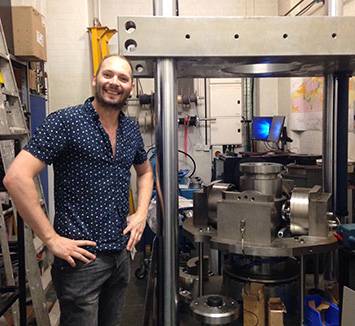 Tom Mitchell合作论文数Earth Sciences, Faculty of Mathematical & Physical Sciences, University College London1




