Rapidly evolving workloads and exploding data volumes place great pressure on data-center compute, IO, and memory performance, and especially on memory capacity. Increasing memory capacity requires a commensurate reduction in memory cost per bit. DRAM technology scaling has been steadily delivering affordable capacity increases, but DRAM scaling is rapidly reaching physical limits. Other technologies such as Flash, enhanced Flash, Phase Change Memory, and Spin Torque Transfer Magnetic RAM hold promise for creating high capacity memories at lower cost per bit. However, these technologies have attributes that require careful management. We propose a hybrid DIMM architecture that uses a hardware-managed DRAM in front of enhanced Flash, which has much lower read latencies than conventional Flash. We explore the design space of such SCM devices in the context of different technology parameters, evaluating performance and endurance for data-center workloads. Our hybrid memory architecture is commercially realizable and can use standard DIMM form factors, giving it a low barrier to market entry. We find that for workloads like media streaming, enhanced Flash can be combined with DRAM to enable 88% of the performance of a DRAM-only system of the same capacity at 23% of the cost, even when factoring in replacement costs due to wear-out. The bottom line is that cost per performance is a factor of 3.8 better than DRAM.
Cryogenic, superconducting digital processors offer the promise of greatly reduced operating power for server-class computing systems. This is due to the exceptionally low energy per operation of Single Flux Quantum circuits built from Josephson junction devices operating at the temperature of 4 Kelvin. Unfortunately, no suitable same-temperature memory technology yet exists to complement these SFQ logic technologies. Possible memory technologies are in the early stages of development but will take years to reach the cost per bit and capacity capabilities of current semiconductor memory. We discuss the pros and cons of four alternative memory architectures that could be coupled to SFQ-based processors. Our feasibility studies indicate that cold memories built from CMOS DRAM and operating at 77K can support superconducting processors at low cost-per-bit, and that they can do so today.
 Craig Hampel合作论文数90Ely K. Tsern合作论文数58richard m barth合作论文数43richard e perego合作论文数39donald c stark合作论文数36paul g davis合作论文数28abhijit m abhyankar合作论文数18matthew murdy griffin合作论文数14
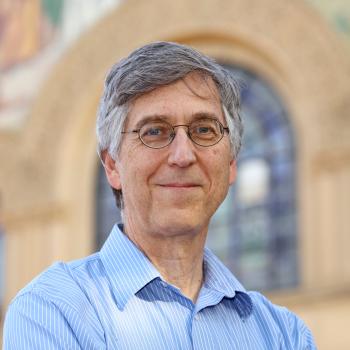 Mark Horowitz合作论文数Department of Electrical Engineering, Stanford University;Department of Computer Science, School of Engineering, Stanford University13james a gasbarro合作论文数12
 Nguyen David P合作论文数National Institute on Aging, National Institutes of Health12todd w bystrom合作论文数10bradley a may合作论文数10John B. Dillon合作论文数10ian shaeffer合作论文数9wayne s richardson合作论文数7
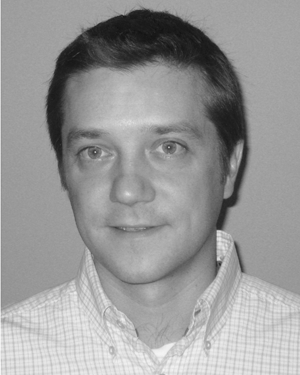 Palmer, R.合作论文数7
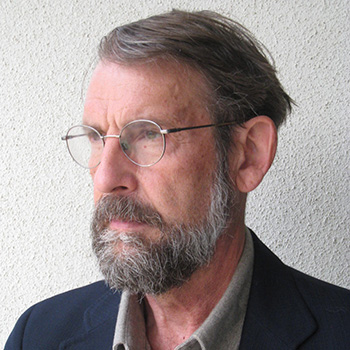 John Poulton合作论文数NVIDIA Corporation7suresh rajan合作论文数6billy wayne garrett合作论文数6scott best合作论文数6
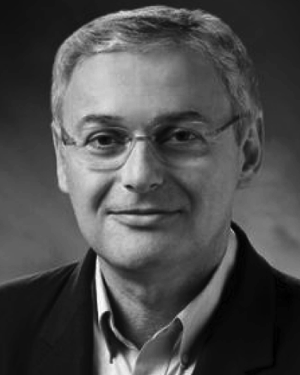 Gary Bronner合作论文数Rambus Inc, Sunnyvale, CA 94089 USA6kishore ven kasamsetty合作论文数5lawrence lai合作论文数5brent haukness合作论文数5
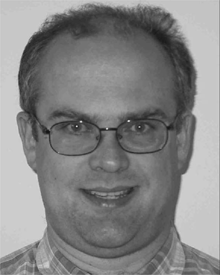 Thomas Vogelsang合作论文数5
 Steven Woo合作论文数Rambus5wayne f ellis合作论文数4yuanlong wang合作论文数4chad a bellows合作论文数4
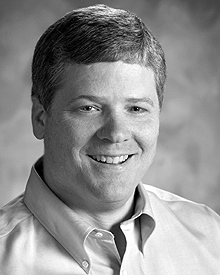 Kevin S Donnelly合作论文数4Michael P. Farmwald合作论文数4donald r mullen合作论文数3
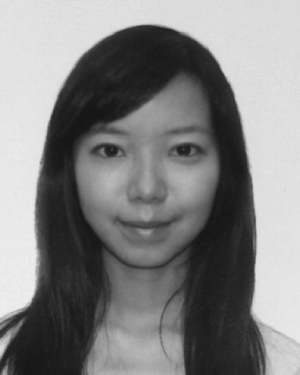 Ming Li合作论文数3
 Andrew M. Fuller合作论文数3
 Thomas Jay Sheffler合作论文数3
 Paul Franzon合作论文数Department of Electrical and Computer Engineering, North Carolina State University;Bandit Flight3WARMKE RICHARD E合作论文数2peter d macwilliams合作论文数2john eric linstadt合作论文数2karnamadakala krishnamohan合作论文数2Eric Linstadt合作论文数2
 Sally A. Mckee合作论文数Holcombe Department of Electrical and Computer Engineering, Chalmers University of Technology2
 Brian Leibowitz合作论文数2
 Liji Gopalakrishnan合作论文数2
 Kenneth L Wright合作论文数H. Lee Moffitt Cancer Center, University of South Florida2Akash Bansal合作论文数2dinesh patil合作论文数1paul m farmwald合作论文数1




