A thermo-optic dynamics model and a novel form of induced transparency and corresponding slowlight based on thermo-optic dynamics is demonstrated in optically pumped silicon microcavities. The phenomenon provides group delay as high as 0.5 µs in a silicon photonic crystal cavity at room temperature.
Controlling the optical response of a medium through suitably tuned coherent electromagnetic fields is highly relevant in a number of potential applications, from all-optical modulators to optical storage devices. In particular, electromagnetically induced transparency (EIT) is an established phenomenon in which destructive quantum interference creates a transparency window over a narrow spectral range around an absorption line, which, in turn, allows to slow and ultimately stop light due to the anomalous refractive index dispersion. Here we report on the observation of a new form of both induced transparency and amplification of a weak probe beam in a strongly driven silicon photonic crystal resonator at room temperature. The effect is based on the oscillating temperature field induced in a nonlinear optical cavity, and it reproduces many of the key features of EIT while being independent of either atomic or mechanical resonances. Such thermo-optically induced transparency will allow a versatile implementation of EIT-analogs in an integrated photonic platform, at almost arbitrary wavelength of interest, room temperature and in a practical, low cost, and scalable system.
We demonstrate a novel form of induced transparency and associated slow light due to thermo-optic effect. The phenomenon provides group delay as high as 0.5 µs in a silicon photonic crystal cavity at room temperature.
We report on ZnO nanoparticles-polystyrene (PS) nanocomposites (NC) engineered to modify PS matrix permeability and refractive index (n), and to fabricate 1D all-polymer photonic crystals (PC) for sensing applications. The new NC can be easily processed from solutions to prepare high quality thin films by spin coating. ZnO nanoparticles (n = 1.98) have been synthetized by solvothermal route and grafted with a silane to reduce phase segregation in the PS matrix (n = 1.58). Such procedure led to an increase of the matrix refractive index of about 1%. By casting alternated layers of the NC and cellulose acetate (CA, n = 1.46), we fabricated free-standing and flexible distributed Bragg reflectors (DBRs) of excellent optical quality. Preliminary results on the use of such DBRs as solvent vapor sensors are reported. (© 2015 WILEY-VCH Verlag GmbH & Co. KGaA, Weinheim)
GaN L3 photonic crystal cavities were fabricated based on a genetic algorithm optimization. Optical characterization of several replicas led to an average unloaded quality factor of 16900, which is well accounted for by first-principles simulations.
We report on the experimental realization of ultra-high quality factor (Q) designs of the L3-type photonic crystal nanocavity. Based on genetic optimization of the positions of few nearby holes, our design drastically improves the performance of the conventional L3 as experimentally confirmed by direct measurement of Q ≃ 2 × 10⁶ in a silicon-based photonic crystal membrane. Our devices rank among the highest Q/V ratios ever reported in photonic crystal cavities, holding great promise for the realization of integrated photonic platforms based on ultra-high-Q resonators.
We experimentally demonstrate ultra-high quality factors (Q= 1.45×10⁶) in evolutionary optimized 2D L3 photonic crystal nanocavities fabricated in Si slabs. Together with ultra-small effective mode volumes ~ 0.96(λ/n)3, such a nanocavity offers a new platform in future integrated nanophotonics.
We experimentally demonstrate ultra-high quality factors (Q = 1.96 × 10⁶) in genetically designed 2D L3 photonic crystal nanocavities fabricated in Si slabs. Together with ultra-small effective mode volumes ~ 0.96(λ/n)3, such a nanocavity offers a new platform in future integrated nanophotonics.
Photonic crystal point-defect cavities were fabricated in a GaN free-standing photonic crystal slab. The cavities are based on the popular L3 design, which was optimized using an automated process based on a genetic algorithm, in order to maximize the quality factor. Optical characterization of several individual cavity replicas resulted in an average unloaded quality factor Q = 16 900 at the resonant wavelength λ∼1.3 μm, with a maximal measured Q value of 22 500. The statistics of both the quality factor and the resonant wavelength are well explained by first-principles simulations including fabrication disorder and background optical absorption.
 Matteo Galli合作论文数8
 Dario Gerace合作论文数Dipartimento di Fisica "A. Volta",, Universití degli Studi di Pavia6
 Vincenzo Savona合作论文数Laboratory of Theoretical Physics of Nanosystems, Ecole Polytechnique Federale de Lausanne;Institute of Theoretical Physics, École Polytechnique Fédérale de Lausanne;Physics Section, Ecole Polytechnique Federale de Lausanne5
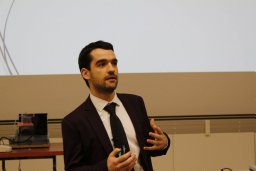 Momchil Minkov合作论文数Jacobs University Bremen5
 s pirotta合作论文数3
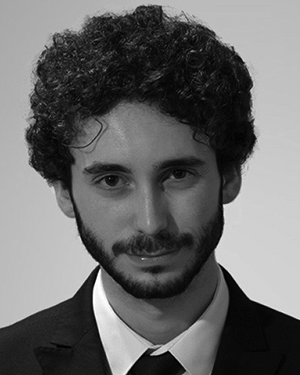 Marco Clementi合作论文数3
 Sebastian A Schulz合作论文数3
 Simone Iadanza合作论文数Munster Technological University3Yiming Lai合作论文数3
 Antonio Badolato合作论文数Institute of Quantum Electronics3J-F Carlin合作论文数2
 Noelia Vico Triviño合作论文数IBM Res Europe Zurich2
 Raphaël Butté合作论文数Institute of Physics, School of Basic Sciences, Federal Institute of Technology in Lausanne2
 Nicolas Grandjean合作论文数Laboratory of Advanced Semiconductors for Photonics and Electronics, Institute of Physics, School of Basic Sciences, Ecole Polytechnique Federale de Lausanne2
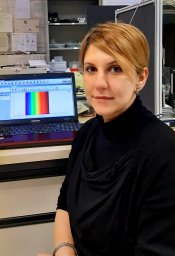 Paola Lova合作论文数Dipartimento Chim Chim Ind, Univ Studi Genova1C. Hu合作论文数1
 Cesare Soci合作论文数Division of Physics and Applied Physics, School of Physical and Mathematical Sciences, Nanyang Technological University/Energy Research Institute, Nanyang Technological University1
 Valentina Caratto合作论文数Department of Chemistry and Industrial Chemistry (DCCI),, University of Genoa;CNR-SPIN;Department of Chemistry and Industrial Chemistry (DCCI),, University of Genoa1
 F. Marabelli合作论文数1Manfredi Giovanni合作论文数1
 Luca Boarino合作论文数Istituto Elettrotecnico Nazionale Galileo Ferraris1
 M. Ferretti合作论文数Dipartimento di Chimica e Chimica Industriale, Università di Genova1
 Davide Comoretto合作论文数Department of Chemistry and Industrial Chemistry, University of Genova1
 Tonia Losco合作论文数NEST CNR-INFM and Scuola Normale Superiore1
 Maila Castellano合作论文数Dipartimento di Chimica e Chimica Industriale, Università di Genova1
 Michele Laus合作论文数Department of Science and Technological Innovation, Università Piemonte Orientale1




