Chiral magnetic skyrmions, localized and topologically protected vortex-like magnetic textures that can be found in chiral magnets, are currently under intense study as an entity for information storage and processing. A recent study showed that so-called rank-one materials can host both skyrmions and antiskyrmions at the same energy. In such systems the Dzyaloshinskii-Moriya interaction, in general a tensorial quantity, is reduced to only one non-zero component. The presence of both skyrmions and antiskyrmions allows for the investigation of the possible interplay between them. Here, we investigate the stability and interaction of skyrmions and antiskyrmions as well as their transport properties subject to spin-orbit torque for a model system described by an atomistic spin-lattice Hamiltonian employing the simulation software Spirit. The spin-orbit torque driven spin-dynamics described by the Landau-Lifshitz-Gilbert equation is compared to the effective one of the Thiele equation. We demonstrate that, even though skyrmions and antiskyrmions can be seen as antiparticles, a rather dense arrangement of both along a memory track is possible, enabling their use as representations of the binary data bits “0” and “1” in a memory device.
It is shown that in isotropic crystals of a chiral magnet, the dipole strings (DSs), representing coupled magnetic singularities (Bloch points) of the opposite sign, can emerge as stable states in geometrically confined samples as well as in the interior of bulk crystals. Here, the authors also report an intriguing effect of spontaneous nucleation of DSs at elevated temperatures near the paramagnetic phase transition, which may shed light on the nature of the $A$ phase (anomalous phase) observed in bulk crystals of $B$20-type chiral magnets.
The current development to employ magnetic skyrmions in novel spintronic device designs has led to a demand for room-temperature-stable skyrmions of ever smaller size. We present extensive studies on skyrmion stability in atomistic magnetic systems in two- and three-dimensional geometries. We show that for materials described by the same micromagnetic parameters, the variation of the atomistic exchange between different neighbors, the stacking order, and the number of layers of the atomic lattice can significantly influence the rate of the thermally activated decay of a skyrmion. These factors alone are important considerations, but we show that their combination can open up novel avenues of materials design in the search for sub-10 nm skyrmions, as their lifetime can be extended by several orders of magnitude.
The \textit{Spirit} framework is designed for atomic scale spin simulations of magnetic systems of arbitrary geometry and magnetic structure, providing a graphical user interface with powerful visualizations and an easy to use scripting interface. An extended Heisenberg type spin-lattice Hamiltonian including competing exchange interactions between neighbors at arbitrary distance, higher-order exchange, Dzyaloshinskii-Moriya and dipole-dipole interactions is used to describe the energetics of a system of classical spins localised at atom positions. A variety of common simulations methods are implemented including Monte Carlo and various time evolution algorithms based on the Landau-Lifshitz-Gilbert equation of motion, which can be used to determine static ground state and metastable spin configurations, sample equilibrium and finite temperature thermodynamical properties of magnetic materials and nanostructures or calculate dynamical trajectories including spin torques induced by stochastic temperature or electric current. Methods for finding the mechanism and rate of thermally assisted transitions include the geodesic nudged elastic band method, which can be applied when both initial and final states are specified, and the minimum mode following method when only the initial state is given. The lifetime of magnetic states and rate of transitions can be evaluated within the harmonic approximation of transition-state theory. The framework offers performant CPU and GPU parallelizations. All methods are verified and applications to several systems, such as vortices, domain walls, skyrmions and bobbers are described.
Various transitions that a magnetic Skyrmion can undergo are found in calculations using a method for climbing up the energy surface and converging onto first order saddle points. In addition to collapse and escape through a boundary, the method identifies a transition where the Skyrmion divides and forms two Skyrmions. The activation energy for this duplication process can be similar to that of collapse and escape. A tilting of the external magnetic field for a certain time interval is found to induce the duplication process in a dynamical simulation. Such a process could turn out to be an important avenue for the creation of Skyrmions in future magnetic devices.
The skyrmion racetrack is a promising concept for future information technology. There, binary bits are carried by nanoscale spin swirls-skyrmions-driven along magnetic strips. Stability of the skyrmions is a critical issue for realising this technology. Here we demonstrate that the racetrack skyrmion lifetime can be calculated from first principles as a function of temperature, magnetic field and track width. Our method combines harmonic transition state theory extended to include Goldstone modes, with an atomistic spin Hamiltonian parametrized from density functional theory calculations. We demonstrate that two annihilation mechanisms contribute to the skyrmion stability: At low external magnetic field, escape through the track boundary prevails, but a crossover field exists, above which the collapse in the interior becomes dominant. Considering a Pd/Fe bilayer on an Ir(111) substrate as a well-established model system, the calculated skyrmion lifetime is found to be consistent with reported experimental measurements. Our simulations also show that the Arrhenius pre-exponential factor of escape depends only weakly on the external magnetic field, whereas the pre-exponential factor for collapse is strongly field dependent. Our results open the door for predictive simulations, free from empirical parameters, to aid the design of skyrmion-based information technology.
Chiral magnets are an emerging class of topological matter harboring localized and topologically protected vortex-like magnetic textures called skyrmions, which are currently under intense scrutiny as an entity for information storage and processing. Here, on the level of micromagnetics we rigorously show that chiral magnets can not only host skyrmions but also antiskyrmions as least energy configurations over all non-trivial homotopy classes. We derive practical criteria for their occurrence and coexistence with skyrmions that can be fulfilled by (110)-oriented interfaces depending on the electronic structure. Relating the electronic structure to an atomistic spin-lattice model by means of density functional calculations and minimizing the energy on a mesoscopic scale by applying spin-relaxation methods, we propose a double layer of Fe grown on a W(110) substrate as a practical example. We conjecture that ultra-thin magnetic films grown on semiconductor or heavy metal substrates with C 2v symmetry are prototype classes of materials hosting magnetic antiskyrmions.Skyrmions, localized defects in the magnetization, can be stabilised in materials by the Dzyaloshinskii-Moriya interaction (DMI). Hoffmann et al. predict that, when the DMI is anisotropic, antiskyrmions can be formed and coexist with skyrmions, enabling studies and exploitation of their interactions.
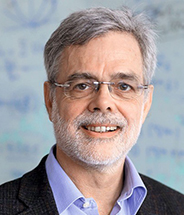 Stefan Blügel合作论文数Peter Grünberg Institute, Forschungszentrum Jülich GmbH;Institute for Advanced Simulation, Forschungszentrum Jülich GmbH8
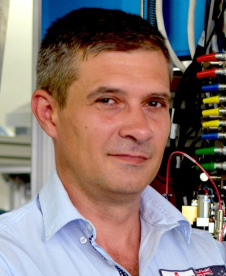 Nikolai Kiselev合作论文数Spin Dynamics Group, Peter Grünberg Institute, Forschungszentrum Jülich;Institute for Advanced Simulation, Forschungszentrum Jülich5
 Markus Hoffmann合作论文数Inst Adv Simulat, Forschungszentrum Julich4
 Hannes Jónsson合作论文数School of Engineering and Natural Sciences, Faculty of Physical Sciences, University of Iceland4
 V. M. Uzdin合作论文数Department of Physics, ITMO University2
 Pavel Bessarab合作论文数Department of Physics and Electrical Engineering, Faculty of Technology, Linnaeus University2
 Filipp N. Rybakov合作论文数Institute of Metal Physics;Ural Division;Russian Academy of Sciences;Institute of Metal Physics, Russian Academy of Sciences2
 Christof Melcher合作论文数School of Mathematics;University of Minnesota;School of Mathematics, University of Minnesota2Constantin Disselkamp合作论文数1Stefanos Mavros合作论文数1
 Moritz Sallermann合作论文数1
 S. M. Vlasov合作论文数St Petersburg State Univ1
 Fabian R. Lux合作论文数Institute of Physics, Johannes Gutenberg University Mainz1
 Zimmermann Bernd合作论文数1
 Igor Sergeevich Lobanov合作论文数Department of Mathematics, St. Petersburg State University of Information Technologies1
 Lars Bergqvist合作论文数Institute of Solid State Physics1
 Anna Delin合作论文数Division of Materials and Nanophysics, Department of Applied Physics, School of Engineering Sciences, KTH Royal Institute of Technology1




