Singing voice transcription is a key task in Music Information Retrieval (MIR) that focuses on identifying sung notes within a music audio segment. Advancing state-of-the-art methods in this area relies heavily on high-quality data, yet annotating such data is resource-intensive and requires musical expertise. In genres like pop music, data sharing is further complicated by copyright and distribution limitations. In this paper, we refine a recently proposed data augmentation technique that leverages AI-generated music audio to address these data-related challenges. Specifically, we create musical accompaniments for vocals with known target notes, enabling the generation of new mixes that retain the original piece’s harmony while introducing substantial audio variation. Our cross-dataset experiments reveal that using harmony-matched mixes improves generalization, though performance remains below that achieved by training with additional real data.
Multi-modal deep learning techniques for matching free-form text with music have shown promising results in the field of Music Information Retrieval (MIR). Prior work is often based on large proprietary data while publicly available datasets are few and small in size. In this study, we present WikiMuTe, a new and open dataset containing rich semantic descriptions of music. The data is sourced from Wikipedia's rich catalogue of articles covering musical works. Using a dedicated text-mining pipeline, we extract both long and short-form descriptions covering a wide range of topics related to music content such as genre, style, mood, instrumentation, and tempo. To show the use of this data, we train a model that jointly learns text and audio representations. The model is evaluated on two tasks: tag-based music retrieval and music auto-tagging. The results show that while our approach has state-of-the-art performance on multiple tasks, we still observe a difference in performance depending on the data used for training.
Singing voice transcription is a very popular task in MIR which consists of obtaining the notes being sung in a given excerpt of music audio. Data is essential for state-of-the-art methods, but annotating it is labor-intensive, requiring musical expertise. Moreover, in cases such as pop music, sharing such data is even more challenging due to copyright and data distribution rights. We present in this paper a data augmentation technique leveraging AI-generated music audio to alleviate the aforementioned data-related difficulties. Specifically, we generate the music accompanying the vocals for which target notes are already known. In this way, we create new mixes that maintain the harmony of the original piece while providing large variations in the audio content. We conducted a set of cross-dataset experiments and discovered that our proposed approach with harmonic-matching mixes yields the best results compared to other augmentation strategies. The employed tools for this augmentation are open-source and ready to be used by the research community.
Individualization of head-related transfer functions (HRTFs) can improve the quality of binaural applications with respect to the localization accuracy, coloration, and other aspects. Using anthropometric features (AFs) of the head, neck, and pinna for individualization is a promising approach to avoid elaborate acoustic measurements or numerical simulations. Previous studies on HRTF individualization analyzed the link between AFs and technical HRTF features. However, the perceptual relevance of specific errors might not always be clear. Hence, the effects of AFs on perceived perceptual qualities with respect to the overall difference, coloration, and localization error are directly explored. To this end, a listening test was conducted in which subjects rated differences between their own HRTF and a set of nonindividual HRTFs. Based on these data, a machine learning model was developed to predict the perceived differences using ratios of a subject's individual AFs and those of presented nonindividual AFs. Results show that perceived differences can be predicted well and the HRTFs recommended by the models provide a clear improvement over generic or randomly selected HRTFs. In addition, the most relevant AFs for the prediction of each type of error were determined. The developed models are available under a free cultural license.
The individualization of head related transfer functions (HRTFs) can make an important contribution to improving the quality of binaural technology applications. One approach to individualization is to exploit relations between the shape of HRTFs on the one hand and anthropometric features of the ears, head, and torso of the corresponding listeners on the other hand. To identify statistically significant relations between the two sets of variables, a relatively large database is required. For this purpose, full-spherical HRTFs of 96 subjects were acoustically measured and numerically simulated. A detailed cross-evaluation showed a good agreement to previous data between repeated measurements and between measured and simulated data. In addition to 96 HRTFs, the database includes high resolution head-meshes, a list of 25 anthropometric features per subject, and headphone transfer functions for two headphone models.
This chapter presents several computational approaches aimed at supporting knowledge discovery in music. Our work combines data mining, signal processing and data visualization techniques for the automatic analysis of digital music collections, with a focus on retrieving and understanding musical structure. We discuss the extraction of midlevel feature representations that convey musically meaningful information from audio signals, and show how such representations can be used to synchronize different instances of a musical work and enable new modes of music content browsing and navigation. Moreover, we utilize these representations to identify repetitive structures and representative patterns in the signal, via self-similarity analysis and matrix decomposition techniques that can be made invariant to changes of local tempo and key. We discuss how structural information can serve to highlight relationships within music collections, and explore the use of information visualization tools to characterize the patterns of similarity and dissimilarity that underpin such relationships. With the help of illustrative examples computed on a collection of recordings of Frederic Chopin's Mazurkas, we aim to show how these content-based methods can facilitate the development of novel modes of access, analysis and interaction with digital content that can empower the study and appreciation of music.
Numerical simulations offer a feasible alternative to the direct acoustic measurement of individual head-related transfer functions (HRTFs). For the acquisition of high quality 3D surface scans, as required for these simulations, several approaches exist. In this paper, we systematically analyze the variations between different approaches and evaluate the influence of the accuracy of 3D scans on the resulting simulated HRTFs. To assess this effect, HRTFs were numerically simulated based on 3D scans of the head and pinna of the FABIAN dummy head generated with 6 different methods. These HRTFs were analyzed in terms of interaural time difference, interaural level difference, energetic error in auditory filters and by their modeled localization performance. From the results, it is found that a geometric precision of about 1 mm is needed to maintain accurate localization cues, while a precision of about 4 mm is sufficient to maintain the overall spectral shape.
This paper presents a low-latency neural network based speech enhancement system. Low-latency operation is critical for speech communication applications. The system uses the time-frequency (TF) masking approach to retain speech and remove the non-speech content from the observed signal. The ideal TF mask are obtained by supervised training of neural networks. As the main contribution different neural network models are experimentally compared to investigate computational complexity and speech enhancement performance. The proposed system is trained and tested on noisy speech data where signal-to-noise ratio (SNR) ranges from -5 dB to +5 dB and the results show significant reduction of non-speech content in the resulting signal while still meeting a low-latency operation criterion, which is here considered to be less than 20 ms.
The aim of immersive teleconferencing is to convey a realistic sound field impression to a remote participant. To this end, the spatial distribution of talkers as well as room information needs to be captured by the nearend system and accurately reproduced on the far-end. As illustrated in Figure 1, we consider a setup where high speech quality is obtained by means of several close microphones (spot microphones) and spatial information is captured with a small circular or spherical microphone array in the center of the acoustic scene. The proposed automatic mixing system robustly estimates the directions of multiple active talkers and mixes the closemicrophone signals with the room information gathered by the central microphone array, whereas the spot microphones need not be synchronized with the microphone array and their positions are assumed to be unknown. Furthermore, we propose a novel automatic gain control method that keeps natural speech dynamics while equalizing speech level fluctuations due to unintentional changes of the talker-microphone distance. To allow for maximal flexibility concerning the reproduction system on the far-end (e.g. different loudspeaker setups or binaural reproduction for headphones), the sound field is encoded in higher-order Ambisonics. Listening experiments of our concluding evaluation indicate the optimal settings for recorded multi-talker scenarios using both headphoneand loudspeaker-based reproduction. With
Studies show that many people have difficulties in understanding dialogue in movies when watching TV, especially hard-of-hearing listeners or in adverse listening environments. In order to overcome this problem, we propose an efficient methodology to enhance the speech component of a stereo signal. The method is designed with low computational complexity in mind, and consists of first extracting a center channel from the stereo signal. Novel methods for speech enhancement and voice activity detection are proposed which exploit the stereo information. A speech enhancement filter is estimated based on the relationship between the extracted center channel and all other channels. Subjective and objective evaluations show that this method can successfully enhance intelligibility of the dialogue without affecting the overall sound quality negatively.
Speech de-noising algorithms often suffer from introduction of artifacts, either by removal of parts of the speech signal, or imperfect noise reduction causing the remaining noise to sound unnatural and disturbing. This contribution proposes to spatially distribute monaural noisy speech signals based on single-channel source separation, in order to improve the perceived speech quality. Stereo up-mixing is utilized on the estimated speech and noise sources instead of simply suppressing the noise. This paper investigates the case of non-negative matrix factorization (NMF) speech enhancement applied to high levels of non-stationary noise. NMF-based and spectral subtraction speech enhancement algorithms are evaluated in a listening test in terms of speech intelligibility, presence of interfering noises and overall quality with respect to the unprocessed signal. In the result, the listening test provides evidence for superior noise reduction by NMF, yet also a drop in perceived speech quality that is not covered by the employed set of common objective metrics. However, stereo up-mixing of NMF-separated speech and noise delivers high subjective noise reduction while preserving the perceived speech quality.
Automatically inferring the structural properties of raw multimedia documents is essential in today's digitized society. Given its hierarchical and multi-faceted organization, musical pieces represent a challenge for current computational systems. In this article, we present a novel approach to music structure annotation based on the combination of structure features with time series similarity. Structure features encapsulate both local and global properties of a time series, and allow us to detect boundaries between homogeneous, novel, or repeated segments. Time series similarity is used to identify equivalent segments, corresponding to musically meaningful parts. Extensive tests with a total of five benchmark music collections and seven different human annotations show that the proposed approach is robust to different ground truth choices and parameter settings. Moreover, we see that it outperforms previous approaches evaluated under the same framework.
In this paper we investigate whether we can extract the commonalities shared by a group of cover songs or versions of the same musical piece. As a main contribution, we introduce the concept of cover group thumbnail, which is the most representative, essential subsequence for an entire group of versions. Opposed to previous approaches, we jointly consider all versions of a given song to compute a single cover group template, which then shows a high degree of robustness against version-specific aspects. To compute such a template, we introduce a modification of a recent audio thumbnailing technique. To evaluate the reliability of our conceptual contribution, we consider the task of template-based version identification, where we show comparable accuracies to existing systems.
In this paper, we investigate to which extent well-known audio fingerprinting techniques, which aim at identifying a specific audio recording, can be modified to also deal with more musical variations. To this end, we replace the standard peak fingerprints based on a spectrogram by peak fingerprints based on other more “musical” feature representations. Our systematic experiments show that such modified peak fingerprints allow for a robust identification of different versions and performances of the same piece of music if the query length is at least 15 seconds. This indicates that highly efficient audio fingerprinting techniques can also be applied to accelerate tasks such as audio matching or cover song identification.
Locating boundaries between coherent and/or repetitive segments of a time series is a challenging problem pervading many scientific domains. In this paper we propose an unsupervised method for boundary detection, combining three basic principles: novelty, homogeneity, and repetition. In particular, the method uses what we call structure features, a representation encapsulating both local and global properties of a time series. We demonstrate the usefulness of our approach in detecting music structure boundaries, a task that has received much attention in recent years and for which exist several benchmark datasets and publicly available annotations. We find our method to significantly outperform the best accuracies published so far. Importantly, our boundary approach is generic, thus being applicable to a wide range of time series beyond the music and audio domains.
In this paper, we introduce an automated procedure for segmenting a given folk song field recording into its constituent stanzas. One challenge arises from the fact that these recordings are performed by elderly non-professional singers under poor recording conditions such that the constituent stanzas may reveal significant temporal and spectral deviations. Unlike a previously described segmentation approach that relies on a manually transcribed reference stanza, we introduce a reference-free segmentation procedure, which is driven by an audio thumbnailing procedure in combination with enhanced similarity matrices. Our experiments on a Dutch folk song collection show that our segmentation results are comparable to the ones obtained by the reference-based method.
The automatic transcription of music recordings with the objective to derive a score-like representation from a given audio representation is a fundamental and challenging task. In particular for polyphonic music recordings with overlapping sound sources, current transcription systems still have problems to accurately extract the parameters of individual notes specified by pitch, onset, and duration. In this article, we present a music transcription system that is carefully designed to cope with various facets of music. One main idea of our approach is to consistently employ a mid-level representation that is based on a musically meaningful pitch scale. To achieve the necessary spectral and temporal resolution, we use a multi-resolution Fourier transform enhanced by an instantaneous frequency estimation. Subsequently, having extracted pitch and note onset information from this representation, we employ Hidden Markov Models (HMM) for determining the note events in a context-sensitive fashion. As another contribution, we evaluate our transcription system on an extensive dataset containing audio recordings of various genre. Here, opposed to many previous approaches, we do not only rely on synthetic audio material, but evaluate our system on real audio recordings using MIDI-audio synchronization techniques to automatically generate reference annotations.
 Meinard Müller合作论文数International Audio Laboratories Erlangen, Friedrich-Alexander-University of Erlangen-Nürnberg25
 Manoj Dinakaran合作论文数Huawei Technol, German Res Ctr, Riesstr 25, Munich, Germany6
 Fabian Brinkmann合作论文数the Audio Communication Group, TU Berlin;c;the Audio Communication Group, TU Berlin6Stefan Weinzierl合作论文数Institut für Physik, Fachbereich Physik, Mathematik und Informatik, Johannes Gutenberg-Universität Mainz6
 Joan Serrà合作论文数SonyAI6
 Robert Pelzer合作论文数Tech Univ Berlin, Audio Commun Grp, Einsteinufer 17c, Berlin, Germany5
 Nanzhu Jiang合作论文数4
 Josep Lluís Arcos合作论文数Artificial Intelligence Research Institute (IIIA-CSIC)3
 Sebastian Ewert合作论文数Spotify;Queen Mary University of London3Frans Wiering合作论文数Centre for Content and Knowledge Engineering, Utrecht University3Holger Kirchhoff合作论文数3
 Xavier Serra合作论文数Department of Information and Communication Technologies, Universitat Pompeu Fabra Barcelona3Stine Harder合作论文数Dept. of Appl. Math. & Comput. Sci., Tech. Univ. of Denmark;c;Dept. of Appl. Math. & Comput. Sci., Tech. Univ. of Denmark2
 Frank Kurth合作论文数Commun Syst Fraunhofer FKIE Wachtberg2
 Björn Schuller合作论文数School of Computation, Information and Technology, Technical University of Munich;School of Medicine and Health, Technical University of Munich;Department of Computing, Faculty of Engineering, Imperial College London;AudEERING GmbH2
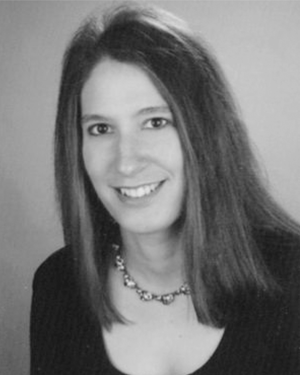 Verena Konz合作论文数2
 Jürgen T. Geiger合作论文数Department of Electrical Engineering and Information Technologies, Technische Universität München2
 Rasmus R. Paulsen合作论文数Department of Applied Mathematics and Computer Science, Technical University of Denmark2
 Fabian Seipel合作论文数1
 Josep Ll. Arcos合作论文数1
 Kazuyoshi Yoshii (吉井和佳)合作论文数Department of Intelligence Science and Technology, Graduate School of Informatics, Kyoto University;Center for Advanced Intelligence Project, RIKEN1Benno Weck合作论文数1
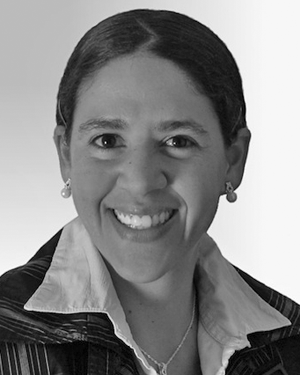 Yesenia Lacouture-Parodi合作论文数1
 Ron Weiss合作论文数Google1
 Christian Schorkhuber合作论文数Sonible GmbH, Graz, Austria1
 Juan Pablo Bello合作论文数Department of Computer Science and Engineering, Tandon School of Engineering, New York University;Music and Audio Research Laboratory, New York University1
 Tuomas Oskari Virtanen合作论文数Audio Research Group, Tampere University1
 Gerhard Rigoll合作论文数Department of Electrical and Computer Engineering, Technische Universitat Munchen1
 Matthias Mauch合作论文数Queen Mary University of London;Apple1Matthias Frank合作论文数1Zhe Zuo合作论文数1
 Masataka Goto (後藤真孝)合作论文数National Institute of Advanced Industrial Science and Technology1
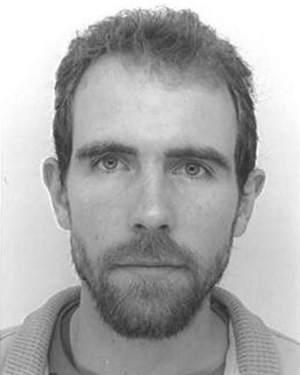 Cyril Joder合作论文数1
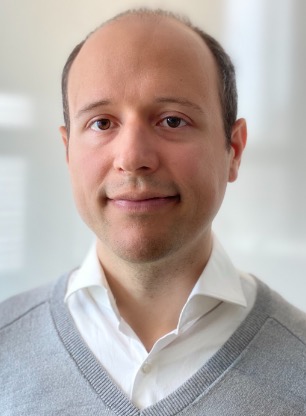 Felix Weninger合作论文数Microsoft1
 Steffen Lepa合作论文数1
 Robert Holdrich合作论文数Institute of Electronic Music and Acoustics;University of Music;Institute of Electronic Music and Acoustics, University of Music1
 Hendrik Schreiber合作论文数International Audio Laborator1
 Craig Sapp合作论文数1
 Mikko Parviainen合作论文数HELSINKI;UNIVERSITY OF TECHNOLOGY;HELSINKI|UNIVERSITY OF TECHNOLOGY1
 Franz Zotter合作论文数University of Music;Performing Arts Graz;University of Music|Performing Arts Graz1
 Pasi Pertilä合作论文数Patria1




