The DARHT-II accelerator produces an 18-MeV, 2-kA, 2-μs electron beam pulse. After the accelerator, the pulse is delivered to the final focus on an x-ray producing target via a beam transport section called the Downstream Transport. Ions produced due to beam ionization of residual gases in the Downstream Transport can affect the beam dynamics. Ions generated by the head of the pulse will cause modification of space-charge forces at the tail of the pulse so that the beam head and tail will have different beam envelopes. They may also induce ion-hose instability at the tail of the pulse. If these effects are significant, the focusing requirements of beam head and tail at the final focus will become very different. The focusing of the complete beam pulse will be time dependent and difficult to achieve, leading to less efficient x-ray production. In this paper, we will describe the results of our calculations of these ion effects at different residual-gas pressure levels. Our goal is to determine the maximum residual-gas pressure allowable in DARHT-II Downstream Transport such that the required final beam focus is achievable over the entire beam pulse under these deleterious ion effects.
Ion-hose instability growth of the 2-mus electron beam pulses will be studied during the Phase-II commissioning of the DARHT-II Facility. We have done simulations in support of the experiment using pressure profiles estimated for different pumping arrangements along the accelerator. Results of these simulations are reported in this paper and compared to simulation results reported previously using constant pressure profile along the accelerator. Good agreement is found.
The DARHT-2 facility at Los Alamos National Laboratory accelerates a nominally 2-musec, 2-kA electron beam to 18-MV using a series of inductive accelerating cells. The cell inductance is provided by large Metglas 2605SC cores, which are driven by pulse-forming networks. The original cell design was susceptible to electrical breakdown near the outer radius of the cores. We developed a numerical model for the magnetic properties of Metglas over the range of dB/dt (magnetization rate) relevant to DARHT, and implemented the model in the Lsp electromagnetic code. Lsp simulations showed that the field stress distribution across the outer radius of the cores was highly nonuniform. This was subsequently confirmed in experiments at LBNL. The calculated temporal evolution of the electric field stress inside the cores approximately matches experimental measurements. The cells have been redesigned to greatly reduce the field stresses along the outer radius, and a refurbishment program is underway.
Megagauss Magnetic Field Generation, Its Application to Science and Ultra-High Pulsed-Power Technology, pp. 671-675 (2004) No AccessTHE ATLAS PULSED POWER SYSTEM: A DRIVER FOR PRODUCING MULTI-MEGAGAUSS FIELDSJ. C. COCHRANE, JR., R. R. BARTSCH, G. A. BENNETT, D. W. BOWMAN, H. A. DAVIS, C. A. EKDAHL, R. F. GRIBBLE, H. J. KIMERLY, K. E. NIELSEN, W. M. PARSONS, J. D. PAUL, D. W. SCUDDER, R. J. TRAINOR, M. C. THOMPSON, and R. G. WATTJ. C. COCHRANE, JR.Los Alamos National Laboratory, Los Alamos, NM, USA, R. R. BARTSCHLos Alamos National Laboratory, Los Alamos, NM, USA, G. A. BENNETTLos Alamos National Laboratory, Los Alamos, NM, USA, D. W. BOWMANLos Alamos National Laboratory, Los Alamos, NM, USA, H. A. DAVISLos Alamos National Laboratory, Los Alamos, NM, USA, C. A. EKDAHLLos Alamos National Laboratory, Los Alamos, NM, USA, R. F. GRIBBLELos Alamos National Laboratory, Los Alamos, NM, USA, H. J. KIMERLYLos Alamos National Laboratory, Los Alamos, NM, USA, K. E. NIELSENLos Alamos National Laboratory, Los Alamos, NM, USA, W. M. PARSONSLos Alamos National Laboratory, Los Alamos, NM, USA, J. D. PAULLos Alamos National Laboratory, Los Alamos, NM, USA, D. W. SCUDDERLos Alamos National Laboratory, Los Alamos, NM, USA, R. J. TRAINORLos Alamos National Laboratory, Los Alamos, NM, USA, M. C. THOMPSONLos Alamos National Laboratory, Los Alamos, NM, USA, and R. G. WATTLos Alamos National Laboratory, Los Alamos, NM, USAhttps://doi.org/10.1142/9789812702517_0141Cited by:1 PreviousNext AboutSectionsPDF/EPUB ToolsAdd to favoritesDownload CitationsTrack CitationsRecommend to Library ShareShare onFacebookTwitterLinked InRedditEmail Abstract: Atlas is a pulsed power machine designed for hydrodynamic experiments for the Los Alamos High Energy Density Physics Experimental program. It is presently under construction and should be operational in late 2000. Atlas will store 23 MJ at an erected voltage of 240 kV. This will produce a current of 30 MA into a static load and as much as 32 MA into a dynamic load. The current pulse will have a rise time of ~5 μs and will produce a magnetic field driving the impactor liner of several hundred Tesla at the target radius of one to two centimeters. The collision can produce shock pressures of ~15 megabars. Design of the pulsed power system will be presented along with data obtained from the Atlas prototype Marx module. FiguresReferencesRelatedDetailsCited By 1Test results of the Atlas Marxed pulsed power systemJ.C. Cochrane, G. Bennett, W. Hinckley, K. Hosack and K. Nielsen et al. Megagauss Magnetic Field Generation, Its Application to Science and Ultra-High Pulsed-Power TechnologyMetrics History PDF download
The DARHT-2 accelerator generates a 2 kA, 18 MeV, 2 /spl mu/sec flat-top electron beam. The beam risetime is about 700 ns, and a "beam cleanup zone" (BCUZ) has been designed to scrape off these mismatched electrons. Experiments on DARHT-1 (which has a 60 ns flat-top) have provided excellent quantitative data on stimulated and thermal desorption of neutral monolayers on various metal surfaces by multi-MeV electrons. We have used these data in the particle-in-cell code UP to model the production of ions from the walls of the DARHT-2 BCUZ. The effect of these ions on the transport of the main beam pulse is discussed.
Neutrals desorbed from solid surfaces by electron beam impact can be ionized by the beam and trapped in the beam potential causing beam disruption. This can increase the beam diameter on radiographic bremsstrahlung targets degrading resolution. Measurements of the number and species of neutrals desorbed by impact of a 19.8 MeV, 1.7 kA, 60 ns electron beam on thin-foil targets are made in open and closed geometries. The study focuses on aluminum and graphite foil surfaces. A fast Bayard–Alpert ionization gauge measures the number of neutral molecules released, and a quadrupole mass spectrometer measures the species mix. At high beam current density, where thermal desorption due to target heating is expected, the dominant neutral species is H2O, and approximately one monolayer of desorbed gas is released. Other prominent species such as H2, CO, and CO2 are not thermally desorbed until current densities near foil destruction are approached. The observations are in agreement with a previous hypothesis based on the comparison of computer calculations with beam-dynamics observations.
Ions or ionized neutrals released from solid surfaces by electron beam impact can be accelerated and trapped in the beam potential causing beam disruption. Experiments have been performed on the DARHT-I accelerator (1.7 kA, 19.8 MeV, 60 ns) to study this phenomenon. The beam, focused to a range of diameters, was transmitted through thin targets made of various materials. The time evolution of the beam radial profile was measured downstream of the target. For low current density, the downstream-beam radial profile was time invariant as expected for a pure electron beam. At higher current density, the downstream beam was clearly disrupted during the pulse followed by a large-amplitude transverse centroid instability. Two-dimensional calculations using the Lsp particle-in-cell code show that if the space-charge-limiting ion current is allowed to flow after the target surface temperature increases by about 400 K, the main features of the experimental observations are replicated. Three-dimensional Lsp calculations show growth of the ion hose instability at a frequency close to that observed in the experiments.
The Dual-Axis Radiographic Hydrodynamics Test (DARHT) facility will employ two perpendicular electron linear induction accelerators to produce intense, bremsstrahlung X-ray pulses for flash radiography. We intend to produce measurements containing three-dimensional information with sub-millimeter spatial resolution of the interior features of very dense, explosively driven objects. The facility will be completed in two phases with the first phase having become operational in July 1999 utilizing a single-pulse, 20 MeV, 2 kA, 60 ns accelerator, a high-resolution electrooptical X-ray imaging system, and other hydrodynamics testing systems. We describe this machine and discuss its current operating status. The first electron beams will be generated in the second phase of DARHT this year. The second DARHT accelerator consists of a 18.4 MeV, 2 kA, 2-microsecond pulse-width accelerator. Four short electron micropulses of variable pulse-width and spacing will be chopped out of the original, long accelerator pulse for producing time-resolved X-ray images. The second phase also features an extended, high-resolution electro-optical X-ray system with a framing speed of about 2 MHz. We discuss this accelerator by summarizing the overall design of the long-pulse injector and accelerator as well as some component test results. We also discuss the fast kicker used to separate the long-pulse beam into short bursts suitable for radiography.
Summary form only given, as follows. Experiments have been performed on the first axis of the DARHT electron beam accelerator to study the effects on the beam of ion emission from surfaces struck by electrons. Calculations using the two-and three-dimensional Lsp particle-in-cell code were performed to compare with experimental results. Two-dimensional calculations, which allow the release of ions when the impacted surface temperature increases by 400 K accurately replicate experimental results showing beam blow-up downstream of the surface just after ion emission. Three-dimensional calculations show the onset of a hose instability after beam blow up in agreement with observations. The frequency of this instability indicates a large component of H/sup +/ ions, which may come from the "cracking" of desorbed water. Calculations in support of experiments to identify the desorbed species are presented.
Summary form only given, as follows. A major concern for the new generation radiography facilities like DARHT and AIRIX is that ions or ionized neutrals released from solid surfaces by beam impact can be accelerated and trapped by the beam potential. This time-dependent positive-charge distribution, inside the beam channel, can disrupt the beam. Possible release mechanisms include electron induced desorption of neutrals or ions, thermal desorption due to beam-target heating, and melting or vaporization of the solid target. To study this, we have performed experiments on the DARHT first axis (1.7 kA, 20. MeV, 60ns). Here, the beam, focused to a range of diameters, is transmitted through a thin target made of various materials. The time evolution of the beam radial profile is measured downstream of the target. For low current density, the downstream-beam radial profile is time invariant as expected for a pure electron beam. At higher current density, the downstream beam radial profile is clearly disrupted during the pulse including a large transverse instability. This is indicative of ion release at the target foil. Analysis of the data indicates that the ions are formed from thermally desorbed neutrals ionized by the beam. This is buttressed by observations of substantial neutral release at beam densities above the beam disruption threshold. Measurements to identify the desorbed species are underway and the results will be presented. In addition, the results of experiments to measure the properties of the accelerated ions will be presented. The implications of these findings for the DARHT second axis will be discussed.
A major concern for the DARHT second axis (2 kA, 18.6 MeV, 2000 ns) is that ions or ionized neutrals released from solid surfaces (e.g., apertures, septum, dumps, and targets) by beam impact can be accelerated and trapped by the beam potential. This positive charge will be electrically attracted to the beam and could disrupt it. To study this, experiments were performed on the DARHT first axis. Here, the beam, focused to a range of diameters, is transmitted through thin foils made of various materials. The time-dependent beam radial profile is measured downstream of the target. For low current density (depending on the material used), the downstream-beam profile is time invariant as expected. At higher current density, the downstream-beam radius changes during the pulse followed by transverse instability. Data, particle-in-cell simulations, and comparisons are presented.
The Dual-Axis Radiographic Hydrodynamics Test (DARHT) facility will employ two perpendicular electron Linear Induction Accelerators to produce intense, bremsstrahlung x-ray pulses for flash radiography. We intend to produce measurements containing three-dimensional information with sub-millimeter spatial resolution of the interior features of very dense, explosively-driven objects. The facility will be completed in two phases with the first phase having become operational in July 1999 utilizing a single-pulse, 20-MeV, 2-kA, 60-ns accelerator, a high-resolution electro-optical x-ray imaging system, and other hydrodynamics testing systems. We will briefly describe this machine. The first electron beams will be generated in the second phase of DARHT this year. The second DARHT accelerator consists of a 18.4-MeV, 2-kA, 2-microsecond pulse-width accelerator. Four short electron micropulses of variable pulse-width and spacing will be chopped out of the original, long accelerator pulse for producing time-resolved x-ray images. The second phase also features an extended, high-resolution electro-optical x-ray system with a framing speed of about 2-MHz. We will discuss this accelerator by summarizing the overall design of the long-pulse injector and accelerator. We will also discuss the fast kicker used to separate the long-pulse beam into short bursts suitable for radiography.
Atlas is a pulsed-power facility recently completed at Los Alamos National Laboratory to drive hydrodynamic experiments. This new generation pulsed-power machine consists of a radial array of 24, 240-kV Marx modules and transmission lines supplying current to the load region at the machine center. The transmission lines, powered by the Marx modules, consist of cable headers, load protection switches and tri-plates interfacing to the center transition section through detachable current joints. A conical power-flow-channel attaches to the transition section providing an elevated interface to attach the experimental loads for diagnostic access. Fabrication and assembly of all components for the Atlas machine was completed in August 2000. The machine has also progressed through a test phase where the Marx module/transmission line units were fired, individually, into a test load. Progression continued with eight and sixteen lines being fired. Subsequently, an overall machine test was conducted where all 24 transmission lines were fired simultaneously, delivering 28.6 MA into the test load.
The Dual-Axis Radiographic Hydrodynamics Test (DARHT) facility will employ two perpendicular electron linear induction accelerators to produce intense, bremsstrahlung X-ray pulses for flash radiography. We intend to produce measurements containing three-dimensional information with sub-millimeter spatial resolution of the interior features of very dense, explosively-driven objects. The facility will be completed in two phases with the first phase having become operational in July 1999 utilizing a single-pulse, 20-MeV, 2 -kA, 60-ns accelerator, a high-resolution electrooptical X-ray imaging system, and other hydrodynamics testing systems. The second phase will be operational in 2004 and features the addition of a 20-MeV, 2-kA, 2-microsecond accelerator. Four short electron micropulses of variable pulse-width and spacing will be chopped out of the original, long accelerator pulse for producing time-resolved X-ray images. The second phase also features an extended, high-resolution electro-optical X-ray system with a framing speed of 1.6-MHz. Production of the first beam from the Phase 2 injector will occur this year. In this paper we will present the overall design of the Phase 2 long-pulse injector and accelerator as well as some component test results. We will also discuss the downstream transport section that contains the fast kicker used to separate the long-pulse beam into short bursts suitable for radiography as well as the X-ray conversion target assembly. Selected experimental results from this area of the project will also be included. Finally, we will discuss our plans for initial operations
The Dual-Axis Radiographic Hydrodynamics Test (DARHT) facility will employ two perpendicular electron Linear Induction Accelerators to produce intense, bremsstrahlung x-ray pulses for flash radiography. We intend to produce measurements containing threedimensional information with sub-millimeter spatial resolution of the interior features of very dense, explosively-driven objects. The facility will be completed in two phases with the first phase having become operational in July 1999 utilizing a single-pulse, 20MeV, 2 -kA, 60-ns accelerator, a high-resolution electrooptical x-ray imaging system, and other hydrodynamics testing systems. The second phase will be operational in 2004 and features the addition of a 20-MeV, 2-kA, 2microsecond accelerator. Four short electron micropulses of variable pulse-width and spacing will be chopped out of the original, long accelerator pulse for producing timeresolved x-ray images. The second phase also features an extended, high-resolution electro-optical x-ray system with a framing speed of 1.6-MHz. Production of the first beam from the Phase 2 injector will occur this year. In this paper we will present the overall design of the Phase 2 long-pulse injector and accelerator as well as some component test results. We will also discuss the downstream transport section that contains the fast kicker used to separate the long-pulse beam into short bursts suitable for radiography as well as the x-ray conversion target assembly. Selected experimental results from this area of the project will also be included. Finally, we will discuss our plans for initial operations.
The design requirements, design features, test results and status of the Atlas high-energy pulsed-power facility power flow system are described
Atlas is a pulsed-power facility under development at Los Alamos National Laboratory to drive high-energy density experiments. Atlas will be operational in the summer of 2000 and is optimized for the study of dynamic material properties, hydrodynamics, and dense plasmas under extreme conditions. Atlas is designed to implode heavy-liner loads in a z-pinch configuration. The peak current of 30 MA is delivered in 4 µs. A typical Atlas liner is a 47-gram-aluminum cylinder with ∼4-cm radius and 4-cm length. Three to five MJ of kinetic energy will be delivered to the load. Using composite layers and a variety of interior target designs, a wide variety of experiments in ∼cm 3 volumes will be performed. Atlas applications, machine design, and the status of the project are reviewed.
The continuous high average-power microsecond pulser (CHAMP) ion accelerator is being constructed at Los Alamos National Laboratory. Progress on the testing of the CHAMP diode is discussed. A direct simulation Monte Carlo computer code is used to investigate the puffed gas fill of the CHAMP anode. High plenum pressures and low plenum volumes are found to be desirable for effective gas puffs. The typical gas fill time is 150–180 μs from initiation of valve operation to end of fill. Results of anode plasma production at three stages of development are discussed. Plasma properties are monitored with electric and magnetic field probes. From this data, the near coil plasma density under nominal conditions is found to be on the order of 1×1016 cm−3. Large error is associated with this calculation due to inconsistencies between tests and the limitations of the instrumentation used. The diode insulating magnetic field is observed to result in lower density plasma with a more diffuse structure than for the cases when the insulating field is not applied. The importance of these differences in plasma quality on the beam production is yet to be determined.
Atlas is a pulsed-power facility under development at Los Alamos National Laboratory to drive high-energy density experiments. Design has been completed for this new generation pulsed-power machine consisting of an azimuthal array of 24, 240-kV Marx modules and transmission lines supplying current to the load region at the machine center. The transmission line consists of a cable header, load protection switch, and tri-plate assembly interfacing to the center transition section. The cable header interface to the Marx module provides a mechanism to remove the Marx module for maintenance without removing other components of the transmission line. The load protection switch provides a mechanism for protecting the load during charging of the Marx in the event of a pre-fire condition. The aluminum tri-plate is a low-inductance transmission line that carries radial current flow from the Marx energy storage system at the machine periphery toward the load. All transmission line components are oil insulated except the solid-dielectric insulated power flow channel connected directly to the load. The transition region at the machine center consists of several components that enable the radial converging vertical transmission lines to interface to a horizontal disk/conical power flow channel delivering current to the load. The current carrying transition components include the high-voltage and ground conductors interfacing to the tri-plate transmission lines. The tri-plate tank attachment ring interfaces to the tri-plate tanks and the base-plate. The base-plate supports the transition components and interfaces to the center support structure of the machine. The bottom insulator also attaches to the base-plate and to the high-voltage conductor, providing an oil containment seal between the transition and vacuum vessel, Design has been completed for all Atlas components. Some prototype hardware fabrication has been completed and first article hardware is in various stages of completion. The first article is a single line of the machine and includes a Marx module, cable header, load protection switch, tri-plate transmission line, and a dump load for testing. Testing is in progress on some prototype and first article components to verify performance before production begins on critical system components. Production will soon begin for much of the overall system, including the Marx tanks, tri-plate tanks, support structure, some transition components, and the personnel platform. These components will be fabricated and installed while the remaining internal components are being fabricated.
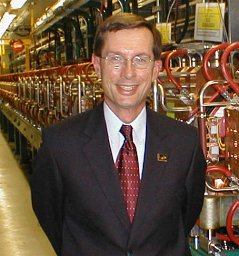 D.J. Rej合作论文数Los Alamos National Laboratory21
 W. J. Waganaar合作论文数14R. R. Bartsch合作论文数13Olson, J.C.合作论文数11
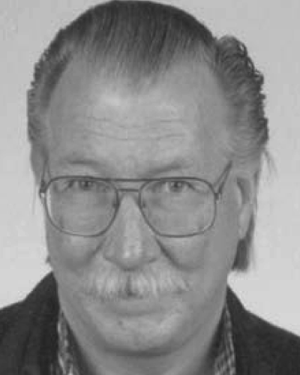 C. A. Ekdahl合作论文数Los Alamos National Laboratory;Lawrence Livermore National Laboratory;Lawrence Berkeley National Laboratory;Lawrence Livermore National Laboratory, Lawrence Berkeley National Laboratory11Ballard, E.O.合作论文数7Nielsen, K.E.合作论文数7
 T. Hughes合作论文数7Parsons, W.M.合作论文数6J. B. Greenly合作论文数6Moir, D.C.合作论文数5
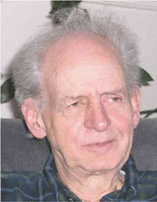 Gribble, R.F.合作论文数5Scudder, D.W.合作论文数5Hans H. Fleischmann合作论文数5j c cochrane合作论文数5Gp Johnston合作论文数4
 Regan Stinnett合作论文数4Bowman, D.W.合作论文数4Vermare, C.合作论文数DAM, CEA;c;CEA4
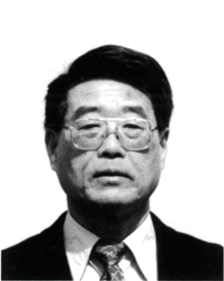 Kiyoshi Yatsui合作论文数Extreme Energy-Density Research Institute, Nagaoka University of Technology4G. A. Bennett合作论文数4Wa Reass合作论文数3
 Ross E Muenchausen合作论文数3Watt, R.G.合作论文数3Thompson, M.C.合作论文数3Coates, D.合作论文数3
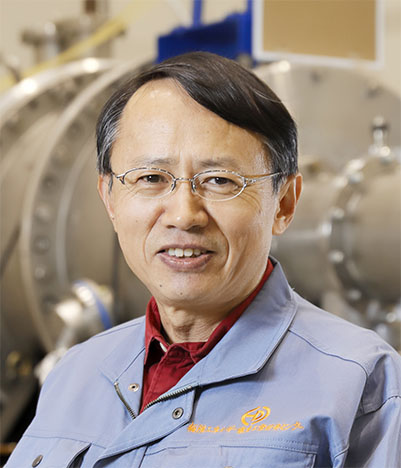 Weihua Jiang (江伟华)合作论文数Department of Nuclear System Safety Engineering, Nagaoka University of Technology;Extreme Energy-Density Research Institute, Nagaoka University of Technology3E. Sherwood合作论文数3
 Bruce Carlsten合作论文数Los Alamos National Laboratory3Kevin C. Walter合作论文数3Ivars Henins合作论文数3BP Wood合作论文数3GA Wurden合作论文数2r h lovberg合作论文数2h m schleinitz合作论文数2r j trainor合作论文数2l j bitteker合作论文数2w l waldron合作论文数2james paul合作论文数2sheng yu合作论文数2GE Remnev合作论文数2Rickey J. Faehl合作论文数2
 Elizondo, J.M.合作论文数Sandia Nat. Labs.;c2
 Shlachter, J.S.合作论文数2Fulton, R.D.合作论文数2Burns, M.合作论文数2
 Rick Olson合作论文数2
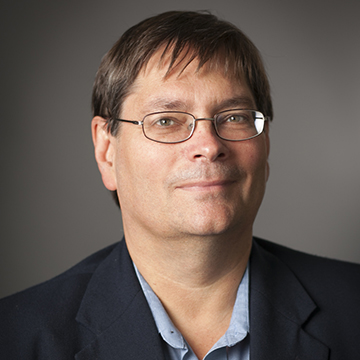 Michael Thompson合作论文数Department of Materials Science and Engineering, College of Engineering, Cornell University2
 Michael Nastasi合作论文数Department of Nuclear Engineering, College of Engineering, Texas A&M University2




