In this paper we present a scene-driven urban road traffic control online simulation system called SD-UTCS. With this system, managers and researchers can realize the construction and simulation of various types of traffic scenarios, the rapid development and optimization of new control strategies, and the application of effective control strategies to actual traffic management. Firstly, the parallel system concept is adopted to realize the deep integration of the real-time traffic control system and the real-time simulation system, and the visual hardware and software in the loop system is used for display. Secondly, the virtual scene base engine and the strategy agent engine are put forward in the system design. By designing a common control strategy API to achieve data and control strategy separation, help researchers focus on the control algorithm itself without paying attention to the detection data and basic data, and use the detection data and GIS data to complete the automatic calibration of simulation parameters to ensure traffic simulation accuracy. Finally, in order to verify the real-time and stability of the simulation system, simulations were carried out using different scale road networks in Shunyi District of Beijing and Weifang City of Shandong Province, which proved the advantages of the simulation subsystem in performance and simulation scale.
Urban road network traffic state discrimination is the basis of traffic control and dynamic induction in intelligent transportation systems, and it's also an important content of traveler information services. Hence, based on the floating car data and map layer data, the road network micro-indicator set and macro-level indicators have been established. Then the macro and micro evaluation method of road network been proposed by using the gray system theory and information entropy theory, which is based on gray correlation entropy. The rationality and effectiveness of the method proposed in this paper have been verified by actual data.
Data-driven intelligent transportation systems (D2ITSs) have drawn significant attention lately. This work investigates a novel multi-agent-based data-driven distributed adaptive cooperative control (MA-DD-DACC) method for multi-direction queuing strength balance with changeable cycle in urban traffic signal timing. Compared with the conventional signal control strategies, the proposed MA-DD-DACC method combined with an online parameter learning law can be applied for traffic signal control in a distributed manner by merely utilizing the collected I/O traffic queueing length data and network topology of multi-direction signal controllers at a single intersection. A Lyapunov-based stability analysis shows that the proposed approach guarantees uniform ultimate boundedness of the distributed consensus coordinated errors of queuing strength. The numerical and experimental comparison simulations are performed on a VISSIM-VB-MATLAB joint simulation platform to verify the effectiveness of the proposed approach.
In urban road traffic, detectors often cause incomplete data and missing data as a result of inadequate coverage or equipment damage and other reasons. Therefore, the data needs to be repaired to ensure data support for the traffic management service. This paper regards traffic flow data from section geomagnetic detectors as the object, processing graphically section flow information. And the missing data of network is predicted and complemented by the idea of generating network analysis images. This paper analyzes the influence of missing area size and loss at random of data on the accuracy of complete information. The results prove the feasibility and applicability of this method.
Urban freeway is the aorta of urban traffic, but in recent years, traffic congestion has become prominent increasingly, which seriously affects the urban traffic efficiency. Based on the analysis of the traffic flow characteristic of urban freeway and streets system, the macroscopic traffic flow model integrated urban freeway with streets system is established, by using store-and-forward model to describe the evolution law of states for the two systems. Then on this basis, the green ratio adaptive control method based on linear quadratic optimal control is put forward. Finally, the VISSIM traffic simulation software is used to simulate and compare with the fixed-time signal control. The simulation results show the feasibility and effectiveness of the method.
In view of the existing regional traffic state classification method cannot completely reflect the controllable state of city road network problems, puts forward a constraint based on saturation equilibrium of multi intersection state controllability analysis model. First, the equilibrium of saturation control method to control the multi intersection; secondly, the equilibrium of saturation constraints, introducing demand rate and cumulative rate of definition of multi intersection controllability. Finally, the simulation is carried out using the actual data of the road network, the results show that the proposed algorithm can more accurately reflect the control of city road network.
Continuous increase of traffic demands, often more than the network capacity, is the primary reason for traffic congestion. Recently, the existence of macroscopic fundamental diagram in urban road network has been validated by many research works, and then activated the researches for the perimeter control of the network to realize objective of reducing network congestion. In this paper, the centralized state-feedback control design approach for the perimeter control of the network, with the objective of the network balance, is developed, which can realize the balance of network flows and moreover guarantee the maximum network capacity in saturated state of the network. A state-space model of the network perimeter control, with the number of vehicles in links as state variables and perimeter flows as control inputs, is first proposed. Furthermore, LQR approach is applied for the design of perimeter input. Also, the distributed signal control approach of the network under the proposed perimeter control law is proposed, realizing the integration of the perimeter and signal control of the network.
Mixed-control algorithm only considers about freeways and ramp without the coordination with upstream intersections of side roads, which will result the jam on the upstream intersections of side roads. Therefore, this article has proposed an improved control algorithm of coordination of entrance ramp metering, freeways and upstream intersection of side roads based on the Mixed-control. The article has simulated this algorithm using CPN, and has proved the effectiveness of the algorithm through simulating the real road network by VISSIM.
Aiming at the problem that the intersection traffic status is not accurate, this method is put forward. First of the intersection of the physical space composed of decomposition, each direction of the road and internal conflict in the region was decomposed. Secondly, the saturation calculation method on the direction of the road traf-fic state identification, the green light at the time of the end of the remaining vehicles cumulative front and the dis-tance between the vibration time than the internal conflict of regional traffic state discrimination were used. Finally, the comprehensive traffic state discrimination method refinement of intersection traffic state identification, and the actual collection of data simulation verification of the method. The simulation results show that the method can be more accurate to judge the traffic state of intersections.
When there's heavy traffic passing off-ramp of urban freeway and close to joint section, the intersection and the passage of the side road traffic will be influenced. In this paper, a coordinated control method based on the mixed logic dynamic(MLD) model will be introduced using bi-level programming genetic algorithm to coordinately control the off-ramp and the downstream intersection. In bi-level programming, the first stage is acquisition of the best cycle length of the downstream intersection using genetic algorithm, and the second, the optimized result is considered as the initial condition to optimize the waiting time of the vehicles to obtain the best green-time of each phase. Compared with single-programming method, which will bring in errors because the cycle length of downstream intersection must be a known quantity, bi-programming optimization can avoid the problem. The control method is verified by road network simulation using VISSIM.
Mixed-control algorithm only aims at on-ramp metering without the consideration of coordination with upstream intersections of side roads, which may result in traffic jam on upstream intersections of side roads. Motivated by this problem, the improvement on mixed-control algorithm is proposed, where on-ramp metering algorithm admits consideration of upstream intersections of side roads. Furthermore, the stateflow model is established to show the proposed algorithm. At last, the effectiveness of the algorithm is verified by simulating the real road network using traffic simulation software VISSIM.
为了有效改善交通枢纽内部行人设施的运行状况,提出交通枢纽行人设施客流适应度的概念,以此对交通枢纽的服务水平进行量化分析.同时,将粒子群算法进行改进,并应用于行人设施客流适应度的博弈分析各行人设施对应粒子的每一维参与博弈,通过粒子位置的更新实现参与博弈的行人设施控制参数的更新,经过博弈迭代搜索到交通枢纽行人设施客流适应度的最优值及对应的各行人设施的控制参数仿真实例表明:该方法对实际交通枢纽中行人设施的组织优化具有一定的应用价值.
Notice of Retraction After careful and considered review of the content of this paper by a duly constituted expert committee, this paper has been found to be in violation of IEEE's Publication Principles. We hereby retract the content of this paper. Reasonable effort should be made to remove all past references to this paper. The presenting author of this paper has the option to appeal this decision by contacting TPII@ieee.org. The typical intersection traffic flow control ways play poor role in saturated status, in order to resolve this problem, at first, the intersection control features under saturated status is analyzed, then by the queue length detection by video detection way, a new control way with threshold and rule is put forward, in which three control stages are included. Simulation result shows that this method has more effectiveness than the Webster's method when traffic flow is saturated.
The typical intersection traffic flow control ways play poor role in saturated status, in order to resolve this problem, at first, the intersection control features under saturated status is analyzed, then by the queue length detection by video detection way, a new control way with threshold and rule is put forward, in which three control stages are included. Simulation result shows that this method has more effectiveness than the Webster's method when traffic flow is saturated. © 2011 IEEE.
The expressway traffic flow characteristics of off-ramp have an important impact on traffic congestion. By analyzing the vehicle car-following and lane-changing behavior, the cellular automata model of off-ramp area was built. When analyzing lane-changing behavior, the behavior of vehicle changing lane from main lane to off-ramp buffer lane was considered, and the information interaction process between the vehicle ready to changing lane and the rear vehicle on the target lane was considered, the new lane-changing rules were built. In the new lane-changing rules, free lane-changing and compulsory lane-changing were included. By analyzing the simulation results, when traffic flow density is lower, the behavior of vehicles in the main lane changing lane into off-ramp buffer lane has less effect on traffic capacity of the road section, but when traffic flow density rising to a certain extent, the behavior of vehicles in the main lane changing lane into off-ramp buffer lane will bring an adverse effect on traffic capacity of the road section.
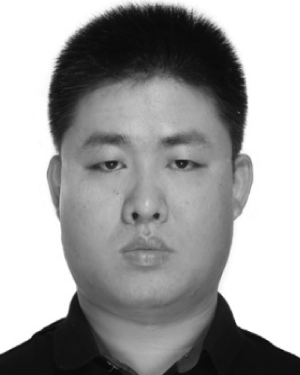 zhang lili合作论文数5
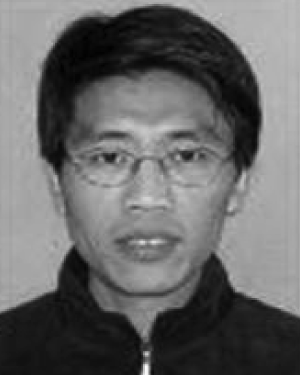 Xiaoming Liu合作论文数4
 LingYu Zhang (张玲玉)合作论文数4
 Zhengxi Li (李正熙)合作论文数Inverier Technology Engineering Research Center of Beijing, North China University of Technology4
 Li Wang (王力)合作论文数North China University of Technology4Zhonghe He合作论文数2Jiaqing Yan (闫佳庆 Yan Jiaqing)合作论文数1Weijie Xiu合作论文数1
 Honghai Ji (吉鸿海)合作论文数1
 Lingling Fan合作论文数1Kai-long LI (李凯龙)合作论文数1
 Lili Zhang合作论文数1
 Dai Li合作论文数1
 Zhongsheng Hou (侯忠生)合作论文数Academy of Systems Science and Control, Qingdao University1Min Li (李敏)合作论文数1




