(51) Int. C1.7 ................................................ G05B 15/00 (52) U.S. C1. ....................... 700/260; 7001245; 7001248; 7001257; 7001262; 7001263; 901127; 901128; 901130; 901134; 901136; 6001595; 6011130; 341120; 3451157; 3451161 (58) Field of Search ................................. 7001245, 248, 7001257, 260, 262, 263; 901127, 28, 30, 34, 36; 6001595; 6061130; 341120; 3451157, 161
Site construction operations by autonomous robotic systems are essential for a sustained robotic presence and human habitation on mars.
Efficient miniature actuators that are light, compact, and driven by low power are needed to drive telerobotic devices and space mechanisms in future NASA missions. Examples of space mechanisms and devices that require actuators include robotic arms, miniature rovers, release mechanisms, positioning devices, aperture opening and closing devices, and real-time compensation for thermal expansion in space structures. These motors need to operate at various temperatures and pressures with a large range of thermal variations over a relatively short period swing. Ultrasonic rotary motors have the potential to meet this NASA need and they were developed as actuators for miniature telerobotic applications. These motors were adapted for operation in the environment of Mars, which includes very low temperatures and vacuum. A hybrid analytical model, including the influence of the rotor and stator dynamics, friction effects, and interface effects, was developed to design an efficient ultrasonic motor as a complete system. In parallel, efforts have been made to determine the thermal and vacuum performance of these motors, and effective operation at temperatures as low as −150°C and at a pressure of 16 mtorr were demonstrated. To explore telerobotic applications for USMs a robotic arm was constructed with such motors.
A tool was developed that assists surgeons in manipulating surgical instruments more precisely than is possible manually. The tool is a telemanipulator that scales down the surgeon's hand motion and filters tremor in the motion. The signals measured from the surgeon's hand are transformed and used to drive a six-degrees-of-freedom robot to position the surgical instrument mounted on its tip. A pilot study comparing the performance of the telemanipulator system against manual instrument positioning was conducted at the University of Southern California School of Medicine. The results show that a telerobotic tool can improve the performance of a microsurgeon by increasing the precision with which he can position surgical instruments, but this is achieved at the cost of increased time in performing the task. We believe that this technology will extend the capabilities of microsurgeons and allow more surgeons to perform highly skilled procedures currently performed only by the best surgeons. It will also enable performance of new surgical procedures that are beyond the capabilities of even the most skilled surgeons.
The engineering details of the Robot Assisted MicroSurgery (RAMS) telerobotic system designed to assist microsurgeons improve the precision and dexterity with which they can position surgical instruments is described in this paper.
A telerobotic platform developed in a collaboration between NASA-JPL and MicroDexterity Systems, Inc (MDS) is described in this paper. The lightweight, compact 6 dof master-slave system is precise to better than 10 microns and can cover a workspace greater than 400 cubic centimeters. Current capabilities of the system include manual position control with augmented shared control modes and automatic modes of control of the robot. Simulated force feedback on the master device has been implemented and plans are to integrate force reflection from the slave end effector and evaluate the performance improvements enabled by the telerobot in simulated microsurgical tasks. The telerobot was used in a recent demonstration of a simulated eye microsurgical procedure.
A telerobotic workstation for microsurgery has been developed that enables scaling down motions and filtering tremor in a surgeon's hand. The system is compact and light-weight and has the potential for improving the performance of all surgeons and enabling the development of new surgical procedures currently limited by the dexterity of even the most skilful surgeons.
We report the development of a new six degree-of-freedom (d.o.f.) manipulator. This robot and its task-space controls enable relative tip positioning to better than 25 microns over a singularity-free work volume exceeding 20 cubic centimeters. By virtue of an innovative cable drive design, the robot has zero backlash in five joints and can sustain full extent loads of over three pounds. The robot is applicable to both fine motion manipulation of microsurgical tools and also dexterous handling of larger powered devices for minimally invasive surgery. Our current development emphasis is a teleoperated system for dexterity-enhanced microsurgeries; we believe the new robot will also have useful applications in computer assisted surgeries, e.g. image-guided therapies. In this brief paper, we outline the robot mechanical design, controls implementation, and preliminary evaluations. Our accompanying oral presentation includes a five minute videotape that illustrates engineering laboratory results achieved to date.
A novel approach to the design of training methodologies or programs for operators in man-machine systems and its application to the training of skilled human teleoperators is described. This approach requires that training goals are separated into four distinct categories: the maximization of performance consistency or reliability for critical tasks, the maximization of positive transfer between learned and new tasks, the minimization of the effects of internal operator states (e.g. fatigue, stress, workload), and the minimization of the effects of situational uncertainty or anomaly on performance. Being different from one another in fundamental ways these categories or goals entail the development and application of different training techniques. The paper reports the development of training procedures for achieving the first goal, that of performance consistency, for skilled teleoperators. This part methodology was evaluated against the training practices commonly used in the field, and was found to enhance the learning, hence promote the acquisition of performance consistency, of a challenging and realistic satellite servicing task.
 Paul S. Schenker合作论文数TTG Imaging Solutions7
 Haya Zak合作论文数5Timothy R. Ohm合作论文数4
 Paolo Pirjanian合作论文数Embodied, Inc4Curtis Boswell合作论文数4
 Steve Charles合作论文数4
 Sukhan Lee合作论文数Intelligent Systems Research Institute, Sungkyunkwan University;College of Information and Communication Engineering, Sungkyunkwan University;School of Artificial Intelligence, Sungkyunkwan University4Ashitey Trebi-Ollennu合作论文数Group Leader, Senior Member of Engineering Staff4guillermo rodriguez合作论文数3
 Terry Huntsberger合作论文数Jet Propulsion Laboratory, California Institute of Technology3Satyadhar Joshi合作论文数Department of Mechanical & Aeronautical Engineering University of California, Davis3Timothy Ohm合作论文数3
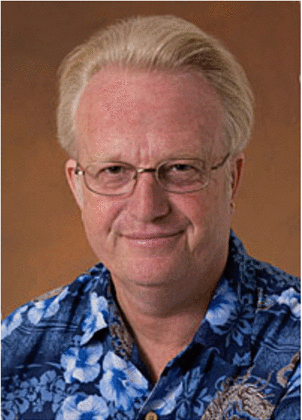 Robert D. Steele合作论文数3Eric Paljug合作论文数2
 Michael Garrett合作论文数2
 Paolo Fiorini合作论文数Department of Engineering for Innovation Medicine, University of Verona;Needleye Robotics Srl2
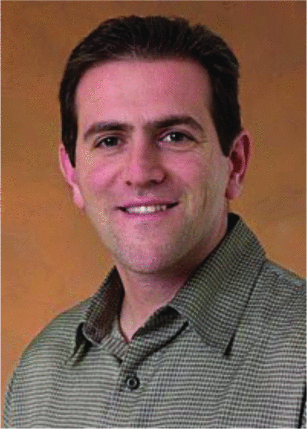 Issa A.D. Nesnas合作论文数Jet Propulsion Laboratory2Hrand Aghazarian合作论文数Jet Propulsion Laboratory|California Institute of Technology2Tim Ohm合作论文数2
 Tara Estlin合作论文数Machine Learning and Instrument Autonomy Group, NASA Jet Propulsion Laboratory, California Institute of Technology2robert steele合作论文数2
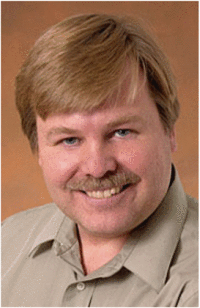 Richard Petras合作论文数2
 Darren Mutz合作论文数Amazon Web Services2
 Richard Volpe合作论文数Autonomous Systems Division, Jet Propulsion Laboratory, California Institute o f Technology2D Frambach合作论文数1mars exploration合作论文数1Antal K. Bejczy合作论文数1Paljug, E.合作论文数1
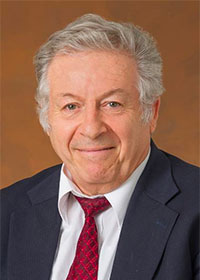 Yoseph Bar Cohen合作论文数Advanced Technologies Group, Jet Propulsion Laboratory, California Institute of Technology;Nondestructive Evaluation and Advanced Actuators Technologies Lab, Jet Propulsion Laboratory, California Institute of Technology1E. D. Paljug合作论文数1C. D. Boswell合作论文数1
 Xiaoqi Bao (鲍小琪)合作论文数jet propulsion laboratory1Anthony Ganino合作论文数1
 Won S. Kim合作论文数1Terrance L. Huntsberger合作论文数1Margo K. Apostolos合作论文数1




