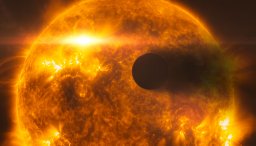
The planetary effective surface temperature alone is insufficient to characterize exoplanet atmospheres and their stability or evolution. Considering the star-planet system as a whole is necessary, and a critical component of the system is the photoionizing stellar extreme ultraviolet emission (EUV; 100-912 {\AA}). EUV photons drive atmospheric mass loss through thermal and nonthermal processes, and an accurate accounting of the EUV energy deposition in a planet's energy budget is essential, especially for terrestrial habitable zone planets and close-in gaseous planets. Direct EUV observations of exoplanet host stars would require a new, dedicated observatory. Archival observations from the $\textit{EUVE}$ satellite, models, and theory alone are insufficient to accurately characterize EUV spectra of the majority of exoplanet host stars, especially for low-mass stars.
The EUV (100-912 A) is a spectral region notoriously difficult to observe due to attenuation by neutral hydrogen gas in the interstellar medium. Despite this, hundreds to thousands of nearby stars of different spectral types and magnetic activity levels are accessible in the EUV range. The EUV probes interesting and complicated regions in the stellar atmosphere like the lower corona and transition region that are inaccessible from other spectral regions. In this white paper we describe how direct EUV observations, which require a dedicated grazing-incidence observatory, cannot yet be accurately substituted with models and theory. Exploring EUV emission from cool dwarf stars in the time domain can make a major contribution to understanding stellar outer atmospheres and magnetism, and offers the clearest path toward detecting coronal mass ejections on stars other than the Sun.
We have studied how young Mars lost its atmospheric and exospheric oxygen and carbon into the solar wind when ionized atmospheric oxygen and carbon atoms are picked up by the solar wind convection electric field. Analysis was made by a 3D kinetic hybrid model which treats ions as particles and electrons as a massless charge neutralizing fluid. The hybrid simulation allows to study self-consistently the motion of ions in the Martian magnetosphere and to estimate the total ion escape rate.
We study the Type III solar bursts simultaneously recorded by radio experiments onboard Cassini, Ulysses and Wind. Those radio bursts cover a large frequency range from about 14 MHz to a few kHz. The corresponding source locations are mainly in the solar corona and the interplanetary medium. The empirical electron density models provide different distances depending on the emission mode, fundamental or harmonic. A real trouble arises due to the distance discrepancies, as inferred from the models. Also the Archimedean spiral trajectories of the electrons, at the origin of the Type III bursts, are another difficulty to correctly estimate the source locations. We show in our analysis that the stereoscopic observations are essential to reduce the source location inaccuracy. We finally discuss the relationship between the Type III beams, the emission modes and the source locations.
 Bernhard Hofmann-Wellenhof合作论文数27
 Helmut Lammer合作论文数Space Research Institute, Austrian Academy of Sciences;University of Graz16
 Ute V. Amerstorfer合作论文数Austrian Space Weather Office, GeoSphere Austria8Elmar Wasle合作论文数7
 Yu. N. Kulikov合作论文数Polar Geophysical Institute (PGI),, Russian Academy of Sciences7
 Manuel Scherf合作论文数Institute for Geodesy, Technical University6
 Maxim L. Khodachenko合作论文数Space Research Institute, Austrian Academy of Sciences6Colin Johnstone合作论文数School of;Physics and Astronomy;University of St Andrews;CEA Saclay6
 Hannes Groller合作论文数5
 Esa Kallio合作论文数Finnish Meteorological Institute5Martin Pfleger合作论文数4Sergey Dyadechkin合作论文数4
 Kristina G. Kislyakova合作论文数Department of Astrophysics, University of Vienna3
 Mats Holmström合作论文数Swedish Institute of Space Physics3Igor I. Alexeev合作论文数3
 Luca Fossati合作论文数Institut für Weltraumforschung, ÖAW;Space Research Institute, Austrian Academy of Sciences3
 Meng Jin合作论文数2naoki terada合作论文数2
 Vincent Bourrier合作论文数Observ Astron, Univ Geneva2Brian T. Fleming合作论文数2
 James Paul Mason合作论文数Lab Atmospher & Space Phys, Univ Colorado2
 Allison Youngblood合作论文数NASA Goddard Space Flight Center2
 Jesper Lindkvist合作论文数Dept Phys, Umea Univ2
 Audrey Vorburger合作论文数Univ Bern2
 Markku Alho合作论文数Department of Physics, University of Helsinki2Feng Tian (田丰)合作论文数Center For Earth System Science, Tsinghua University;National Astronomical Observatories, Chinese Academy of Sciences2
 Tommi Koskinen合作论文数Lunar and Planetary Laboratory, College of Science, University of Arizona2
 Jeremy J. Drake合作论文数Lockheed Martin2Berta-Thompson Zachory合作论文数2
 A. Mura合作论文数Instituto di Fisica dello Spazio Interplanetari, I-00133 Rome, Italy2
 Andre Galli合作论文数2
 Sandro Krauss合作论文数Space Research Institute, Austrian Academy of Sciences2Elena Belenkaya合作论文数Institute of Nuclear Physics;Moscow State University;Institute of Nuclear Physics, Moscow State University2Mohammed Yahia Boudjada合作论文数2
 Adam Kowalski合作论文数Department of Astrophysical and Planetary Sciences, College of Arts and Sciences, University of Colorado Boulder;Laboratory for Atmospheric and Space Physics, University of Colorado Boulder;National Solar Observatory2
 Walter Hausleitner合作论文数2
 Cecilia Garraffo合作论文数AstroAI Institute, Harvard-Smithsonian Center for Astrophysics2Thomas Penz合作论文数2
 Guillaume Gronoff合作论文数Langley Research Center, National Aeronautics and Space Administration;Science Systems and Applications Inc Hampton2
 Rachel Osten合作论文数Space Telescope Science Institute;Center for Astrophysical Sciences, Johns Hopkins University2
 Kevin France合作论文数University of Colorado2
 Cynthia S. Froning合作论文数Department of Astronomy, University of Texas at Austin;McDonald Observatory, University of Texas at Austin2Joel C. Allred合作论文数University of Washington;Department of Physics;Department of Physics, University of Washington2Levente Dimen合作论文数1T. Lueftinger合作论文数1Robert Faber合作论文数1Fabian Hinterberger合作论文数1E. Erker合作论文数1E. Fragner合作论文数1




